

3.2 Work
What Work Is
Work is the energy transferred into or out of a system by a force acting over a distance. It’s how energy moves mechanically, when forces cause displacement.
Conservative vs. Non-Conservative Forces
Forces split into two camps depending on whether the work they do depends on the path taken.
Property | Conservative force | Non-conservative force |
Path dependence | Path independent | Path dependent |
Work for different paths | (same endpoints) | |
Work for a closed loop | ||
Depends on | Only the start and end positions | The path you take |
Conservative forces. Examples include the gravitational force (near Earth’s surface, , and universal, ), the spring force (), and the electrostatic force (). The key thing is that conservative forces have potential energy functions, so energy can be stored and fully recovered.
Non-conservative forces. Examples include friction, air resistance/drag, and tension in a cord. These usually dissipate energy (turning mechanical energy into thermal energy), and the work they do depends on the path taken.
On the AP exam, the nonconservative forces you’ll see most are friction and air resistance. Only conservative forces have a potential energy. A potential energy is a number that depends only on where things are, and that only makes sense when the work depends only on the starting and ending positions. Friction’s work depends on the path, so there’s no such thing as “friction potential energy.”
Example: two paths, same endpoints. You move a 2.0 kg box from the floor onto a platform 1.5 m high ( m/s²).
Path 1, lift it straight up. Gravity points down and the displacement points up, so J.
Path 2, slide it up a frictionless ramp 3.0 m long at 30°. The ramp rises m, and the angle between gravity (down) and the displacement (up the ramp) is 120°, so J.
Same work, because gravity is conservative. Now lower the box back to the floor by any path: J. For the round trip , and the system’s potential energy is back where it started ().
Now slide the box across the floor (, so N) from point A to point B, 4.0 m apart. Straight across, friction does J. Take a curved 6.0 m path around an obstacle and friction does J. Go from A to B and back to A, and friction does J, not zero. The energy friction removes is the friction force times the path length, and it ends up as thermal energy (plus a little sound).
Work Is a Scalar
Work is a scalar, not a vector, but it can be positive, negative, or zero. It’s positive when force and displacement point the same way (energy added), negative when they point opposite ways (energy removed), and zero when the force is perpendicular to the displacement or there’s no displacement at all.
Calculating Work
Constant force:
where:
- = work (J)
- = magnitude of the force (N)
- = magnitude of the displacement (m)
- = angle between the force and displacement vectors
This only works when the force is constant.
AP Physics C writes the constant-force formula with the parallel component of the force:
where is the part of the force along the displacement. One detail: is the displacement of the point where the force is applied. For a rigid box that’s the same as how far the box moves, but it matters for things that bend or stretch (more on that below).
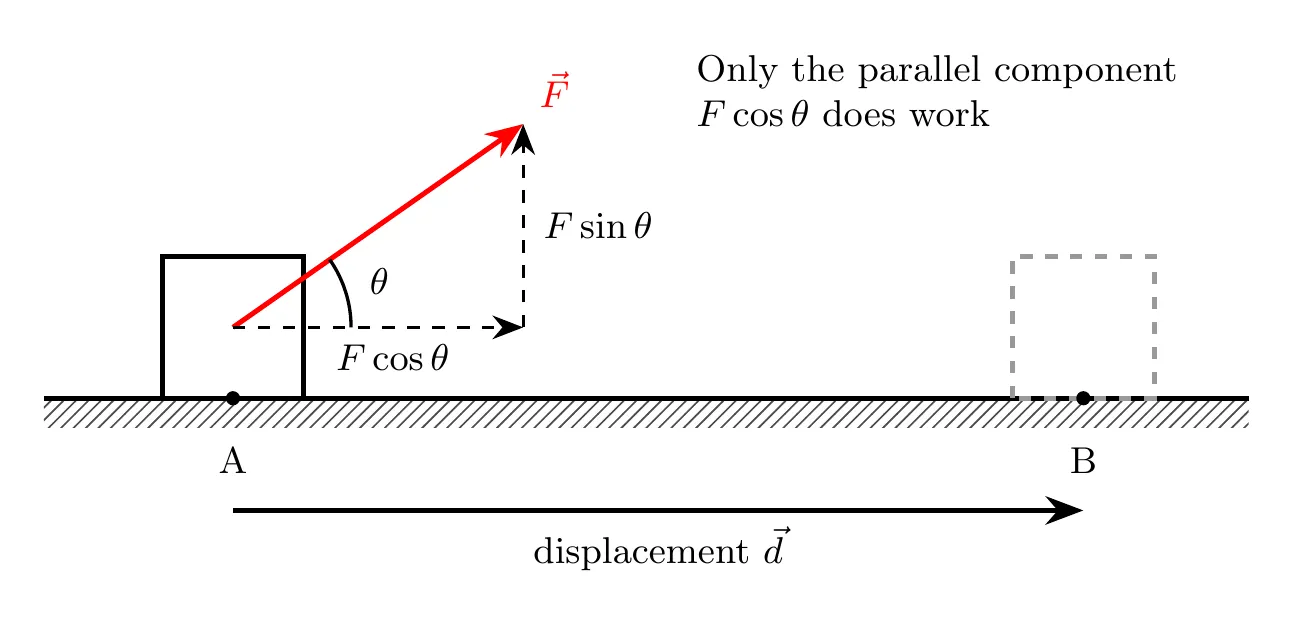
Special cases: gives (maximum positive work), gives (no work), and gives (maximum negative work).
Dot product form. Work is the dot product of force and displacement, . The dot product of any two vectors is a scalar:
The component form is handy when vectors come in unit-vector notation. Example: a constant force N acts on a puck while it moves through m. Then J. (Check: N and m, so and . Same work either way.)
Perpendicular components do no work. Only the component of a force parallel to the displacement changes a system’s energy. The perpendicular component can still change the direction of motion, just not the speed. Take a 0.20 kg puck tied to a string and sliding in a circle on frictionless ice at a steady 3.0 m/s. The tension always points toward the center, perpendicular to the velocity, so it does zero work. The puck’s kinetic energy stays J the whole time, even though its velocity keeps changing direction.
Variable force. When the force changes with position, you integrate:
For one-dimensional motion (force and displacement along the same line):
This is the general definition of work. The constant-force formula is just the special case where can come out of the integral.
Work-Energy Theorem
The work-energy theorem is one of the most powerful tools in mechanics. It says the net work done on an object equals its change in kinetic energy:
You’ll also see it written as , where is the total work from all forces. And connecting it to Newton’s second law, for a constant force:
On the AP equation sheet, the work-energy theorem is written as:
Find the work done by each force separately (each can be positive, negative, or zero), then add. Example: you push a 5.0 kg box across a floor with a 40 N force aimed 37° below the horizontal, for 2.0 m, starting from rest. The coefficient of kinetic friction is 0.25 ( m/s², , ).
Your push: N, so J.
Friction: the push also presses the box down with N, so N and N. Then J.
Gravity and the normal force are perpendicular to the motion, so .
So J, and m/s. The downward part of your push did no work itself, but it still cost you energy indirectly by increasing friction.
Objects vs. Systems: Where the Work Goes
The work-energy theorem is cleanest when the thing you’re analyzing can be treated as an object: every part moves together, so the center of mass moves the same distance as the point where each force is applied. Then the only energy that can change is kinetic energy. A box sliding across a floor is a good example.
When the system can change shape, an external force can change the system’s configuration instead of (or as well as) its kinetic energy. Two cases to know:
Squeezing a spring against a wall. You slowly push the free end of a spring ( N/m) in by 0.10 m. Your hand’s point of application moves 0.10 m, so you do work, J. But the spring ends at rest, so none of it is kinetic energy. The work changed the spring’s shape and is stored as elastic potential energy. (The wall’s force does no work, since the end against the wall never moves.)
Jumping off the floor. When you jump, the floor pushes up on your feet, but your feet don’t move while they’re touching the floor. The point of application doesn’t move, so the floor does zero work on you, even though your center of mass rises and you gain kinetic energy. That energy comes from inside your body (your muscles), so you can’t model yourself as a single object here.
The rule: in , each is the displacement of that force’s point of application. If the system acts like an object, all of that work goes into kinetic energy.
Work as Area Under a Force-Displacement Graph
Work equals the area under a force-vs-displacement curve:
The integral is just that area.
Constant force (algebra-based).
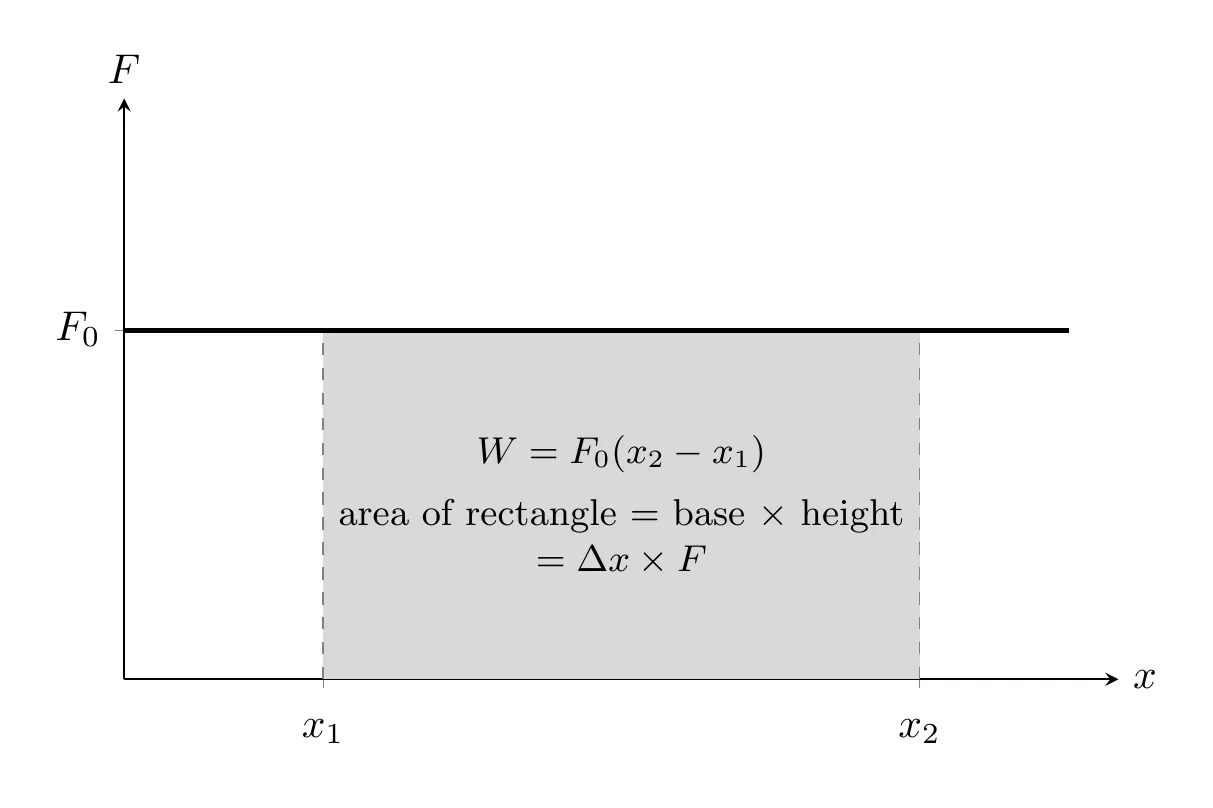
A constant force gives a horizontal line, so the area is a rectangle: .
Variable force (calculus-based).
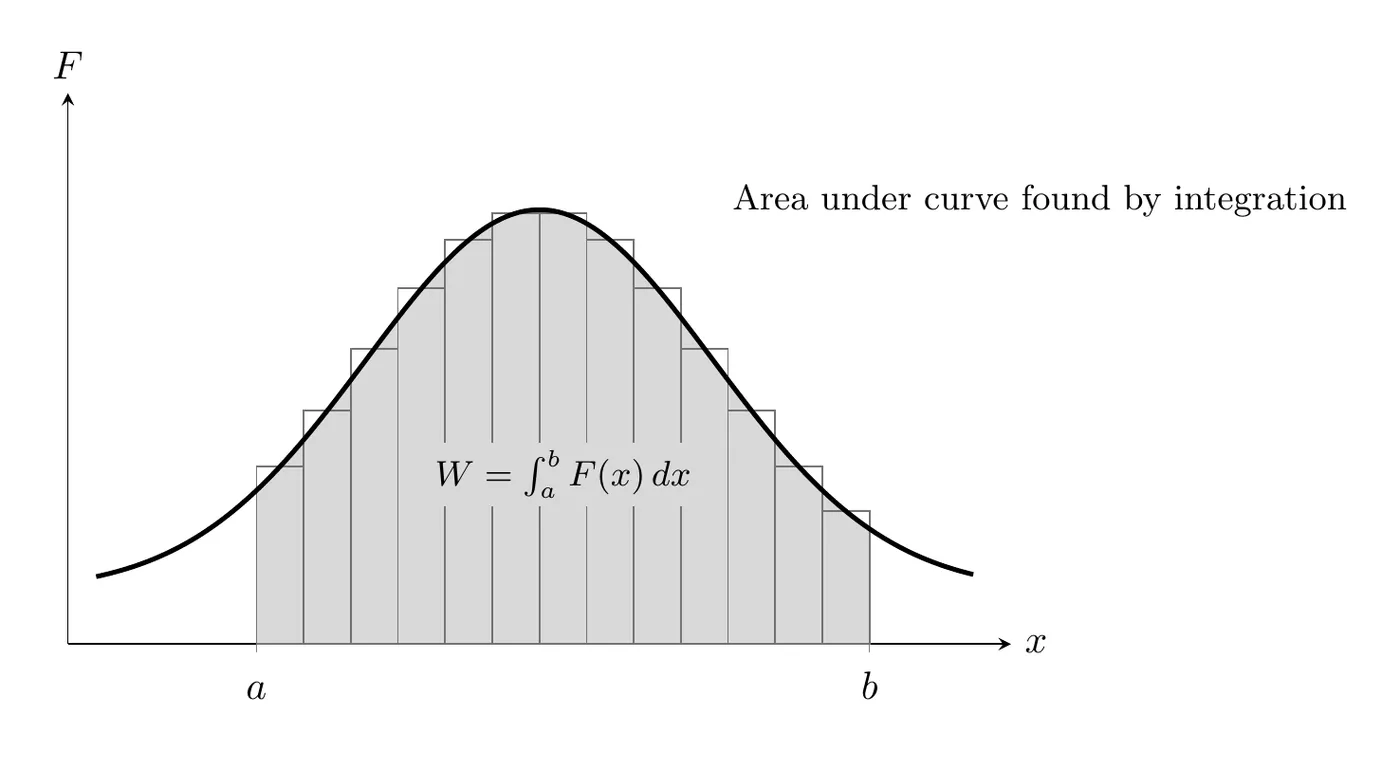
A variable force means you integrate to find the area. In algebra-based courses you’ll also see triangular regions () and trapezoidal regions ().
Area below the axis counts as negative work. If the force points opposite the displacement ( is negative), the area between the curve and the axis is below the axis and the work is negative. Add the areas with their signs to get the net work.
Example Problem: Work from a Force vs. Position Graph
A 2.0 kg cart moves along the -axis with only one horizontal force on it, (in newtons, with in meters). The cart passes moving in the direction at 3.0 m/s.
- Find the work done by the force from to m and from m to m.
- Find the cart’s speed at m and at m.
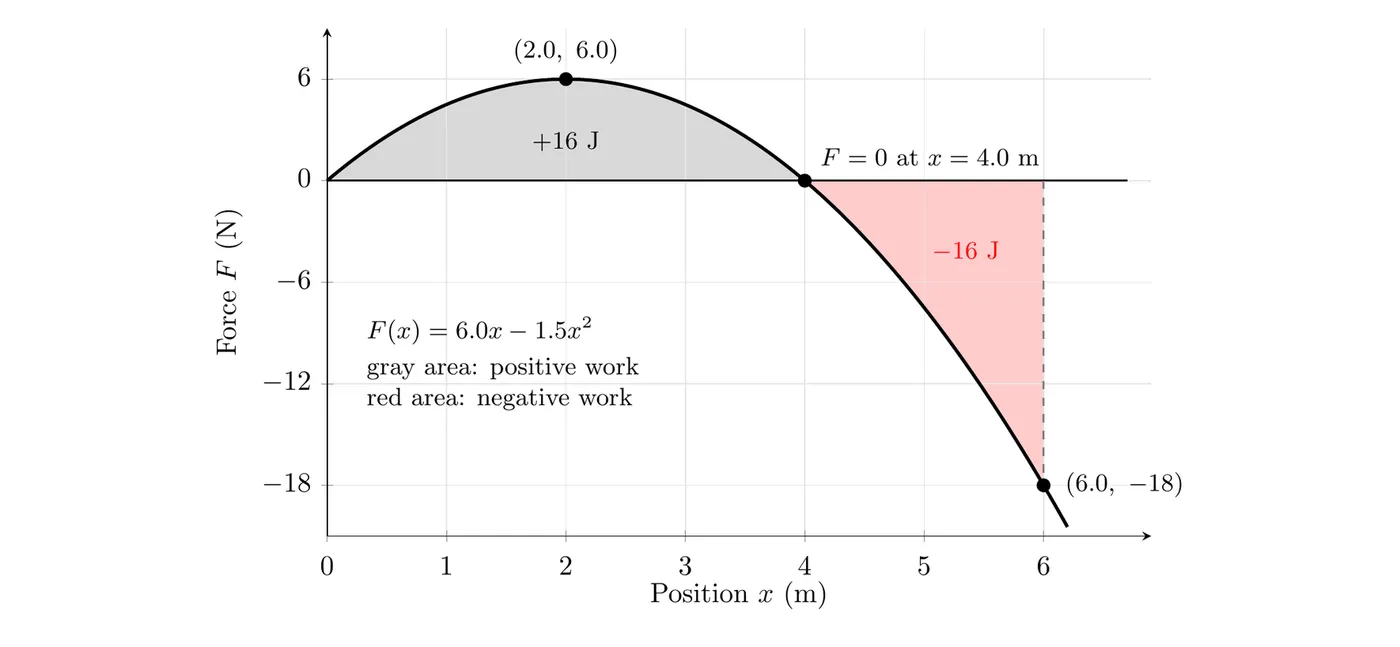
Part (a): Work. Integrate with the power rule (the antiderivative is ):
On the graph, these are the gray area above the axis and the red area below it. The force pushes forward until m, then pushes backward.
Part (b): Speeds. Use the work-energy theorem with J:
The cart is fastest at m, exactly where the force crosses zero: before that, positive work adds kinetic energy, and after it, negative work takes it away. From 0 to 6.0 m the net work is zero, so the cart ends with the same speed it started with.
Example Problem: Work with Variable Acceleration
A skier of mass accelerates down a slope at angle above the horizontal. The acceleration varies with time as:
where is the maximum acceleration and is when the skier reaches terminal speed. Friction between the skis and snow is negligible, and the skier starts from rest at .
- Find the velocity as a function of time during the acceleration phase.
- Find the work done on the skier at .
Give your answers in terms of , , , and fundamental constants.
Part (a): Velocity vs. time. Velocity is the integral of acceleration, and since the skier starts from rest ( at ):
using as the integration variable to keep it separate from the upper limit . With :
Since :
Checking the initial condition at : , which is right.
Part (b): Work at t = T. Use the work-energy theorem, and since the skier starts from rest ():
Find the final velocity at :
Then the work:
So . This work accelerates the skier from rest to a final speed of , and all of it goes into kinetic energy.
Summary of Key Formulas
Concept | Formula | When to use |
Work (constant force) | Force is constant | |
Work (variable force) | Force varies with position | |
Work-energy theorem | Always valid | |
Kinetic energy | Translational motion | |
Velocity from acceleration | Calculus approach |
Common Mistakes
- Forgetting the angle. It’s , not just . The angle matters unless .
- Using the constant-force formula for variable forces. If force depends on position or time, you must integrate: .
- Confusing work with force or energy. Work is energy transfer, not a force. Its units are joules, same as energy.
- Sign errors. Force opposing motion does negative work, force assisting motion does positive work. Check the angle.
- Dropping the initial kinetic energy. , not just . If it starts from rest, .
- Botching definite integrals. Don’t forget to subtract: .
- Thinking . It’s and . Don’t mix them up.
- Forgetting to square velocity in KE. It’s , not .
- Misclassifying forces. Friction and air resistance are non-conservative. Gravity and springs are conservative.
- Thinking work is always positive. A force opposing motion (like friction) does negative work and removes energy.
- Integrating trig functions wrong. Remember .
- Missing forces in net work. With several forces, , and each can be positive, negative, or zero.
- Confusing displacement with distance. For a constant force like gravity, uses the displacement, so the path doesn’t matter and a round trip gives zero. Friction is different: it always points against the motion, so its work is times the total path length. Sliding a box 3.0 m out and 3.0 m back means friction does , not zero.
- Not checking units. Work is in joules. .
- Applying the work formula perpendicular to motion. The normal force on a block sliding along a horizontal surface does zero work, since it’s perpendicular to the motion (, ).