

3.3 - Potential Energy
Definition and Basic Properties
Potential energy is energy stored in a system because of where its objects are or how they’re arranged.
You need a couple of things for potential energy: a system with two or more objects, and objects that interact only through conservative forces. It’s a scalar (magnitude, no direction), it’s tied to the positions of the objects, and it can be positive, negative, or zero depending on the reference point you choose.
Review: Common Potential Energy Equations
From algebra-based physics you’ve already met these.
Gravitational potential energy near Earth’s surface:
Elastic potential energy (springs):
Universal gravitational potential energy:
On the AP equation sheet these are written as , , and . A few details matter:
Springs: is how far the spring is stretched or compressed from its natural (unstretched) length, not the block’s position on some other axis. Stretching or compressing by the same amount stores the same energy, since is positive either way.
Universal gravity: is the distance between the centers of the two objects (for planets, moons, and stars, center to center), and when they’re infinitely far apart. That’s why is always negative.
Near a planet’s surface: gives the change in potential energy when an object moves up or down by . It works because the gravitational field is nearly constant close to the surface. Far from the surface (satellites, rockets), use instead (see below).
Choosing the Zero Point
Where potential energy equals zero is a choice you make to simplify the problem. You get to pick where (where or ), and you should pick whatever makes the problem easiest. If the problem gives you a zero point, use it; if not, you’re free to choose. Common picks: for gravity, ground level, the lowest point of the motion, or infinity (for universal gravitation); for springs, the natural unstretched length; and in general, setting zero at an initial or final position when it’s convenient.
Example: a 0.50 kg book on a shelf 2.0 m above the floor gets moved to a desk 0.80 m above the floor ( m/s²).
Zero chosen at | on shelf | on desk | |
Floor | 10 J | 4.0 J | J |
Shelf | 0 J | J | J |
The values of depend on your choice, but , which is what actually shows up in energy equations, doesn’t. A negative just means below the zero you picked.
Relationship Between Force and Potential Energy
This is the new calculus-based piece that goes beyond algebra-based physics.
Finding potential energy from force (integration). A conservative force and the potential energy are linked by:
For one-dimensional motion:
That negative sign is crucial: potential energy is the work done against the conservative force. To raise potential energy (like lifting something), you work against the conservative force (gravity pulling down), and the negative sign captures that opposition.
Deriving Common Potential Energy Formulas
Example 1: Gravitational potential energy. The conservative force is the weight (downward), which is if up is positive:
That recovers the familiar .
Example 2: Elastic potential energy. The spring force is :
That recovers the spring formula.
Example 3: Universal gravitational potential energy. The force is (negative because it’s attractive), and integrating from infinity to distance :
That’s why universal gravitational potential energy is negative (with zero set at infinity).
Where comes from. Move an object of mass from a planet’s surface (radius , mass ) up to a height . Using :
When is much smaller than , , so . And is just at the surface, so . The approximation is off by a factor of . For a 100 m tower on Earth that’s an error of about 0.002%, but it gets big fast for satellites.
Example: how much does the potential energy of the Earth-satellite system increase when a 500 kg satellite is lifted from Earth’s surface to an altitude equal to Earth’s radius? Use kg and m (problems give these; they aren’t on the equation sheet). At the surface , and at the final altitude :
Using instead gives J, about twice the real answer, because gravity gets weaker as the satellite climbs. Use near the surface, and whenever the distance from the planet’s center changes by a noticeable fraction.
Finding Force from Potential Energy (Differentiation)
If you know the potential energy function, you get the conservative force by differentiating:
So the force is the negative of the slope of the potential energy graph. In three dimensions:
but for AP Physics C Mechanics you usually stay in one dimension.
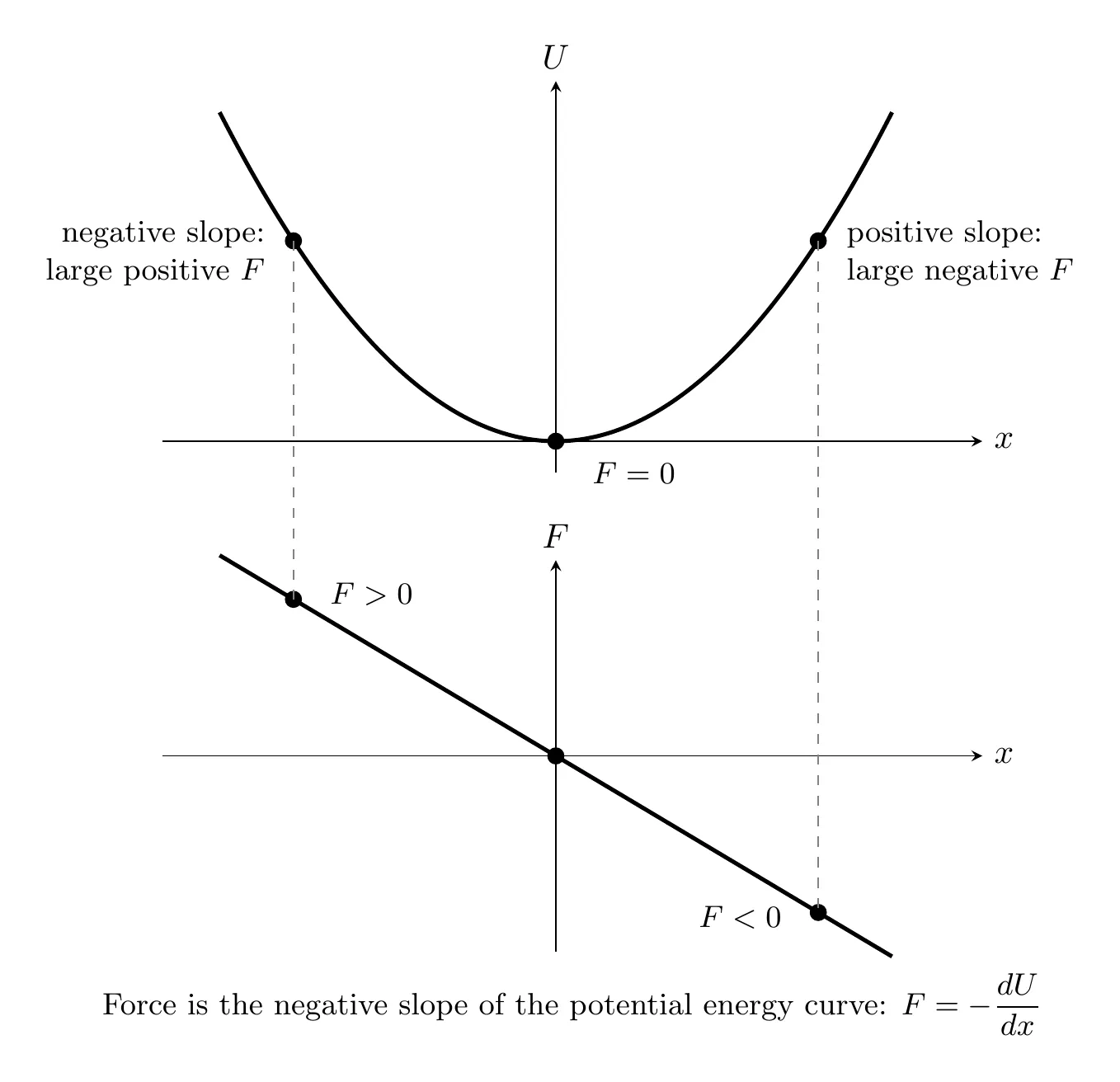
Key observations: where has a negative slope the force is positive (points right/up), where has a positive slope the force is negative (points left/down), where is at a minimum the force is zero (stable equilibrium), and where is at a maximum the force is also zero (unstable equilibrium).
Potential Energy Graphs
In calculus-based physics, potential energy graphs get more interesting because they’re real functions, not just straight lines. A few features to spot:
- Equilibrium points, where (the force is zero). A local minimum of is stable equilibrium (like a valley), and a local maximum is unstable equilibrium (like a hilltop).
- Turning points, where the total energy line crosses . There the object has (momentarily at rest) and reverses direction.
- Forbidden regions, where . Reaching them would need , which is impossible, so the object can’t go there.
Stable equilibrium is a position where a small displacement produces a force pointing back toward equilibrium, so the object accelerates back. On a graph that’s a local minimum: nudge the object right and the slope is positive, so points left; nudge it left and the slope is negative, so points right.
Unstable equilibrium is a position where a small displacement produces a force in the same direction as the displacement, so the object accelerates away. On a graph that’s a local maximum.
A quick calculus check: at an equilibrium point (), if the curve is concave up (a minimum, stable), and if it’s concave down (a maximum, unstable).
Example Problem: Reading a Potential Energy Curve
A 0.25 kg particle moves along the -axis, and the only force on it is conservative, with potential energy
where is in joules and is in meters. The particle is released from rest at m.
- Find the force on the particle at m.
- Find the equilibrium positions and classify each one as stable or unstable.
- Find the turning points of the motion and the particle’s maximum speed.
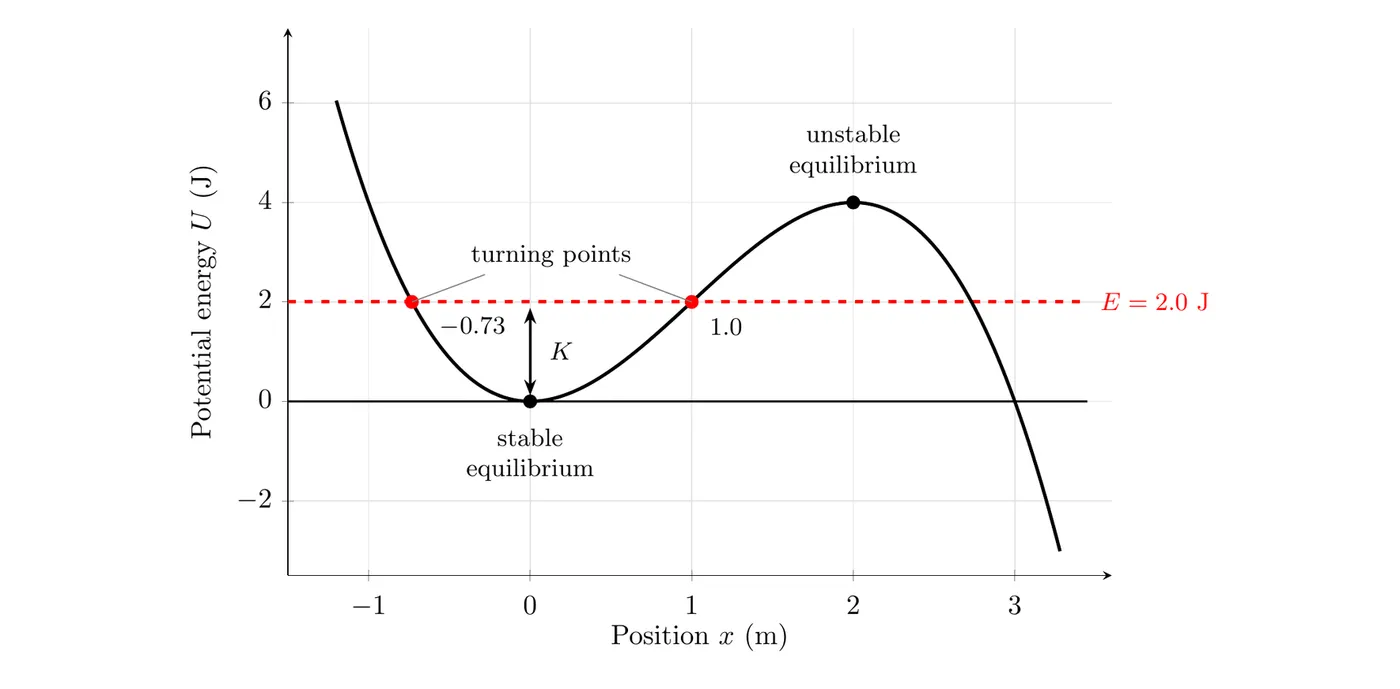
Part (a): Force. Differentiate and take the negative:
At m, N. The force points in the direction, which is downhill on the graph (toward lower ), so the particle starts moving left.
Part (b): Equilibrium positions. Set : , so and m. The second derivative is . At it’s (a minimum, stable), and at m it’s (a maximum, unstable).
Check with forces: at m, N, which pushes back toward (stable). At m, N, which pushes farther right, away from m (unstable).
Part (c): Turning points and maximum speed. Released from rest, the total energy is J, the red line on the graph. Turning points are where :
so m or m. The particle starts at m and moves left, so it swings back and forth between m and m. The third crossing, m, can’t be reached: getting there means climbing over the hill at m, where J is more than (a forbidden region).
The speed is greatest where is smallest, at the bottom of the well (, ):
If the particle had more than 4.0 J of total energy, it could pass over the hill at m and keep going to the right, speeding up as drops.
Example Problem: Non-Linear Spring
A spring stretched by produces a restoring force of:
where and are positive constants. How much work does an external force do in stretching the spring by an amount from equilibrium?
Key idea: potential energy is the work done against the restoring force. The spring’s restoring force is , so an external force pulls the other way, .
Set up the work integral (external work equals the change in potential energy):
Integrate with the power rule:
So the external force does (equivalently ) of work. Unlike an ideal spring where , this one has both quadratic and cubic terms because of the non-linear restoring force: the term in the force turns into a term in the potential energy.
Systems With More Than Two Objects
Potential energy belongs to a pair of interacting objects. With three or more objects, add up the potential energy of every pair: For objects there are pairs (3 pairs for 3 objects, 6 pairs for 4).
Example: three small spheres sit at the corners of a right triangle: A (2.0 kg) at the right angle, B (3.0 kg) 3.0 m from A, and C (4.0 kg) 4.0 m from A, so B and C are 5.0 m apart. The gravitational potential energy of the system is:
Each pair counts once (don’t add both and ). The negative total means you’d have to do J of work to pull all three apart to infinite separation.
The same idea works with different kinds of potential energy. For a block hanging on a vertical spring near Earth, the system (block, spring, and Earth) has : gravitational energy from the block-Earth pair plus elastic energy in the spring.
Summary of Force and Potential Energy Relationships
Given | Find | Operation | Formula |
Force | Potential energy | Integrate | |
Potential energy | Force | Differentiate |
A quick memory aid: going from force to potential energy you integrate (accumulate work), and going from potential energy to force you differentiate (find the slope).
Common Mistakes
- Dropping the negative sign. Both formulas have one: and .
- Confusing force direction with potential energy change. Lifting an object (raising its potential energy) means working against gravity, which is what the negative sign accounts for.
- Wrong integration limits. Integrate from the initial to the final position. Stretching a spring from natural length means going from 0 to .
- Thinking potential energy is always positive. It can be negative (like gravitational PE with zero at infinity). Only kinetic energy must be non-negative.
- Missing equilibrium points on graphs. Where the slope is zero (), the force is zero and you’re at equilibrium.
- Confusing stable and unstable equilibrium. Stable is a minimum of (ball in a valley), unstable is a maximum (ball on a hilltop).
- Wrong derivative of . If , then , so (not ). The negative sign in the formula is separate from any sign in the function.
- Not evaluating both limits. . Subtract the lower-limit value.
- Picking an awkward zero point. You can choose any zero, but bad choices make problems harder. Put zero at a point that’s actually involved.
- Mixing up work by vs. against a conservative force. Work done by a conservative force is . Work done against it is .
- Not noticing whether you’re given force or potential. Given , integrate for . Given , differentiate for .
- Integrating polynomials wrong. . For you get , not .
- Assuming every spring follows Hooke’s law. In calculus-based physics, springs can be non-linear like . Use the given function, not automatically .
- Chain rule slips. If , then , so .
- Confusing total energy with potential energy on graphs. A horizontal line on a vs. graph is usually the total energy , and is the kinetic energy at that position.