

3.4 - Conservation of Energy
Mechanical Energy
Mechanical energy is the sum of a system’s kinetic and potential energies:
where:
- = total mechanical energy (J)
- = kinetic energy (translational and rotational)
- = potential energy (gravitational, elastic, and so on)
Breaking it down, kinetic energy can be translational () or rotational (, from Unit 6), and potential energy can be gravitational near Earth (), universal gravitational (), or elastic (). All together:
What Energy a System Can Have
Which kinds of energy you count depends on what’s in your system.
A single object can only have kinetic energy. Potential energy comes from interactions between objects in the system, so a system that’s just one object (a ball, a box) has no potential energy. If your system is only the ball, gravity is an outside force: instead of a term, you count the work gravity does on the ball.
A system of interacting objects can have kinetic and potential energy. The ball plus Earth (interacting by gravity) can store . A block plus a spring can store . Any system that can change shape reversibly, like a spring, a trampoline, or a drawn bow, can store elastic potential energy and give it back. A shape change that isn’t reversible (a car crumpling, clay squishing) doesn’t store energy you can get back; that energy ends up as thermal energy and sound.
The Key Principle
Energy is conserved in all interactions. How you apply that depends on the system and the forces involved.
In practice that means the energy bookkeeping always balances. If one type of energy in a system goes up, either another type in the system went down by the same amount, or energy crossed the boundary of the system because a force from outside did work on it. That gives two useful facts. First, you can always choose a system big enough that its total energy is constant (include everything that interacts: Earth, the spring, the surfaces that rub). Second, if a system’s total energy does change, the change equals the energy transferred in or out:
Here counts every kind of energy in the system, including thermal energy. The cases below track the mechanical part, .
Case 1: Isolated System with Only Conservative Forces
When no external work is done and only conservative forces act inside the system, the total mechanical energy stays constant:
This is the classic conservation of energy from algebra-based physics. Take a ball thrown straight up with no air resistance: at the bottom it has high and low , at the top it has low (zero) and high , and the total stays the same throughout.
Case 2: System with Non-Conservative Forces
When non-conservative forces (friction, air resistance) act, mechanical energy is not conserved. The change in mechanical energy equals the work done by those forces:
Rearranged, that’s the generalized work-energy equation:
Understanding Non-Conservative Forces
Non-conservative forces usually dissipate mechanical energy, turning it into other forms (usually thermal energy). Common ones are friction (kinetic and static), air resistance/drag, and tension in a cord (which can do work).
Where does the dissipated energy go? Mostly into thermal energy (the rubbing surfaces warm up), with some into sound. AP Physics C: Mechanics only asks you to calculate the mechanical energy, but you should know the energy isn’t destroyed. It just leaves .
Work done by friction:
The negative sign means friction removes mechanical energy from the system (converting it to heat). For an object sliding across a surface that isn’t moving, friction’s work is always negative, because friction points opposite the object’s motion. (Friction can do positive work in other setups: when a truck speeds up, static friction from the truck bed pushes a crate forward and does positive work on it.)
The System Matters
Whether a system’s energy stays constant depends on how you define your system. Take a block sliding with friction.
If your system is the block only, then friction is an external force (from the floor on the block), so , specifically (negative), and the mechanical energy decreases.
If your system is the block plus the floor plus Earth, then friction is internal (between parts of the system), so the system’s total energy stays constant (mechanical turns into thermal). Mechanical energy still decreases while thermal energy rises, so .
In AP Physics C Mechanics you usually take the first view, with friction external, and account for it through .
Example: same fall, two systems. A 0.50 kg ball is dropped from rest 3.2 m above the ground (air resistance negligible, m/s²). Find its speed just before it lands.
System = ball + Earth. Gravity is internal, so it shows up as potential energy. No outside work is done and there are no nonconservative forces inside, so the mechanical energy is constant:
System = ball only. A single object has no potential energy, so gravity is an outside force that does work on the ball, and energy is transferred into the system:
Same answer, different bookkeeping. With the bigger system the energy just changes form inside it ( to ). With the smaller system 16 J crosses the boundary as work. The one thing you can’t do is count both and , which counts gravity twice.
Problem-Solving Strategy: Before and After
Organize energy problems as a “before and after” comparison. Before (initial state): what kinetic energy exists ()? what potential energy ()? total . During: what non-conservative forces act, over what distance, and what’s ? After (final state): what kinetic energy ()? what potential energy ()? total . Then the equation ties it together:
Example Problem: Spring-Launched Block with Friction
A horizontal spring with spring constant is compressed by distance and used to launch a box of mass across a floor. The coefficient of kinetic friction between the box and floor is . Derive an expression for the box’s launch speed (its speed when it leaves the spring).
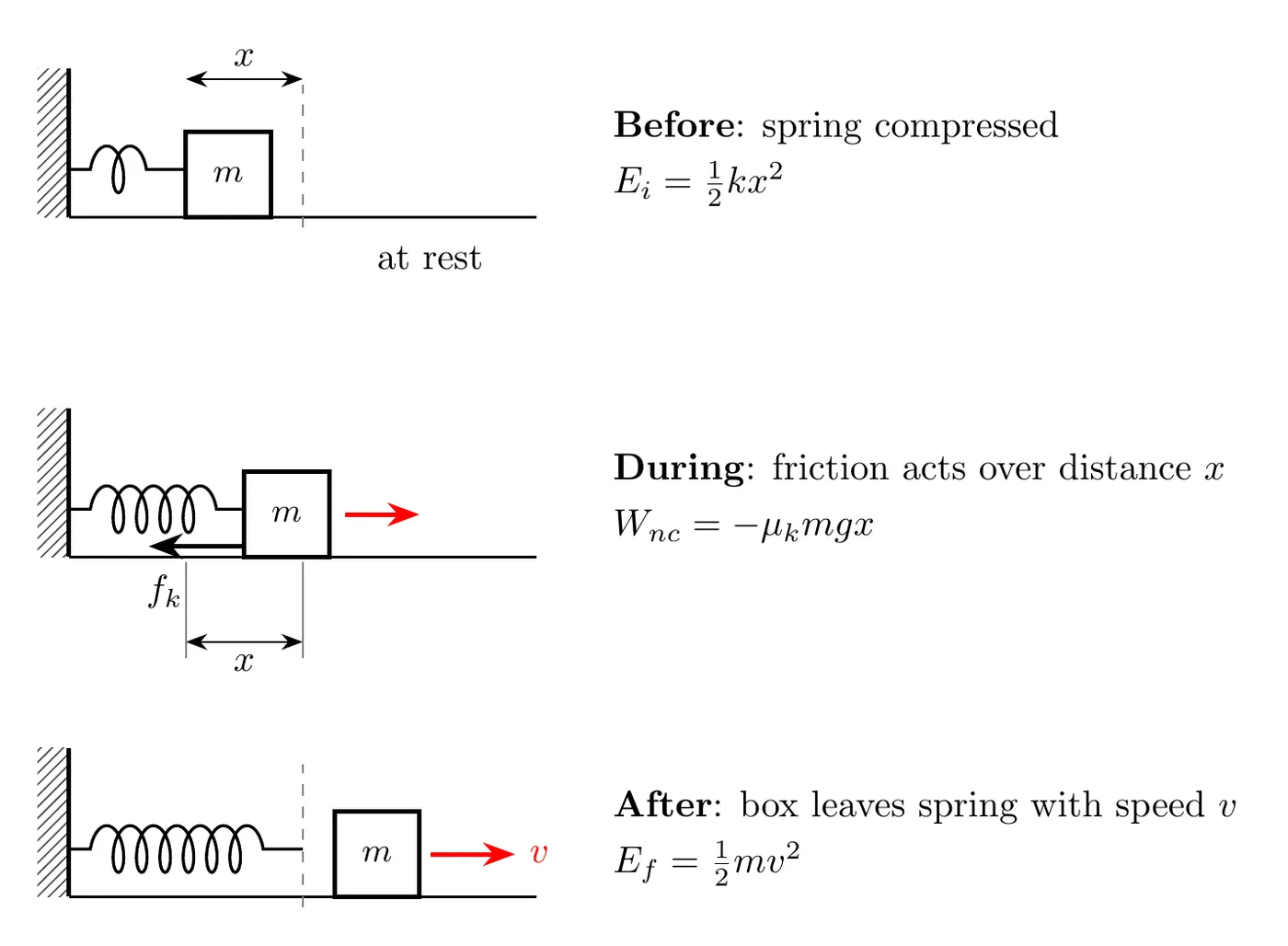
Step 1: The before state. The spring is compressed and the box is at rest:
Step 2: The non-conservative work. Friction acts as the box moves from the compressed position to the spring’s natural length, a distance :
On a horizontal surface , so .
Step 3: The after state. The box leaves at speed with the spring relaxed:
Step 4: Apply the energy equation.
Step 5: Solve for v. Multiply by 2, divide by , and take the square root:
Reading it: with no friction () you get , the maximum possible speed. With friction, the term is subtracted and the speed drops. More friction (bigger ) means a smaller launch speed, and a stronger spring (bigger ) means a bigger one.
With numbers: take N/m, m, kg, and ( m/s²). The spring stores J, and friction does J, leaving J:
Without friction, all 8.0 J would become kinetic energy, giving m/s.
Comparison: With and Without Friction
Scenario | Energy equation | Launch speed |
No friction | ||
With friction |
Friction always cuts the final kinetic energy and speed, because it turns mechanical energy into thermal energy.
Testing it in lab. You can check the no-friction prediction with a spring launcher on a low-friction track: measure the compression with a ruler and the launch speed with a photogate or motion sensor, for several compressions. Squaring both sides gives , so a graph of vs. should be a straight line through the origin with slope . If friction matters, the points fall below that line.
Energy Bar Charts
A handy way to picture the transformation is an energy bar chart.
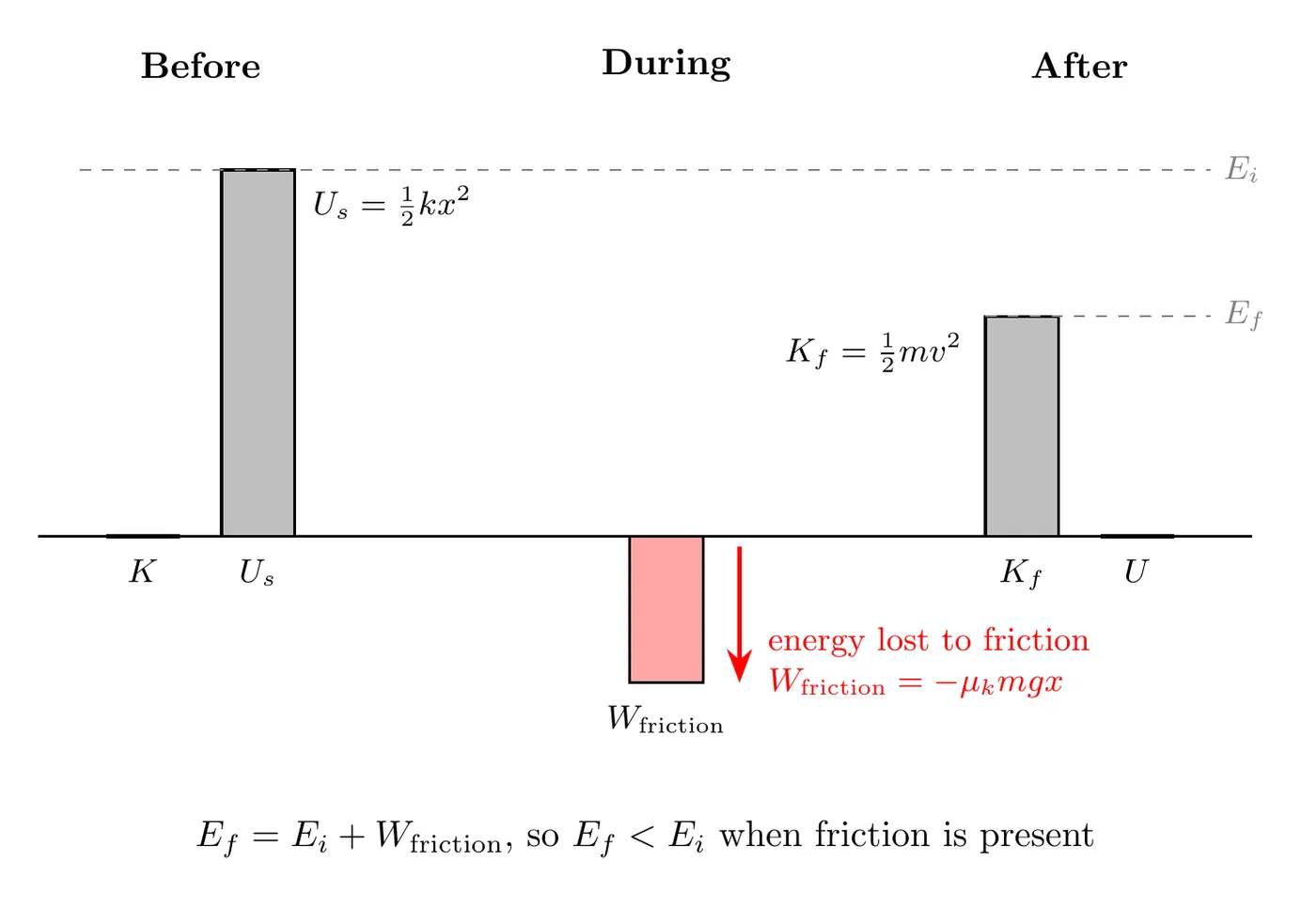
The idea: the final bars plus the energy lost to friction add back up to the initial energy.
Sign Conventions for Work by Non-Conservative Forces
Friction and drag oppose motion, so their work is negative (), the mechanical energy decreases (), and the energy is dissipated as heat. Applied forces can assist motion, so their work can be positive (), the mechanical energy increases (), and energy is added to the system. The general rule is : negative shrinks the mechanical energy, positive grows it, and zero conserves it.
Common Mistakes
- Leaving out friction’s work. In calculus-based physics you have to account for non-conservative forces. Don’t just set when friction is present.
- Wrong sign for friction work. It’s negative because friction opposes motion: .
- Wrong distance for friction work. Use how far the object moves while friction is acting. In the spring problem that’s the compression distance , not the total distance traveled.
- Confusing normal force with weight. On a horizontal surface , but not always (inclines or extra vertical forces change it).
- Missing energy forms. List every kinetic and potential energy in the initial and final states. Don’t forget spring PE, gravitational PE, or kinetic energy.
- Inconsistent reference point. Once you pick or , use it for both initial and final states.
- Square root errors. From , remember , and don’t keep the negative root, since speed is positive.
- Algebra slips. Watch your parentheses. are all the same thing.
- Not sanity-checking. If friction goes up but your answer says the speed goes up, something’s wrong. Friction should always lower the final speed.
- Thinking mechanical energy is always constant. Total energy is conserved in every interaction, but a system’s mechanical energy only stays constant when . With friction or drag it decreases.
- Double-counting friction. Friction is non-conservative, so its effect belongs in , not as a potential energy term.
- Forgetting to multiply by distance. Work = force × distance, so for friction .
- Wrong units. Every energy term is in joules. As a check, works out to (N/m)(m²)/kg = m²/s², which matches units of .
- Assuming the spring returns to natural length. Here “leaves the spring” means the spring is at natural length, but always read carefully to pin down the final configuration.
- Not choosing between energy and force methods. Energy methods shine when you care about the start and end but not the details in between. Use Newton’s laws when you need forces, accelerations, or instantaneous quantities.