

3.5 - Power
What Power Is
Power is the rate at which energy changes over time. It describes how quickly energy is transferred into or out of a system, or converted from one form to another. In short, power measures how fast work is done or energy is transformed.
Average Power
In algebra-based courses you usually compute average power:
where:
- = average power (W)
- = change in energy (J)
- = time interval (s)
Since work is energy transfer ():
This gives the average rate of energy transfer over an interval.
Instantaneous Power
In calculus-based physics you can find instantaneous power, the power at a specific moment:
The notation means you’re taking a derivative (an instantaneous rate of change), so this gives the power at a particular instant.
Units of Power
The SI unit of power is the watt (W):
Other common units: the kilowatt (), horsepower (, often for engines and motors), and the megawatt (, for power plants).
Power in Terms of Force and Velocity
A really useful form of power connects force and velocity. Starting from and :
and since :
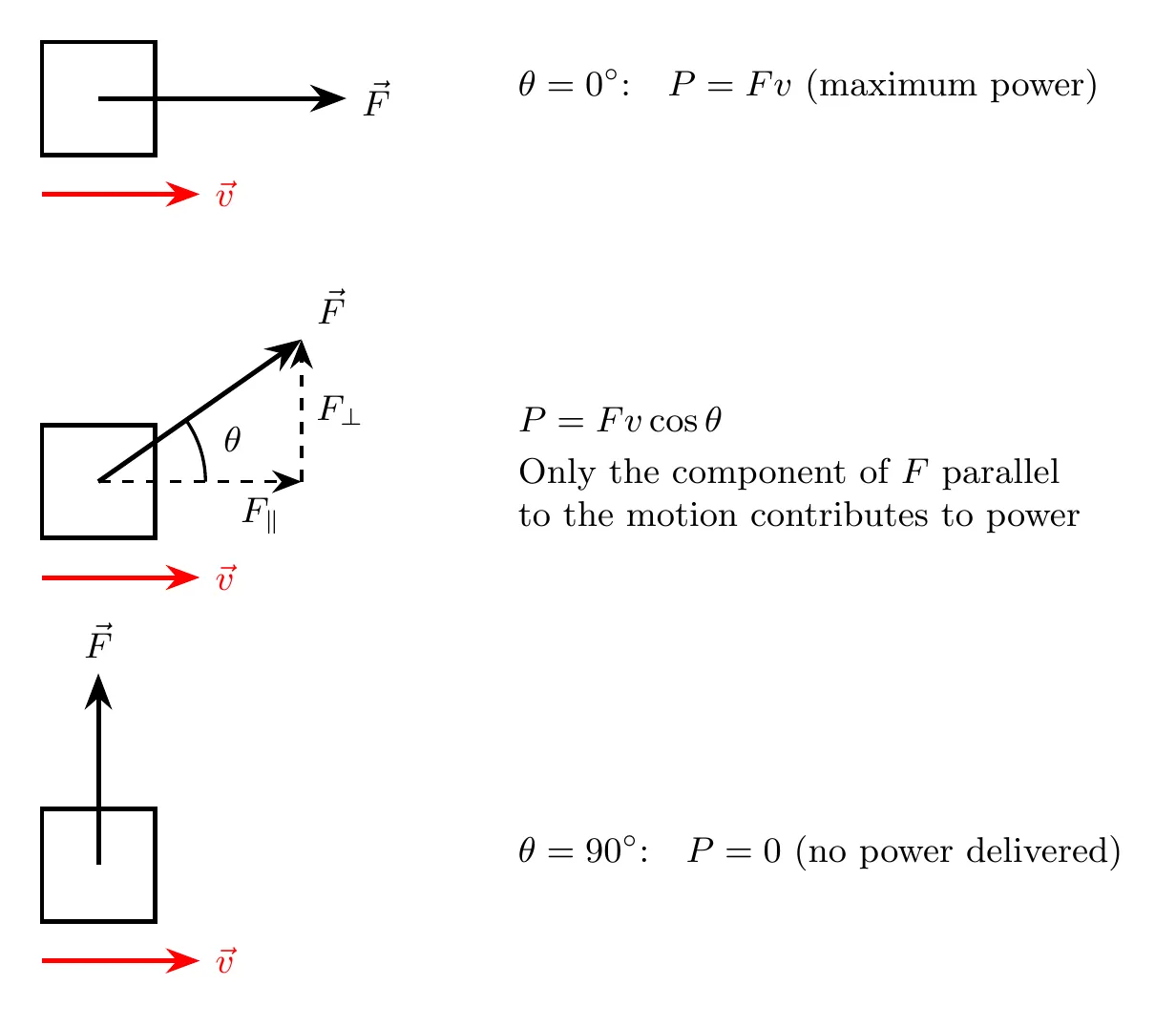
General formula:
where is the force magnitude (N), is the speed (m/s), and is the angle between the force and velocity.
Special cases: when force and velocity are parallel (), , which is the most common case, force applied in the direction of motion; and when force is perpendicular to velocity (), , like the normal force on a block sliding horizontally, which does no work and delivers no power.
On the AP equation sheet you get and . The force-velocity form is a derived equation, so it isn’t printed. AP Physics C writes it as:
where is the component of the force along the velocity. Just like with work, only the parallel component transfers energy.
Power for energy changing form inside a system. Power isn’t only about energy crossing a boundary. When a 2.0 kg rock falls at 15 m/s (system = rock + Earth, m/s²), gravitational potential energy is turning into kinetic energy at a rate of W. As the rock speeds up, that rate grows.
Physical Interpretation
High power means either a large force applied at high speed or energy transferred quickly. Low power means a small force at low speed or energy transferred slowly. Compare an elevator motor (high power, lifting heavy loads fast) with a hand crank (low power, same work but much slower). Both can do the same amount of work, but the elevator does it in less time, so it has higher power.
Example Problem: Motor Dragging a Machine
A motor and cable drag a 300 kg machine across a horizontal floor at a constant 0.50 m/s. The coefficient of kinetic friction is .
- What force must the motor apply?
- What power must the motor deliver?
Use m/s².
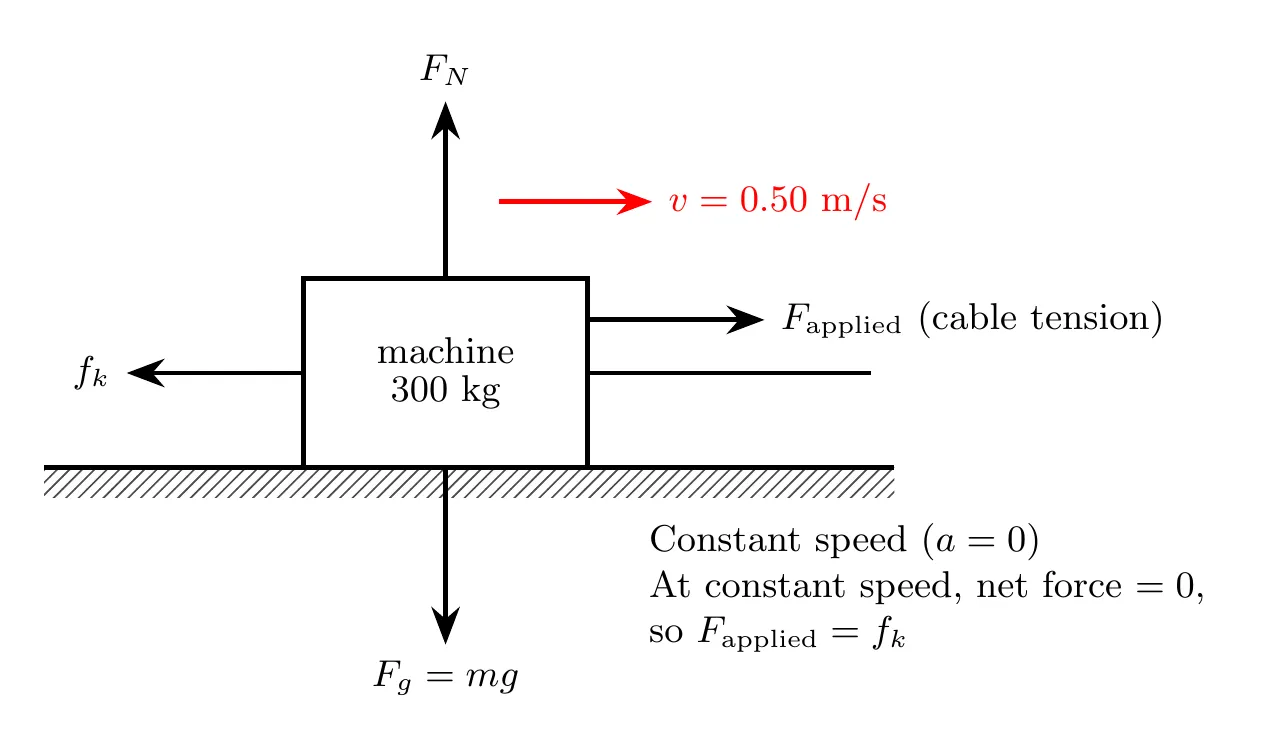
Part (a): The applied force. No vertical acceleration, so :
Then friction:
At constant speed the horizontal acceleration is zero, so :
The motor must apply 1800 N.
Part (b): The power. The applied force is parallel to the velocity ():
The motor must deliver 900 W, which is 0.90 kW or about 1.2 hp. All of it goes into overcoming friction and gets dissipated as heat at the machine-floor interface. None of it raises kinetic energy, since the speed is constant.
Power and Energy Over Time
Because power is the rate of energy transfer, the total energy transferred is the integral of power over time:
For constant power, . For example, a 900 W motor running 10 seconds transfers:
Power in Different Contexts
Mechanical power (the focus here) is , used for motors, engines, and machines doing mechanical work. Electrical power (in E&M) is , used for circuits and devices. Human power output varies: about 100 W at rest (basal metabolic rate), 200 to 300 W walking, 500 to 1000 W running, and up to about 2000 W for an elite sprinter in brief bursts. Appliance ratings span a wide range too: an LED bulb around 10 W, a laptop 50 to 100 W, a refrigerator 100 to 200 W, a microwave 1000 to 1500 W, and an electric car charger anywhere from 7000 to 250,000 W.
Variable Force and Velocity
When force or velocity changes with time, use the instantaneous form:
and to get the total energy over an interval :
For example, if power varies as , the total energy from to is:
This need for calculus is the main gap between algebra-based and calculus-based power problems.
Example Problem: Average vs. Instantaneous Power
A 2.0 kg cart starts from rest on a frictionless horizontal track. A constant 6.0 N horizontal force pushes it for 4.0 s.
- Find the instantaneous power delivered by the force as a function of time, and its value at s.
- Find the work done and the average power over the 4.0 s.
Part (a): Instantaneous power. The acceleration is m/s², so . The force is parallel to the velocity, so:
At s, W. The power grows with time even though the force is constant, because the cart keeps speeding up.
Part (b): Work and average power. Integrate the power over time:
Check with the work-energy theorem: at 4.0 s the speed is 12 m/s, so J. It matches. The final instantaneous power (72 W) is twice the average (36 W): rises linearly from 0, so the average equals the value halfway through.
Efficiency
Efficiency measures how well a machine turns input into useful output:
usually written as a percentage. A motor at 80% efficiency with 1000 W in delivers 800 W of useful mechanical power and loses 200 W to heat, sound, and so on. No real machine hits 100%, thanks to friction, air resistance, and other dissipative forces.
Summary of Key Formulas
Concept | Formula | When to use |
Average power | Energy or work over an interval | |
Instantaneous power | Power at a specific instant | |
Power from force and velocity | Force acting on a moving object | |
Power (parallel force) | Force parallel to velocity | |
Total energy (constant power) | Constant power over time | |
Total energy (variable power) | Power varies with time |
Common Mistakes
- Confusing power with force or energy. Power is not a force. It’s the rate of energy transfer, in watts (J/s), not newtons or joules.
- Forgetting the cosine. When force and velocity aren’t parallel, use . Only when they’re parallel can you use .
- Using the wrong velocity. The in is the velocity of the object the force acts on.
- Thinking power is always positive. It can be negative when a force opposes motion (like friction), meaning energy is being removed.
- Assuming constant power. When force or velocity changes, power changes too. For variable power use and integrate if needed.
- Wrong units. Power is in watts. If force is in N and velocity in m/s, gives W. Convert horsepower with .
- Confusing average and instantaneous power. is the average over an interval, is the value at a moment.
- Not linking constant speed to zero acceleration. At constant speed the net force is zero, so the applied force equals the resistive force (like friction).
- Ignoring efficiency. Real machines don’t turn 100% of input into useful output. Some is always lost.
- Wrong friction force. It’s . On a horizontal surface , but on inclines or with extra vertical forces .
- Thinking zero displacement means zero power. Power is about the rate of work, not total displacement. Even with zero net displacement, power can be nonzero during the motion.
- Adding power like vectors. Powers add algebraically with signs. If one force gives 500 W and friction takes 400 W, the net is +100 W.
- Using with one fixed force value when the force isn’t constant. For a varying force, evaluate at the moment you care about, or integrate for total energy.
- Not checking that the formula applies. with the average velocity gives the average power only when the force is constant in magnitude and direction over the interval. For varying forces, use the instantaneous form.
- Confusing power delivered with power dissipated. Power delivered by an applied force (a motor) can be positive, power from kinetic friction on an object sliding over a fixed surface is always negative. Net power = power in minus power out.