

4.2 - Change in Momentum and Impulse
Rate of Change of Momentum
The rate of change of a system’s momentum equals the net external force on that system:
This is really just Newton’s Second Law rewritten to use momentum explicitly.
How It Connects to Newton’s Second Law
The traditional form is .
Since and
(for constant mass):
The momentum form is more general. It also handles a system whose mass changes while its velocity stays constant (see “When the Mass Changes” below).
When the Mass Changes (Constant Velocity)
Sometimes the velocity stays constant but the mass of the moving system changes, like sand or gravel landing on a moving conveyor belt. Since and is constant, only changes, so the derivative becomes:
Here is the rate the mass changes (kg/s). This isn’t on the equation sheet, but it comes straight from with . Notice that would wrongly give zero force, because the belt never speeds up. A force is still needed, because every new bit of mass that joins the system has to be brought up to speed .
Example: Gravel falls straight down onto a conveyor belt at a steady 4.0 kg/s, and the belt moves at a constant 1.5 m/s. What extra horizontal force must the belt’s motor supply to keep the belt moving at constant speed?
Check with impulse: in 10 s, 40 kg of gravel lands and gets brought up to 1.5 m/s, a momentum change of kg·m/s. A 6.0 N force for 10 s delivers N·s. They match. The force points in the direction the belt moves.
Impulse
Impulse is the effect of applying a force over a time interval.
Variable Force (Calculus-Based)
When the force changes with time:
where:
- = impulse (N·s or kg·m/s)
- = force as a function of time
- The integral runs over the time interval.
This is the area under a force vs. time graph.
Constant Force (Algebra-Based)
When the force is constant:
where:
- = constant force (N)
- = time interval (s)
The key difference between Physics 1 and Physics C:
- Physics 1: the force is usually constant, so use .
- Physics C: the force can be a function of time, so use .
Impulse Is a Vector
Impulse is a vector, and it points in the same direction as the net force.
For example:
- A force applied to the right gives an impulse directed to the right.
- A force applied downward gives an impulse directed downward.
In component form:
Example: A 0.16 kg hockey puck slides across frictionless ice at 6.0 m/s and hits the boards at 30° from the normal (the line perpendicular to the boards). It bounces off at the same speed and the same 30° angle on the other side of the normal. The contact lasts 0.015 s. Find the impulse from the boards and the average force.
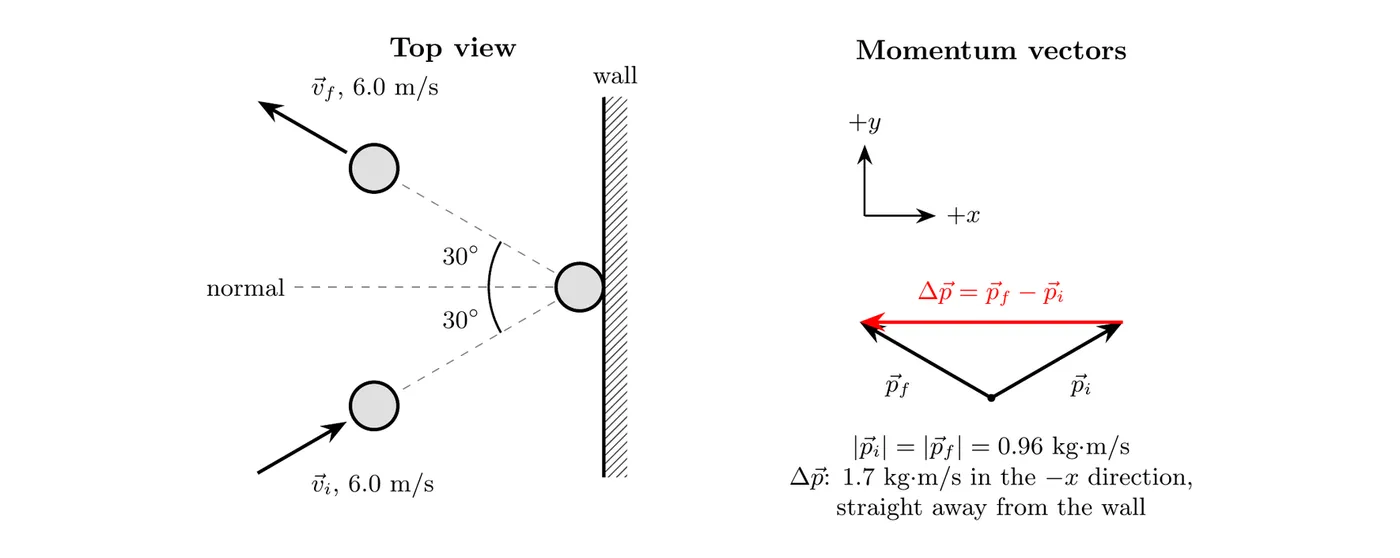
Take toward the boards and along them, and work each component separately.
Along the boards (): m/s before and after, so .
Toward the boards (): goes from m/s to m/s, so:
Answer: the impulse is 1.7 N·s and the average force is N, both pointing straight away from the boards (). The puck’s speed didn’t change, but its momentum did, because momentum is a vector. And the impulse doesn’t point along either velocity. It points the way the net force (the push from the boards) points.
Application: Car Safety and Airbags
The point of an airbag is not to change the impulse. It’s to stretch out the time interval over which the collision force acts.
The Physics of Airbags
During a collision, the change in momentum (the impulse) is fixed:
That doesn’t change whether you have an airbag or not, since the person has to come to a stop either way.
Using :
That’s an inverse relationship, so a larger means a smaller .
Without an airbag:
- The collision time is short (you hit a hard dashboard).
- The force is very large, so you get a serious injury.
With an airbag:
- The collision time is longer (a cushioned deceleration).
- The force is reduced, so the injury is less severe.
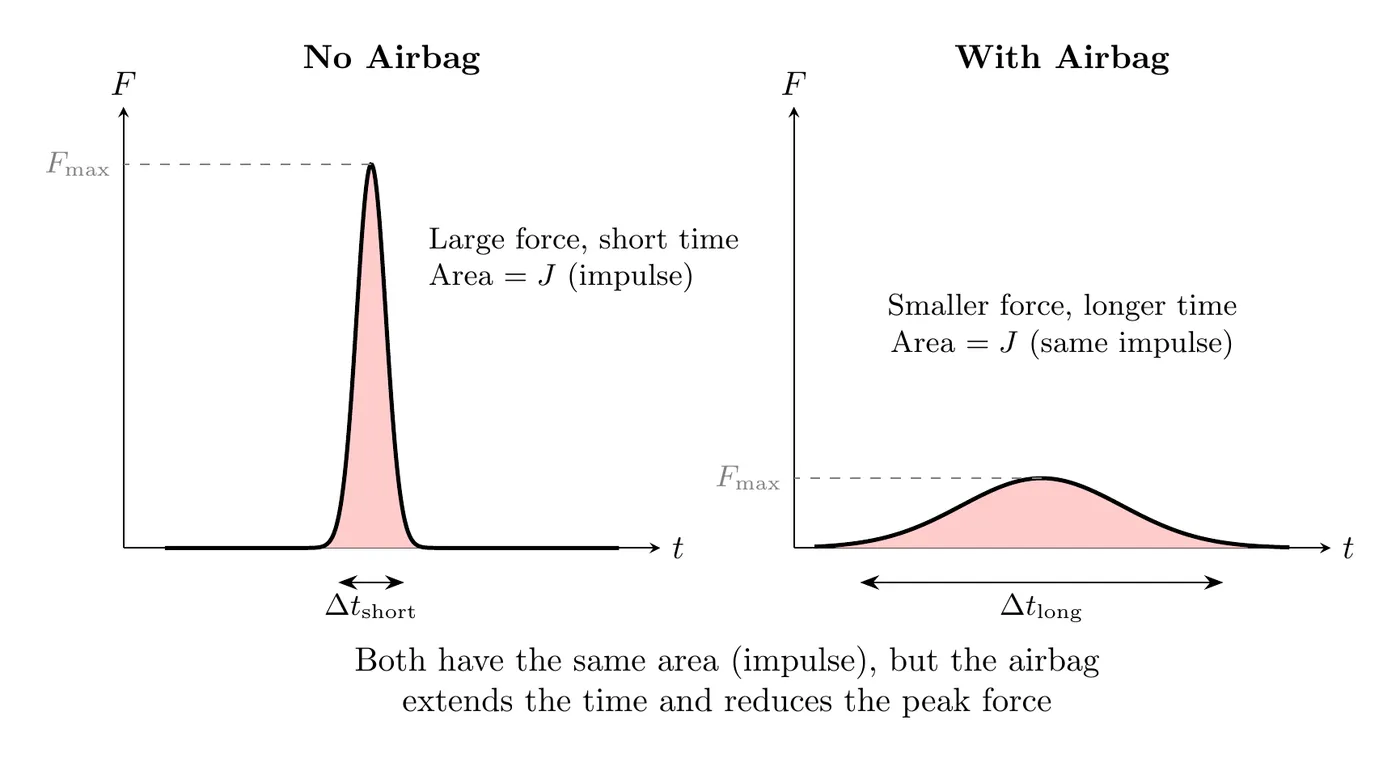
The key insight: airbags, crumple zones, and seat belts all work by extending the collision time, which reduces the force the passengers feel.
Change in Momentum
The change in momentum is the difference between the final and initial momentum:
Important: this is a vector. In one dimension, it can be positive or negative depending on direction.
In component form (2D or 3D):
The Impulse-Momentum Theorem
The impulse-momentum theorem links the impulse delivered to an object and the change in that object’s momentum.
In words: the impulse applied to an object equals the change in its momentum.
One detail: this is the impulse from the net force. The equation sheet writes it as . If several forces act during the interval, add up their impulses (or integrate the net force) before setting it equal to .
Expanded Form
This connects force over time to a change in velocity.
A Common Multiple Choice Trap
The question format: “Impulse equals ________”
The answer choices might include:
- (A) momentum
- (B) change in momentum ✓
- (C) final momentum
- (D) force times time
The correct answer is (B), change in momentum.
Why the confusion? Sometimes the initial momentum is zero (the object starts from rest), so:
In that special case, the impulse does equal the final momentum, but that isn’t true in general. The fundamental relationship is .
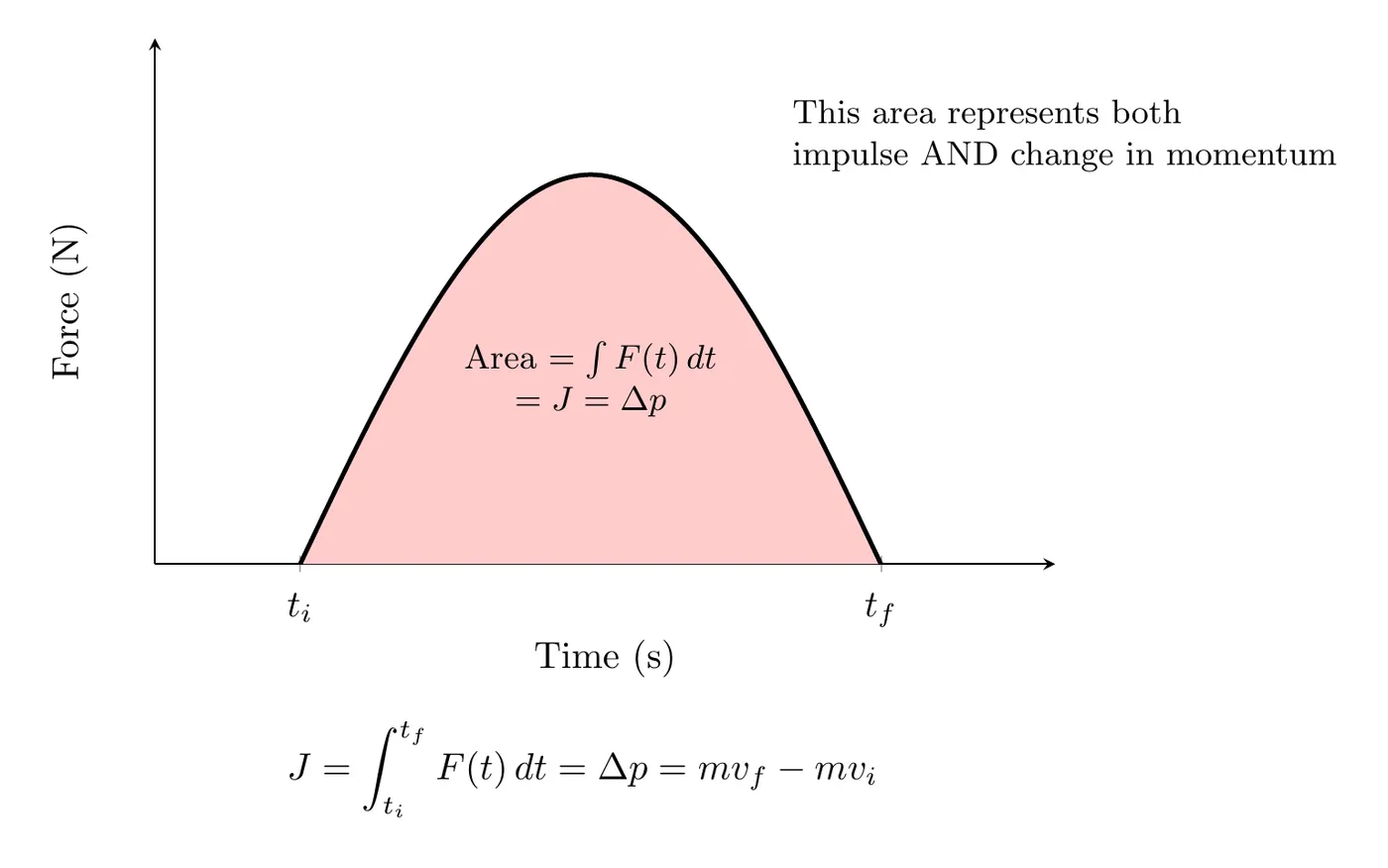
Impulse as Area Under a Force-Time Graph
Graphically, impulse is the area under a force vs. time curve.
And since :
Net Force as the Slope of a Momentum-Time Graph
Since , the slope of a momentum vs. time graph at any instant equals the net force at that instant. This is the reverse of the area rule: the area under vs. gives , and the slope of vs. gives .
So a straight, rising segment means a constant positive net force, a flat segment means zero net force, and a falling segment means a negative net force. On a curved segment the net force is changing, so find it at one instant from the slope of the tangent line.
Example: A 0.50 kg object moves along a straight line with momentum , where is in kg·m/s and is in seconds. Find the net force at s, the time when the net force is zero, and the object’s velocity at s.
The net force is zero when , so s. That’s where the momentum graph is flat for an instant (its minimum, kg·m/s).
Example Problem: Variable Force and Impulse
Problem: The net force on an object moving in a straight line is given as a function of time by:
where N/s² and N. What is the change in momentum of the object from to seconds?
Solution
The key relationship: impulse equals change in momentum, so .
Step 1: Set up the impulse integral
Step 2: Substitute the force function
Step 3: Integrate with the power rule
Step 4: Evaluate the definite integral
Upper limit ():
Lower limit ():
Step 5: Subtract
Step 6: Apply the impulse-momentum theorem
Answer: the change in momentum is 30 kg·m/s (or 30 N·s, which is the same thing).
Extension: Finding the Average Force
If a follow-up asks for the average force over this interval:
Visualizing the Example
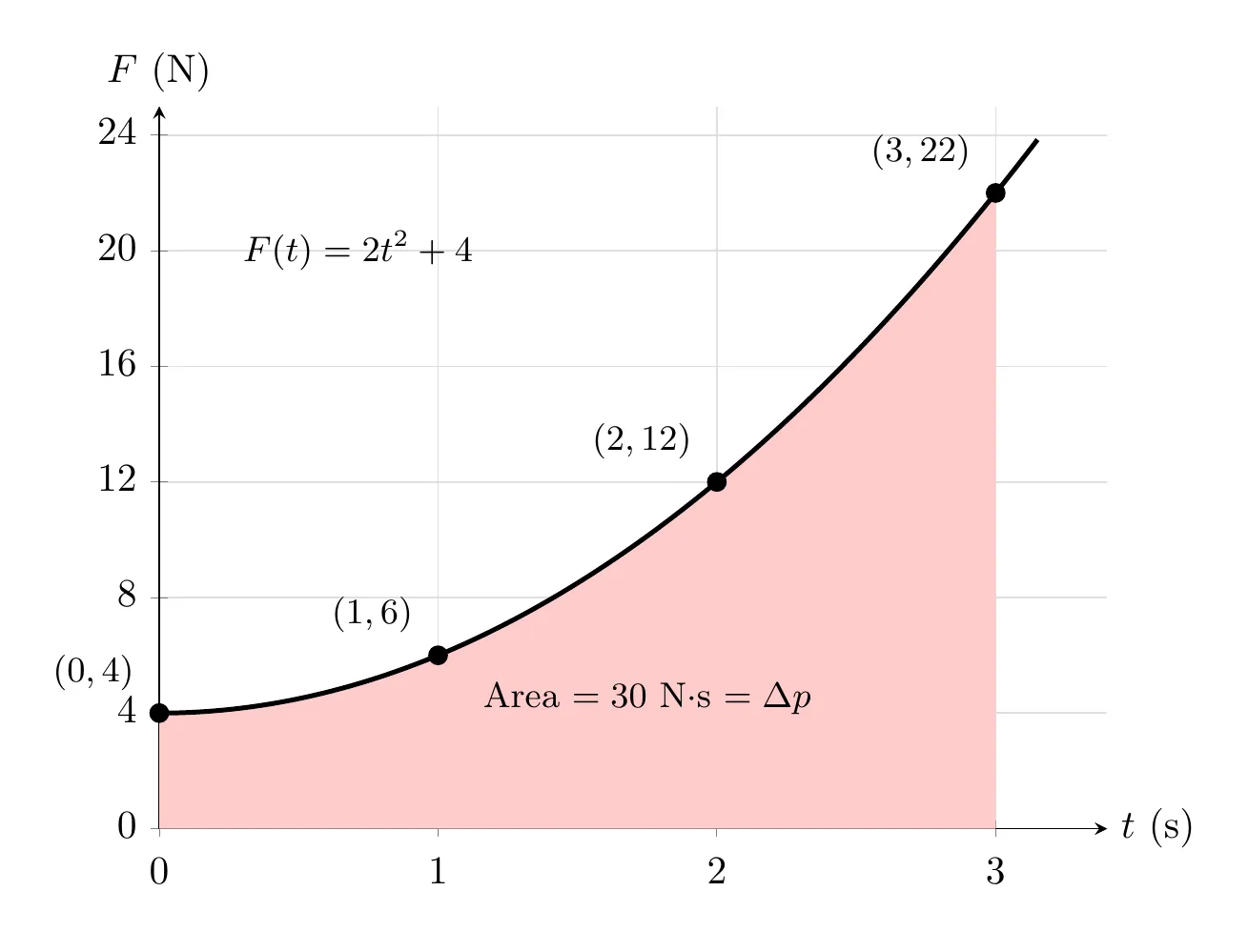
The read: the force grows quadratically with time. Even though it starts at 4 N and climbs to 22 N, the average effect across the 3-second interval is the same as a constant 10 N force.
Example Problem: Reading Force and Momentum Graphs
Problem: A 2.0 kg cart moves along a straight track at +1.0 m/s. Starting at , the net force on it follows the top graph below: it rises steadily from 0 to 4.0 N over the first 2.0 s, stays at 4.0 N until s, is N from 4.0 s to 5.0 s, and is zero after that. (a) Find the impulse from 0 to 5.0 s. (b) Find the cart’s velocity at s. (c) When is the cart fastest, and how fast is it going then?
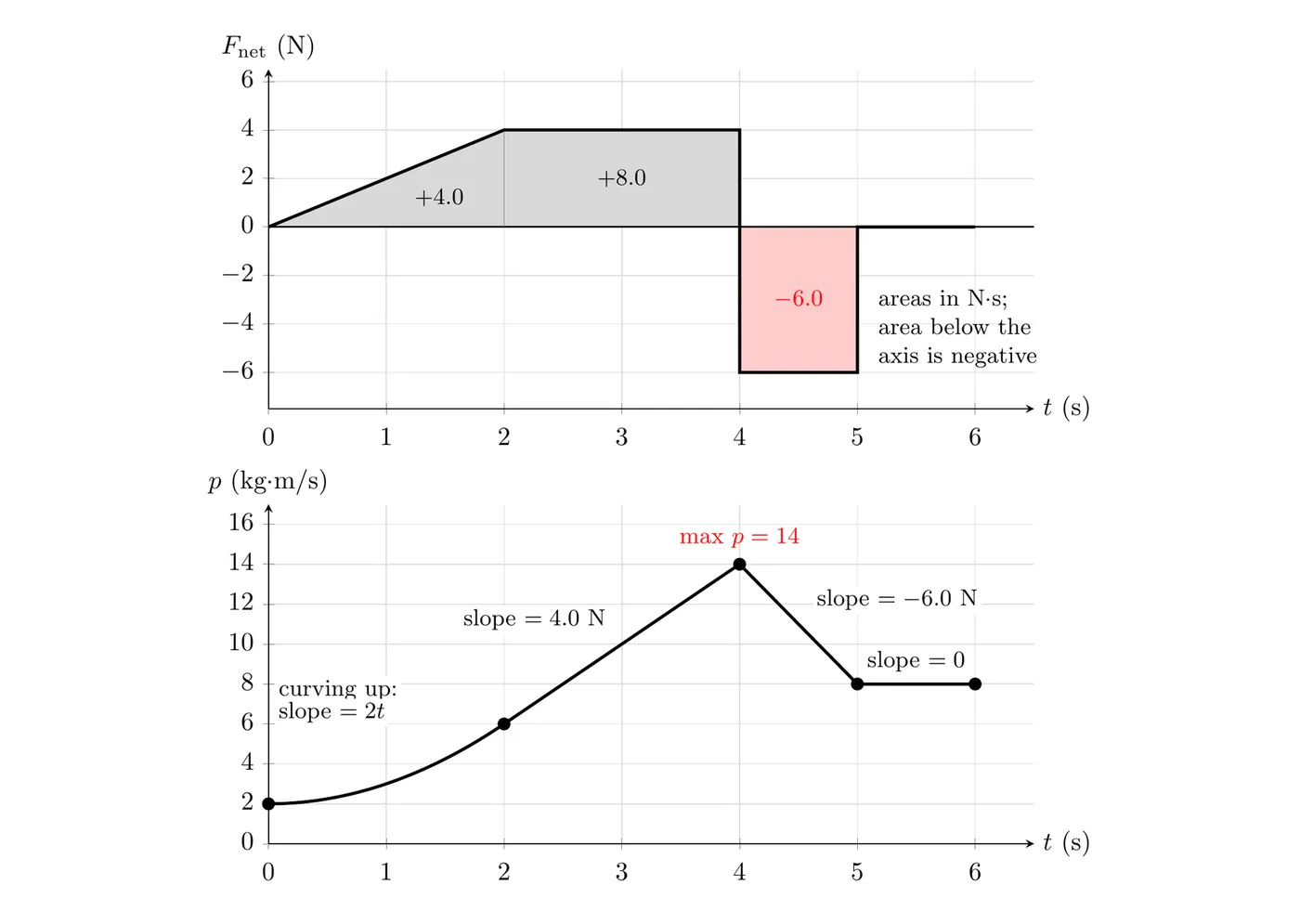
Solution
Step 1: Find each area under the force graph
- 0 to 2.0 s (triangle): N·s
- 2.0 to 4.0 s (rectangle): N·s
- 4.0 to 5.0 s (rectangle below the axis): N·s
Step 2: Add them (areas below the axis count as negative)
Step 3: Use the impulse-momentum theorem
The force is zero after 5.0 s, so the momentum stays 8.0 kg·m/s through s:
Step 4: Find the fastest moment
The momentum keeps growing as long as the net force is positive and starts dropping the instant the force turns negative, so the maximum is at s: kg·m/s, and m/s.
Answer: (a) 6.0 N·s in the positive direction. (b) 4.0 m/s. (c) At s, moving at 7.0 m/s.
The read: the bottom graph is the cart’s momentum. Its slope at each moment equals the force on the top graph ( while the force ramps up, then 4.0 N, then N, then 0), and the change in its height over any interval equals the area under the force graph over that interval.
Summary of Key Relationships
Concept | Equation | Meaning |
Newton’s 2nd Law (momentum form) | Force is the rate of change of momentum | |
Impulse (variable force) | Impulse from a force over time | |
Impulse (constant force) | The special case for constant force | |
Change in momentum | The difference between momentum states | |
Impulse-Momentum Theorem | Impulse equals change in momentum | |
Expanded form | Connecting force to velocity change |
Units of Impulse
Impulse can be written two equivalent ways.
From the definition, :
From the impulse-momentum theorem, :
These are the same:
You can verify it, since :
Common Mistakes
- Confusing impulse with momentum. Impulse is the change in momentum (), not momentum itself. Only when does .
- Forgetting impulse is a vector. Impulse has a direction, the same as the force. In 2D problems, calculate and separately.
- Using with a variable force. That formula only works for a constant force. With a variable force, you have to integrate: .
- Using the wrong limits of integration. Integrate from the initial time to the final time, . In the example, that’s from 0 to 3 seconds.
- Forgetting to evaluate at both limits. After integrating, evaluate at the upper limit minus the lower limit.
- Not noticing when the lower limit is zero. When you integrate from and the function only has terms, the lower-limit contribution is zero, which simplifies things.
- Sign errors in the change in momentum. It’s , not . Direction matters, so be consistent with your positive and negative directions.
- Thinking airbags reduce impulse. Airbags increase the collision time, which reduces the force. The impulse (change in momentum) stays the same.
- Applying the power rule wrong. , not . Add 1 to the exponent, then divide by the new exponent.
- Forgetting units. Impulse is in N·s or kg·m/s. Change in momentum is in kg·m/s. They’re equivalent.
- Mixing up areas under different graphs. Area under an F vs. t graph is impulse. Area under a v vs. t graph is displacement. Don’t confuse them.
- Assuming impulse equals force. Impulse needs both force and time. A huge force for a tiny time can give the same impulse as a small force for a long time.
- Not recognizing that the integral is an area. is the mathematical way of finding the area under the curve, and that area is the impulse.
- Forgetting the initial momentum. If an object is already moving, , not just . The impulse changes the momentum from one value to another.
- Thinking impulse only applies to collisions. Collisions are the common example, but impulse applies any time a force acts over time: accelerating a car, throwing a ball, rocket thrust, and so on.