

4.4 - Elastic and Inelastic Collisions
The Fundamental Principle
No matter what type of collision it is, momentum is always conserved in an isolated system.
What separates the different types of collisions is whether kinetic energy is conserved.
Types of Collisions
Elastic Collisions
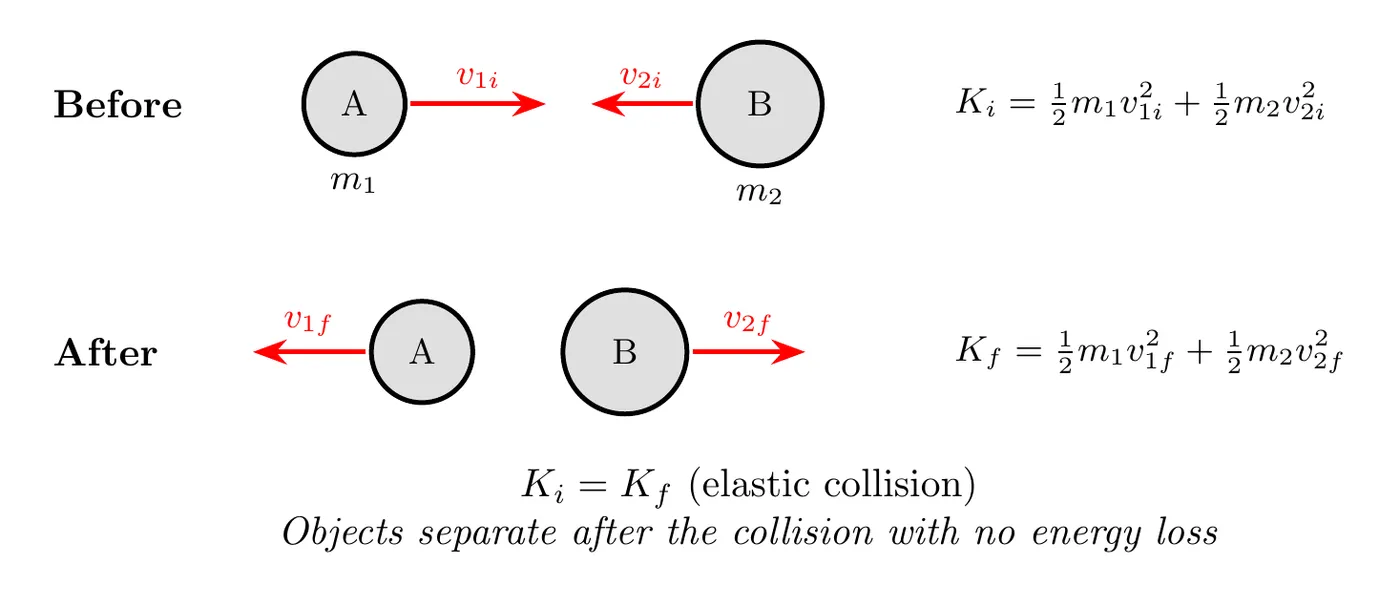
In an elastic collision, both momentum and kinetic energy are conserved.
Momentum conservation:
Kinetic energy conservation:
or just:
Important: the individual kinetic energies of each object can change. What stays the same is the sum of all the kinetic energies.
Examples:
- Collisions between hard spheres (billiard balls, marbles).
- Atomic and molecular collisions.
- A superball bouncing (roughly elastic).
Characteristics:
- The objects bounce off each other.
- There’s no permanent deformation.
- No energy gets converted to heat, sound, or deformation.
- You get maximum rebound.
A Special Formula for Elastic Collisions
For elastic collisions in one dimension (head-on) only, there’s an extra useful relationship:
or, equivalently:
In words: the relative velocity of approach equals the negative of the relative velocity of separation.
This equation only works for elastic collisions in one dimension, and pairing it with momentum conservation saves you from solving the squared kinetic energy equation. It isn’t on the equation sheet, so know where it comes from:
Rewrite momentum conservation and kinetic energy conservation with each object’s terms on one side (the factors of cancel):
Factor each difference of squares, , and divide the second equation by the first. Everything cancels except:
Inelastic Collisions
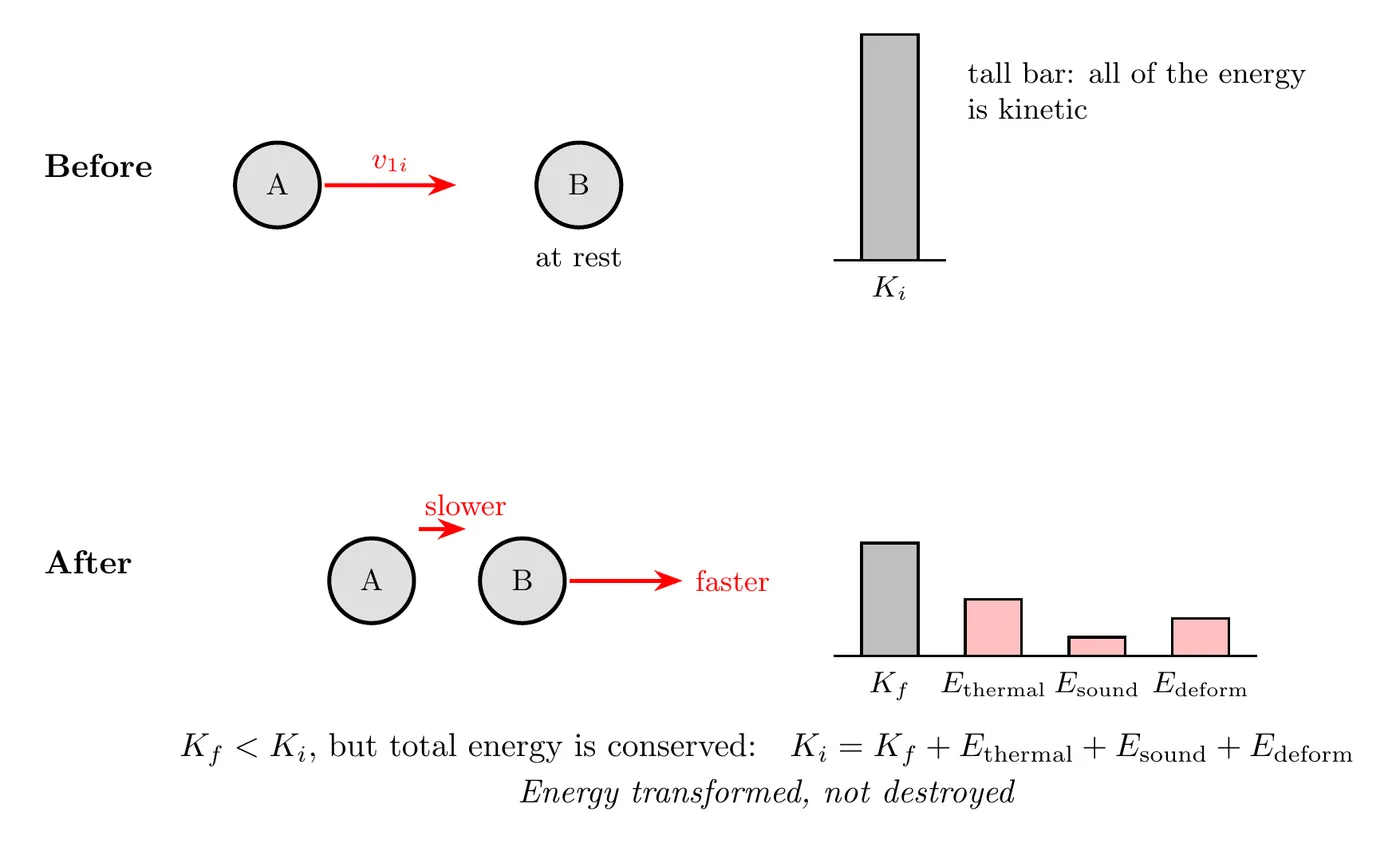
In an inelastic collision, momentum is conserved but kinetic energy is not.
Momentum conservation:
Kinetic energy is not conserved:
Where does the kinetic energy go? Some of it gets transformed by non-conservative forces into other forms:
- Heat (thermal energy from friction).
- Sound (the audible energy released).
- Deformation (permanent shape changes, like crumpling).
- Internal energy (molecular vibrations).
Examples:
- Car crashes, where the metal crumples.
- Clay balls colliding.
- Most real-world collisions.
Characteristics:
- The objects may or may not stick together.
- Some energy is lost to non-mechanical forms.
- Permanent deformation is possible.
- There’s less rebound than in an elastic collision.
Perfectly Inelastic Collisions
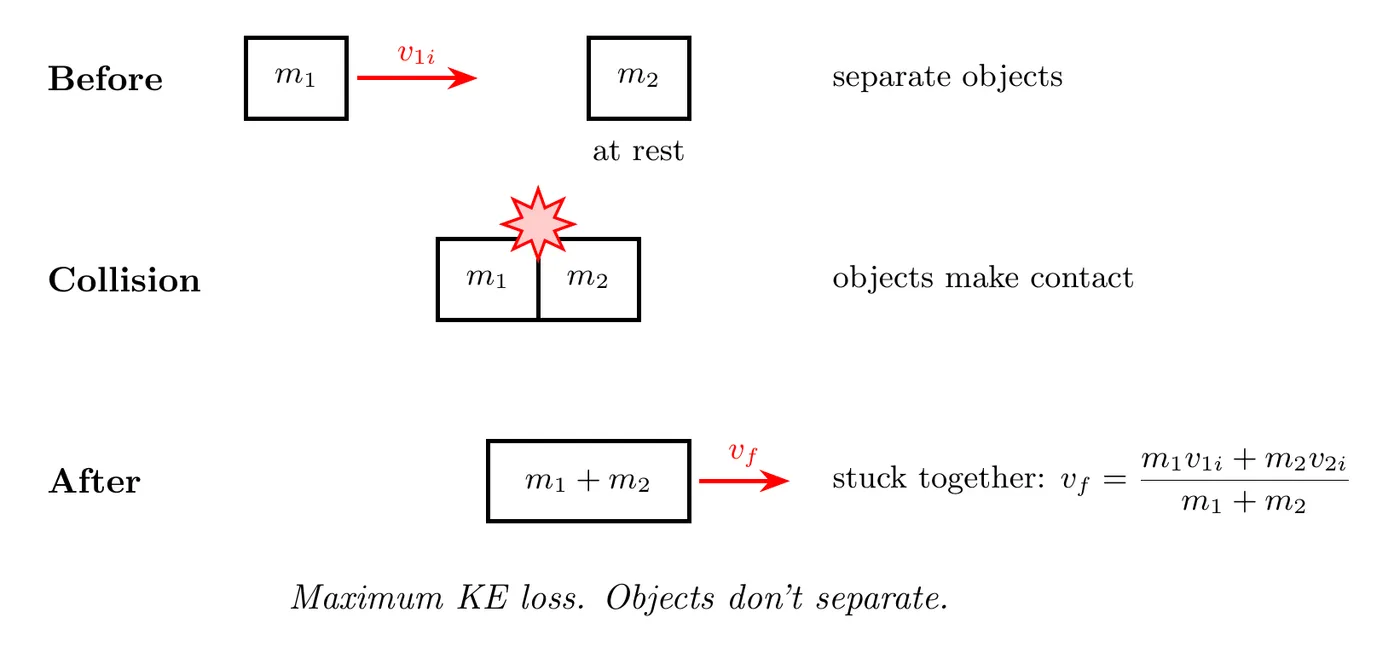
A perfectly inelastic collision is the special case where the objects stick together after colliding and move off with a common final velocity.
Momentum conservation:
Solving for the common final velocity:
Kinetic energy:
This is the collision type with the maximum kinetic energy loss for a given initial condition.
Examples:
- A child jumping onto a sled.
- Train cars coupling together.
- A bullet embedding in a block.
- A tackle in sports.
Characteristics:
- The objects stick together.
- They move as one combined mass.
- You get the maximum energy loss for the given collision.
- There’s one final velocity for the whole system.
Summary Table: Types of Collisions
Property | Elastic | Inelastic | Perfectly Inelastic |
Momentum conserved? | Yes | Yes | Yes |
KE conserved? | Yes | No | No |
Kinetic energy after | (maximum loss) | ||
Objects after collision | Separate | May separate | Stick together |
Energy loss | Zero | Some | Maximum (for the given initial state) |
Special equation | None | ||
Example | Billiard balls | Car crash | Bullet in a block |
Example Problem: Perfectly Inelastic Collision
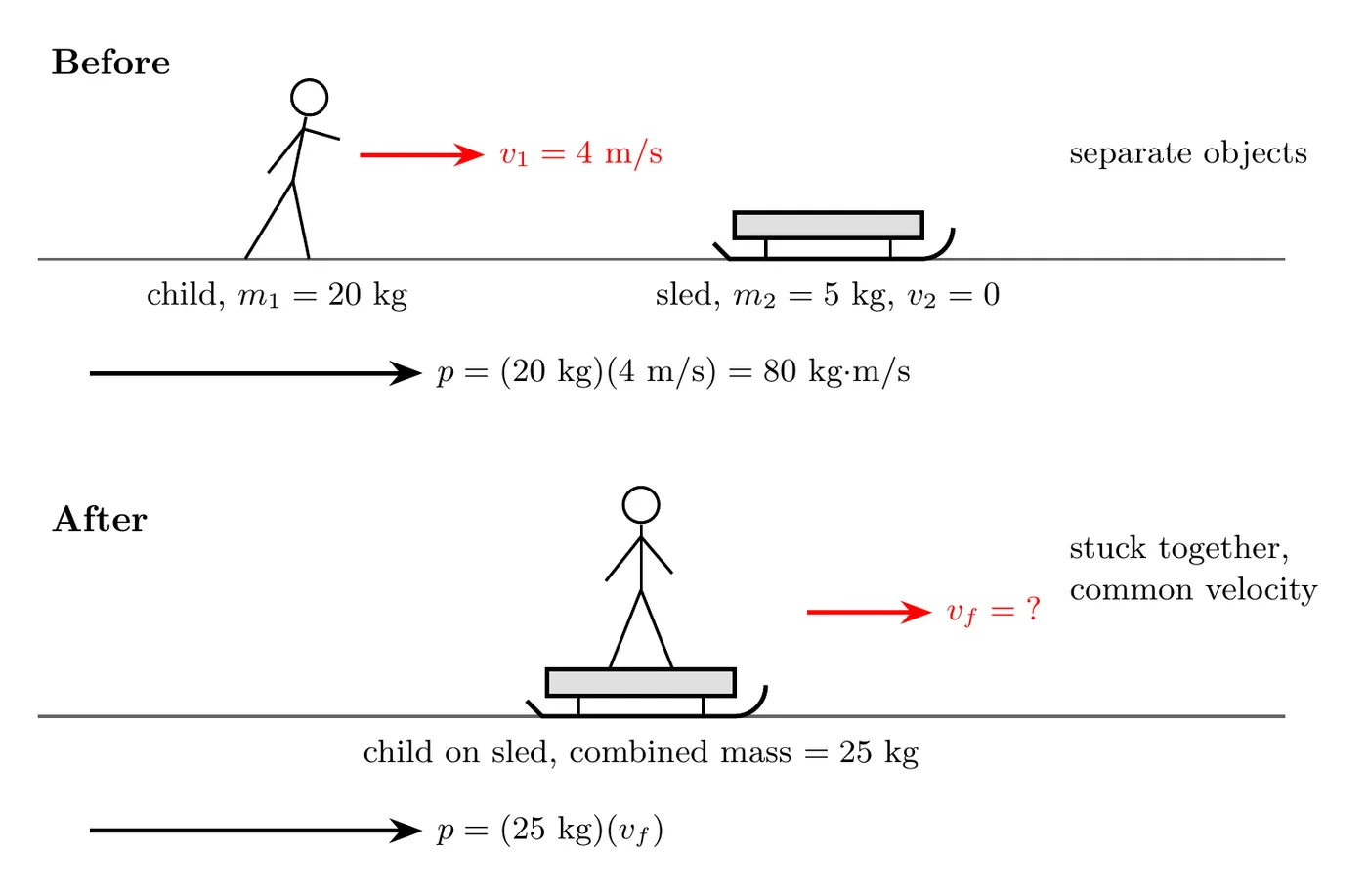
Problem: A 20 kg child runs at 4 m/s and jumps onto a stationary 5 kg sled on a frozen lake. How fast do the child and sled slide across the ice?
Solution
Step 1: Recognize this is perfectly inelastic
The child “jumps onto” the sled and they move together, so it’s a perfectly inelastic collision.
Step 2: Write conservation of momentum
Step 3: Identify what you know
- Child: kg, m/s.
- Sled: kg, m/s (stationary).
- Combined mass: kg.
- Unknown: .
Step 4: Substitute and solve
Answer: the child and sled slide across the ice at 3.2 m/s.
Extension: Energy Analysis
Optional, but useful: find the kinetic energy before and after to see how much was lost.
Kinetic energy before:
Kinetic energy after:
Energy lost:
So 32 J of kinetic energy got converted into other forms (sound, heat, deformation).
Percentage of energy lost:
Percentage remaining:
Answer: 20% of the kinetic energy was lost, and 80% remains as kinetic energy of the moving child-and-sled system.
The read: that “lost” 32 J went into:
- Heat, from friction and deformation.
- Sound, the thud of the landing.
- Vibrations in the sled.
The energy wasn’t destroyed. It just turned into non-mechanical forms.
Example Problem: Elastic or Inelastic?
Problem: On a level, frictionless track, cart 1 (0.40 kg) moves at +3.0 m/s toward cart 2 (0.60 kg), which is at rest. Two trials use different bumpers. Decide whether each collision is elastic or inelastic.
Trial | Cart 1 after | Cart 2 after |
A (spring bumper) | m/s | m/s |
B (soft foam bumper) | m/s | m/s |
Solution
Step 1: Check momentum (it should be the same in both trials)
Trial A: kg·m/s. Trial B: kg·m/s. Momentum is the same in both, as it has to be with no net external force.
Step 2: Compare the total kinetic energy before and after
Trial A: J. The total kinetic energy didn’t change, so Trial A is elastic. Notice cart 1’s kinetic energy dropped from 1.8 J to 0.072 J and cart 2’s rose from 0 to 1.728 J. Individual kinetic energies can change in an elastic collision. Only the total stays the same.
Trial B: J. The total dropped by 0.81 J (45%), so Trial B is inelastic. The foam’s internal friction turned that energy into thermal energy and sound. The carts didn’t stick together, so it isn’t perfectly inelastic.
Shortcut check: in a one-dimensional elastic collision, the speed of separation equals the speed of approach. Approach: 3.0 m/s. Trial A separation: m/s (elastic). Trial B separation: m/s (inelastic).
Answer: Trial A is elastic. Trial B is inelastic, with 0.81 J of kinetic energy transformed into other forms.
Problem-Solving Strategy
Step 1: Identify the collision type
- Do the objects stick together? Perfectly inelastic.
- Is it stated or implied that no energy is lost? Elastic.
- Otherwise, it’s inelastic (the general case).
Step 2: Always use conservation of momentum
Step 3: If it’s elastic, also use conservation of kinetic energy
Step 4: If it’s perfectly inelastic, use the common velocity formula
Step 5: Solve the system of equations
Step 6: Check that the answer makes physical sense
- Are the velocities reasonable?
- If inelastic, is ?
- If elastic, is ?
Two-Dimensional Collisions
In Physics C, you may run into 2D collisions where the objects don’t move along a single line.
The key principle: conserve momentum in each direction independently.
That gives you two equations, which you can use to solve for two unknowns, like the x and y components of a final velocity.
Example: A Two-Dimensional Collision
Problem: On a frictionless air table, puck A (0.20 kg) slides at 4.0 m/s in the direction and hits puck B (0.30 kg), which is at rest. After the collision, puck A moves at 2.0 m/s at 60° above the axis. Find puck B’s velocity (speed and direction), and decide whether the collision is elastic.
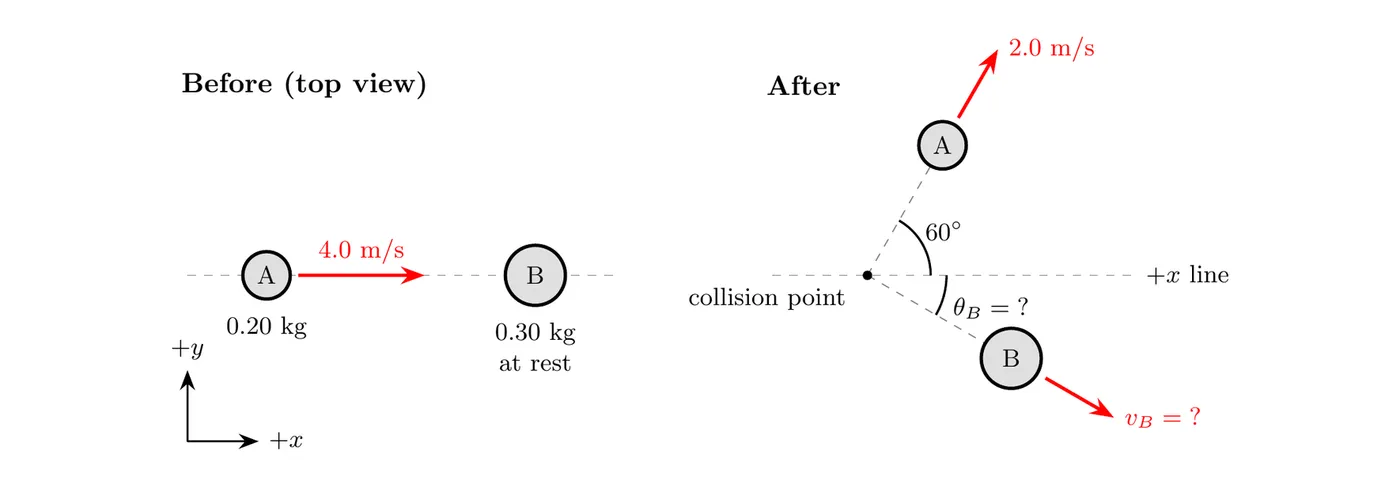
Step 1: Conserve momentum in
Step 2: Conserve momentum in (nothing moved in before, so the total momentum after is zero)
Step 3: Combine the components
Step 4: Check kinetic energy
Before: J. After: J. The total kinetic energy dropped by 0.40 J, so the collision is inelastic.
Answer: puck B moves at 2.3 m/s, 30° below the axis, and the collision is inelastic (25% of the kinetic energy was transformed into other forms).
Common Mistakes
- Assuming kinetic energy is always conserved. Only in elastic collisions. Most real collisions are inelastic.
- Forgetting momentum is always conserved. No matter the collision type, momentum is conserved in isolated systems.
- Using the wrong mass in perfectly inelastic collisions. After the collision, the combined mass is , not the individual masses.
- Misusing the elastic special formula. The equation only works for elastic collisions, not inelastic ones.
- Sign errors with velocities. If the objects move opposite ways, one velocity has to be negative. Be consistent with your positive direction.
- Thinking energy is lost forever. In inelastic collisions, kinetic energy drops, but the total energy is conserved. It just becomes heat, sound, deformation, and so on.
- Not recognizing a perfectly inelastic collision. Key phrases: “stick together,” “move as one,” “coupled,” “embeds in.” All of those signal perfectly inelastic.
- Calculating the energy loss wrong. The energy lost is (initial minus final), which should come out positive for an inelastic collision.
- Forgetting both objects can be moving initially. Don’t assume one object is always at rest. Read the problem carefully.
- Mixing up before and after. Keep them separate. Before means just before the collision, and after means just after it.
- Getting percentages wrong. Percentage lost is . Percentage remaining is .
- Assuming maximum speed after the collision. In a perfectly inelastic collision, the final speed is less than at least one of the initial speeds, because energy is lost.
- Not squaring the velocity in kinetic energy. It’s , not . Don’t forget the square.
- Forgetting the factor of 1/2 in kinetic energy. It’s , not .
- Thinking all inelastic collisions involve sticking. Objects can bounce apart and still have an inelastic collision if some KE is lost. “Perfectly inelastic” is the specific case where they stick.
- Using the wrong formula for the common velocity. For perfectly inelastic, it’s , not , which would just be an average velocity and is wrong.
- Not checking that for inelastic collisions. Always verify the kinetic energy went down. If , you made an error, since that breaks energy conservation.
- Confusing the momentum and kinetic energy equations. Momentum is linear in : . Kinetic energy is quadratic: . Don’t mix them.
- Using the elastic shortcut in two dimensions. only works for head-on (one-dimensional) elastic collisions. In 2D, conserve momentum in and separately, and compare total kinetic energies to check whether the collision is elastic.