

4.3 - Conservation of Linear Momentum
Velocity of the Center of Mass
A group of objects with their own individual momenta can be described as one system with a single center of mass velocity.
Formula
where:
- = velocity of the center of mass
- = mass of individual object
- = velocity of individual object
- = total mass of the system
You can also write it using momentum:
This looks like a momentum equation because the numerator is the sum of the individual momenta:
Where this comes from: the center of mass position is (see 2.1). Take the time derivative of both sides. The masses are constant and , so . Multiplying by the total mass gives a useful result:
So the whole system’s momentum is the same as if all its mass were moving at the center of mass velocity.
The Center of Mass Velocity Stays Constant Without a Net External Force
Combine with . Only external forces can change the system’s total momentum, because internal forces come in Newton’s third law pairs that cancel. So:
If the net external force is zero, is constant. That stays true during a collision or explosion too: the objects inside can speed up, slow down, bounce, or stick, but the center of mass keeps moving in a straight line at the same speed.
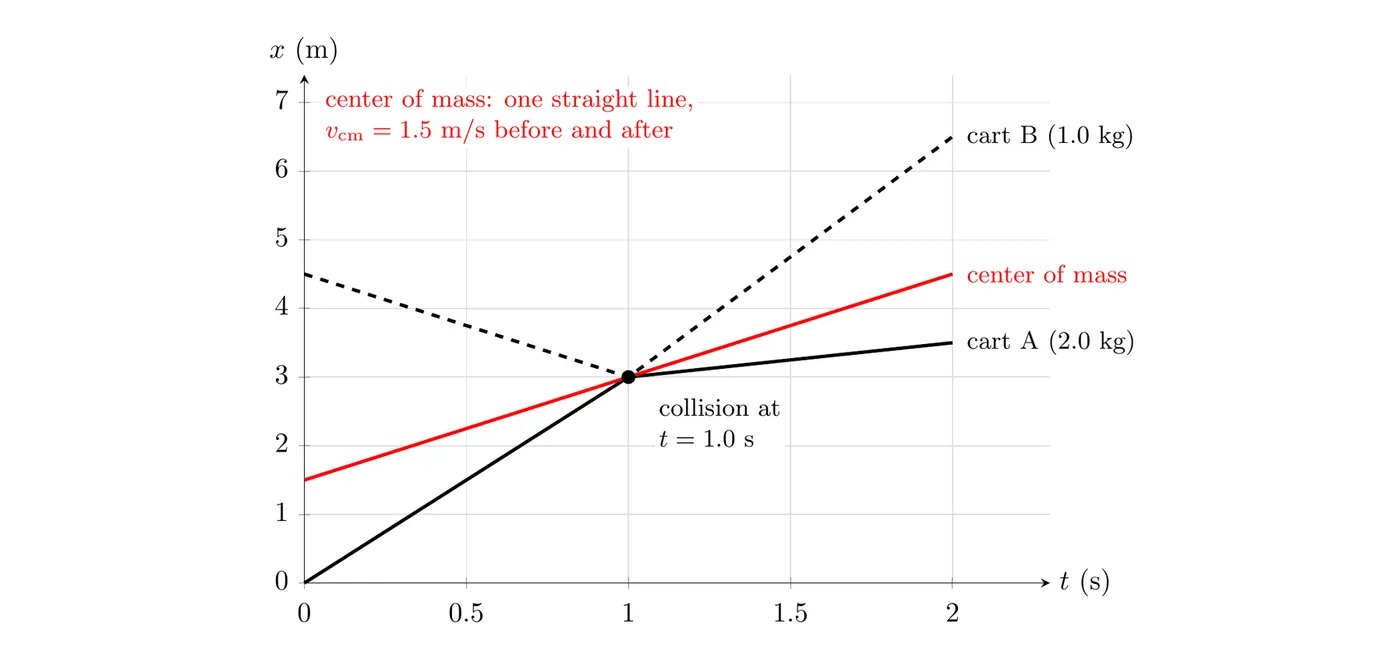
Example: On a frictionless track, cart A (2.0 kg) moves at +3.0 m/s toward cart B (1.0 kg), which moves at m/s. After they collide, cart A moves at +0.50 m/s. Find the center of mass velocity and cart B’s velocity after the collision.
With no net external force, the total momentum stays 4.5 kg·m/s after the collision:
After the collision, m/s, the same as before. On a position vs. time graph, each cart’s line bends at the collision, but the center of mass line doesn’t:
Total Momentum of a System
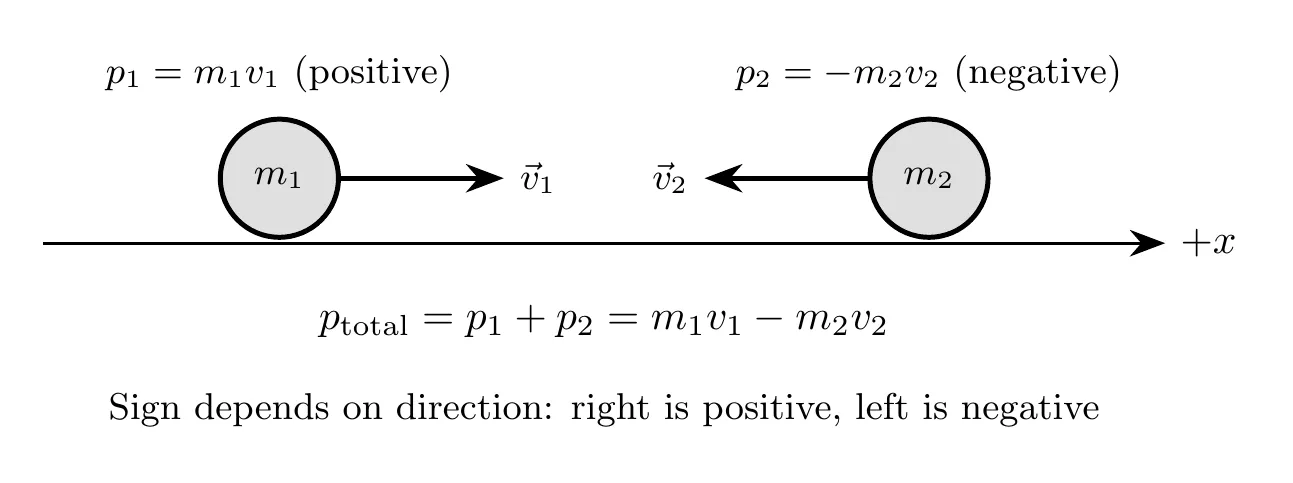
The total momentum of a system is the vector sum of all the individual momenta:
Important: when you calculate the total momentum, you have to account for the direction (the sign) of each momentum.
Example in 1D:
- Object 1 moving right: (positive).
- Object 2 moving left: (negative).
- Total: .
Conservation of Momentum: The Core Principle
The statement: with no net external forces, any change to the momentum of one object inside a system has to be balanced by an equal and opposite change in momentum somewhere else in the system.
or, equivalently:
This applies to both collisions and explosions.
The key insight: no matter what kind of interaction it is, momentum is always conserved in an isolated system.
Why It Works: Equal and Opposite Impulses
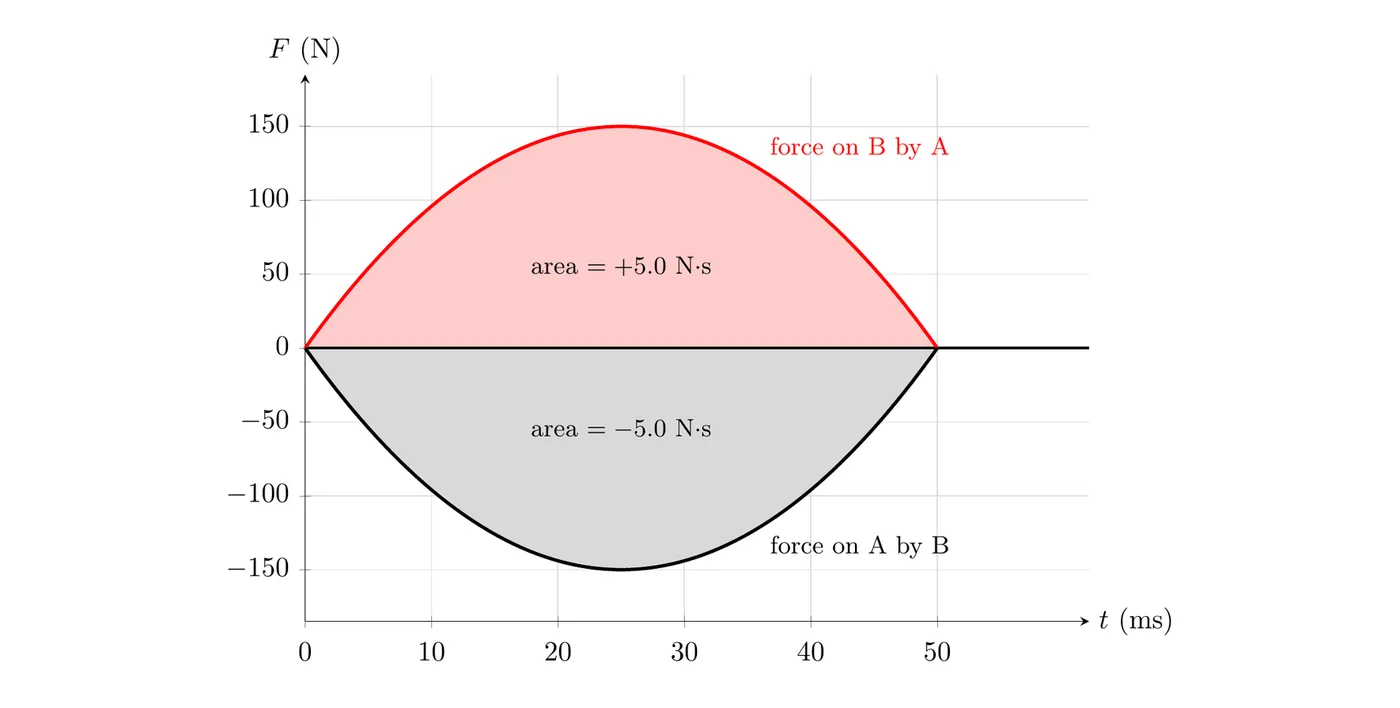
When object A pushes on object B, Newton’s third law says B pushes back on A with a force of equal size in the opposite direction, at every instant of the contact. Both forces also last for exactly the same time. So the impulses are equal and opposite:
Whatever momentum one object gains, the other loses. Momentum moves from one object to the other inside the system, and the total doesn’t change. On a force vs. time graph, the two forces are mirror images across the time axis, so their areas are equal and opposite.
Example: For the two carts in the center of mass example above, the contact lasts 0.050 s. Cart A’s momentum changes by kg·m/s, and cart B’s changes by kg·m/s. Equal and opposite, as expected. The average force on each cart is N. The real force isn’t constant (it builds up, peaks at 150 N in the graph below, and drops back to zero), but the two areas still match.
Conditions for Conservation of Momentum
Case 1: Zero Net External Force
If the net external force on a system is zero, the system’s total momentum is constant: it has the same value before, during, and after any interaction inside the system.
Written out:
Case 2: Non-Zero Net External Force
If the net external force is not zero, the system’s total momentum is not constant. Momentum is still conserved (it isn’t created or destroyed), but some of it is transferred between the system and its surroundings.
The change in momentum equals the impulse from the external forces:
This is the impulse-momentum theorem applied to the whole system. Whatever momentum the system gains, the surroundings lose, and the other way around.
Example: A 2.0 kg block slides at 3.0 m/s across a rough floor () until it stops. Take the block alone as the system. Friction is external: N. The block’s momentum changes by kg·m/s, so friction delivered an impulse of N·s, which takes s.
The block’s momentum wasn’t destroyed. It was transferred to the floor and Earth, which gained +6.0 kg·m/s. With Earth’s mass of about kg, that’s a speed change of about m/s, far too small to notice. If you choose the block and Earth as the system, friction is internal and the total momentum stays constant.
Why System Choice Matters
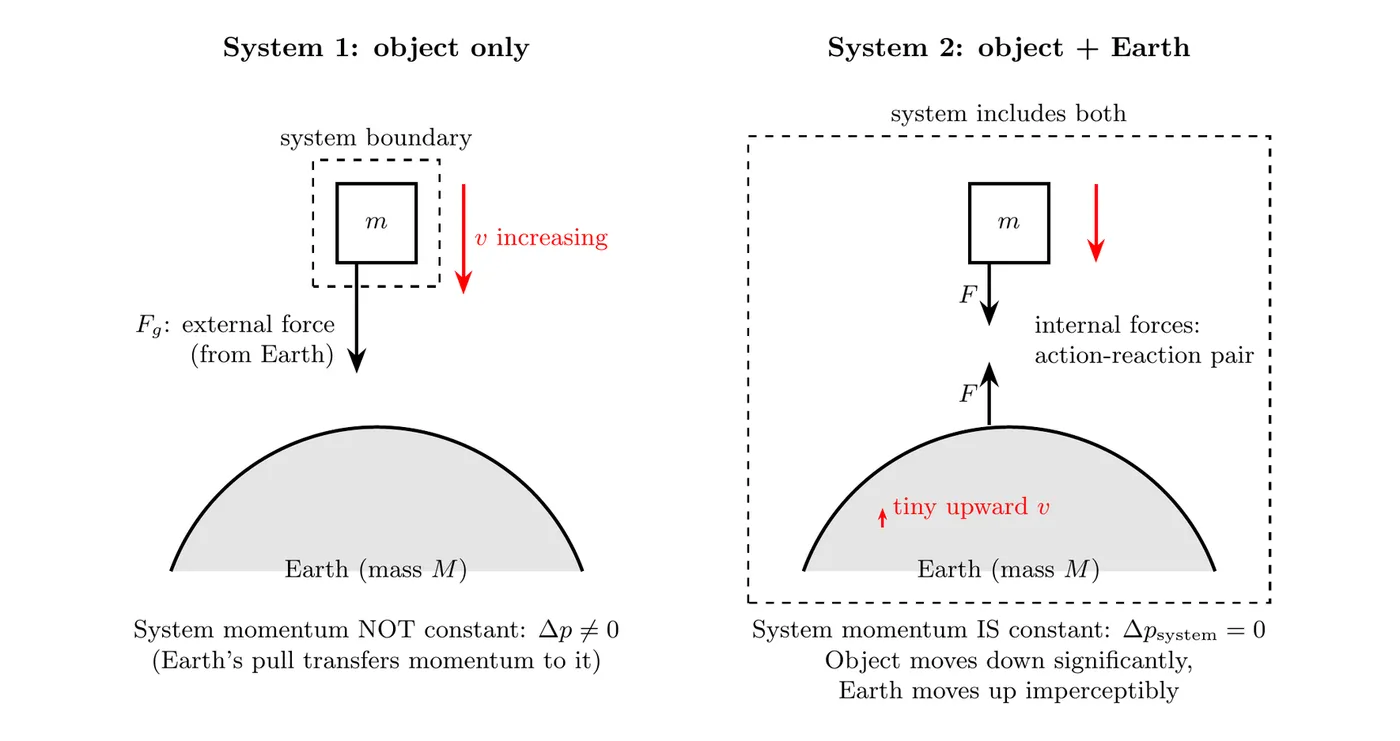
Here’s a critical idea: whether a system’s momentum stays constant depends on how you define your system.
Example: Dropping an Object
System 1: the object only (not including Earth)
- The gravitational force from Earth is external.
- The net external force isn’t zero.
- The object’s momentum is not constant, since it speeds up as it falls. Earth’s pull transfers momentum to it.
System 2: the object plus Earth
- The gravitational force is now internal, between parts of the system.
- There’s no net external force.
- The total momentum is constant. The object falls down and Earth “falls” up imperceptibly.
A practical note: when Earth is involved, we usually leave it out of the system, because its velocity change is negligibly small thanks to its enormous mass.
“Conserved” vs. “constant.” The AP exam uses these two words carefully:
- Conserved: momentum is conserved in every interaction. It’s never created or destroyed. It only moves from one object or system to another.
- Constant: a chosen system’s total momentum stays the same only if the net external force on it is zero. If it isn’t zero, momentum is transferred between the system and its environment, and the change equals the external impulse, .
- Choosing the system: you can almost always pick a system whose momentum is constant. Include every object that exerts a large force during the interaction (both colliding objects, the gun and the bullet, the person and the raft).
Problem-Solving Strategy
Step 1: Write the conservation statement
Always start by explicitly saying that momentum is conserved:
- Option A:
- Option B:
- Option C:
Why bother? On free-response questions, showing that you recognized this as a conservation problem earns you points.
Step 2: Identify “before” and “after”
- Before: the initial state, prior to the collision, explosion, or interaction.
- After: the final state, once it’s over.
Pick “before” as immediately before the collision or explosion and “after” as immediately after it. External forces like friction, gravity, or a string’s tension act during the longer motion before and after, so they can change the momentum then. Over the brief interaction itself their impulse is tiny, so momentum conservation gives you the velocities right before and right after. Use other tools (kinematics, energy) for the motion before and after.
Step 3: Write the momentum expressions
List every object and its momentum before and after:
Step 4: Account for directions
Use positive and negative signs consistently to represent direction.
Step 5: Solve for the unknown
Use algebra to isolate what you want.
Example Problem: Explosion
Problem: An object of mass moves at speed to the right on a horizontal frictionless surface. It explodes into two pieces. One piece, with mass , flies to the left at speed . What is the speed of the other piece?
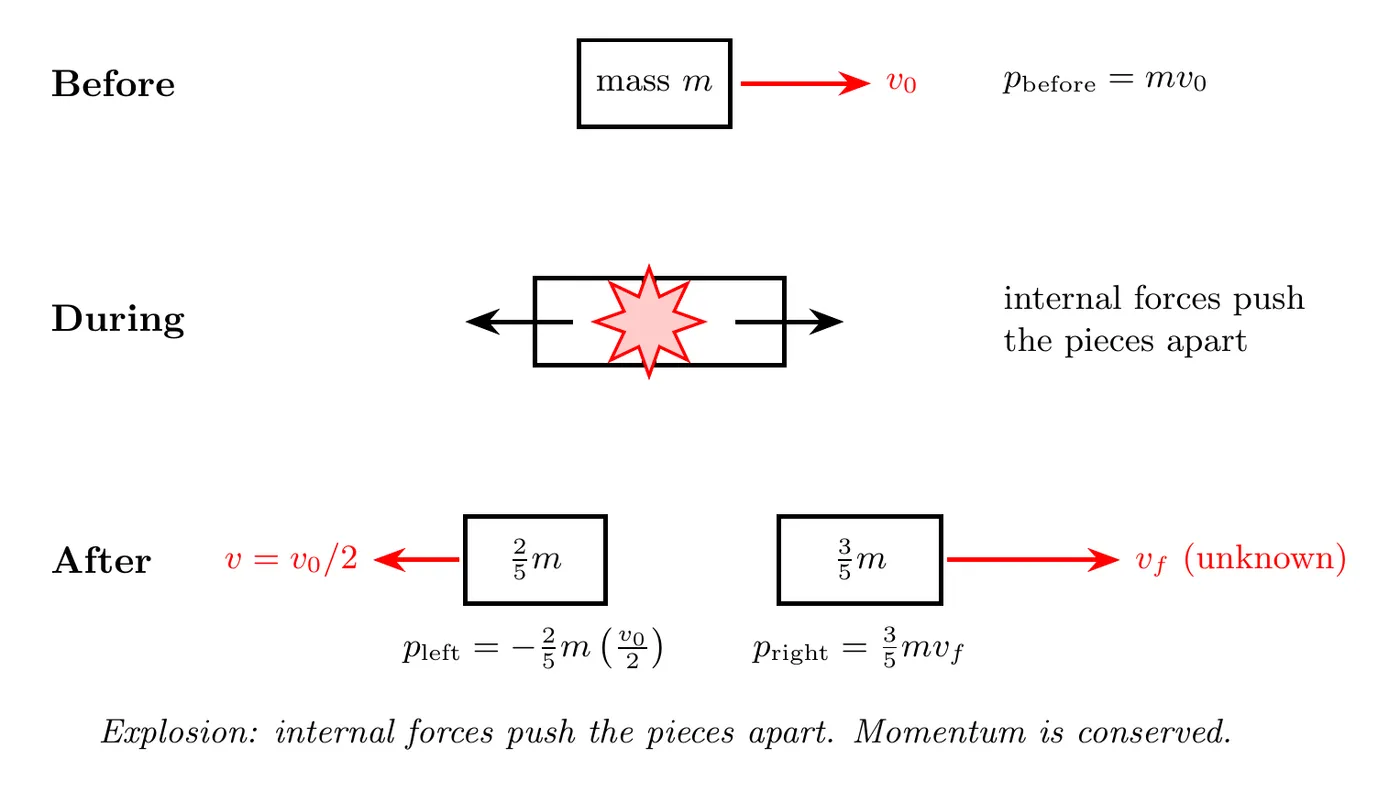
Solution
Step 1: State conservation of momentum
or .
Step 2: Write the momentum before the explosion
The object moves right at speed :
Step 3: Write the momentum after the explosion
After the explosion there are two pieces.
Piece 1 (moving left): mass = , velocity =
(negative because it goes left).
Piece 2 (moving right): mass = , velocity =
(unknown, assumed positive and rightward).
Total momentum after:
Step 4: Apply conservation of momentum
Step 5: Solve for
Divide everything by :
Add to both sides:
Multiply both sides by :
Answer: the other piece moves at , double the original speed, heading right.
The read: the larger piece () has to move faster than the original object to make up for the smaller piece () going backward. The momentum “lost” by the backward piece has to be “gained” by the forward piece, so the net momentum still matches the original.
Verification
Check that momentum is conserved.
Before:
After:
Momentum is conserved.
Example Problem: Momentum, Then Energy
Problem: A 0.012 kg bullet is fired horizontally into a 2.0 kg wooden block hanging from two light strings. The bullet sticks in the block, and the block swings up until it is 0.15 m higher than where it started. How fast was the bullet moving? Use .
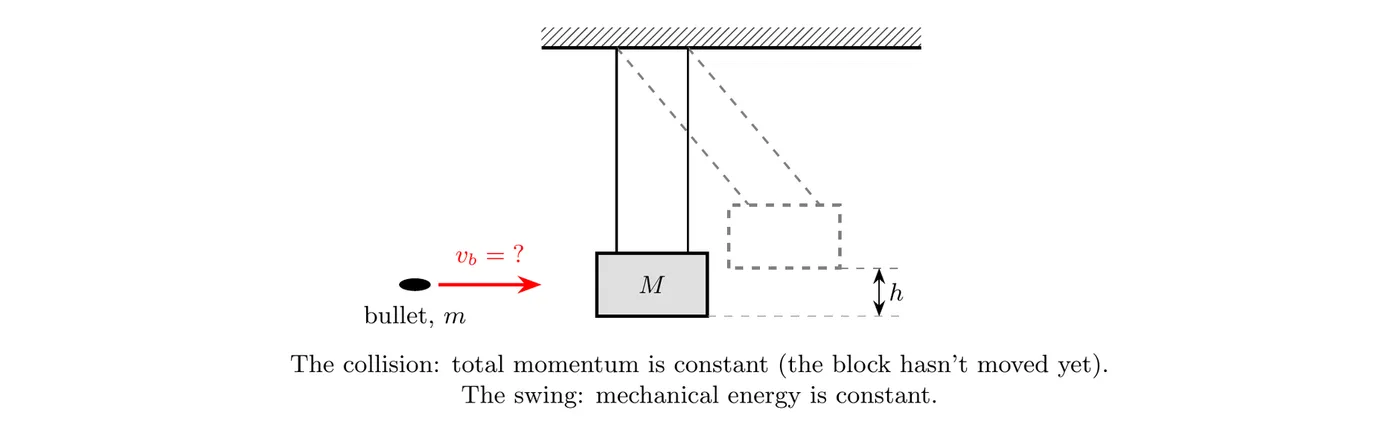
Solution
This happens in two stages, and each stage gets a different conservation law.
Step 1: The swing (energy), working backward
After the collision, the block and bullet swing up together. The string tension does no work (it’s always perpendicular to the motion), so the mechanical energy of the block, bullet, and Earth stays constant during the swing:
Step 2: The collision (momentum)
The collision is so quick that the block hasn’t moved yet when the bullet stops inside it. Immediately before, only the bullet moves. Immediately after, the block and bullet move together at :
Answer: the bullet was moving at about m/s (290 m/s).
The read: mechanical energy is not constant across the collision. The bullet starts with J of kinetic energy, but right after the collision the block and bullet have only J. More than 99% of the kinetic energy turned into thermal energy and deformation as the bullet tore into the wood. This is a perfectly inelastic collision (see 4.4).
Summary of Conservation Equations
General form:
Expanded form:
In components (2D or 3D):
On the AP exam you’ll calculate collisions in one or two dimensions. Three-dimensional collisions only come up qualitatively (for example, explaining which way a piece has to move so the total momentum works out). For a worked two-dimensional collision, see 4.4.
For two objects:
Common Mistakes
- Not stating conservation explicitly on free-response. Always write or at the start. That earns partial credit even if your calculation has errors.
- Forgetting direction signs. Objects moving opposite ways have opposite signs. Be consistent with your choice of positive direction.
- Assuming kinetic energy is conserved. Momentum is always conserved in isolated systems, but kinetic energy is only conserved in elastic collisions. Don’t confuse the two.
- Including external forces in the system. If friction or another external force acts on your system, the system’s momentum is not constant. Either pick a system where the external forces are negligible (or internal), or account for the impulse from them.
- Getting the mass fractions wrong. In the example, the pieces were and , which add to . Check that your fractions add up: . ✓
- Sign errors in the algebra. When a piece moves left, its velocity is negative. Don’t lose the negative signs midway through.
- Not checking whether the answer makes sense. If one piece is much lighter, it should move much faster after the explosion. If your answer breaks that intuition, recheck your work.
- Confusing velocity and speed. Velocity has direction and can be negative, while speed is always positive. The problem asks for “speed,” but you have to track velocity (with its sign) during the calculation.
- Getting confused about momentum direction. Momentum and velocity point the same way for positive masses, but be careful with the signs.
- Forgetting to include every object. In the “after” state, include all the pieces. Don’t leave any part of the system out.
- Not recognizing when the system’s momentum isn’t constant. If there’s significant friction, air resistance, or another external force during the interval you’re analyzing, the system’s momentum changes. Read the problem carefully.
- Choosing the system badly. If you don’t define your system correctly, your conservation equation will be wrong. Be explicit about what’s inside and what’s outside.
- Adding speeds instead of velocity components in 2D. In multi-dimensional problems, conserve momentum in each direction independently. Don’t add magnitudes.
- Forgetting that isn’t always zero. The center of mass can be moving. In explosions from rest, , but in other setups it may not be.
- Thinking an explosion means momentum isn’t conserved. It’s the opposite. Explosions are a classic example of momentum conservation. Internal forces don’t change the total momentum.