

4.1 - Linear Momentum
Definition of Linear Momentum
Linear momentum (or just “momentum”) is:
where:
- = linear momentum (kg·m/s)
- = mass (kg)
- = velocity (m/s)
One terminology note for the AP Physics C exam: when they say “momentum” with no qualifier, they mean linear momentum, not angular momentum. If they want angular momentum, they’ll say so explicitly.
Momentum Is a Vector
Momentum is a vector pointing the same direction as the velocity. Its magnitude is (with the speed), its direction matches the velocity, it can be positive or negative in one dimension, and in multiple dimensions you handle it with vector addition.
Momentum Components in Two Dimensions
In two-dimensional problems (common in Physics C), you break momentum into components:
where is the angle of the velocity vector, usually measured from the horizontal (x-axis).
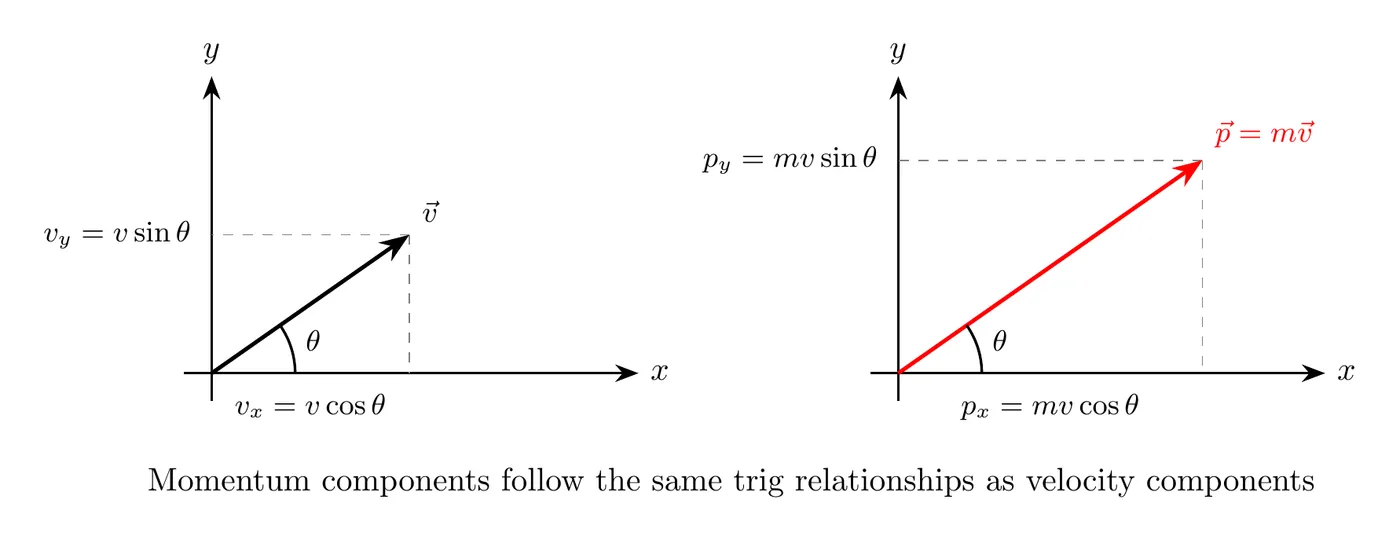
By convention, use the angle from the x-axis rather than from the y-axis.
Example. A 0.145 kg baseball leaves the bat at 42 m/s, 25° above the horizontal. Its momentum has magnitude kg·m/s, and it points the same way as the velocity (25° above the horizontal). The components are:
Keep the unrounded 6.09 in the calculation and round at the end. As a check, kg·m/s.
Physical Interpretation: Inertia in Motion
In algebra-based courses, momentum is often called “inertia in motion,” the tendency of a moving object to keep moving. At rest, (no momentum); as an object starts moving, its momentum grows; and a larger mass or faster speed means more momentum and a harder object to stop. Everyday cases: a truck and a car at the same speed differ because the truck has more momentum (bigger ), and a bullet can have momentum comparable to a baseball’s despite its small mass, thanks to its very high speed.
Applications: Collisions and Explosions
Momentum is the main tool for two kinds of interactions.
Collisions. A collision is a model where the forces between the objects are much larger than any external forces during the interaction. The objects come together, internal forces dominate, and it happens over a short time with large forces. Examples: two cars colliding, a ball hitting a wall, billiard balls striking each other. The key point is that during a collision external forces (like friction) are tiny compared to the collision forces, so you can usually treat momentum as conserved.
Explosions. An explosion is a model where internal forces within the system push objects apart. The objects move away from their initial arrangement, internal forces drive them in opposite directions, and it can start from rest. Examples: a cannon firing a projectile, a firecracker going off, rocket propulsion, and radioactive decay. This is why cannons need wheels or recoil systems: the explosion pushes the cannonball forward and the cannon backward, and modern cannons use recoil mechanisms to absorb that backward momentum safely.
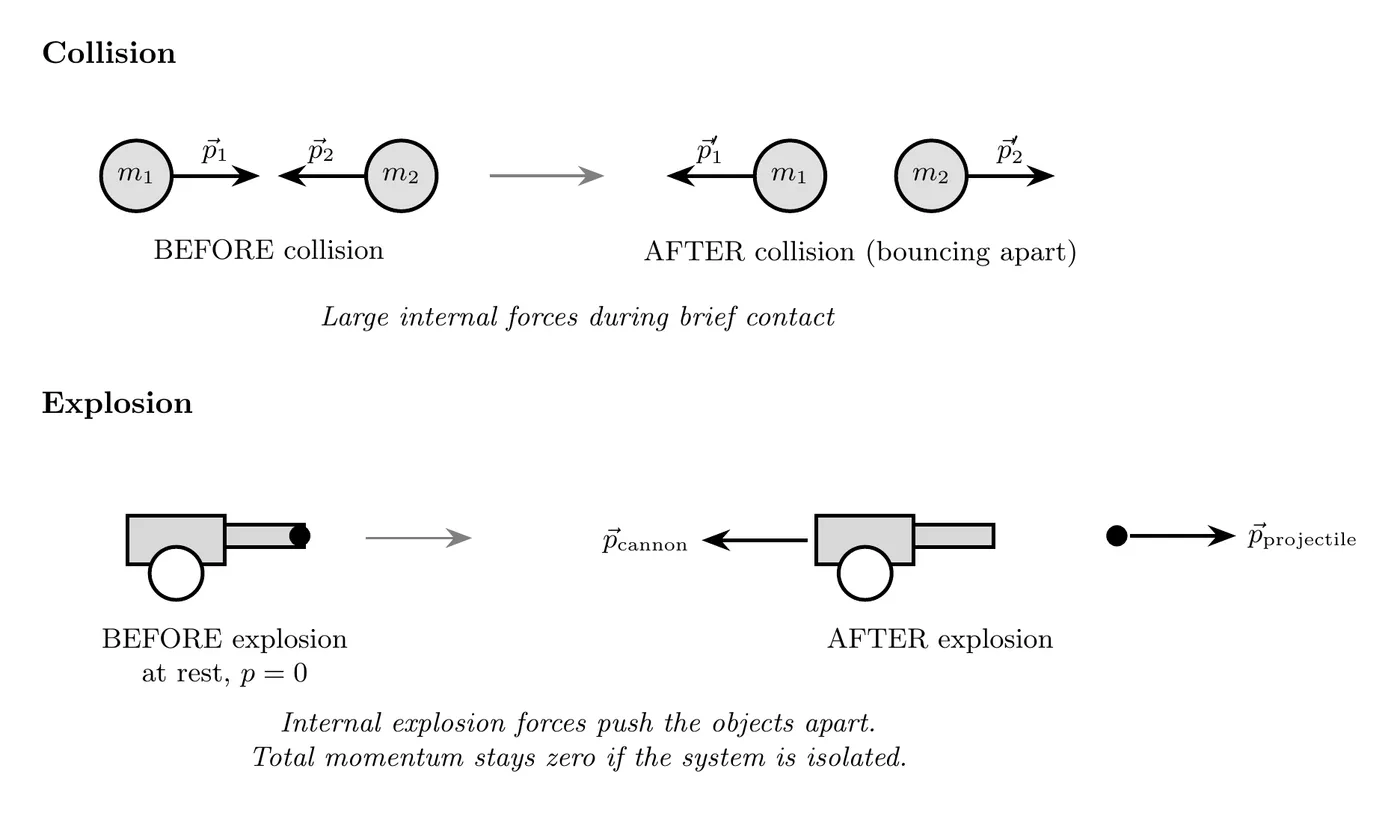
Why the collision model works, with numbers. External forces like friction still act during a collision, but the contact is so short that they deliver almost no impulse. Say two 1.0 kg carts collide, and the contact lasts 0.020 s with an average force of 150 N between them. That collision force changes each cart’s momentum by kg·m/s. Friction on each cart is about N, so during the contact friction delivers at most N·s to the pair, less than 1% of the momentum the carts trade. So the total momentum right after the collision is very nearly the same as right before it.
Only the before and after states matter. In a collision or explosion you compare the state just before the interaction with the state just after it. You don’t track what happens during the contact (the squishing, the vibrating, the exact force at each instant). That’s why you can use the object model: treat each object as a single point with a mass and a velocity, and ignore its size, shape, and internal structure.
Relationships Between Momentum and Kinetic Energy
Momentum and kinetic energy are different quantities, but they’re linked through mass and velocity.
Kinetic energy in terms of momentum. Start with and , solve the first for , and substitute:
So:
Momentum in terms of kinetic energy. Solve for , then substitute into :
So:
Summary of Key Formulas
Quantity | Standard form | Alternative form |
Momentum | ||
Kinetic energy | ||
Velocity from momentum | - | |
Velocity from KE | - |
When to Use the Alternative Forms
Use when you’re given momentum and mass and need kinetic energy, or when momentum is conserved. Use when you’re given kinetic energy and mass and need momentum, or when comparing momenta of objects with known kinetic energies. For instance, if two objects have the same kinetic energy, which has more momentum? From , with fixed, , so the heavier object has more momentum.
Comparison: Momentum vs. Kinetic Energy
Property | Momentum () | Kinetic energy () |
Type | Vector | Scalar |
Direction | Yes (same as velocity) | No |
Sign | Can be positive or negative | Always positive (or zero) |
Velocity dependence | Linear () | Quadratic () |
Conservation | Conserved in every interaction; a system’s total is constant when the net external force on it is zero | Total energy is always conserved, but a system’s kinetic energy stays the same only in elastic collisions |
Units | kg·m/s | J (joules) |
The takeaway: an object can have large momentum but small kinetic energy (big mass, slow speed), or small momentum but large kinetic energy (small mass, fast speed).
Example: Comparing Two Objects
Object A has mass 2 kg and velocity 3 m/s; object B has mass 1 kg and velocity 6 m/s.
Momenta: kg·m/s and kg·m/s, so they have the same momentum.
Kinetic energies: J and J, so object B has twice the kinetic energy despite the same momentum. That’s because kinetic energy depends on , so doubling the speed quadruples it, while momentum depends linearly on , so doubling the speed can be offset by halving the mass.
Units of Momentum
The SI unit is kg·m/s:
Using Newton’s second law in the form , you can also write it as:
Both kg·m/s and N·s are equivalent units for momentum.
Common Mistakes
- Treating momentum as a scalar. It’s a vector with direction. In 2D or 3D you work with components separately.
- Confusing momentum with kinetic energy. Different quantities, different units, different conservation laws, and one is a vector while the other is a scalar.
- Forgetting that velocity is squared in KE but not in momentum. Doubling the velocity doubles momentum but quadruples kinetic energy.
- Wrong trig functions for components. With measured from horizontal, use for the x-component and for the y-component.
- Mixing up “conserved” and “constant.” Momentum is conserved in every interaction: it’s never created or destroyed, only transferred from one object to another. A system’s total momentum stays constant only when the net external force on it is zero. Individual objects can gain or lose momentum.
- Assuming equal momenta means equal kinetic energies. Two objects can share the same momentum but have different kinetic energies if their masses differ.
- Sign errors in 1D. Stay consistent with your positive direction. If right is positive, leftward velocity and momentum are negative.
- Simplifying wrong. Don’t drop the factor of 2 inside the root. It’s not .
- Bad algebra bringing into the root. Since , .
- Confusing linear and angular momentum. Linear is (translation), angular is (rotation). Different quantities studied separately.
- Using these formulas for rotational problems. This section is translational motion only. Rotating objects need angular momentum.
- Forgetting explosions conserve momentum. Even as the pieces fly apart, total momentum is conserved. Starting from rest, the final momenta sum to zero (equal and opposite).
- Not recognizing when to use the alternative forms. Given momentum and asked for kinetic energy, use instead of solving for velocity first.
- Dimensionally wrong equations. Momentum is kg·m/s, not kg·m/s².
- Thinking more kinetic energy always means more momentum. That’s only true for equal masses. With different masses it depends on both and .