

7.3 - Representing and Analyzing SHM
Position Functions for SHM
Which equation you use for displacement in SHM depends on where the object is when you start the clock. There are two basic forms:
and since , you can also write them as:
Which one to use. Use sine when the timer starts at the equilibrium position, since . Use cosine when the timer starts at maximum amplitude, since . Cosine is the more common choice.
The General Form: Phase Constant
The CED and the AP equation sheet use one general form that covers every starting point:
The equation sheet writes the amplitude as , so it reads . The phase constant (in radians) sets where in the cycle the object is at . Plug in :
Where the object is at | Same as | |
At | ||
At equilibrium, moving in the direction | ||
At | ||
At equilibrium, moving in the direction |
So the sine and cosine forms above are special cases. Any other starting point just gives some other .
Deriving Velocity and Acceleration Functions
Velocity is the derivative of position and acceleration is the derivative of velocity, so you can just differentiate your way there. Starting from:
the velocity (first derivative) is:
and the acceleration (second derivative) is:
Maximum values. These happen when the sine or cosine hits ±1:
These two are not on the formula sheet, so you need to memorize them or be able to derive them.
Acceleration and position. Compare with . The acceleration is just times the position:
This holds at every instant and for any phase constant: the acceleration is proportional to the displacement and always points back toward equilibrium. It’s the SHM condition from 7.1 () divided by the mass, with .
Where the maximums happen. The speed reaches when the object passes through equilibrium (). The acceleration reaches in magnitude at the turning points (), which you can see straight from .
Example Problem: Finding the Amplitude and Phase
A 0.50 kg block on a horizontal spring ( N/m) is at m and moving in the direction at 0.40 m/s at . Find (a) , (b) the amplitude, and (c) the phase constant, and write .
Solution
(a)
(b) The block isn’t at a turning point, so the amplitude isn’t 0.030 m. Use energy (7.4): . Divide by and use :
(c) At , and :
Cosine positive and sine negative puts in the fourth quadrant: rad (about ). So:
Watch the quadrant. by itself gives rad, which would describe the block moving in the direction.
The Second-Order Differential Equation
The defining feature of simple harmonic motion can be written as a differential equation:
This is the second-order differential equation of simple harmonic motion, and it says the acceleration is proportional to the displacement but points the opposite way.
Where it comes from. Apply Newton’s second law to a block on a horizontal spring. The only horizontal force is the spring force, and acceleration is the second derivative of position:
Match it to and you can read off the angular frequency. This is where the spring period in 7.2 comes from:
Its solution has to be a function that, differentiated twice, comes back to itself with a negative sign and a constant factor out front. Cosine (and sine) does exactly that, which is why those functions naturally describe simple harmonic motion.
On the exam you’re expected to know that is the solution and to recognize SHM when you see it, not to prove the solution is correct. A quick check is still easy: differentiate twice and you get .
Recognizing SHM. If Newton’s second law for a system can be rearranged into (second derivative of a quantity) (positive constant) (that quantity), the system is in SHM, and the constant is .
Example: A Block Between Two Springs
A 0.20 kg block on a frictionless surface sits between two springs, N/m on the left and N/m on the right. Both are attached to the block and both are at their natural lengths when the block is at . Show that the block does SHM and find its period.
Move the block a distance to the right. The left spring stretches by and pulls left with . The right spring compresses by and pushes left with . Both forces point back toward equilibrium:
That’s the SHM form, so:
The two springs act like one spring with N/m (springs in parallel, from 2.8).
Resonance
Resonance happens when you apply a periodic external force at the system’s natural frequency, driving the amplitude up dramatically. Pushing someone on a swing once per swing, timed with the motion, is resonance (each push builds the amplitude), and so is one tuning fork setting another identical fork vibrating.
Natural frequency. The natural frequency is the frequency a system oscillates at when you displace it from equilibrium and let it go, with no driving force. For the oscillators in this unit:
Why driving at the natural frequency builds the amplitude. When the driving force has the same frequency as the natural motion, it can stay in step with the velocity, pushing forward while the object moves forward. Then the force does positive work every cycle, energy piles up, and the amplitude grows. In a real system the growth stops when friction removes energy as fast as the driver adds it, but the amplitude at is still far bigger than at other frequencies. Drive the system at some other frequency and the force spends part of each cycle pushing against the motion, so the energy it adds mostly cancels out and the amplitude stays small.
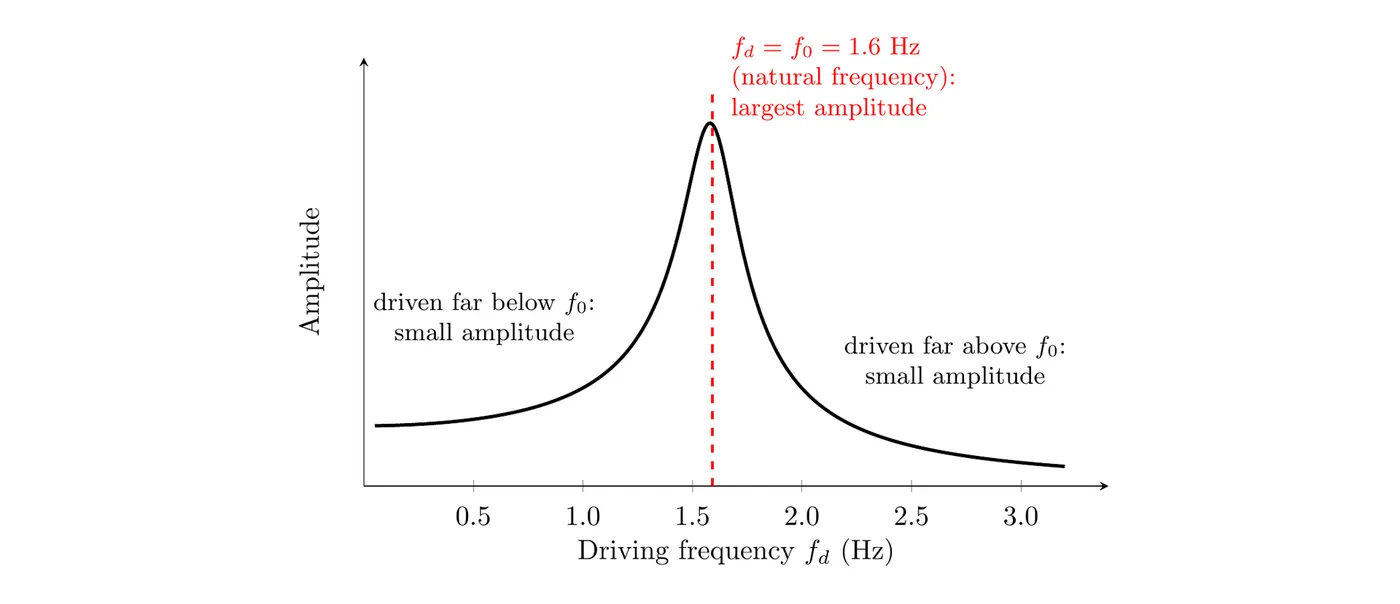
Example: Finding the Resonant Frequency
A 2.0 kg mass hangs from a spring with N/m. A motor shakes the top of the spring up and down, and the motor’s frequency is slowly raised from 0.50 Hz to 3.0 Hz. (a) At what frequency is the amplitude largest? (b) If the mass is changed to 8.0 kg, where does that peak move?
(a) The amplitude peaks when the motor matches the natural frequency:
(b) . Four times the mass gives half the natural frequency, so the peak moves down to 0.80 Hz.
Amplitude and Period
One important property: changing the amplitude of a system in SHM does not change its period. Period is amplitude-independent.
Why amplitude doesn’t matter. Double the amplitude and the restoring force doubles at every matching point in the cycle (), so the acceleration doubles and the object moves twice as fast. It has twice as far to go at twice the speed, so each cycle takes the same time. In the math, never shows up in .
For example, the 0.50 kg block on the 50 N/m spring above has s whether m or m. What changes is (0.50 m/s vs. 1.0 m/s) and (5.0 m/s² vs. 10 m/s²).
Graphical Analysis
You can pull every property of SHM out of graphs of position, velocity, and acceleration versus time.
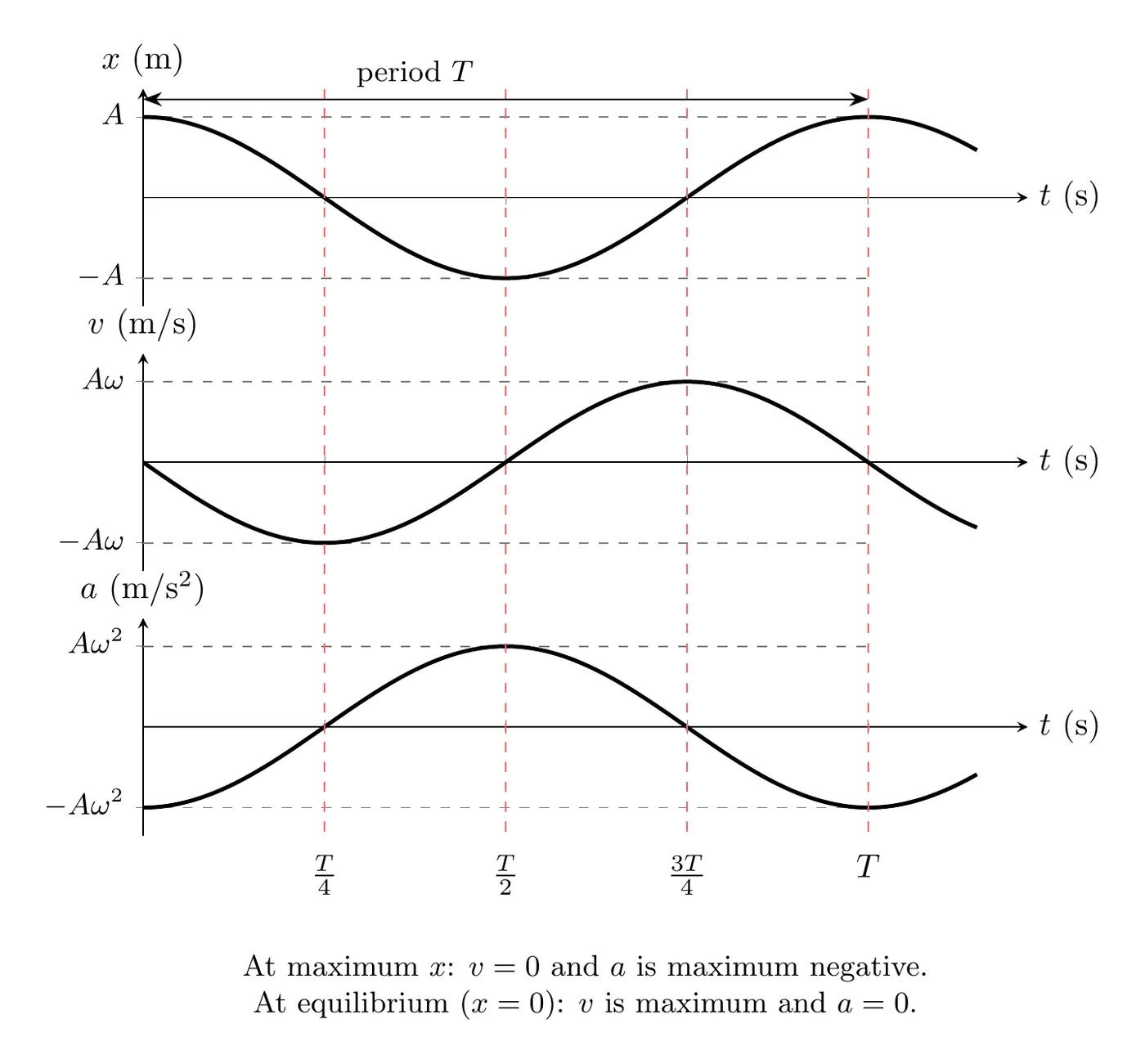
Reading the graphs (for , as above):
Time | Where the object is | |||
turning point | ||||
equilibrium, moving in | ||||
turning point | ||||
equilibrium, moving in | ||||
back where it started |
Zeros and extremes line up. Wherever is at a maximum or minimum (a turning point), and has its largest magnitude, opposite in sign to . Wherever (equilibrium), the speed is at its maximum and .
Slopes. is the slope of the graph, and is the slope of the graph. A peak on the graph has zero slope, which is why there. The graph is the graph flipped upside down and scaled by , because .
Speeding up or slowing down. When and have the same sign, the object is speeding up (moving toward equilibrium). When they have opposite signs, it’s slowing down (moving away from equilibrium, toward a turning point).
Example Problem: Reading SHM Graphs
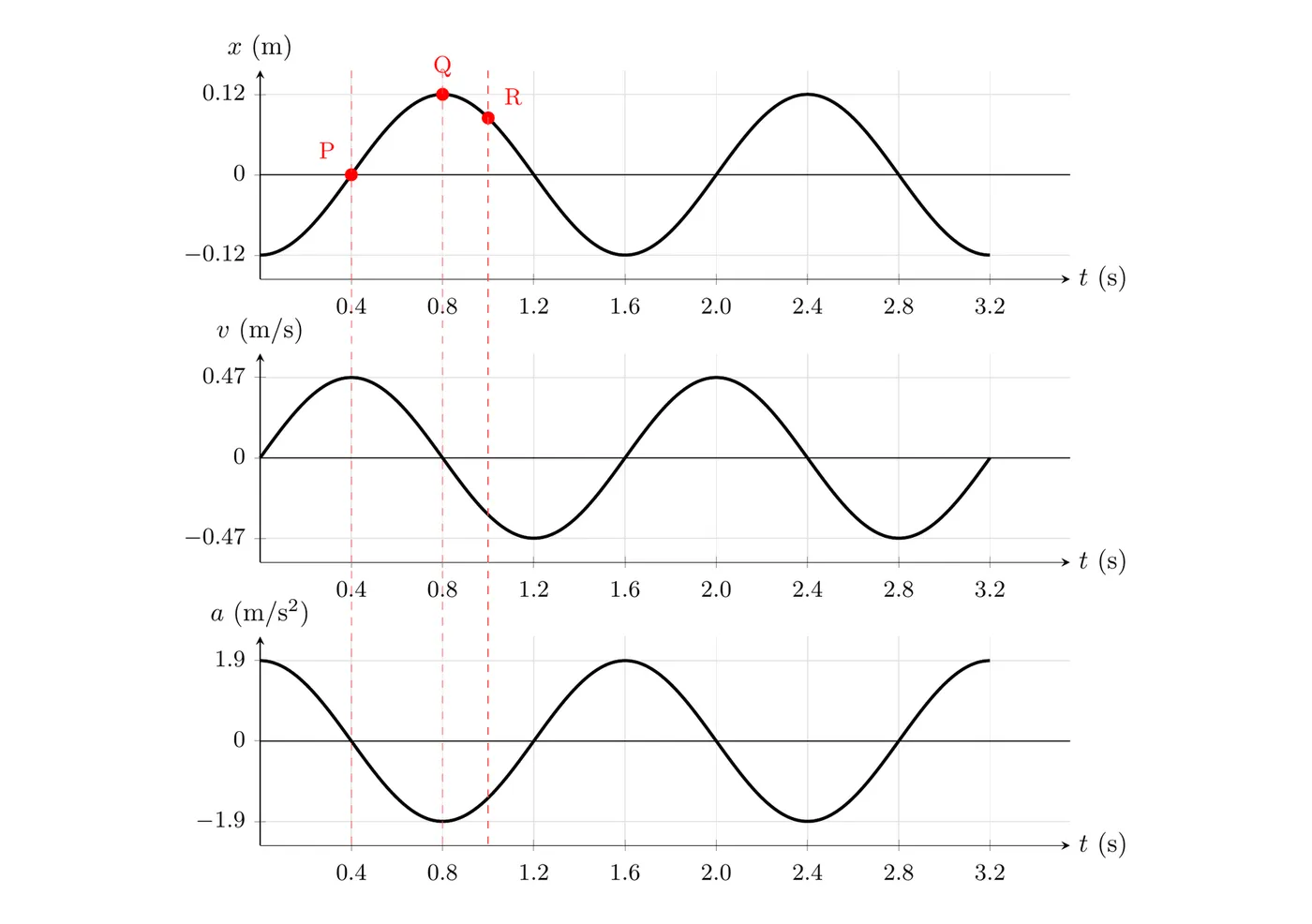
A 0.50 kg cart on a spring is released from rest at . Its position graph is the top graph below. The velocity and acceleration graphs underneath are what you’d sketch from it. Using the position graph, find (a) the amplitude, period, frequency, and angular frequency, (b) in the form , (c) the maximum speed and maximum acceleration, (d) what the cart is doing at points P, Q, and R, and (e) the spring constant.
Solution
(a) The graph swings between m and m, so m. It starts at a minimum and reaches the next minimum at 1.6 s, so s.
(b) At the cart is at , so (see the phase constant table near the top of this page):
(c)
(d) Read each point off the graphs:
- P ( s, which is ): , so the cart is at equilibrium. The graph is rising as steeply as it ever does, so m/s (maximum speed, moving in ) and .
- Q ( s, which is ): m, a turning point. , and m/s², the largest acceleration, pointing back toward equilibrium.
- R ( s): m, and the graph slopes down, so the cart is heading back toward equilibrium. From , m/s, and m/s². Same signs, so the cart is speeding up.
(e) From :
Example Problem
A 3.0 kg object on a spring oscillates with position function , where m and rad/s. Find (a) the maximum velocity, (b) the maximum acceleration, and (c) the magnitude of the maximum net force.
Solution
The given values are m, rad/s, and kg, so the position function is:
One practical note: when you evaluate this, your calculator has to be in radian mode.
(a) Maximum velocity:
(b) Maximum acceleration:
(c) Maximum net force. It happens at maximum acceleration, so from Newton’s second law:
Alternative Approach: Write Out the Full Functions
If you don’t want to memorize the maximum-value shortcuts, just build the functions.
Velocity:
so the maximum velocity is 1.5 m/s.
Acceleration:
so the maximum acceleration is 4.5 m/s².
Net force:
so the maximum net force is 13.5 N. The maximum values are just the coefficients sitting in front of the trig functions.
Common Mistakes
- Using degrees instead of radians. When evaluating trig functions of , your calculator has to be in radian mode.
- Mixing up sine and cosine. Cosine starts at maximum amplitude, sine starts at equilibrium.
- Dropping the negative signs. Velocity is and acceleration is . Those minus signs carry the direction information.
- Not spotting the maximum values. The maximum of any or is just , the absolute value of the coefficient.
- Thinking amplitude affects period. Period is amplitude-independent. Doubling the amplitude doesn’t change how long a cycle takes.
- Not being able to derive when you need to. If you forget and , you need to be able to get the velocity and acceleration functions by differentiating.
- Mixing up and . They’re related by , but they aren’t equal.
- Getting the phase constant’s quadrant wrong. only returns angles from 0 to . Check the sign of the starting velocity to pick the right .
- Mixing up natural frequency and driving frequency. The natural frequency is set by the system ( and , or and ). The driving frequency is whatever the outside force does. Resonance is when they match.