

7.5 - Simple and Physical Pendulums
Physical Pendulum
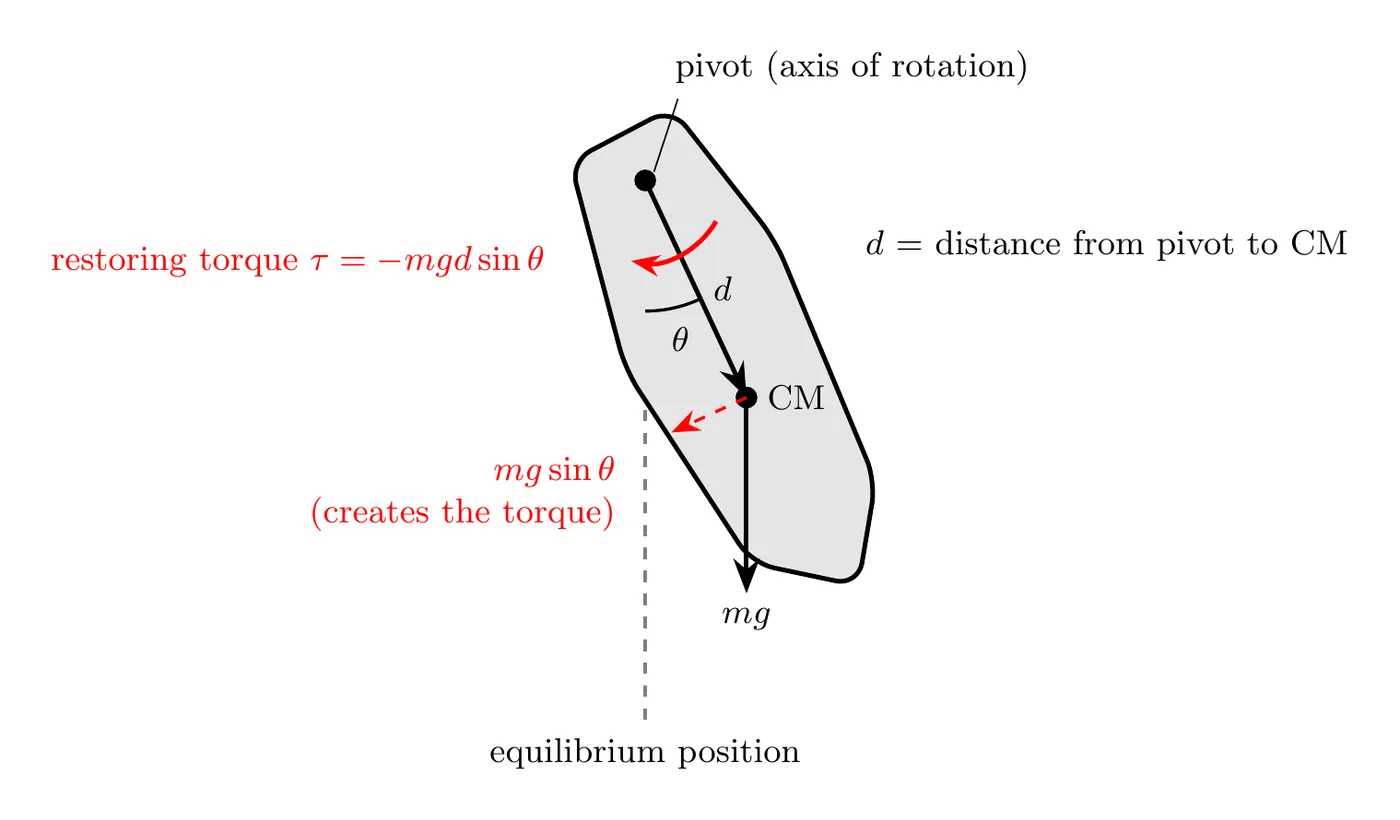
A physical pendulum is a rigid body swinging about a fixed axis. Unlike a simple pendulum, which pretends the mass is a single point, a physical pendulum has its mass spread out and rotates about a pivot.
The system oscillates about a fixed axis, gravity acts on the center of mass, and that creates a restoring torque when the object is displaced. For small angles, the motion is approximately simple harmonic.
Small angle approximation. For small angular displacements (usually , about 0.26 radians):
This is what makes the period derivation possible, and the angle has to be in radians, not degrees.
Restoring torque. When a physical pendulum is displaced by angle , the exact torque is:
and with the small angle approximation:
where:
- = mass of the pendulum (kg)
- = gravitational acceleration (m/s²)
- = distance from the pivot to the center of mass (m)
- = angular displacement (rad)
The negative sign means the torque opposes the displacement, which is what makes it restoring.
Period of a physical pendulum:
where is the moment of inertia about the pivot axis (kg·m²), is the total mass (kg), is gravitational acceleration (m/s²), and is the pivot-to-center-of-mass distance (m).
This is on the AP equation sheet. The has to be about the pivot, so you’ll often need the parallel axis theorem from the sheet, .
Example: A Meter Stick Pendulum
A uniform meter stick ( kg, m) hangs from a nail through a hole 0.20 m from one end. It’s pulled a few degrees to the side and released. Find its period.
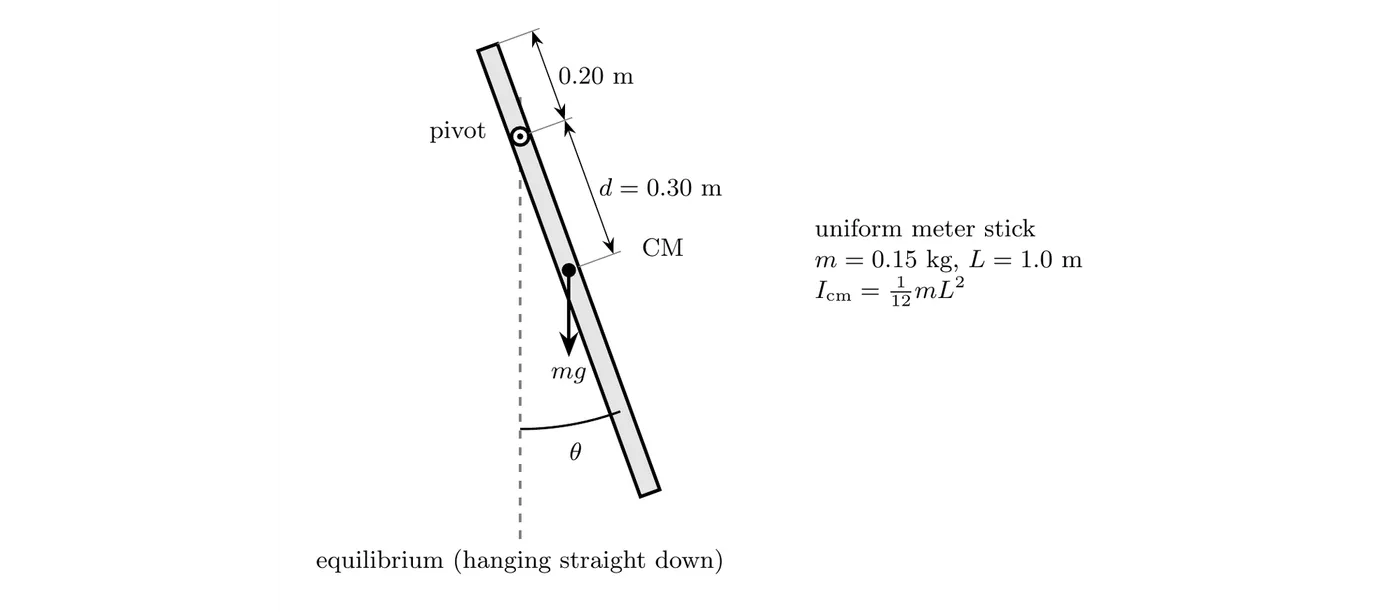
Step 1: Distance to the center of mass. The center of mass is at the 0.50 m mark, so:
Step 2: Rotational inertia about the pivot. Use the parallel axis theorem with for a uniform rod:
Step 3: Period.
Compare a simple pendulum with its bob 0.30 m below the pivot: s. The stick is slower because its mass is spread out along its length instead of sitting at the center of mass, which makes bigger than . It swings like a simple pendulum of length m.
Torsional Pendulum
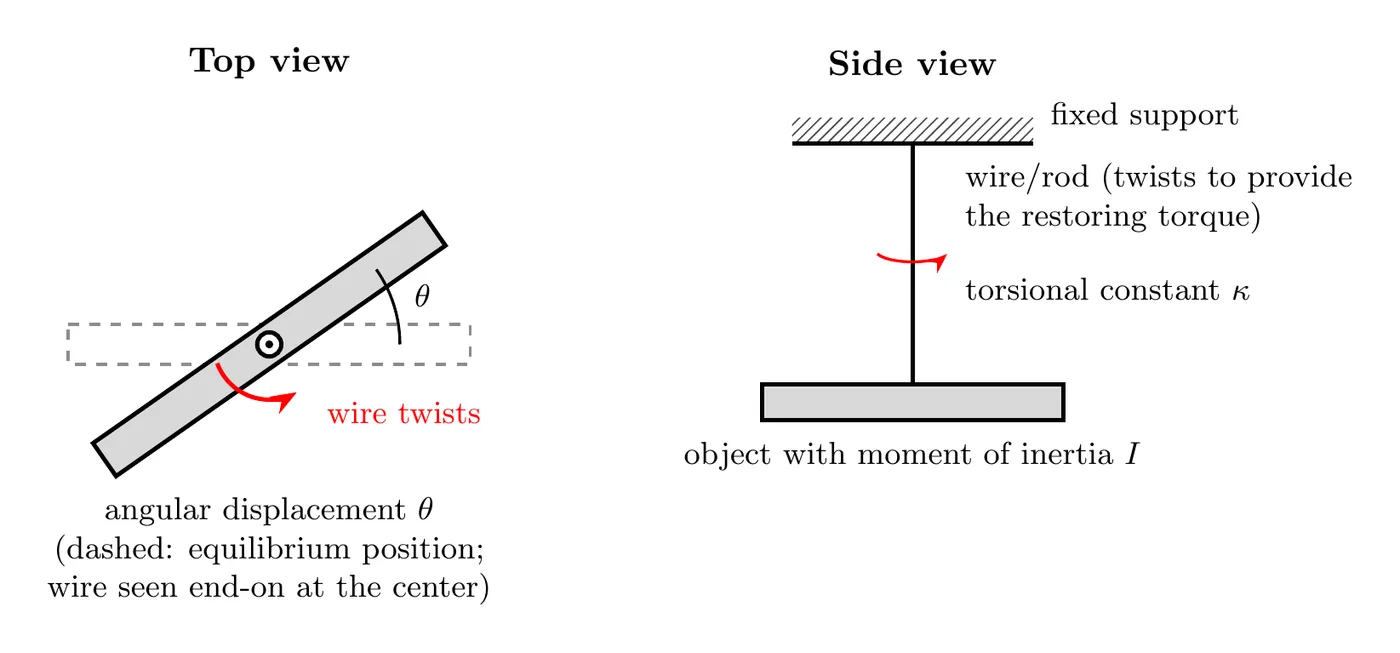
A torsional pendulum is an object hanging from a wire or rod that twists when you rotate the object. The restoring torque comes from the wire’s elasticity, the same way a spring’s restoring force comes from its stretch.
Restoring torque:
where (kappa) is the torsional constant (N·m/rad), the rotational cousin of the spring constant , and is the angular displacement (rad). This is the rotational version of Hooke’s law, .
The CED writes this torque law as , using for the torsion constant. It’s the same equation: Newton’s second law for rotation with a restoring torque proportional to the angular displacement. The torsional period formula below is not on the equation sheet, so be ready to derive it (see the example problem below).
Period of a torsional pendulum:
where is the moment of inertia of the oscillating object (kg·m²) and is the torsional constant (N·m/rad).
The Second-Order Differential Equation
The equation that characterizes simple harmonic motion, linear or rotational, is:
This second-order differential equation is the launching point for every SHM derivation. Get a system’s equation of motion into this shape and you can read straight off it, which hands you the period and frequency.
Once you have :
Comparison of Pendulum Types
Property | Simple pendulum | Physical pendulum | Torsional pendulum |
Mass distribution | Point mass | Extended rigid body | Extended rigid body |
Restoring agent | Gravity | Gravity | Elastic twist |
Period formula | |||
Restoring torque | |||
Key parameter | Length | Moment of inertia , distance | Torsional constant |
Example Problem: Deriving the Period of a Torsional Pendulum
A disk with moment of inertia hangs from a wire with torsional constant . Twisted by angle and released, it oscillates. Derive the period and frequency.
Solution
Step 1: The restoring torque.
Step 2: Newton’s second law for rotation.
where is the angular acceleration.
Step 3: Combine them.
Step 4: Rearrange into standard form. Divide both sides by :
Step 5: Read off . Comparing to :
Step 6: Get the period. Since :
Step 7: Get the frequency. Since :
So the period is and the frequency is .
Example with Numbers: Disk vs. Ring
A uniform disk (mass 0.40 kg, radius 0.10 m) hangs horizontally from a wire attached at its center. A torque of 0.0080 N·m holds it twisted by 0.20 rad. Find (a) the torsional constant, (b) the period, and (c) the period if the disk is replaced by a thin ring with the same mass and radius.
(a) The wire’s restoring torque balances the applied torque, and it’s proportional to the twist:
(b) For a disk, kg·m², so:
(c) A ring has all its mass at the rim, so kg·m², twice the disk’s. , so the period grows by a factor of :
Gravity never shows up, so this pendulum would have the same period on the Moon.
Second Example: Physical Pendulum Derivation
A uniform rod of length and mass is pivoted at one end. Derive the period of small oscillations.
Solution
Step 1: The parameters. For a uniform rod pivoted at one end, the moment of inertia is and the distance to the center of mass is .
Step 2: The restoring torque, using the small angle approximation:
Step 3: Newton’s second law for rotation.
Step 4: Rearrange.
Step 5: Read off .
Step 6: Compute the period.
Simple Pendulum: A Special Case
A simple pendulum is a physical pendulum whose mass is all at one point, a distance from the pivot. (A real bob on a light string fits this model when the bob is small compared to the string length.) For a point mass, and :
That’s from 7.2, so the simple pendulum formula is just a special case of the physical pendulum formula.
Comparing the two. A 0.60 m uniform rod pivoted at one end has, from the result above, s. A simple pendulum 0.60 m long has s. The rod is faster than a simple pendulum of its full length because much of its mass is closer to the pivot than the tip, so it behaves like a simple pendulum only as long. Compared with a simple pendulum of length , though, the rod is slower, just like the meter stick above: a physical pendulum always swings like a simple pendulum of length , which is never shorter than .
Lab: Measuring g with a Pendulum
A classic experiment design question: find from the way a simple pendulum’s period depends on its length.
- Hang a small, dense bob from a light string. Measure the length from the pivot to the center of the bob.
- Pull the bob to a small angle (about 15° or less) and release it from rest.
- Time 10 full cycles with a stopwatch and divide by 10 to get . Repeat a few times and average.
- Change the length and repeat, for at least five different lengths.
- Graph vs. and draw a best-fit line.
Why vs. ? Squaring gives a straight line through the origin:
A graph of vs. would curve, and it’s much harder to get a value from a curve than from the slope of a line.
Sample data (made-up numbers for practice):
(m) | Time for 10 cycles (s) | (s) | (s²) |
0.20 | 9.02 | 0.902 | 0.814 |
0.40 | 12.66 | 1.266 | 1.603 |
0.60 | 15.58 | 1.558 | 2.427 |
0.80 | 17.93 | 1.793 | 3.215 |
1.00 | 20.09 | 2.009 | 4.036 |
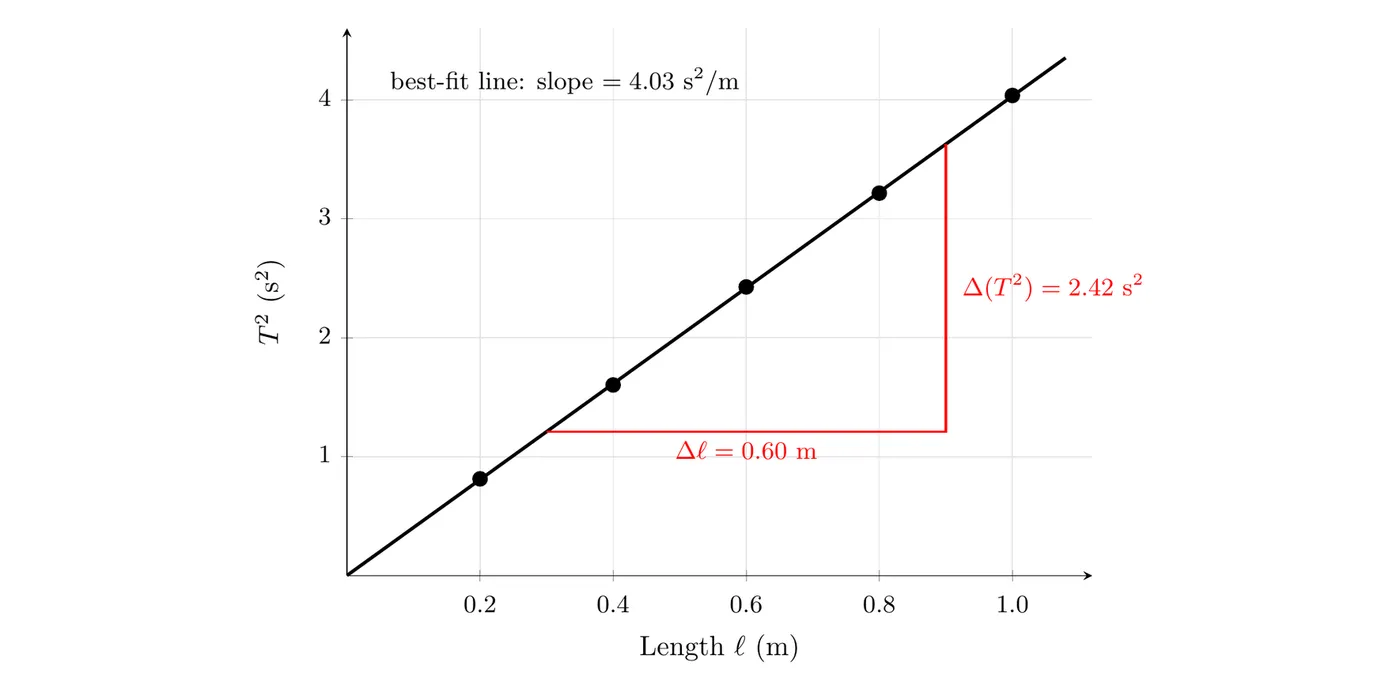
Use two points on the best-fit line (not two data points) to find the slope:
That’s the real value of near Earth’s surface (the exam rounds it to 10 m/s² for calculations). The line passes very close to the origin, as the model predicts. A clear positive -intercept would point to a systematic error, like measuring to the top of the bob instead of its center.
Common Mistakes
- Confusing with . In torsional pendulums, is the torsional constant (N·m/rad), not the spring constant (N/m).
- Using degrees instead of radians. The small angle approximation only works when is in radians.
- Forgetting the small angle approximation. The period equations here are only valid for small oscillations. Large angles need more complicated analysis.
- Confusing and in physical pendulums. is the distance from the pivot to the center of mass, which isn’t necessarily the object’s total length.
- Using the wrong moment of inertia. has to be about the pivot axis, not the center of mass. Use the parallel axis theorem if you need it: .
- Not starting from the differential equation. When deriving period formulas, always start with and push it into the form .
- Dropping the negative sign in the restoring torque. It opposes the displacement: or . That sign is essential.
- Mixing up the physical and simple pendulum formulas. Simple: . Physical: . Different formulas.
- Bad algebra going from to . Remember , so if , then . Don’t forget to flip the fraction inside the root.
- Thinking torsional pendulums depend on gravity. Unlike gravitational pendulums, a torsional pendulum behaves the same no matter the gravitational field strength. Its restoring torque comes from the twisted wire, not from gravity.
- Mixing up the two omegas. In , is the angular frequency of the oscillation, a constant. The pendulum’s angular velocity is something else: it changes all the time, from zero at the turning points to its maximum at the bottom.
BackNext