

7.1 - Defining Simple Harmonic Motion (SHM)
Periodic Motion
Periodic motion is motion that repeats itself over and over. It cycles through the same pattern again and again, each cycle takes a definite amount of time (the period), and after one full cycle the object is back at the same position with the same velocity. Swinging pendulums, a mass bouncing on a spring, Earth orbiting the Sun, and a vibrating guitar string are all examples.
Side note on why school “periods” are called periods: a period is just a repeating time interval. A physics period repeats every so many seconds, and a school period repeats every set number of minutes. The motion repeats itself when the bell rings.
Simple Harmonic Motion (SHM)
Simple harmonic motion is a special case of periodic motion. What defines it: SHM happens when the magnitude of the restoring force is directly proportional to the object’s displacement from equilibrium.
where:
- = restoring force (N)
- = force constant (N/m)
- = displacement from equilibrium (m)
- the negative sign means the force opposes the displacement
Not every periodic motion is SHM. Only motion with a linear restoring force () qualifies.
The AP equation sheet writes the spring force as , and the SHM condition is written the same way, . Here is the displacement from the equilibrium position. In this unit, usually means exactly that: how far the object is from equilibrium.
Why “proportional” matters. Double the displacement and the restoring force doubles, so the acceleration doubles too. That exact scaling is what makes the motion a perfect sine or cosine curve, and it’s why the period doesn’t depend on how far you pull the object (more on that in 7.2 and 7.3).
Example: Periodic but Not SHM
A hockey puck slides back and forth on frictionless ice between two walls 3.0 m apart, bouncing off each wall with no loss of speed. Is its motion periodic? Is it SHM?
Periodic? Yes. It repeats the same 6.0 m round trip over and over. At 2.0 m/s the period is:
SHM? No. Between bounces the net force on the puck is zero no matter where it is, so there’s no restoring force that grows with the displacement from the center. Another giveaway: start the puck at 4.0 m/s and the period drops to 1.5 s, so the period depends on how much energy the puck has. In true SHM, more energy just means a bigger amplitude, and the period stays the same.
Restoring Force
A restoring force points opposite to the object’s displacement from equilibrium, always back toward the equilibrium position, working to bring the object home:
The negative sign is what guarantees the force opposes the displacement.
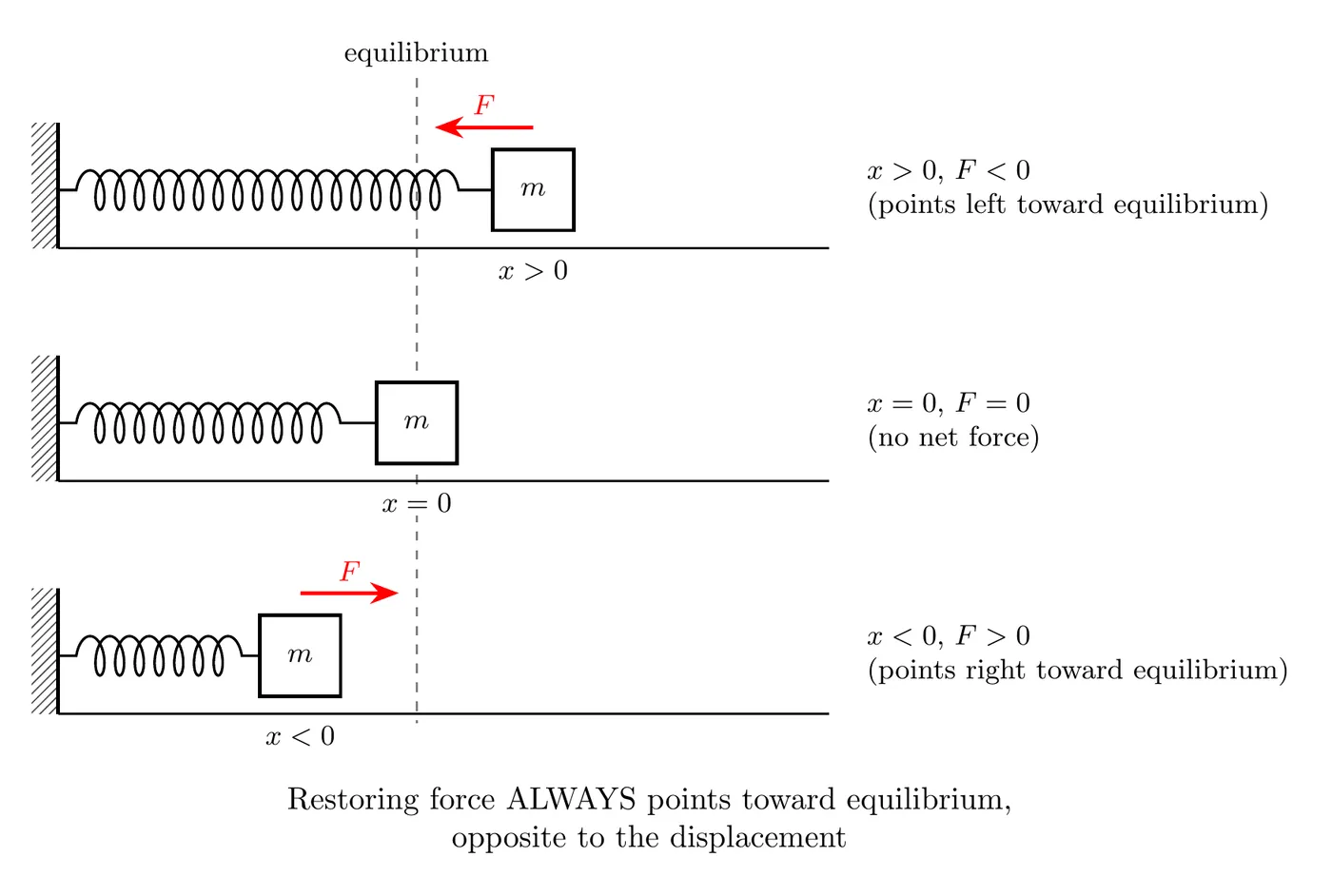
Equilibrium Position
The equilibrium position is where the net force on the object is zero:
There’s no net force there, so if you place the object at equilibrium with zero velocity it just stays. The object naturally oscillates around this point, and it’s where the restoring force (and the acceleration along the path) is zero. For a mass-spring system on a horizontal surface it’s the natural length of the spring (no stretch or compression). For a hanging (vertical) spring it’s lower than that, where the spring is stretched just enough to hold up the weight (see the vertical spring example below). For a pendulum it’s the vertical hanging position (string straight down).
Maximum Force and Acceleration
The restoring force (and therefore the acceleration) is largest at maximum displacement.
At maximum displacement: (the amplitude), (maximum restoring force), (maximum acceleration), and (the object is instantaneously at rest, turning around).
At equilibrium: , (no restoring force), (no acceleration), and (maximum speed).
Why the object oscillates at all: the restoring force accelerates it toward equilibrium, it picks up speed as it approaches, its inertia carries it past equilibrium, the restoring force now points the other way, the object slows, stops, reverses, and the whole cycle repeats.
Example: Restoring Force on a Cart
A 0.50 kg cart on a level, frictionless track is attached to a spring with N/m. Equilibrium is at , and is to the right. Find the force on the cart and its acceleration at (a) m and (b) m.
(a) At m:
The cart is to the right of equilibrium, so the force and the acceleration point left, back toward equilibrium.
(b) At m:
Now the cart is left of equilibrium and the force points right. Half the displacement gave half the force (0.96 N vs. 1.92 N), with the opposite sign. That’s the proportional, opposite-direction restoring force that defines SHM.
Two Primary Oscillators
1. Mass-Spring System
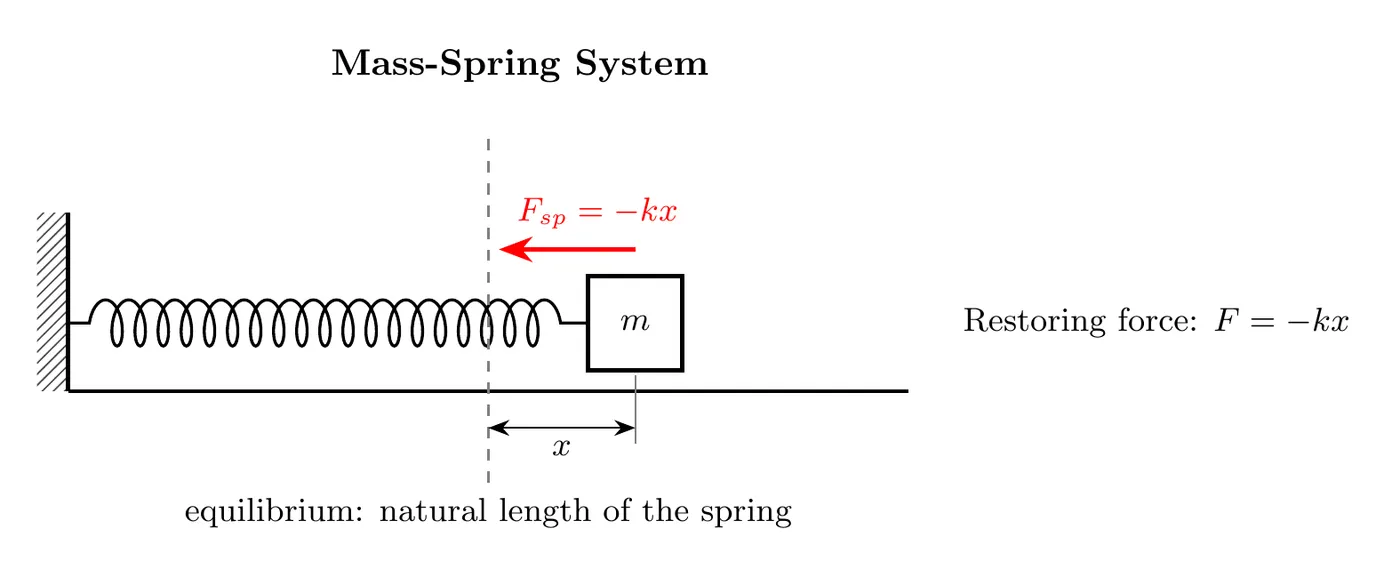
The restoring force is:
which is just Hooke’s law, the spring force. It works horizontally or vertically, and the spring constant sets the stiffness. On a horizontal surface, equilibrium sits at the spring’s natural length. Hanging vertically, equilibrium sits lower, but is still measured from equilibrium and the restoring force is still (shown below).
Vertical springs. Hang a mass from a spring and it stretches until the spring force balances the weight. Call that stretch :
Now pull the mass down an extra distance below that equilibrium point. The spring is stretched , so it pulls up with , while gravity still pulls down with . Taking up as positive:
The and cancel, so the net force is upward, back toward equilibrium. Push the mass above equilibrium and the same algebra gives a net force pointing down. Measured from the new equilibrium, the restoring force is times the displacement, so a hanging mass on a spring does SHM with the same . Gravity only shifts where equilibrium is.
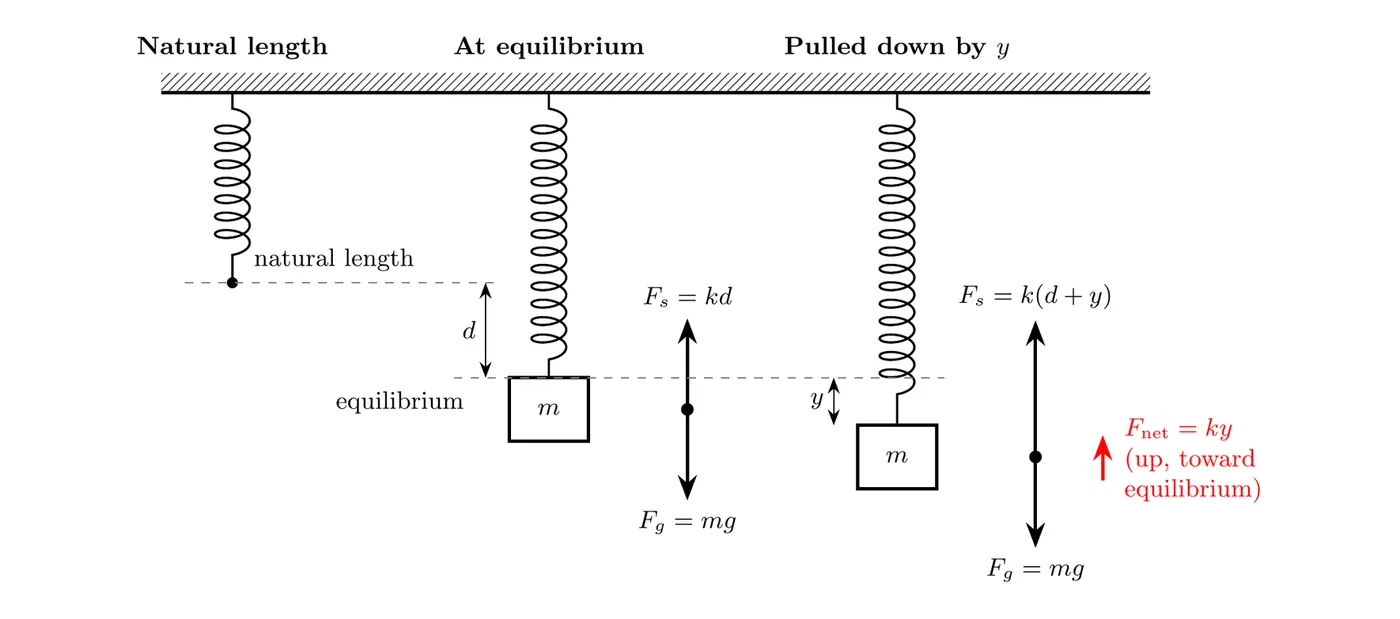
Example. A 0.20 kg mass hangs from a spring with N/m. (a) How far below the spring’s natural length is the equilibrium position? (b) The mass is pulled 0.040 m below equilibrium and released. What’s the net force on it at that moment?
(a) Equilibrium is where :
(b) The spring is now stretched m, so it pulls up with N. Gravity pulls down with N:
That matches the shortcut N, pointing up toward equilibrium.
2. Simple Pendulum
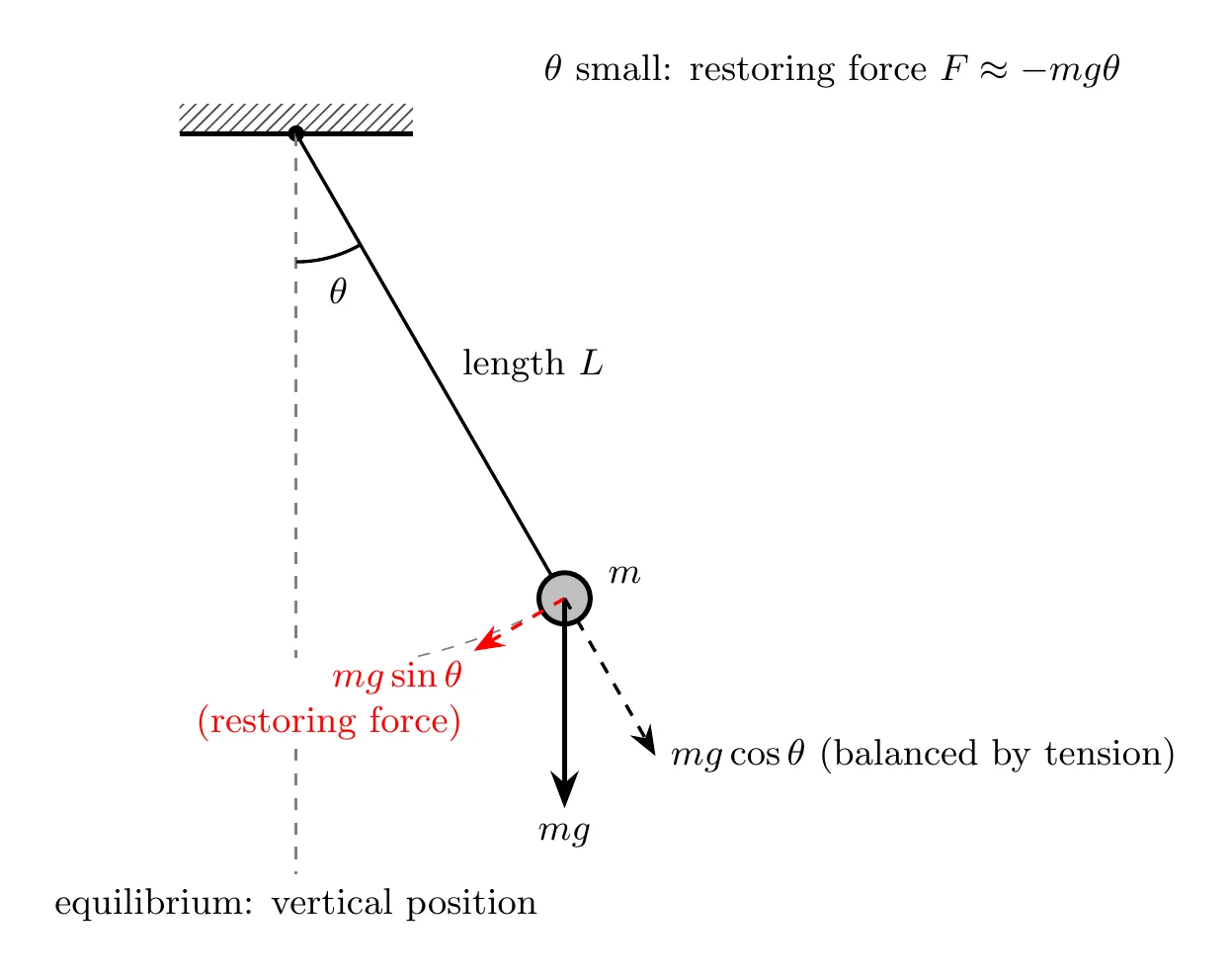
The restoring force (tangent to the arc) is:
For small angles (, or rad), , so:
and since the arc length is , meaning :
That has the form “force = negative constant times displacement,” so it’s SHM. The restoring force here is the tangential component of the weight, it only counts as SHM for small angles, and equilibrium is the vertical hanging position.
Summary: What Makes SHM
For motion to be simple harmonic, it has to satisfy with some positive constant.
Things that are SHM: a mass on an ideal spring (), and a simple pendulum at small angles ().
Things that are not SHM: a pendulum at large angles (, which isn’t proportional to , so it’s nonlinear), an object with air resistance (damping ruins pure harmonic motion), and non-linear springs like (not proportional to alone).
Example Problem: Mass-Spring with Friction
A block of mass is attached to a spring with force constant on a horizontal surface. The block is pulled to position and released to oscillate. The coefficient of kinetic friction between block and surface is .
- Derive an expression for the block’s acceleration.
- Write (but don’t solve) the differential equation for the block’s position as a function of time.
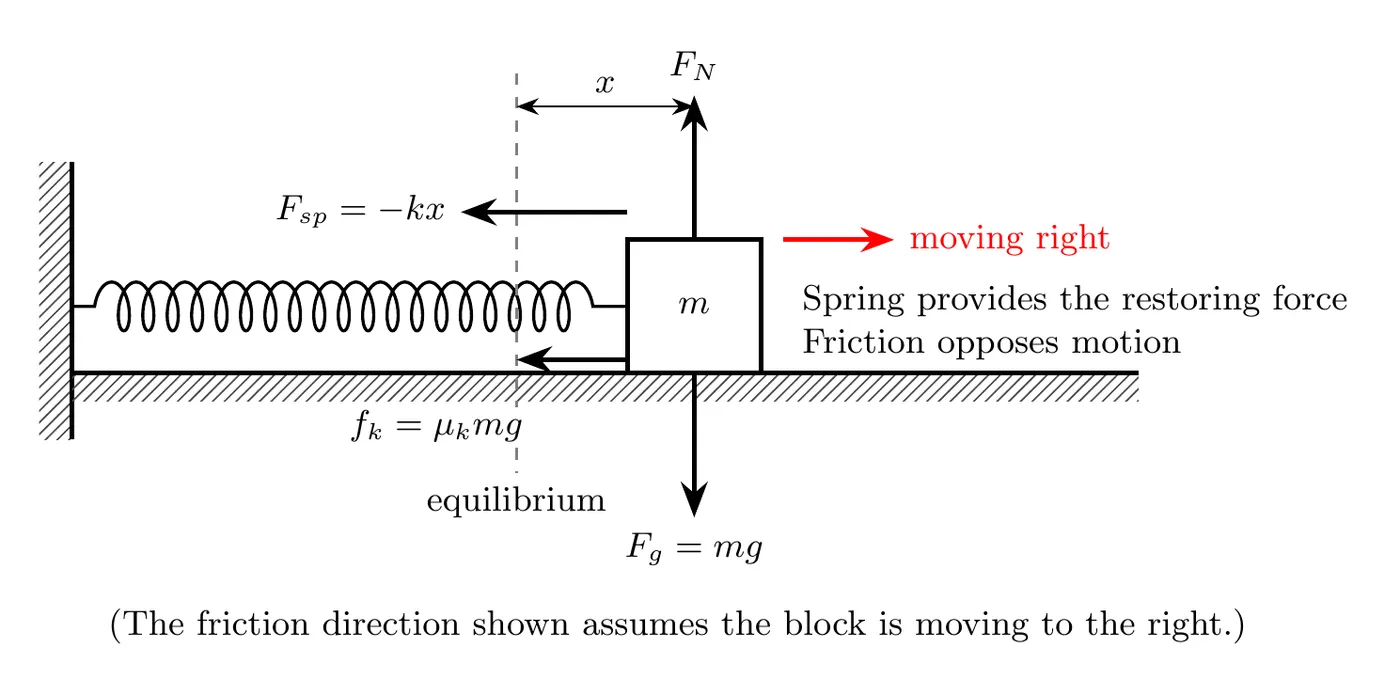
Part (a): Deriving the Acceleration
Step 1: The forces on the block are the spring force (toward equilibrium), friction (opposing the motion), the normal force (up), and the weight (down).
Step 2: Vertical forces. No vertical acceleration, so:
Step 3: Horizontal forces. With the block moving right, friction points left, so both horizontal forces point in the negative direction:
Step 4: Solve for acceleration.
Reading the Acceleration Expression
There are two pieces here. The spring term is the SHM restoring acceleration: it’s proportional to the displacement and points toward equilibrium. The friction term is a constant opposing force that always fights the motion (flipping direction whenever the velocity flips) and drains energy.
Without friction (), , which is pure SHM. With friction, , which is damped oscillation rather than pure SHM, because friction is a constant and isn’t proportional to .
Part (b): The Differential Equation
Acceleration is the second derivative of position:
so substituting into the acceleration expression gives:
or rearranged:
The question only asks you to write it, not solve it.
Understanding the Differential Equation
Since :
so the first derivative of position gives velocity and the second gives acceleration. It’s called a differential equation because it contains derivatives (), tying position, velocity, and acceleration together.
Comparing Forces
On a spring with no friction, : a pure restoring force, true SHM. On a spring with friction, : a restoring force plus a constant opposing force, giving damped oscillation (not pure SHM), where the amplitude shrinks over time and the block eventually stops near equilibrium (at a turning point where the spring force is too small to overcome static friction), not necessarily right at . On a sliding surface with no spring, : just constant friction opposing motion, giving constant deceleration , which isn’t oscillation at all, just slowing to a stop.
Summary
Simple harmonic motion requires a restoring force proportional to displacement (), a force always directed toward equilibrium, and no damping or constant opposing forces (in the idealized case). The two main SHM systems are the mass-spring () and the simple pendulum at small angles (). Add friction or damping and the motion is no longer pure SHM, even though it may still oscillate.
Common Mistakes
- Dropping the negative sign in the restoring force. It’s , not . The minus sign is what makes the force oppose the displacement.
- Thinking every oscillation is SHM. Only motion with counts. Damped oscillations, large-angle pendulums, and non-linear springs are not simple harmonic.
- Confusing equilibrium with zero displacement. Equilibrium is where the net force is zero. For a vertical spring, that’s not the natural length, because gravity shifts it.
- Wrong direction for friction. Friction opposes the motion (the velocity), not the displacement. If the block moves right, friction points left, regardless of whether is positive or negative.
- Folding friction into the restoring force. Friction is a separate constant force. Don’t write . It’s , two separate terms.
- Not realizing it isn’t pure SHM. With friction present, the motion is damped, the amplitude shrinks, and it isn’t true SHM.
- Confusing first and second derivatives. (first), (second). Don’t write .
- Forgetting to divide by mass. Going from to , divide every force term by .
- Wrong sign on the spring force. Displaced to positive , the spring force is (negative, pointing left). Displaced to negative , it’s (positive, pointing right).
- Thinking friction is always negative. Friction’s sign depends on the velocity direction. It always opposes the motion, so it flips sign when the object reverses.
- Not recognizing a differential equation. Any equation with , , or in it is a differential equation.
- Solving when you weren’t asked to. Part (b) says write it, don’t solve it. Don’t burn time solving.
- Confusing position with spring compression. Here is displacement from equilibrium, which isn’t the natural length for vertical springs.
- Not understanding what the equation represents. describes how position changes with time. Solving it would hand you .
- Missing the physics of the two terms. The term varies with position and drives the oscillation. The term is constant, always opposes motion, and causes the damping.