

7.4 - Energy of Simple Harmonic Oscillators
Conservation of Energy in SHM
The total energy of a system in simple harmonic motion is the sum of kinetic and potential:
In ideal SHM, that total stays constant through the whole oscillation. Energy keeps sloshing back and forth between kinetic and potential forms, but the sum never changes.
On the AP equation sheet the pieces are , for a spring, and for gravity. For a block on a horizontal spring:
The total is constant because the only force doing work on the block is the spring force, which is conservative. Energy just moves back and forth between and inside the block-spring system.
This only applies to undamped systems. In damped harmonic motion, outside forces (friction, air resistance) bleed energy away over time and the amplitude shrinks.
Energy Transfer in SHM
The core pattern: kinetic energy peaks exactly when potential energy bottoms out, and potential energy peaks exactly when kinetic energy bottoms out.
Energy in a Pendulum
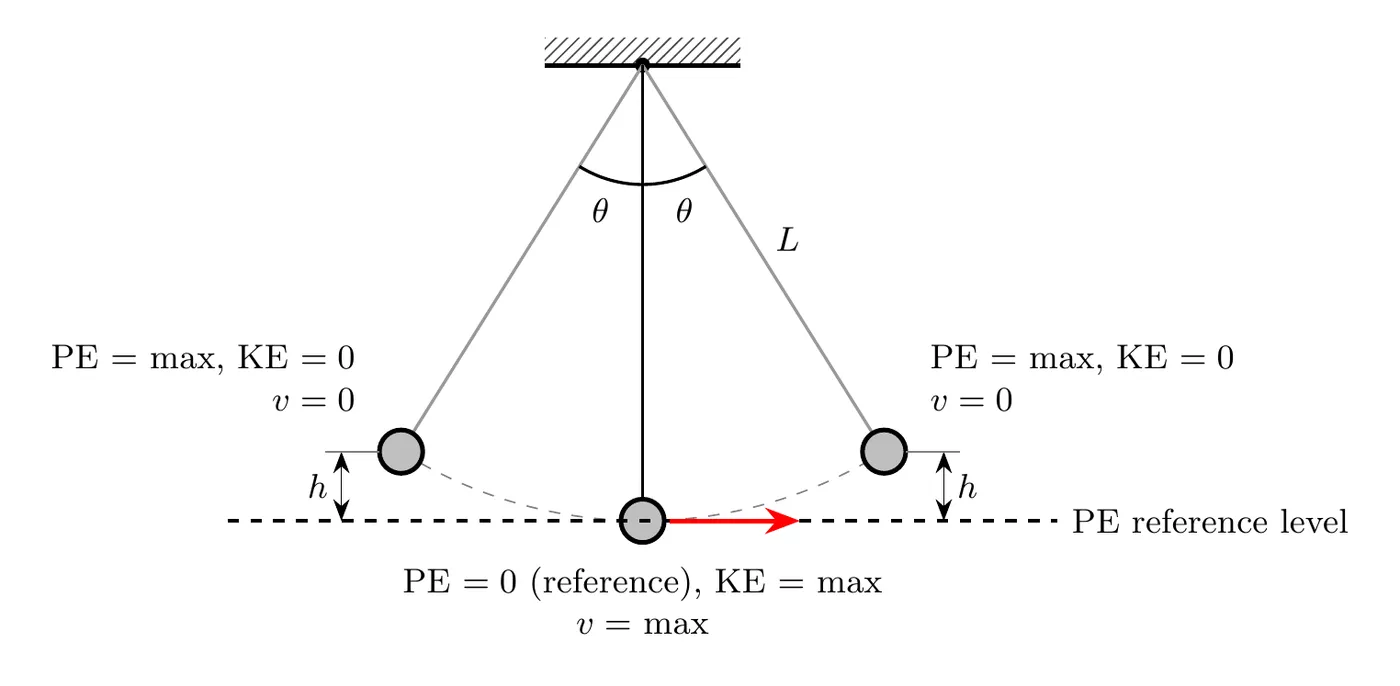
At maximum displacement (the extremes): is at its maximum, , the velocity is zero (an instantaneous stop before reversing), and the force and acceleration are at their largest magnitude.
At the equilibrium position: (choosing equilibrium as the reference), is at its maximum, the velocity is at its maximum, and the restoring force is zero. (The net force isn’t quite zero at the bottom: the string pulls up harder than gravity pulls down, which supplies the centripetal force that curves the bob’s path.)
Energy in a Mass-Spring System
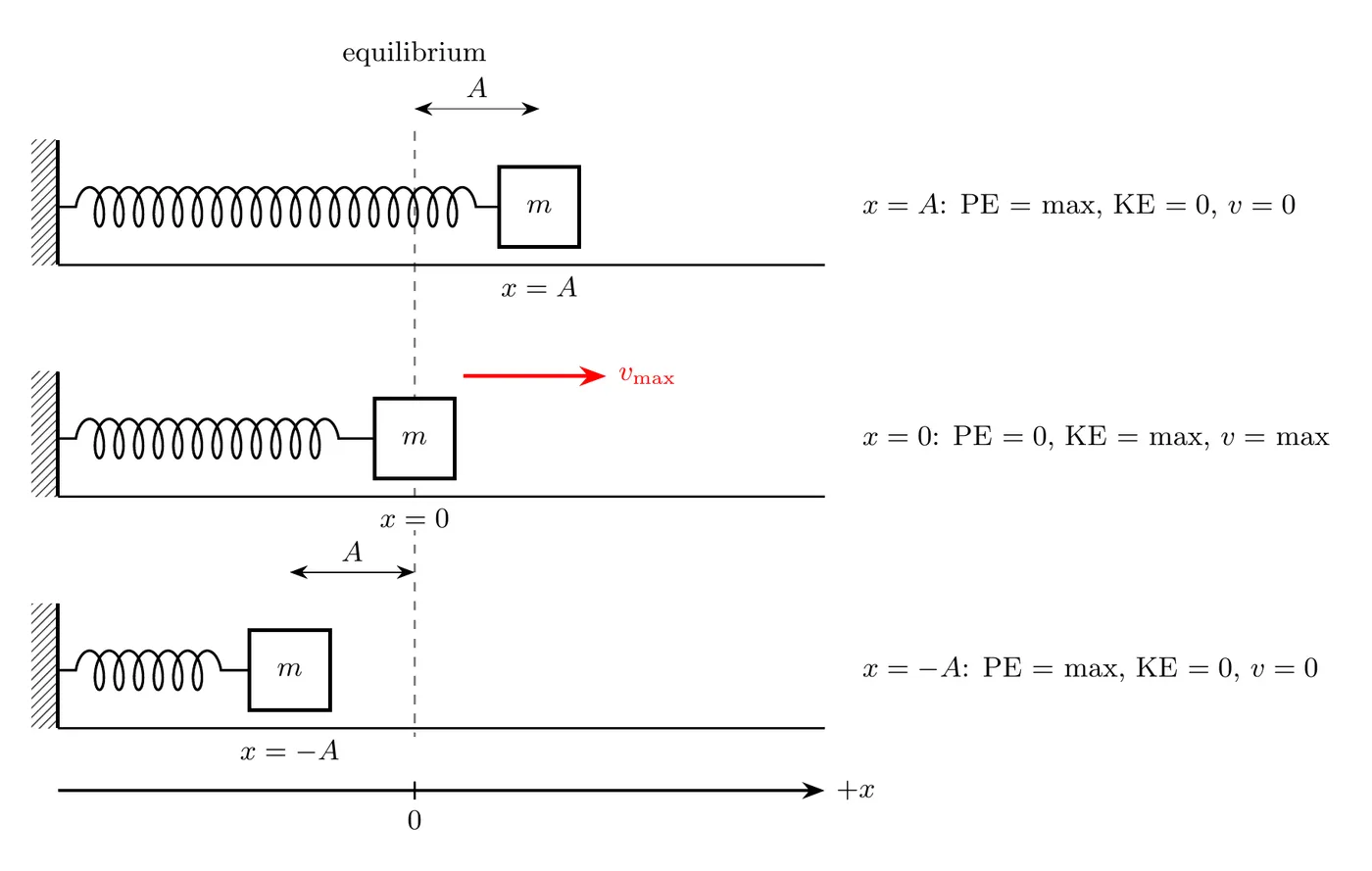
At maximum displacement (): the spring PE is at its maximum, , the velocity is zero, and the spring force and acceleration are at their largest.
At equilibrium (): the spring PE is zero, is at its maximum, the velocity is at its maximum, and the net force is zero.
Vertical springs. For a mass hanging on a spring, count both the spring’s potential energy and the gravitational potential energy. Their sum is smallest at the equilibrium position, so is still largest there. If you measure from equilibrium and call the total potential energy zero there, the two potential energies add up to exactly , so still works.
Total Energy Equations
Mass-spring system. The total mechanical energy is:
where is the spring constant (N/m) and is the amplitude (m). This is the maximum potential energy stored when the spring is pulled or pushed all the way out to the amplitude.
Simple pendulum. The total mechanical energy is:
where is the mass (kg), is gravitational acceleration (m/s²), is the pendulum length (m), and is the maximum angular displacement (rad).
Where the height term comes from: the height the bob rises above its lowest point is, by geometry,
so .
Example. A 0.30 kg pendulum bob on a 0.90 m string is pulled back to 12° and released. Find its total energy and its speed at the bottom.
At the bottom all of that energy is kinetic:
The SHM shortcut agrees. The amplitude along the arc is m, and rad/s, so m/s. At 12° the small-angle model is very close to the exact answer.
Example Problem
An object on a spring with spring constant oscillates in SHM with amplitude and frequency . Derive an expression for the object’s kinetic energy as a function of time.
Solution
For an object starting at maximum amplitude, the position function is:
At any instant, conservation of energy gives:
Solving for kinetic energy:
Substituting :
and using the identity , so :
Sanity check: at , , which is right, since the object starts at maximum displacement with zero velocity. And when , , the maximum kinetic energy, which happens at equilibrium.
The same substitution gives the potential energy, . Add them:
The total never changes, which is conservation of energy falling right out of the math. Also, and repeat every half period, so and each go through two full cycles of their own during one period . peaks every time the object passes equilibrium, going either way, and peaks at both turning points.
Second Example Problem
A 0.40 kg object oscillates on a spring with N/m and amplitude 0.15 m. Find (a) the total mechanical energy, (b) the maximum speed, and (c) the speed when the object is 0.10 m from equilibrium.
Solution
(a) Total mechanical energy:
(b) Maximum speed. At equilibrium, all the energy is kinetic:
(c) Speed at m. Use energy conservation:
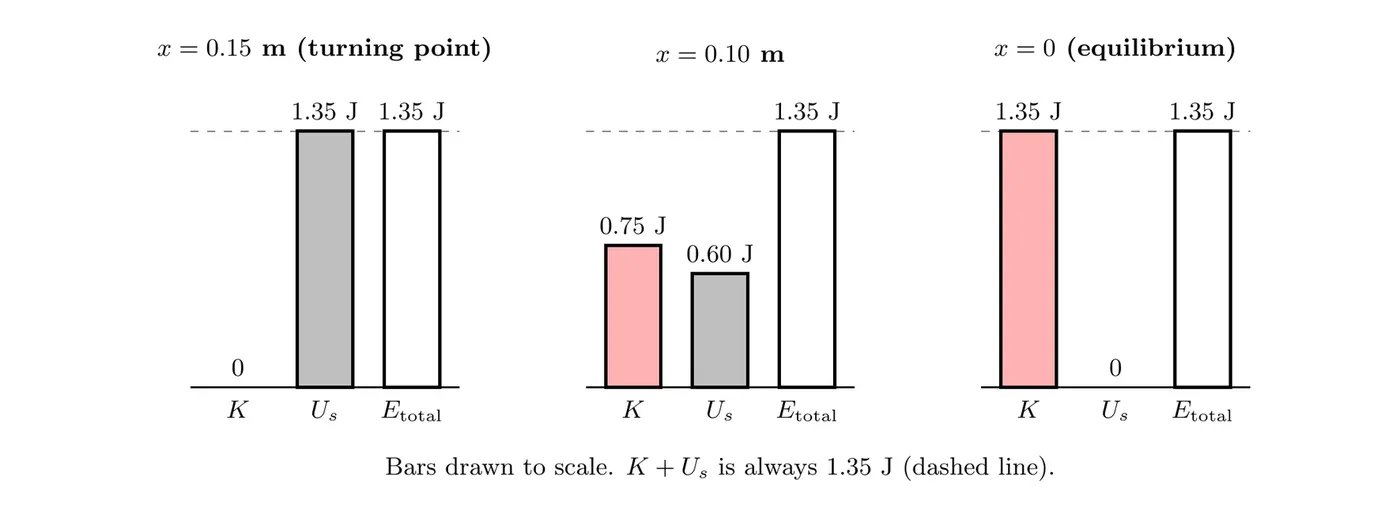
Energy bar charts. Here’s the energy split at three points in this example: the turning point, m, and equilibrium. The bar and the bar always add up to the same 1.35 J. At m, J, which leaves J (the same as ).
Energy vs. position graph. Plotting gives a parabola with its minimum (zero) at equilibrium. is whatever’s left under the total-energy line, so it’s an upside-down parabola. The object can only be where , between the turning points , where the parabola meets the total-energy line.
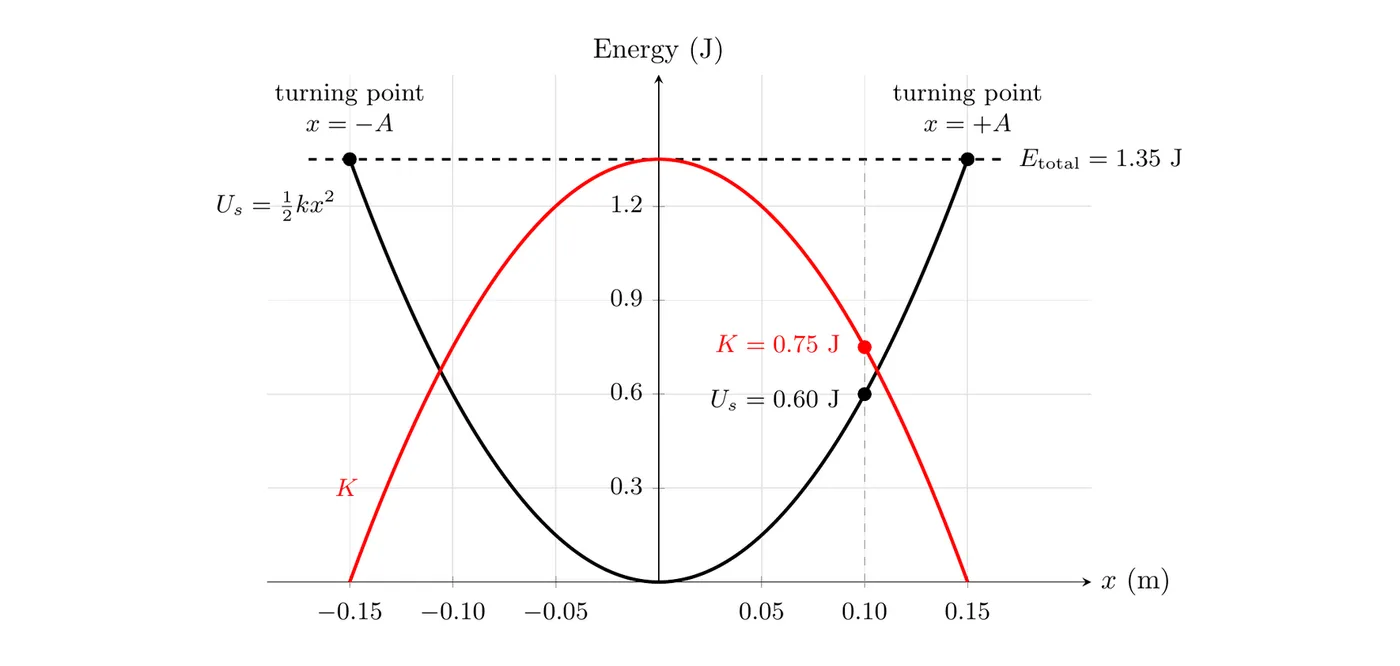
and are equal where , which is m, not halfway out at 0.075 m. Energy depends on , so half the energy doesn’t mean half the distance.
Follow-up: doubling the amplitude. Suppose the same object is started with an amplitude of 0.30 m instead:
Twice the amplitude means four times the energy (), because the maximum potential energy is set by how far the spring gets stretched. The maximum speed doubles to 5.2 m/s (), but the period doesn’t change: s either way.
Common Mistakes
- Mixing up where the energy peaks. Maximum PE happens at maximum displacement (where ), and maximum KE happens at equilibrium (where displacement is zero).
- Forgetting to square in the spring PE. It’s , not .
- Using the wrong amplitude. In , the is the amplitude (maximum displacement), not just any position .
- Botching the pendulum height. It’s , not or . You have to get it from the geometry.
- Thinking ideal SHM loses energy. In ideal (undamped) SHM the total mechanical energy is constant. Only damped motion loses energy over time.
- Setting the wrong reference point. For a pendulum, the PE reference is usually the lowest point. For a spring, the equilibrium position is where PE = 0.
- Missing when to use energy conservation. If you’re asked for the velocity at some position, is usually the fastest route.
- Forgetting KE is never negative. Velocity can be positive or negative, but can’t be. Its minimum is zero, at the turning points. The function never goes below zero.
- Confusing where max displacement and max velocity happen. They’re at different places: max displacement at the extremes, max velocity at equilibrium.