

2.4 - Product
Stages of Product Development, MVP, and Value Proposition
Product development is the process of creating or improving a product through research and iteration, and it usually unfolds across six stages: ideation, validation, design, messaging, production, and launch.
Ideation is about generating ideas for new or improved products, drawing from market research, technical research and development, and plain old brainstorming.
Validation is where those ideas get tested with real potential customers, often using a minimum viable product, or MVP, the simplest version of the product with only its core features. The goal is to see whether the product can reach product-market fit, meaning customer demand is strong enough to actually generate profit.
An MVP can be very simple. It might be a one-page website that describes the product and takes preorders, a small handmade batch sold at a farmers market, or an app with just one working feature. For example, someone with an idea for a meal-prep delivery service could start by cooking meals for 20 neighbors for a month. If those customers keep ordering, pay a price that covers the cost of the food and delivery, and tell their friends, that's evidence of product-market fit. If they stop ordering after the first week, the idea needs to change before the business spends money on a kitchen and delivery vans.
Design is where the business figures out how the product will actually look and work. This includes sourcing materials, building prototypes, and estimating production and delivery costs. It also means deciding on functionality (how it works), user experience (how it feels to use), and attributes like size, color, quality, and style. Businesses gather feedback on these prototypes to learn who's likely to buy and how customers respond to specific features.
Messaging is about building the overall marketing strategy. This includes crafting a value proposition that clearly explains who the product is for, what problem or need it solves, and how it's better than the alternatives, based on research findings. It also involves product positioning, which is planning how potential customers should perceive the product relative to competitors.
A value proposition can often be written as one sentence: for [target customer] who [need or problem], our product [main benefit], unlike [the alternatives]. For example: "For high school athletes who need to stay hydrated at practice, our bottle keeps water ice cold all day and fits in any gym bag, unlike cheap plastic bottles that warm up in an hour." Positioning is about where the product sits in customers' minds compared to rivals, like the cheapest option, the highest quality, the most eco-friendly, or the most stylish. Two businesses can sell nearly the same product but position it very differently, one as a budget choice and the other as a premium one.
Production is about actually building the product at scale, incorporating everything learned from the design stage. Key decisions here include choosing a production process (artisan versus mass production), designing the supply chain (suppliers, manufacturers, distributors), and trying to match production levels with expected customer demand.
Launch is the final stage, where the product actually hits the market. This includes taking orders, distributing to customers, and kicking off marketing to the chosen target segment through ads, promotions, and various channels.
Branding
Branding is the process of developing an identity for a business or product, meant to set it apart from competitors, raise awareness, and build customer loyalty. When shaping a brand identity, businesses think about their overall vision and the value proposition of the product, aiming to make sure the brand actually appeals to its target customer. For instance, if quick delivery is a core promise, the brand might lean on visuals and language that suggest speed and urgency.
A brand identity can be expressed through a name, a concept, a slogan, a symbol or logo, a design style (colors, fonts), or some combination of these, and businesses often trademark these elements to protect them.
Nike is a good example: its name, its "swoosh" logo, and its slogan "Just Do It" all work together to suggest athletic, high-performance gear. A trademark legally protects a name, logo, slogan, or other mark that identifies a brand, so rivals can't use the same or a confusingly similar one. That way customers can trust that a product with that logo really comes from that business.
Not every business goes the branded route, though. Some sell generic products without a strong brand identity, since some customers care more about a lower price than about branding, and generic goods tend to appeal to cost-conscious buyers.
For example, a pharmacy might sell its own store-brand ibuprofen right next to Advil. Both contain the same active ingredient, but the store brand costs less, partly because the business spends little on advertising or fancy packaging. Shoppers who care most about price pick the store brand, while others pay more for the name they know.
To evaluate a brand, ask whether it fits the value proposition and appeals to the target customer, whether it's easy to remember and recognize, whether it stands out from rivals, whether it's used consistently (the same logo, colors, and tone on the package, website, and social media), and whether it can be legally protected. A brand that looks just like a competitor's fails at standing out, and it could also run into trademark problems.
Product Life Cycle and Marketing Strategy
Every product moves through a life cycle shaped by changes in customer demand: introduction, growth, maturity, and decline. At each stage, businesses adjust their marketing strategy to handle competitive pressure and grow or hold onto market share.
The introduction stage starts when the product launches, so it picks up right where the six product development stages end. The graph below shows the typical shape of sales and revenue over a product's life: low and slow at first, then rising faster and faster, then leveling off, then falling.
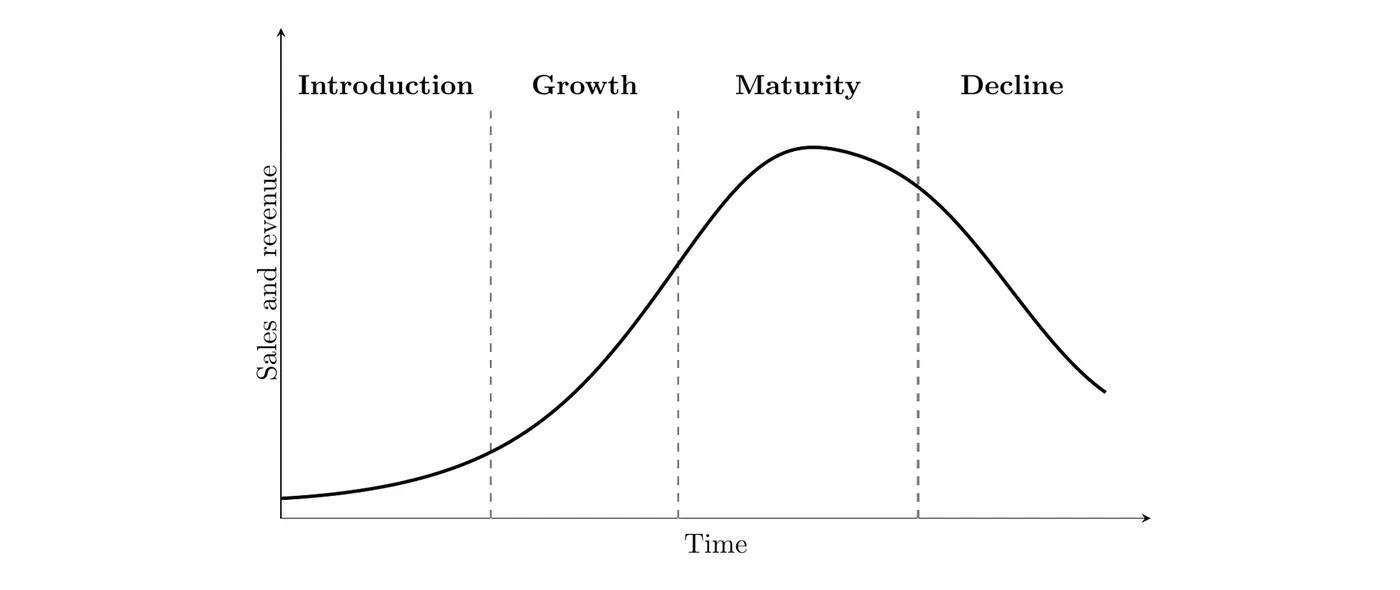
In the introduction stage, the product is brand new, and sales and revenue are typically low. Marketing here focuses on raising awareness of the product and brand and generating initial demand by explaining what it is and why it matters.
In the growth stage, sales and revenue start increasing at an accelerating rate, and production usually ramps up to match. This is also when competitors tend to enter with rival products, so marketing shifts toward differentiating the product, improving quality, promoting the brand, and using advertising to keep driving growth.
In the maturity stage, sales and revenue level off as the market becomes saturated, meaning most potential customers already know or own the product. The focus shifts to retaining market share, which often means continuing to differentiate through new features or styling, using selective discounts and promotions, and innovating just enough to stay relevant.
Since there aren't many new customers left to win in a saturated market, a business mostly grows by keeping its own customers and pulling customers away from rivals. That's why it works to build brand loyalty, for example with rewards programs, and often lowers prices to compete.
In the decline stage, sales and revenue start falling as customers move to rivals or newer substitutes. Marketing focus turns toward cutting costs, whether that's reducing marketing spend or simplifying the product line, or redesigning the product to try to regain relevance. Some products just get discontinued at this point if they're no longer viable.
DVD players show the whole cycle. They went on sale in the U.S. in 1997 at high prices, and few people owned one (introduction). Sales took off in the early 2000s as prices fell and more movies came out on DVD (growth). By the mid-2000s most households already had one, so brands competed on price and features (maturity). As streaming took over in the 2010s, sales fell and fewer companies kept making them (decline).