

2.6 - Place and Channels
Types of Marketing Channels
Place refers to where and how customers actually access a product, whether that's a retail store, a company-owned store, a club membership like a warehouse or subscription club, or an online platform like a website, app, or marketplace.
For example, a bag of chips can be bought at a grocery store (retail store), Apple sells iPhones in its own Apple Stores (company-owned store), Costco sells to members who pay a yearly fee (club membership), and almost anything can be ordered through a website, an app, or a marketplace like Amazon (online).
Place is shaped by a business's marketing channels, also called distribution channels, which make up the final stage of a supply chain. A marketing channel includes everyone and everything needed to get a finished product into the hands of the final customer.
There's a distinction between business-to-consumer (B2C) channels, used when selling directly to consumers through things like websites or retail stores, and business-to-business (B2B) channels, used when selling to other businesses through industrial distributors or wholesalers.
For example, a farm that sells strawberries at its own roadside stand is using a B2C channel. The same farm selling crates of strawberries to a food distributor that supplies restaurants is using a B2B channel. Many businesses use both.
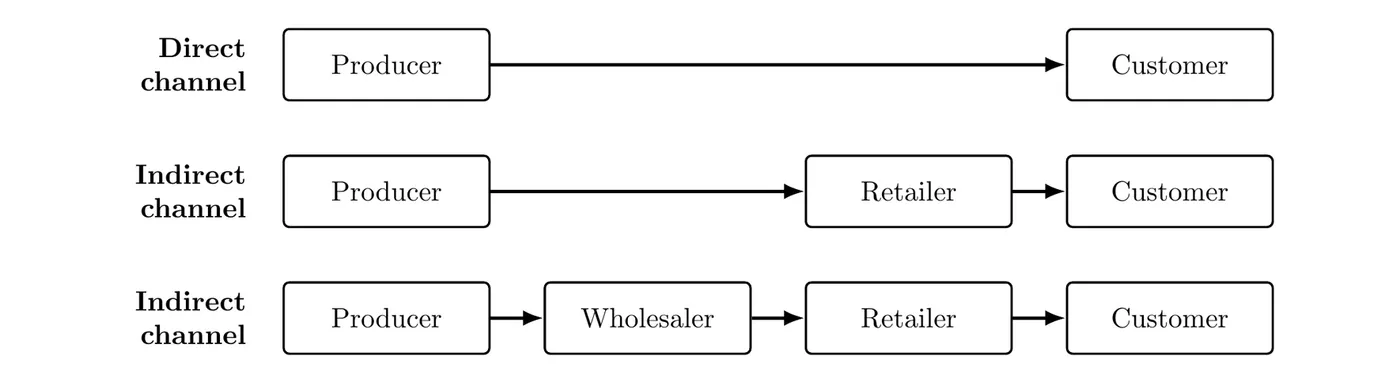
Channels can also be direct or indirect. Direct channels connect a business straight to its customers with no middleman, like a company website, a company-owned store, or an in-house sales team. Indirect channels involve intermediaries like wholesalers, distributors, or retailers standing between the producer and the final customer.
Each intermediary has a job. A wholesaler buys large quantities from producers and sells smaller quantities to retailers. A retailer sells to the final consumer. An indirect channel can have one intermediary (producer to retailer to customer) or several (producer to wholesaler to retailer to customer), and each one adds its own markup to cover its costs and earn a profit.
For some products, like prescription medications or anything posing health or safety risks, the law actually requires specific, approved, or regulated distribution channels.
For example, prescription medicines in the U.S. have to be dispensed by a licensed pharmacy with a valid prescription, so a drug company can't sell them on its own website to anyone who wants them. Most states also generally require alcohol to go through a three-tier system: the producer sells to a licensed distributor, the distributor sells to a licensed retailer, and only the retailer sells to consumers.
Selecting and Evaluating Marketing Channels
When choosing channels, businesses weigh the cost and potential profitability of each option, the customer experience each one offers, and how well each channel can reach target customers and actually deliver the product.
Direct channels, like a company website or its own retail store, give a business more control over pricing and over the customer experience, including service, branding, and messaging. The downside is that they're often more costly to set up and run, may have limited reach compared to big retailers, and require the business to build its own sales and distribution expertise.
Indirect channels, using intermediaries like wholesalers, distributors, retailers, or online marketplaces, give a business access to those partners' expertise and networks, which can lower costs per unit and reach far more customers, like through a large retail chain. The challenge is that some of these channels can be hard to break into if rivals already dominate the distributors or retail space, and the business ends up with less control over final pricing and the customer experience.
Here's a simple comparison. A small hot sauce company makes each bottle for $2.50. Through its own website (direct), it charges $8 a bottle, but website, payment, and shipping costs add about $2 a bottle, so it earns $8 − $2.50 − $2 = $3.50 per bottle. It sells about 2,000 bottles a year this way, for $7,000. Through a grocery chain (indirect), it sells to the chain for $4.50 a bottle, so it earns only $4.50 − $2.50 = $2 per bottle. But the chain puts it in hundreds of stores, and it sells 10,000 bottles, for $20,000. The indirect channel earns less per bottle but more in total. The catch is that the chain controls the shelf price and how the sauce is displayed, and getting shelf space can be hard when big brands already fill it.