6.3 - Second Wave Industrialization and Its Effects
The Second Wave of Industrialization (1870-1914)
Introduction:
- From 1870 to 1914, Europe experienced the Second Industrial Revolution, an extension and intensification of the changes brought about by the first wave of industrialization.
- What was new was the scale and complexity of industry. It spread beyond Britain and Belgium to Germany, northern Italy, and parts of Russia, and the new industries (steel, chemicals, and electricity) depended on science, huge factories, and big companies with thousands of workers and their own research labs. Germany and the United States caught up with Britain and passed it in several industries.
- By 1914, the factory system had become the dominant mode of production in Europe, further transforming the social, economic, and political landscape.
- Factories won out because machines powered by steam, and later by electricity, made goods faster and cheaper than skilled hand workers could. Mass production (making huge numbers of identical goods from standardized, interchangeable parts, and by 1913 on moving assembly lines) cut costs even more. Artisans and cottage workers could not compete, and most became wage workers in factories.
Krupp Family and the Steel Industry:
- The Krupp family in Essen, Germany, played a crucial role in the steel industry, perfecting steel production by 1870. Their dominance in the industry made Krupp Industries a major supplier of weapons to states across Europe and the world.
Manchester, England (The First Industrial City):
- Manchester became the first true industrial city. Its steam-powered cotton mills made it the center of Lancashire's cotton industry (it was nicknamed "Cottonopolis"), and its population more than quadrupled between 1801 and 1851. Factory owners grew rich, but most workers lived in crowded, unhealthy slums, which Friedrich Engels described in 1845 (see 6.4 and 6.7). Later, Trafford Park (1896), next to Manchester, became the world's first planned industrial park, built just for factories.
Technological Innovations:
- Steel:
- In 1856, British inventor Henry Bessemer developed the Bessemer process, which blasted air through melted iron to burn out impurities and turned large batches of iron into steel in minutes. In the late 1870s, the Thomas-Gilchrist process let steelmakers use phosphorus-rich iron ore, like the ore of Lorraine. Cheap, strong steel replaced iron in rails, ships, bridges, machines, and weapons. By 1900, Germany and the U.S. each made more steel than Britain, and firms like Krupp grew into giants.
- Electricity and Communication:
- The telegraph sent messages along wires as electric signals. William Cooke and Charles Wheatstone patented one in Britain in 1837, and Samuel Morse opened the first long line in the U.S. in 1844, using his Morse code. In 1866, a lasting telegraph cable across the Atlantic linked Britain and North America, so news, prices, and orders that once took weeks by ship arrived in minutes, linking their economies more closely.
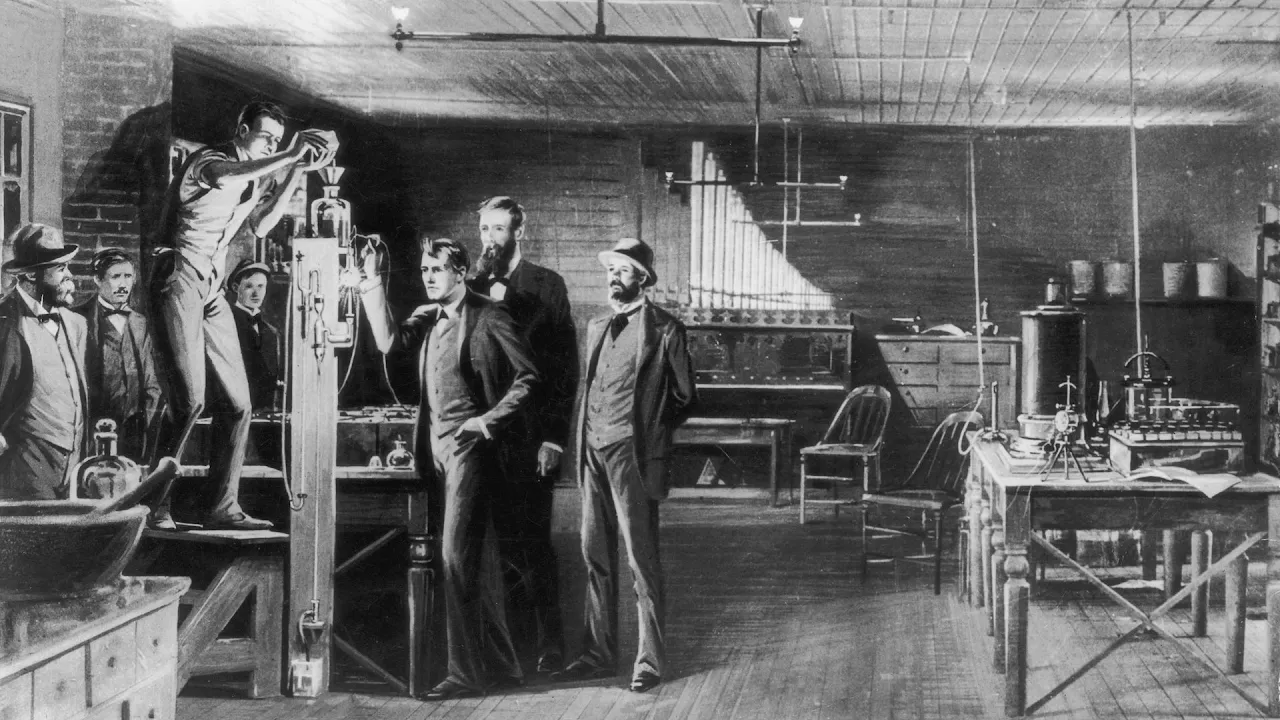
- Electric power: Improved generators (dynamos) made electricity practical in the 1870s and 1880s. Joseph Swan in Britain and Thomas Edison in the U.S. made working light bulbs around 1880, and cities built power stations and electric utilities to supply streets, homes, and factories. Electric motors could run machines anywhere, not just next to a steam engine.
- Telephone and radio: Alexander Graham Bell patented the telephone in 1876, and telephone networks spread through European cities in the 1880s and 1890s. In 1901, the Italian inventor Guglielmo Marconi sent a radio signal across the Atlantic without wires.
- Chemical Engineering:
- Vulcanization, a process that made rubber more durable, became crucial for manufacturing and the coating of electrical wires.
- The chemical industry grew fast, led by Germany. Firms like BASF and Bayer made synthetic dyes from coal tar, fertilizers, explosives, and medicines like aspirin (1899), and by 1900 Germany made most of the world's synthetic dyes. These companies hired university-trained chemists and ran research labs, a new link between science and industry.
- Railroads:
- Railroads became the dominant mode of transportation, linking distant parts of countries into national economies and facilitating urbanization by moving people from rural areas to cities.
- By linking regions, railroads created more fully integrated national economies. Factories could get coal and raw materials from far away and sell their goods cheaply across the whole country, so many small local markets became one national market.
- Steamships and Refrigeration:
- Iron and later steel steamships with screw propellers did not depend on the wind and carried much more cargo. They cut the Atlantic crossing from several weeks under sail to about a week, and the Suez Canal (1869) cut thousands of miles off the trip from Europe to Asia.
- Refrigerated rail cars and ships let meat, milk, and fruit travel long distances without spoiling. By the 1880s, frozen meat was shipped to Britain from Argentina, Australia, and New Zealand, and families kept food cold at home in ice boxes.
- Together with the telegraph, steamships and railroads built a truly global economic network. Europe imported grain, meat, cotton, rubber, and other raw materials from around the world, sold its manufactured goods in return, and invested money abroad, with London as the world's banking center.
- Internal Combustion Engine:
- The rise of the internal combustion engine, powered by gasoline, led to innovations like gas-powered tractors and automobiles, further advancing transportation.
- German engineers led the way. Nikolaus Otto built an efficient four-stroke gas engine in 1876, Karl Benz built one of the first practical automobiles in 1886, and Rudolf Diesel developed the diesel engine in the 1890s. Gasoline engines also made flight possible: the Wright brothers flew the first powered airplane in the U.S. in 1903, and Louis Blériot flew across the English Channel in 1909.
Rise of New Industries:
- The development of new technologies led to the growth of industries like the automobile industry, with figures like Henry Ford establishing manufacturing sites in Europe, including Manchester, England.
- The use of streetcars for urban transportation and the emergence of a leisure travel industry were direct results of these advancements.
- Electric streetcars (trolleys) appeared in the 1880s (Siemens opened one of the first lines, near Berlin, in 1881) and replaced most horse-drawn ones in big cities by the early 1900s. Along with cheap bicycles (the modern "safety bicycle" with a chain drive appeared in the 1880s), they let workers live farther from factories, so cities spread into suburbs.
- Leisure travel: Railways made cheap trips possible. In 1841, Thomas Cook organized a railway outing for a temperance meeting, and his company went on to sell package tours to the Great Exhibition, the seaside, and the continent. Seaside resorts like Blackpool and Brighton filled with day-trippers.
- Professional and leisure sport: Shorter work hours and railways created mass audiences for sport, such as England's professional Football League (1888) and the modern Olympic Games (1896).
- These new industries improved the distribution of goods and enhanced quality of life. Food was fresher and cheaper, homes got gas and then electric light, and ordinary people could travel and enjoy free time in ways only the rich could before.
Consumer Culture and Advertising:
- The increased availability of consumer goods at low prices gave rise to the advertising industry, as companies needed to differentiate their products in a competitive market.
- Department stores became popular, especially among middle-class women, turning shopping into a leisure activity.
- Why demand grew: Late in the century, wages bought more for many workers and mass production made goods cheaper, so more families had money left after food and rent. A heightened consumerism developed: people bought goods for comfort, fashion, and status, beyond what they needed to survive.
- New consumer goods: Factories now made ready-made clothing (sewn on machines instead of by local tailors), processed foods like canned goods, condensed milk, and margarine, and labor-saving devices like the sewing machine and, by the early 1900s, the first vacuum cleaners and electric irons.
- Mass marketing: Companies used brand names, posters, and newspaper ads to sell the same products across the country. Department stores like Le Bon Marché in Paris (from 1852) offered fixed prices and a huge choice under one roof, and mail-order catalogs, delivered by post and rail, brought the same goods to small towns and the countryside.
Economic Challenges and Responses:
- The Long Depression (about 1873 to 1896) began with a stock market crash in Vienna in 1873 that spread across Europe and the U.S. For two decades, prices and profits kept falling, partly because new factories and cheap American and Russian grain flooded markets and partly because the gold standard limited the supply of money. Business swung between booms and busts, and unemployment rose in the bad years.
- Corporations responded by attempting to create monopolies, while governments used protective tariffs to shield domestic industries. Some nations developed free trade agreements to avoid the negative effects of trade wars.
- Monopolies and cartels: To stop price wars, companies merged or formed cartels, agreements among firms to fix prices and split up markets. In Germany, the Rhenish-Westphalian Coal Syndicate (1893) controlled most coal sales in the Ruhr, and giant firms like Krupp owned their own coal and iron mines.
- Banking practices: Big investment banks, like Germany's Deutsche Bank (1870), lent huge sums to industry and placed their own people on company boards. Most major countries also tied their money to gold (the gold standard) by about 1900 to keep it stable.
- Tariffs: Most countries moved away from free trade and raised tariffs to protect their farmers and factories, such as Germany's tariff of 1879 (which protected both industrialists and grain-growing Junkers) and France's Méline Tariff of 1892. Britain was the main exception and kept free trade.
Population Growth and Longer Lives:
- Europe's population roughly doubled during the 1800s, even though tens of millions of Europeans emigrated. Two things drove this growth:
- Better harvests: Farming became a business that produced for markets, called the commercialization of agriculture. Farmers used crop rotation, fertilizers, and machines like mechanical reapers, and railways and steamships brought in cheap grain from the Americas and Russia. With more and cheaper food, famines became rare in western Europe after the 1840s.
- Industrialization: Higher wages, cheaper goods, cleaner cities (see 6.9), and medical advances such as Louis Pasteur's germ theory and Joseph Lister's antiseptic surgery (1867) lowered death rates. Life expectancy rose, and infant mortality began to fall, especially after about 1900.
- Effects: More people meant more workers and more customers for industry, but also more crowded cities (see 6.4) and, where there was too little land, more emigration, mostly to the Americas.
Prussian Industrialization and Economic Unification:
- Prussia’s rich deposits of coal and iron fueled its rapid industrialization, which contributed to the economic unification of the German states.
- Prussia gained the Rhineland, including much of the coal-rich Ruhr valley, at the Congress of Vienna in 1815, and it already held the coal and iron of Silesia. These regions became Germany's industrial heartland.
- The Zollverein Agreement (1834) lowered trade barriers, boosting industrial growth across the German states.
- Prussia led the Zollverein and kept Austria out of it, so the smaller German states became tied to Prussia's economy long before they were united with it politically.
- The National System developed by economist Friedrich List protected nascent German industries with tariffs until they could compete with British manufacturers, leading to significant industrial progress by the early 20th century.
- List laid out these ideas in The National System of Political Economy (1841). He also pushed for a German railway network, and the German states built railways quickly. These lines carried Ruhr coal to markets and later moved Prussian troops to the front in the wars of 1866 and 1870.
- Industry and unification: Prussia's industrial strength paid for a modern army armed with Krupp's steel cannons and moved by railways, which helped it defeat Austria (1866) and France (1870-1871) and become the leader of a unified Germany in 1871 (see 7.3).
- After 1871: The new German Empire industrialized rapidly with government sponsorship. The Prussian state bought up most private railways starting in 1879, the empire raised protective tariffs that same year, and governments funded technical universities and research. The 5 billion francs France paid Germany after the war also brought in money. By 1914, Germany led Europe in steel, chemicals, and electrical goods (with firms like Siemens and AEG).