

6.6 - Reactions and Revolutions
Klemens von Metternich and the Conservative Reaction
Introduction:
- After the defeat of Napoleon, Klemens von Metternich and other conservative leaders at the Congress of Vienna sought to roll back the liberal reforms that had emerged in Europe. They aimed to restore traditional order and prevent further chaos and violence.
Challenges to Conservatism:
- Despite Metternich's efforts, not everyone in Europe welcomed the conservative agenda. Discontent with conservative rule began to surface early in the 19th century, leading to significant uprisings and revolts.
- In the first half of the century, revolutionaries tried to destroy the status quo set up in 1815. Liberals wanted constitutions, elected parliaments, and civil rights, and nationalists wanted states for their own peoples, so both clashed with the conservative monarchies and multiethnic empires that the Concert of Europe protected.
The Greek War of Independence (1821-1832)
Background:
- Greece was under the rule of the Ottoman Empire, a conservative government, at the start of the 19th century.
- The Greek War of Independence began in 1821, driven by Greek nationalists seeking to establish a nation defined by their own language, culture, and historical heritage.
Conflict and Outcome:
- Initially, the Greek forces were no match for the powerful Ottoman Empire, and the Greeks suffered significant defeats.
- However, Britain, France, and Russia eventually allied with the Greeks, not out of sympathy for their cause but as a strategic move to weaken the Ottoman Empire.
- Public opinion also played a part. Many Europeans saw the Greeks as heirs of ancient Greece and as Christians fighting Muslim rule. Romantic "philhellenes" (lovers of Greece), like the poet Lord Byron, who died in Greece in 1824, raised money and volunteered to fight. In 1827, a British, French, and Russian fleet destroyed the Ottoman and Egyptian fleet at the Battle of Navarino.
- With the support of these major powers, Greece won its independence in 1832. This victory was one of the first signs of the growing discontent that would eventually lead to the widespread revolutions of 1848.
- The Greek victory showed that a nationalist revolution could succeed, and that the great powers would bend the Concert's own rule against supporting revolutions when it served their interests.
The Decembrist Revolt (1825)
Background:
- In December 1825, Tsar Nicholas I ascended to the Russian throne after the death of his brother, Alexander I, who had become increasingly conservative in his later years.
- The transfer of power prompted a group of Russian military officers, known as the Decembrists, to attempt a coup, influenced by liberal ideals.
The Revolt:
- The Decembrists sought to implement liberal reforms and challenge the autocratic rule of the Tsar. However, their efforts were quickly crushed by Nicholas’s superior forces.
- Many of the officers had seen western Europe while fighting Napoleon and wanted a constitution, and some wanted to end serfdom. They rose up in St. Petersburg on December 26, 1825 (December 14 in Russia's old calendar), using the confusion over whether Alexander's brother Constantine or Nicholas would take the throne.
Aftermath:
- Following the failed revolt, Tsar Nicholas I became even more committed to suppressing dissent. He significantly increased the use of the secret police to root out and eliminate any opposition, reinforcing his conservative and autocratic rule.
- Five leaders were hanged and more than a hundred others were sent to Siberia. Later Russian revolutionaries remembered the Decembrists as heroes.
The July Revolution (1830)
Background:
- In France, Charles X was an extremely conservative monarch who aimed to restore France to its pre-French Revolution structure.
- In July 1830, Charles X attempted to strip the middle class of voting rights and imposed censorship on the press, actions that provoked widespread anger.
The Revolt:
- In response, middle-class liberals and working-class citizens took to the streets of Paris, leading to three days of intense rioting and fighting.
- Realizing the severity of the situation, Charles X fled the country, abdicating his throne.
Aftermath:
- Louis Philippe succeeded Charles X and restored some of the rights that had been taken away. However, he maintained a conservative stance similar to his predecessor, leading to continued dissatisfaction among the people.
- Louis Philippe called himself the "citizen king" and ruled under a constitution, but only the wealthiest men could vote, so his government mainly served rich bankers and businessmen.
- The July Revolution inspired other revolts in 1830. Belgians rose up against Dutch rule and won independence, which the great powers accepted and later guaranteed as neutral (1839). In the Polish rebellion (1830-1831), Poles rose up against Russian rule, but Russia crushed them and took away Poland's constitution, and thousands of Poles fled into exile in western Europe.
Lead-Up to the Revolutions of 1848
Mood of the Continent:
- By the time of the Revolutions of 1848, Europe was simmering with discontent. In France, under Louis Philippe's conservative regime, many people demanded a more liberal government.
- Two problems came together. Politically, liberals and republicans were angry that only the wealthiest men could vote, and they held "banquets" (political dinners) to demand reform. Economically, the "Hungry '40s" brought bad harvests, potato blight, high food prices, and a business slump in 1846 and 1847 that left many workers without jobs. When the government banned a reform banquet in Paris in February 1848, crowds poured into the streets.
- A bread shortage further fueled the unrest, leading to widespread protests. When the King responded with military force, resulting in the deaths of about 50 protesters, Parisians erected barricades throughout the city.
Outcome:
- The uprising forced Louis Philippe to abdicate the throne, and a provisional government was established, restoring the French Republic and enacting the liberal reforms demanded by the people.
- The new Second Republic gave the vote to all adult men (universal male suffrage) and abolished slavery in France's colonies.
- News of the revolution in Paris set off uprisings across Europe within weeks, in the German states, the Austrian Empire, and the Italian states. This wave is sometimes called the Springtime of Peoples.
The French Republic and Class Division
Provisional Government:
- After the abdication of Louis Philippe, a provisional government was established in France, marking the restoration of the French Republic. However, this government was quickly weakened by internal class divisions.
- A major point of contention was between the Liberals and the Socialists regarding the treatment of the poor:
- Socialists like Louis Blanc demanded that the government guarantee the "right to work." The provisional government set up National Workshops, mostly in Paris, which gave public works jobs to more than 100,000 unemployed men.
- However, in the April 1848 election, the first held under universal male suffrage, rural voters chose mostly moderate and conservative men for the National Assembly. The Assembly saw the workshops as too costly and dangerous and decided to shut them down in June.
Uprising and New Constitution:
- The closure of the workshops led to the June Days uprising (June 1848), when Paris workers built barricades. The army crushed them in four days of street fighting, and thousands were killed or arrested. After this, middle-class liberals and workers feared each other, which split the revolution.
- During this unrest, the National Assembly completed a new Constitution with a strong, elected president. In December 1848, voters elected Louis Napoleon Bonaparte (Napoleon Bonaparte's nephew) by a landslide. He seized full power in a coup in 1851 and, after a popular vote, became Emperor Napoleon III in 1852.
- As a result, the revolution in France in 1848 was ultimately deemed a failure, as it led back to authoritarian rule.
Revolutionary Spirit in the German States
Spread of Revolution:
- The revolutionary spirit that erupted in France in 1848 spread to the German states, particularly in Prussia.
- Inspired by the events in France, revolutionaries in Prussia and other German states began to demand more liberal reforms, including constitutional reforms, voting rights, and most importantly, the unification of the German states.
Prussian Response:
- The revolution reached its peak in Prussia, the strongest of the German states. King Frederick William IV initially suppressed the revolution with force but eventually agreed to make some reforms demanded by the liberals.
- Frankfurt Assembly:
- In response, delegates from the German states convened at the Frankfurt Assembly to draft a new constitution for a unified Germany.
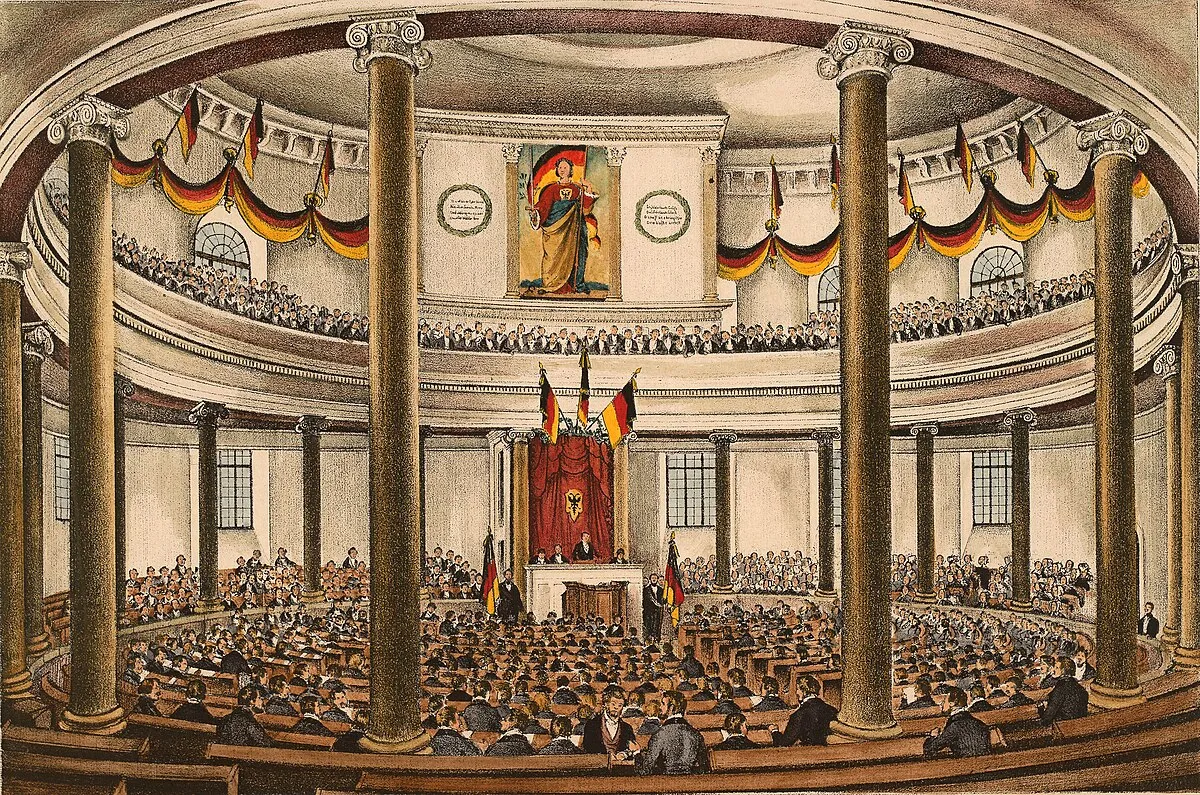
Frankfurt Assembly (1848-1849)
Background:
- The Frankfurt Assembly was convened with the goal of drafting a constitution that would unify the German states. This was a response to the growing demand for national unification and liberal reforms across the German territories.
- The Assembly met in May 1848. Most delegates were educated middle-class men, like professors, lawyers, and officials. They wrote a list of basic rights, such as equality before the law and freedom of speech and religion.
Challenges and Outcome:
- Despite the initial momentum, the conservative monarchy managed to exploit divisions among the delegates, particularly along class and party lines. These divisions prevented the assembly from reaching any significant consensus.
- One big split was over borders. Supporters of a "greater Germany" wanted to include Austria's German lands, while supporters of a "smaller Germany" wanted to leave Austria out and have Prussia lead. Austria refused to break up its empire, so the Assembly chose the smaller plan.
- King Frederick William IV of Prussia ultimately refused to accept the constitution proposed by the Frankfurt Assembly, and he used his authority to crush the remaining protests. As a result, the efforts to unify Germany under a liberal framework failed, marking the collapse of the revolutionary movement in the German states.
- In 1849, the Assembly offered Frederick William IV the crown of a united Germany, but he turned down what he privately called a "crown from the gutter" because it came from an elected assembly, not from his fellow princes. The failure taught German nationalists that unity would come through Prussian power rather than liberal speeches and votes, a lesson Bismarck later used (see 7.3).
Revolutions of 1848 in Austria and Beyond
Austria:
- The Austrian Empire was a multi-ethnic state with various groups, each inspired by nationalism and seeking self-rule.
- In 1848, these different ethnic groups revolted for various reasons. However, with the assistance of Russia, Austria managed to suppress these uprisings, maintaining the conservative order.
- In March 1848, protests in Vienna forced Metternich to resign and flee to Britain. The government promised a constitution and ended serfdom in the empire, one of the revolution's lasting results.
- But the empire's peoples also fought one another, and the army regained control piece by piece. It crushed a Czech uprising in Prague (June 1848), retook Vienna (October 1848), and defeated Piedmont and the Italian rebels (1848-1849). Hungary, led by Lajos Kossuth, declared independence in 1849, so the new young emperor, Franz Joseph, asked Russia's Nicholas I for help, and Russian and Austrian armies crushed Hungary by August 1849.
- Italy: Revolts also broke out in the Italian states, and in Rome, rebels set up a republic led in part by Giuseppe Mazzini. French troops sent by Louis Napoleon crushed it in 1849 and brought back the pope's rule.
General Impact of the 1848 Revolutions:
- The Revolutions of 1848 represented widespread rebellion against the conservative status quo across Europe. However, these revolutions largely failed, leading to a conservative backlash in the states where they occurred. In many cases, this resulted in an increase in conservative measures and the reinforcement of existing power structures.
- The revolutions failed mainly because the revolutionaries were divided. Middle-class liberals wanted constitutions and a limited vote, workers wanted jobs and social reform, and different nationalities fought one another. Meanwhile, the kings kept control of their armies.
- Still, 1848 left lasting changes: universal male suffrage in France, the end of serfdom in the Austrian Empire, and constitutions in Prussia (1850, with votes weighted by wealth) and in Piedmont-Sardinia.
- 1848 also marked the breakdown of the Concert of Europe. With Metternich gone and new leaders like Napoleon III, Cavour, and Bismarck putting their own nations' interests first (Realpolitik), the great powers stopped acting together to defend the status quo. Within a few years, they were fighting one another in the Crimean War (1853-1856) (see 7.3).
Russia and the Aftermath of 1848
Russian Response:
- Although Russia experienced similar revolutionary rumblings, a significant uprising did not occur until 1905.
- Tsar Alexander II was particularly concerned by Russia's loss in the Crimean War and recognized the need for substantial reforms to modernize Russia.
- Alexander II enacted several liberal reforms, including the emancipation of the serfs, the creation of an independent court system, and the modernization of Russia's military and industrial capacity.
- Emancipation of the Serfs (1861): About 23 million serfs on private estates became legally free. But they had to pay for their land through redemption payments over 49 years, often got less land than they had farmed before, and stayed under the control of their village commune (the mir), so many stayed poor and bitter.
- Other reforms: Elected local councils called zemstvos (1864) ran roads, schools, and health care, new courts (1864) used juries and judges who could not be fired at will, and a military reform (1874) required men of all classes to serve.
- Despite these efforts, Alexander II was assassinated, and his successor, Alexander III, took a much more conservative approach, rolling back many of the reforms.
- Why reform bred revolutionaries: The reforms raised hopes but gave Russians no national parliament and no say over the tsar. In the 1870s, young educated Populists (Narodniks) went to the villages to stir up the peasants, who mostly ignored or reported them. A group called People's Will then turned to terrorism and killed Alexander II with a bomb in 1881. Alexander III answered with more censorship, police power, and Russification (pressuring non-Russians to adopt the Russian language and Orthodox faith).
- By 1900, new revolutionary parties had formed in secret: the Marxist Russian Social Democratic Labor Party (1898), which split into the Bolsheviks and Mensheviks in 1903 (see 6.8), and the Socialist Revolutionaries, who focused on the peasants.
Alexander III and Industrialization in Russia
Background:
- After the assassination of Alexander II, his son Alexander III ascended to the Russian throne. Unlike his father, Alexander III was not interested in liberal reforms but focused on strengthening Russian greatness through industrialization.
Economic Reforms:
- Under Alexander III and then his son Nicholas II, Finance Minister Sergei Witte (1892-1903) pushed Russia to industrialize quickly with government support:
- Protective tariffs were enacted to encourage domestic purchases.
- In 1897, the Russian currency (the ruble) was placed on the gold standard, stabilizing it and making foreign investors, especially the French, more willing to lend money to Russia.
- The government used this money to build railways, including the Trans-Siberian Railway (begun in 1891), and heavy industries like coal, iron, and steel. The new factory workers in cities like St. Petersburg and Moscow worked long hours for low pay in crowded conditions.
- While these measures improved the economy, many Russians continued to live in extreme poverty under the authoritarian rule of the Tsar.
The Revolution of 1905
Causes:
- The continued poverty and lack of political freedoms under Tsarist autocracy led to widespread discontent, culminating in the Revolution of 1905.
- The revolutionaries demanded a more liberal government, pushing for greater political representation and civil liberties.
- Russia's humiliating defeat by Japan in the Russo-Japanese War (1904-1905) made the government look weak. On Bloody Sunday (January 22, 1905), troops fired on peaceful workers marching to the Winter Palace in St. Petersburg to ask the tsar for help, killing and wounding hundreds. Strikes, peasant revolts, and mutinies (like the one on the battleship Potemkin) spread across the empire, and in October a general strike shut down the country.
Reforms and the October Manifesto:
- In response to the pressure, Nicholas II issued the October Manifesto (1905), drafted with the help of Sergei Witte, who then became Russia's first prime minister. Key provisions included:
- Civil rights for all Russians, such as freedom of conscience, assembly, and association.
- Freedom of speech.
- A wider right to vote: most men could now vote, but indirectly, and the system gave landowners far more weight.
- The establishment of an elected representative body called the Duma, which had to approve new laws.
Aftermath:
- Despite these concessions, the Tsar retained the absolute right to veto any law, maintaining significant autocratic power.
- Over time, some of the reforms introduced by the October Manifesto were rolled back, leaving many of the revolutionaries' demands unmet and setting the stage for future unrest in Russia.
- Nicholas dissolved the first two Dumas when they demanded too much, and in 1907 he changed the voting law so that landowners controlled the Duma.
- His prime minister, Peter Stolypin (1906-1911), used two approaches: harsh repression, with special courts that hanged many suspected revolutionaries, and land reform that let peasants leave the mir and own their own farms, hoping to create a class of prosperous, loyal peasants. Stolypin was assassinated in 1911, and the anger that remained helped lead to the Russian Revolution of 1917 (see 8.3).