

8.4 - Versailles Conference and Peace Settlement
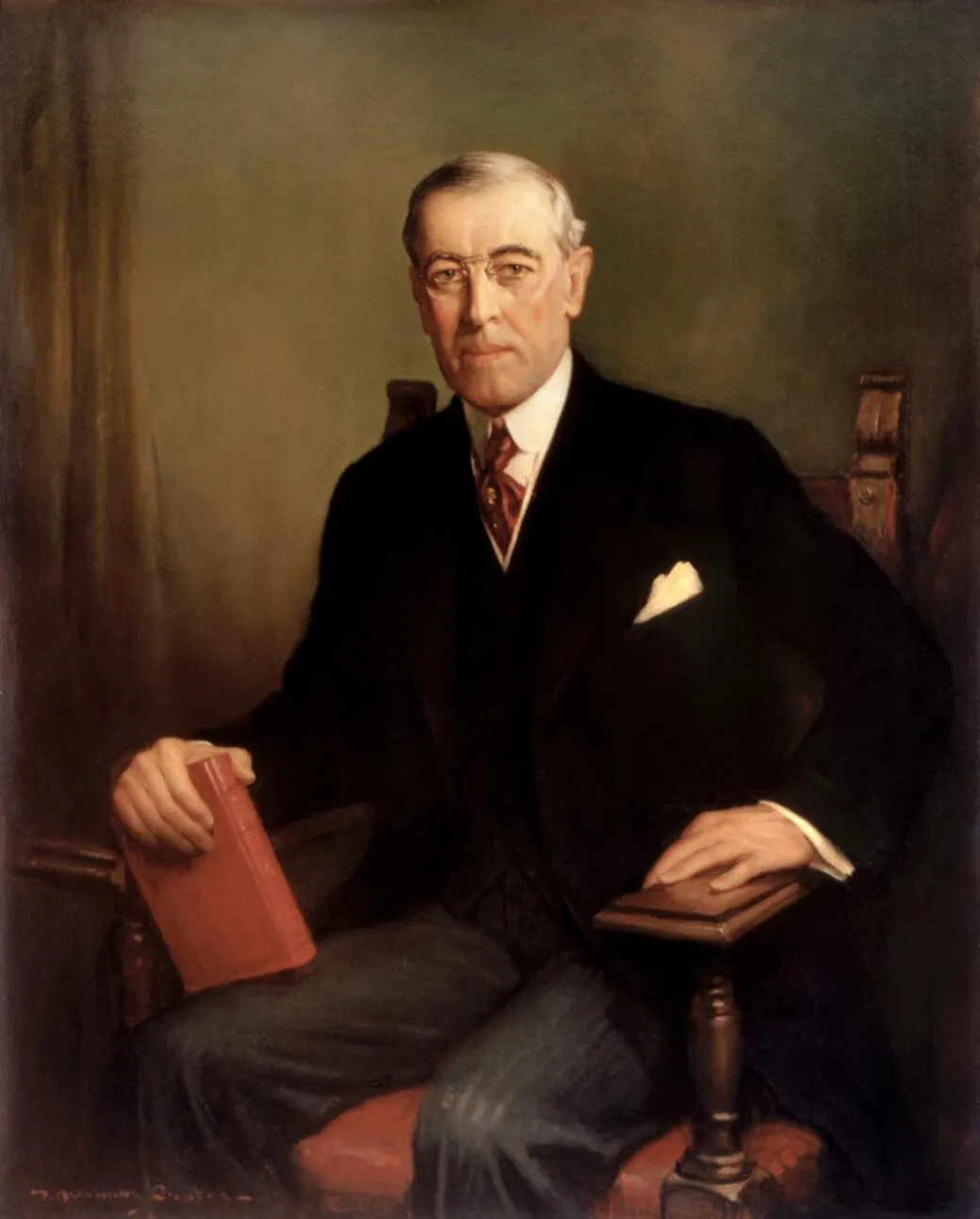
Woodrow Wilson and the Treaty of Versailles
Versailles Peace Conference:
- Tension Among Victorious Powers:
- The United States, Great Britain, and France (the "Big Three") had differing visions for how peace should be administered after World War I.
- The conference opened in January 1919. Italy's Vittorio Orlando made it the "Big Four," but Italy had less influence and walked out for a time when it did not get all the land it had been promised in 1915. Germany and Soviet Russia were not invited; Germany was simply handed the finished treaty, which Germans called a "Diktat" (dictated peace).
Woodrow Wilson’s Vision:
- Idealism:
- U.S. President Woodrow Wilson played a significant role in shaping the peace settlement, despite the relatively small role of the U.S. military in the war.
- Wilson’s vision for European peace was idealistic, aiming to create a world where nations would no longer go to war.
- Wilson announced the Fourteen Points in January 1918. Germany agreed to the armistice expecting a peace based on them, so the much harsher final treaty felt like a betrayal to many Germans.
- The Fourteen Points:
- Key Provisions:
- Reduction of arms among nations.
- Open diplomatic relationships instead of secret treaties.
- Self-Determination: Wilson emphasized the right of nations to determine their own futures, challenging longstanding imperial traditions.
- League of Nations:
- Wilson’s most ambitious proposal was the creation of the League of Nations, an international body dedicated to preventing war.
- Challenges:
- The League of Nations was formed, but it faced significant obstacles: the U.S. Senate refused to ratify it, fearing it would drag the U.S. into wars without Congressional approval. Additionally, Germany and Russia did not participate, undermining its effectiveness.
- Why the League Was Weak:
- The United States never joined, so the world's richest country was missing. Germany was not allowed in until 1926, and the Soviet Union joined only in 1934. Germany and Japan left in 1933, and Italy in 1937.
- The League had no army. It could only condemn aggressors or ask members to impose economic sanctions, and its major decisions needed every member of its council to agree. When Japan seized Manchuria (1931) and Italy invaded Ethiopia (1935), the League did little (see 8.7).
- Idealism Meets Reality:
- Self-determination was applied unevenly. Poles, Czechs, and South Slavs got their own states, but German-speakers in Austria and in Czechoslovakia's Sudetenland were not allowed to join Germany, and neither Europe's colonies nor the Arabs got self-determination.
- The victors were unhappy too. Italy was angry that it did not receive all the land promised in 1915, and its nationalists called the result a "mutilated victory" (see 8.6). Wilson's own country rejected the treaty.
- Democratic successor states such as Poland, Czechoslovakia, Hungary, and Yugoslavia were set up with parliaments and constitutions, but they faced large ethnic minorities, border disputes, weak economies, and little experience with democracy. By the late 1930s, nearly all of them had become dictatorships or been taken over (see 8.6).
British and French Perspectives:
- Punishment of Germany:
- David Lloyd George (Britain): The British Prime Minister campaigned on a platform to punish Germany for the war, which was a popular sentiment in Britain.
- Georges Clemenceau (France): The French Premier sought to punish Germany severely, aiming to protect France from future German aggression. His goals included demilitarizing Germany, imposing reparations, and creating a buffer zone in the Rhineland.
- France had lost about 1.4 million soldiers, and its northeast had been wrecked. Germany still had more people and more industry than France, so Clemenceau wanted guarantees that Germany could never invade again. Britain and the U.S. promised to defend France, but that promise fell through when the U.S. Senate rejected the treaty.
Strained Relations with Russia:
- Distrust of Communism:
- Russia, having undergone a Communist Revolution and withdrawn from the war, was distrusted by Western European powers.
- Support for Neighboring States:
- The Western powers supported new states along Russia's western border, such as Poland, Finland, and the Baltic states (Estonia, Latvia, and Lithuania), as a barrier against communism (a "cordon sanitaire"). Poland, together with Czechoslovakia, Hungary, and Yugoslavia (carved mostly out of Austria-Hungary), makes up the democratic successor states. They were created largely at the expense of Germany, Russia, and Austria-Hungary.
Key Provisions of the Treaty with Germany:
- War Guilt Clause:
- This clause placed the entire blame for the war on Germany and its allies (primarily Germany). The humiliation from this clause contributed to the rise of Fascism in Germany, eventually leading to World War II.
- This was Article 231, which made Germany accept responsibility for all the loss and damage caused by the war. Germans of every party hated it. Many believed the "stab-in-the-back" myth: that the army had not really been defeated but betrayed at home by socialists, Jews, and the politicians who signed the armistice and treaty (the "November criminals").
- Reparations:
- Germany was required to pay reparations for the damage caused during the war. The massive financial burden crippled Germany’s economy and sowed the seeds for future conflict.
- In 1921, the Allies set reparations at 132 billion gold marks. When Germany fell behind on payments, France and Belgium occupied the Ruhr industrial region (1923), which helped set off hyperinflation (see 8.5). The British economist John Maynard Keynes attacked reparations in The Economic Consequences of the Peace (1919), calling the treaty a "Carthaginian peace." Historians still debate how heavy the burden really was, since Germany paid only part of the total before payments ended in 1932.
- Demilitarization and Land Cessions:
- The treaty mandated the demilitarization of Germany and required it to cede territory. These conditions weakened the post-war Weimar Republic, contributing to its eventual collapse in the 1930s.
- The German army was limited to 100,000 men, with no air force, tanks, or submarines. The Rhineland was demilitarized and occupied by Allied troops for 15 years. Germany gave Alsace-Lorraine back to France, lost land to Poland (including the Polish Corridor, which cut East Prussia off from the rest of Germany), lost all its colonies, and was banned from uniting with Austria. Overall, it lost about 13 percent of its European territory and about a tenth of its people.
- Effects on the Weimar Republic:
- Germany's new democracy, the Weimar Republic (1919 to 1933), was blamed for signing the hated treaty, so many Germans saw it as illegitimate from the start.
- It faced revolts from the left (the communist Spartacist uprising, 1919) and the right (the Kapp Putsch, 1920, and Hitler's Beer Hall Putsch, 1923), and its voting system produced many small parties and unstable coalition governments.
- The reparations crisis and the hyperinflation of 1923 wiped out middle-class savings. Things improved under foreign minister Gustav Stresemann with the Dawes Plan (1924) and the Locarno treaties (1925), but the Great Depression brought the crisis back (see 8.5), and the Nazis used anger at Versailles to win votes (see 8.6).
The League of Nations and the Mandate System
Impact of the Treaty of Versailles:
- Redrawing the Map of Europe:
- The peace treaties of 1919 and 1920 significantly altered the map of Europe, particularly Eastern Europe. Besides the Treaty of Versailles with Germany, the Allies signed separate treaties with Austria (Saint-Germain), Bulgaria (Neuilly), Hungary (Trianon), and the Ottoman Empire (Sèvres).
- Dissolution of Empires:
- The Russian Empire lost substantial territory.
- The Austro-Hungarian and Ottoman empires were broken up completely. Hungary lost about two-thirds of its land in the Treaty of Trianon, leaving millions of Hungarians as minorities in neighboring states.
- The German Empire ended when the Kaiser gave up the throne, but Germany itself survived as a republic, smaller and without its colonies.
- New Borders and Ethnic Minorities:
- The new borders were drawn by the victorious powers. They tried to follow ethnic lines in some places (sometimes holding local votes called plebiscites), but they also gave land to their allies for strategic and economic reasons, and Eastern Europe's peoples were too mixed to separate cleanly. Every new state ended up with large minorities: about a third of Poland's people, for example, were not ethnic Poles.
- In some cases, these borders split unified ethnic groups, and in others, they enclosed rival ethnic groups together, sowing seeds for future conflicts.
Establishment of the Mandate System:
- Promises to Arab Nations:
- During the war, the Allied powers promised several Arab nations under Ottoman rule that their independence would be recognized.
- In letters with Sharif Hussein of Mecca (the McMahon-Hussein Correspondence, 1915 to 1916), Britain promised to support Arab independence if the Arabs revolted against the Ottomans. But in the secret Sykes-Picot Agreement (1916), Britain and France planned to divide the same lands between themselves, and in the Balfour Declaration (1917), Britain promised to support a Jewish national home in Palestine.
- However, the temptation to control these regions, particularly due to the wealth of oil in the Middle East, proved too strong.
- Oil mattered more than ever because Britain's navy had switched from coal to oil before the war, and huge oil fields were found in Iraq in 1927. Control of the mandates gave Britain and France a long-term strategic interest in the Middle East.
- Mandates Under the League of Nations:
- France and Britain’s Role:
- Under the authority of the League of Nations, France took control of Lebanon and Syria, while Britain took control of Iraq and Palestine.
- Germany's colonies in Africa and the Pacific also became mandates, mostly under Britain, France, South Africa, Australia, and Japan. With the mandates, the British and French empires reached their greatest size, while Germany lost its overseas empire completely.
- Imperialism in Disguise:
- Although these territories were termed "mandates" and were technically administered for the League of Nations, in reality, they operated much like colonies. This continuation of imperialist practices was thinly veiled by the mandate system.
- Many Arabs felt betrayed. France drove out Faisal, who had been declared king of Syria (1920), and Britain faced a major revolt in Iraq (1920). Britain then made Faisal king of Iraq (1921), which became independent in 1932 but stayed tied to Britain.