

2.3 - Unemployment
Measuring Unemployment and Key Definitions
Unemployment is one of the “big three” economic measures, focused on people rather than output.
- Employed: anyone who did any work for pay during the survey week, even part time.
- Unemployed: someone with no job who is actively searching for one.
- Underemployed: people who have a job but are overqualified for it, or who want full-time work but can only find part-time. They aren’t counted as unemployed.
- Discouraged workers: people without a job who want one but have stopped looking because the job market has been bad for so long. Since they’re not actively searching, they aren’t counted as unemployed either.
- Not in the labor force: adults who don’t have a job and aren’t looking for one, like retirees, stay-at-home parents, full-time students who don’t work, and discouraged workers.
Calculations and Labor Force Concepts
- Labor force: the number of employed people plus the number of unemployed people, meaning everyone who either has a job or is actively looking for one.
- Unemployment rate: number of unemployed divided by the size of the labor force.
- The misleading rate: if a big group of discouraged workers stops looking, they drop out of both the unemployed count and the labor force, which can actually make the unemployment rate look better even though the job market hasn’t improved.
- The underemployed are hidden too: someone working 10 hours a week who wants a full-time job counts as employed, the same as a full-time worker. Since the official rate leaves out discouraged workers and treats part-time workers as fully employed, it understates how much joblessness there really is.
- Labor force participation rate: the percentage of the population (often the working-age population, 16 and up) that’s part of the labor force.
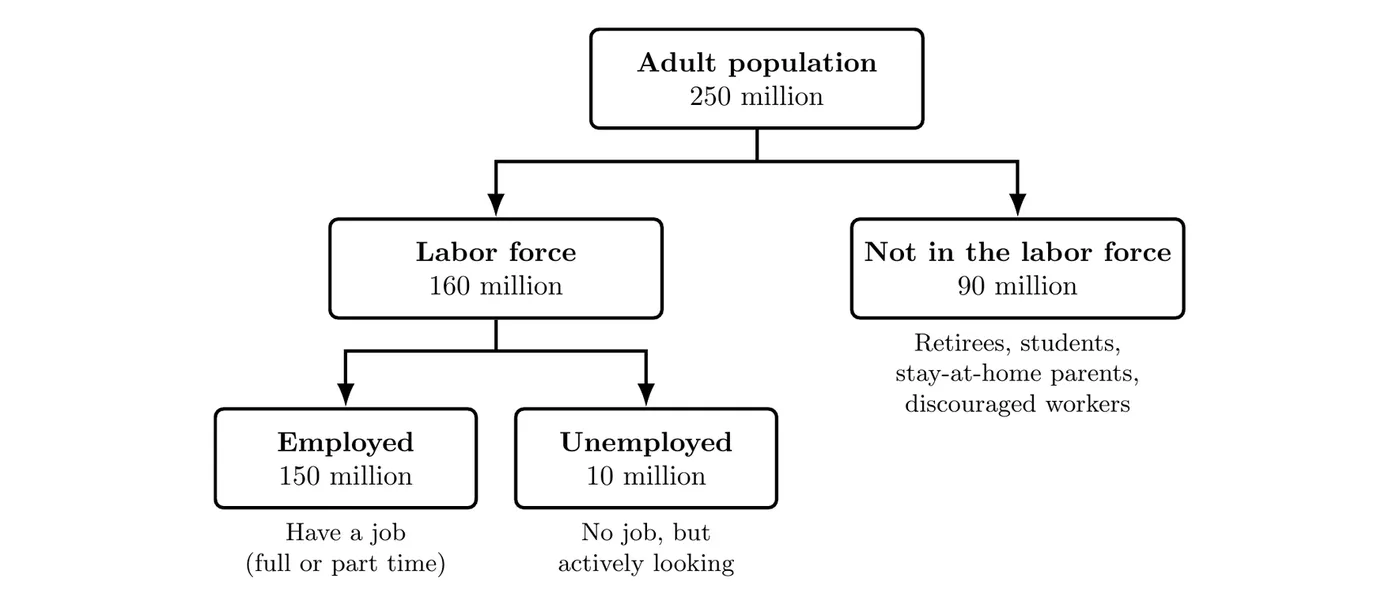
Example: a country has 250 million adults. 150 million are employed, 10 million are unemployed, and 90 million aren’t in the labor force.
- Labor force million
- Unemployment rate
- Labor force participation rate
Now say 2 million of the unemployed give up and become discouraged workers. The unemployed drop to 8 million and the labor force drops to 158 million, so the unemployment rate falls to about 5.1% and the participation rate falls to 63.2%. The unemployment rate looks better, but nobody found a job.
How changes affect the two rates:
What happens | Unemployment rate | Labor force participation rate |
An unemployed person finds a job | Falls | No change |
An unemployed person stops looking (becomes discouraged) | Falls | Falls |
A student or retiree starts looking for work | Rises | Rises |
A new graduate starts a job right away | Falls slightly | Rises |
A worker loses their job and keeps looking | Rises | No change |
A worker retires | Rises slightly | Falls |
Types of Unemployment
- Frictional unemployment: happens while someone is voluntarily job searching, like a recent grad entering the market or someone relocating.
- Structural unemployment: involuntary, caused by a mismatch between someone’s skills and available jobs, often due to technology, like cashiers replaced by self-checkout or factory workers replaced by robots or outsourcing.
- Cyclical unemployment: caused by the business cycle, showing up during recessions when businesses need fewer workers because they’re producing less.
Natural Rate of Unemployment (NRU)
Cyclical unemployment is the only type that’s clearly bad for the economy. Frictional and structural unemployment can actually be signs of a healthy, evolving economy.
The NRU is the unemployment rate when there’s no cyclical unemployment. That’s the rate you get when the economy is producing its full employment output, so an economy at the NRU is said to be at full employment. It equals frictional plus structural unemployment. The NRU doesn’t move with the business cycle, but it can shift gradually due to social, political, and economic conditions. For instance, an aging population might lower the NRU (older workers change jobs less often), while a high minimum wage or a generous social safety net tends to raise it.
Cyclical unemployment is how far the actual unemployment rate is from the natural rate:
For example, if the unemployment rate is 7% and the NRU is 5%, cyclical unemployment is 2%. If the unemployment rate drops below the NRU (say 4%), cyclical unemployment is negative. That happens when the economy is producing more than its full employment output, which can’t last (see 2.7).
So full employment doesn’t mean 0% unemployment. There’s always some frictional and structural unemployment. In recent years, the US NRU has been estimated at around 4% to 5%.
How the types of unemployment change:
- Cyclical rises in a recession, when firms produce less and lay off workers, and shrinks as the economy recovers.
- Structural rises when technology or shifts in demand leave workers with skills employers no longer need, like coal miners after many power plants switched to natural gas. Job training and education can bring it down.
- Frictional falls when it gets easier to match workers with jobs, like with online job sites. It rises when more people are between jobs, like a wave of new graduates, or when more generous unemployment benefits let people search longer.
Since the NRU is frictional plus structural unemployment, changes in those two (and in labor force characteristics like age and skills) are what move the NRU over time.
Takeaway
The official unemployment rate can be misleading, especially since it excludes discouraged workers. Cyclical unemployment is a clear sign of recession, while frictional and structural unemployment are normal and make up the Natural Rate of Unemployment, which is generally the goal for a fully utilized economy.