

4.5 - The Money Market
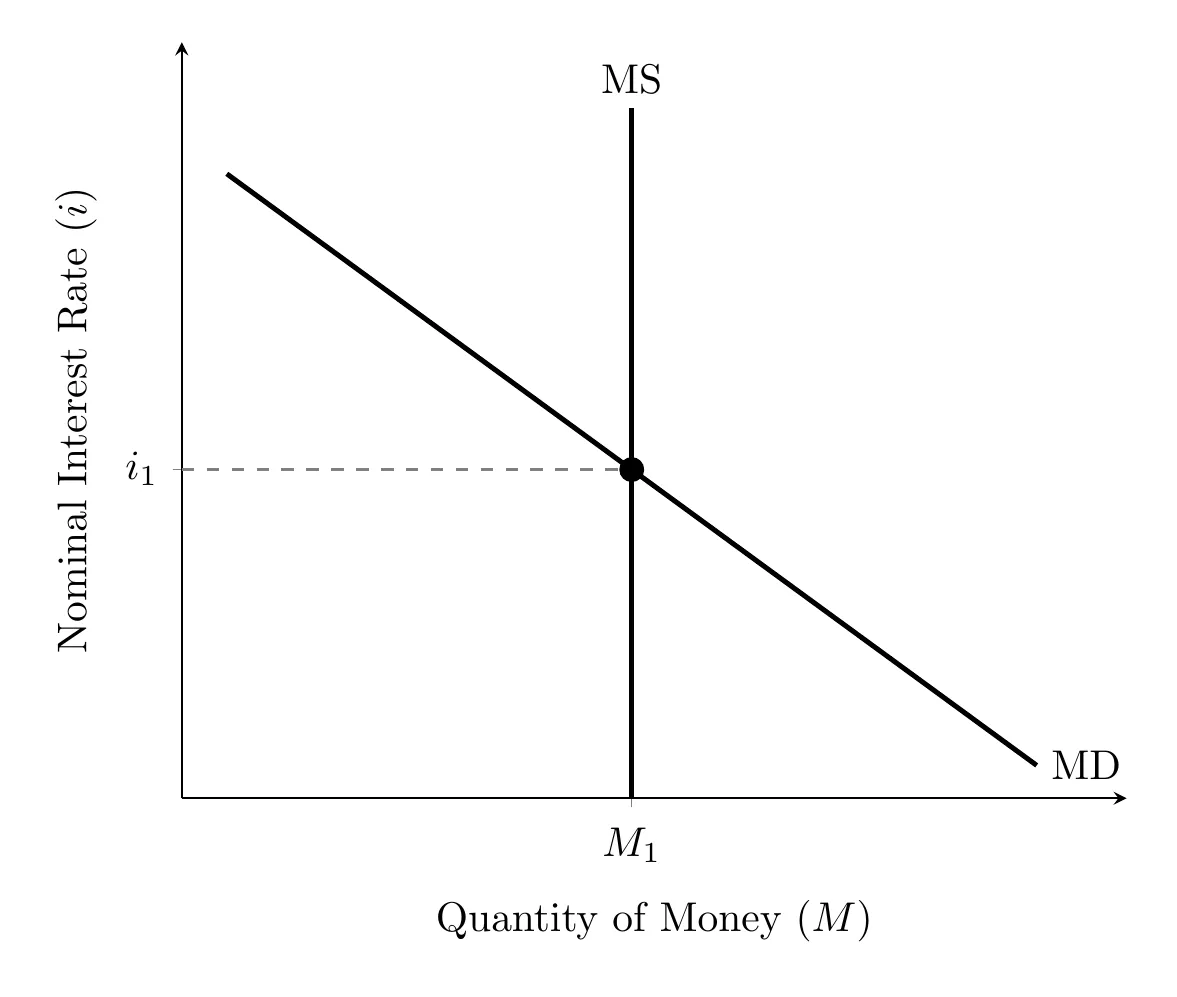
The main model here has the quantity of money on the x-axis and the nominal interest rate on the y-axis.
Money Supply (MS)
The money supply curve is vertical, meaning there’s no relationship between the nominal interest rate and the quantity of money out there. That’s because the Fed controls the money supply directly through the monetary base.
Money Demand (MD)
The money demand curve slopes downward: as the nominal interest rate falls, people want to hold more money. Why do people demand money? So it’s easier to buy stuff.
Remember, holding money instead of an interest-bearing asset has an opportunity cost, the interest you’re giving up. So:
- At a high interest rate (say 10%), the opportunity cost of holding cash is steep.
- At a low rate (say 0.1%), the opportunity cost is tiny, so it’s more convenient to just hold cash.
Equilibrium and Disequilibrium
The money market is in equilibrium at the nominal interest rate where the quantity of money people want to hold equals the quantity of money supplied. That’s where MD crosses MS, at in the graph above. At any other rate, there’s a surplus or a shortage of money, and market forces push the rate back to equilibrium:
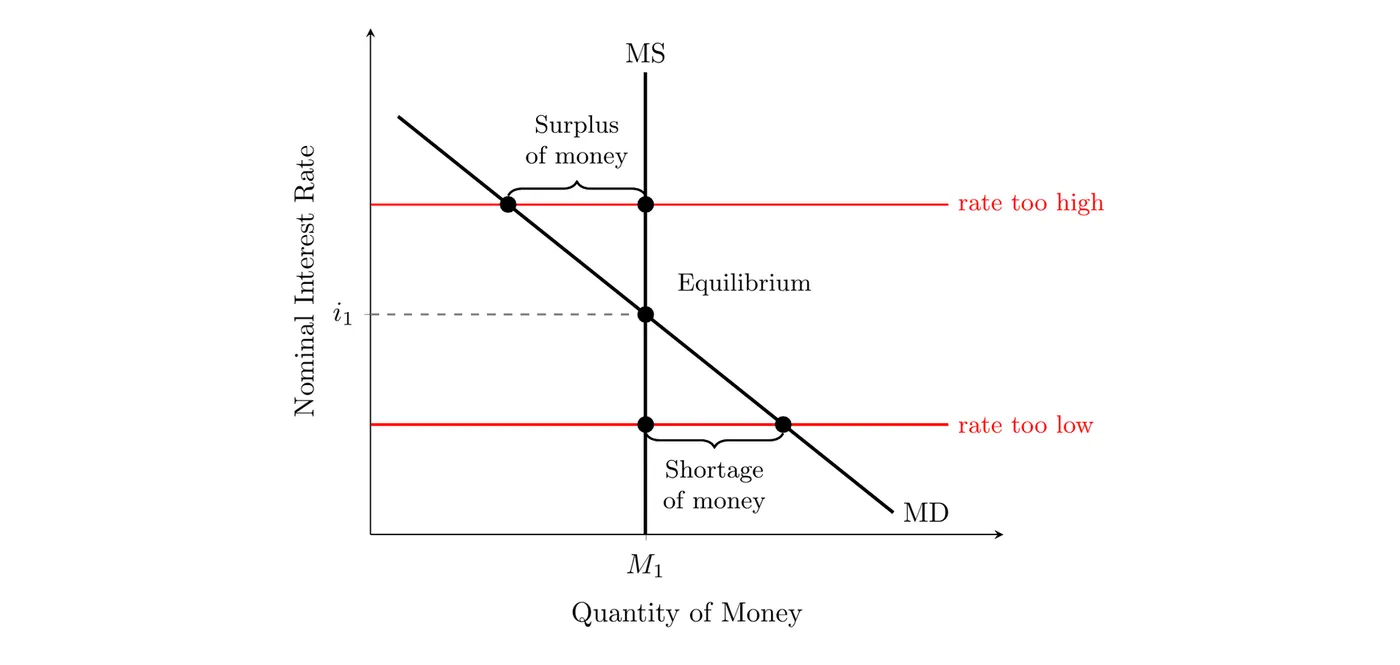
- Rate too high (surplus of money): people are holding more money than they want. They use the extra money to buy bonds and other interest-bearing assets. That extra demand pushes bond prices up, so interest rates fall until the surplus is gone.
- Rate too low (shortage of money): people want to hold more money than there is. They sell bonds to get money, which pushes bond prices down and interest rates up until the shortage is gone.
What Shifts Money Demand
- Price level: if prices rise, people need more cash to buy the same stuff, so MD shifts right (raising the nominal rate). If prices fall, MD shifts left.
- Real GDP: more output being bought and sold means people need more money to handle it, shifting MD right. Since AD affects both P and Y together, a shift in AD moves money demand too.
- Banking convenience: if it’s easier to access money when you need it (say, from an ATM around every corner), people are comfortable holding less cash day-to-day, shifting MD left. If access gets harder (like during a hurricane), people want to hold more cash just in case, shifting MD right.
- Interest on checking accounts: if banks start paying interest on checking, the opportunity cost of holding money drops, so MD shifts right.
Changes in the Equilibrium Interest Rate
In this model, the money supply shifts when the central bank changes it with monetary policy (4.6). If the Fed increases the money supply (for example, by buying bonds), MS shifts right. If it decreases the money supply (by selling bonds), MS shifts left.
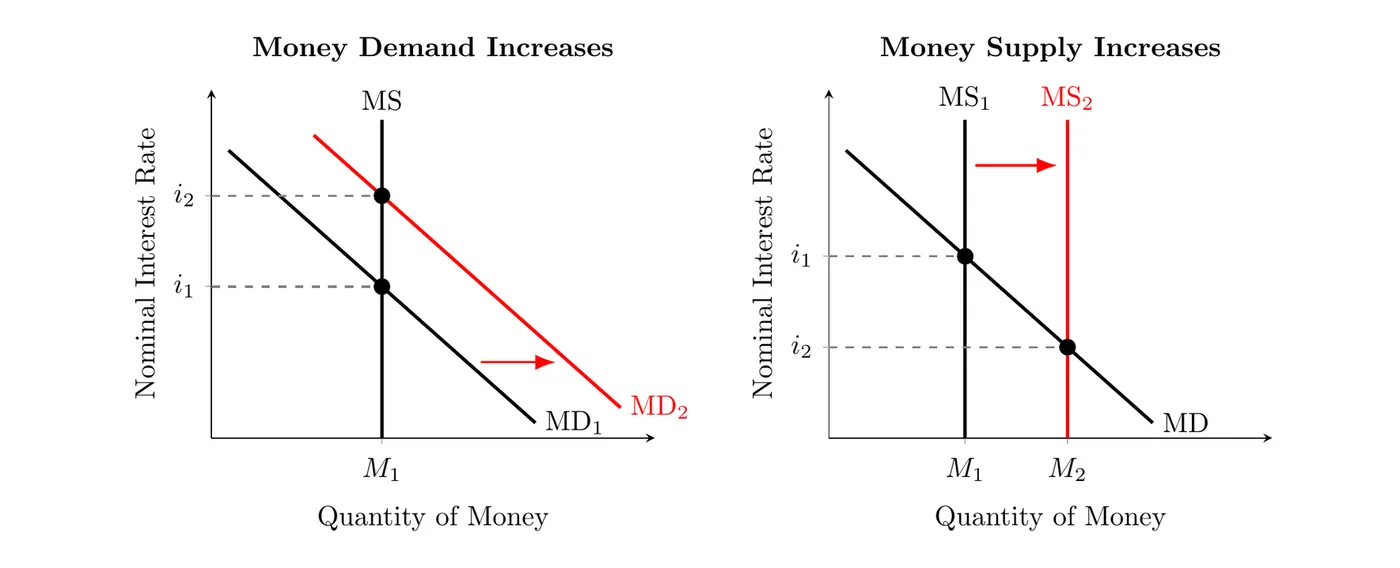
- MD increases (right): the nominal interest rate rises, from to in the left graph. The quantity of money doesn’t change, since MS is vertical.
- MD decreases (left): the nominal interest rate falls.
- MS increases (right): the nominal interest rate falls, from to in the right graph, and the quantity of money rises from to .
- MS decreases (left): the nominal interest rate rises and the quantity of money falls.
Bond prices always move the opposite way from the interest rate (4.1), so a shift in the money market changes the value of bonds too.
Bottom line: the nominal interest rate is the price of holding money. The Fed fixes the money supply vertically, while money demand slopes down because lower rates make holding cash less costly. Demand shifts mainly with the price level and real GDP.