

4.6 - Monetary Policy
What Monetary Policy Is
Monetary policy is what a central bank does to change interest rates and the money supply to reach its goals for the economy. In the U.S., the central bank is the Federal Reserve (the Fed). Its main goals are price stability (low, steady inflation; the Fed aims for 2% inflation over the long run) and maximum employment. Monetary policy is different from fiscal policy (3.8), where Congress and the President change government spending and taxes.
Controlling the Money Supply
The money supply and nominal interest rates move opposite each other: more money out there means lower rates. The Fed changes the money supply specifically to influence interest rates. While banks technically create money through lending, the Fed controls the monetary base and has huge influence over the overall money supply.
Limited reserves vs. ample reserves:
- In a limited reserve system, banks lend out basically everything they’re allowed to, keeping only what’s required.
- In an ample reserve system, banks hold lots of extra reserves regardless of the requirement, making the reserve requirement basically irrelevant.
Tools in a Limited Reserve Economy
- Reserve requirement (RR): the Fed sets what percentage of deposits banks can’t lend out. This directly sets the money multiplier (1/RR). Raise the RR, and the money supply shrinks while rates rise. Lower it, and the opposite happens.
- Discount rate: the rate the Fed charges banks for short-term borrowing (the Fed acts as a lender of last resort). A higher discount rate discourages borrowing, shrinking the money supply and raising rates. Lower it, and borrowing picks up, expanding the money supply and lowering rates.
- Open market operations (OMO): the most commonly used tool. The Fed buys and sells government bonds.
- Open market purchase: the Fed buys bonds from a bank, crediting new reserves to its account. This grows the money supply and lowers rates.
- Open market sale: the Fed sells bonds to a bank, pulling reserves (and money) out of circulation. This shrinks the money supply and raises rates.
How an open market operation changes the money supply: when the Fed buys bonds, it pays by adding reserves to the seller’s bank account, so bank reserves and the monetary base rise by the full amount of the purchase. With limited reserves, banks lend those new reserves out, and the money multiplier (4.4) turns them into even more money. So the money supply rises by more than the monetary base. An open market sale works the same way in reverse.
Example: the reserve requirement is 10%, and the Fed buys $10 million of bonds from Bank A.
- Bank A’s balance sheet: bonds fall $10 million and reserves rise $10 million. Its deposits don’t change, so the whole $10 million is excess reserves.
- Monetary base: rises by $10 million.
- Money supply: can rise by up to $10 million × 10 = $100 million. Nothing gets subtracted here, since the Fed created brand new money (see 4.4).
The Federal Funds Rate and Ample Reserves
The federal funds rate (FFR) is the rate banks charge each other for overnight loans. The Fed influences it through OMOs.
- The discount rate acts as a ceiling on the FFR, since no bank would pay another bank more than what the Fed itself would charge.
- The interest on reserves (IOR) acts as a floor, since no bank would lend to another bank for less than what the Fed guarantees on reserves.
In an ample reserve economy, OMOs stop having much effect on the FFR, since reserves sit in the flat part of the demand curve. Instead, the Fed changes the FFR by adjusting its administered rates (the discount rate and IOR directly). Lowering those rates lowers the FFR, expands the money supply, and lowers the nominal rate.
The reserve market model shows why. Demand for reserves slopes down, then goes flat at the IOR, since no bank would lend its reserves out overnight for less than it earns by leaving them at the Fed. Supply of reserves is a vertical line at whatever amount the Fed provides.
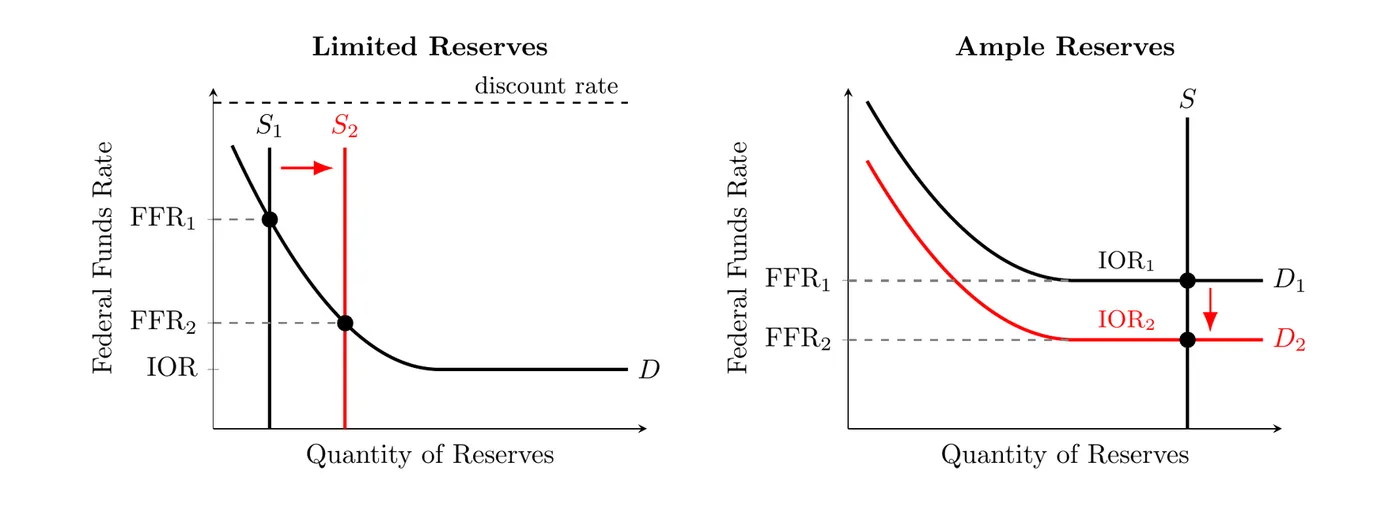
- Limited reserves (left): supply crosses demand on its downward-sloping part. An open market purchase adds reserves (supply shifts from to ), and the FFR falls. The discount rate caps the FFR from above, and the IOR holds it up from below.
- Ample reserves (right): supply crosses demand on its flat part, so adding or removing some reserves barely moves the FFR. To change the FFR, the Fed changes the IOR. Lowering the IOR (from to ) drops the flat part of demand, and the FFR falls with it.
The U.S. today: since the 2008 financial crisis, U.S. banks have held far more reserves than they’re required to, so the U.S. has an ample reserve system, and the Fed’s key policy tool is interest on reserves. (In March 2020, the Fed cut the reserve requirement to 0%.) The FFR is the Fed’s policy rate: the Fed announces a target range for it (for example, 4.25% to 4.50%) and sets its administered rates to keep the FFR inside that range. Many other central banks also target an overnight rate that banks charge each other.
Using Monetary Policy to Close Output Gaps
Whatever tool the Fed uses, the point is to change interest rates, because interest rates change spending. Lower rates make borrowing cheaper, so businesses spend more on investment (new equipment, factories) and households spend more on things they usually buy with loans (cars, houses). Higher rates do the opposite.
- Expansionary monetary policy fixes a recessionary (negative) output gap, when real GDP is below potential. The Fed buys bonds, lowers the discount rate, lowers the reserve requirement, or lowers the IOR. Interest rates fall → investment and consumption rise → AD shifts right → real GDP and the price level rise, and unemployment falls.
- Contractionary monetary policy fixes an inflationary (positive) output gap, when real GDP is above potential. The Fed sells bonds, raises the discount rate, raises the reserve requirement, or raises the IOR. Interest rates rise → investment and consumption fall → AD shifts left → real GDP and the price level fall, and inflation slows.
To show this on a graph, use a money market (or reserve market) graph for the interest rate and an AD-AS graph for output and prices. Here’s expansionary policy closing a recessionary gap:
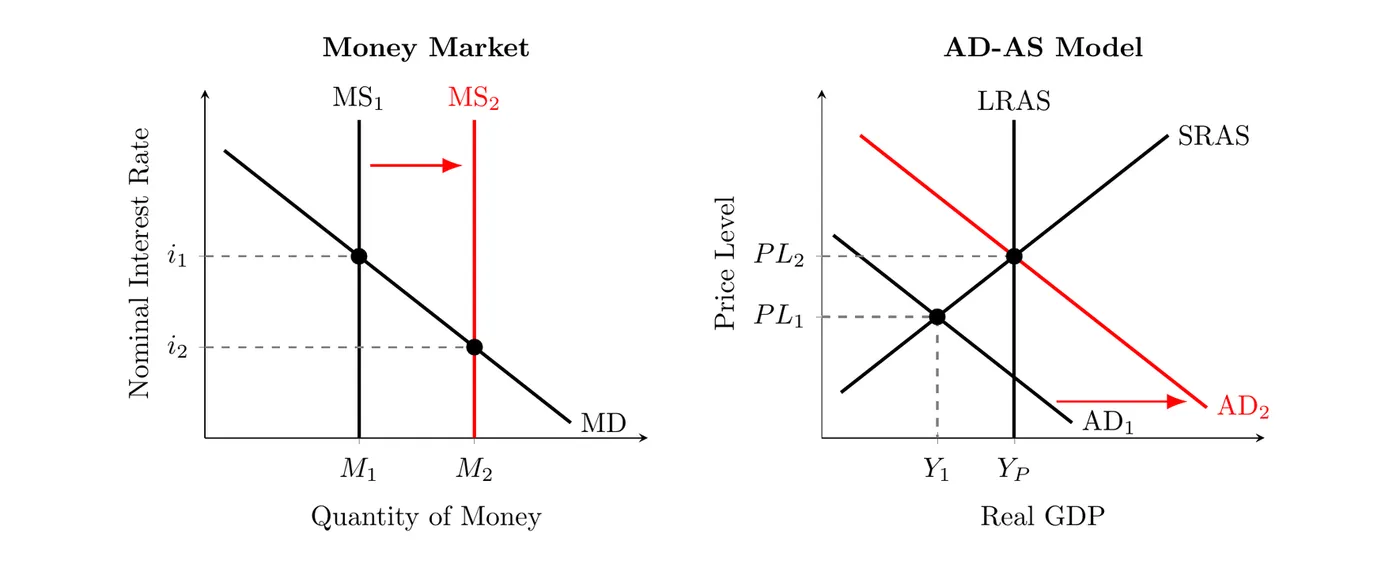
The Fed’s open market purchase shifts the money supply from to , so the nominal interest rate falls from to . Investment and consumption rise, so AD shifts from to . Real GDP rises from to potential output , and the price level rises from to . (Lower interest rates also affect exchange rates and capital flows, which you’ll see in Unit 6.)
Lags in Monetary Policy
Like fiscal policy (3.8), monetary policy doesn’t work instantly. First there’s a recognition lag: it takes time to collect data and realize the economy has a problem. Then, once the Fed acts, it takes time for the economy to adjust, since businesses and households take months to change their borrowing and spending plans. The Fed can decide faster than Congress (its policy committee, the Federal Open Market Committee, meets eight times a year and can also meet in between), but its actions can take a long time to show up in output and prices. By the time a policy kicks in, the economy may have already changed.
Bottom line: the Fed uses different tools depending on the reserve environment. In a limited reserve world, open market operations do the heavy lifting. In an ample reserve world, the Fed relies on adjusting its administered rates (the ceiling and floor) to steer the federal funds rate.