

6.4 - Effect of Changes in Policies and Economic Conditions on the Foreign Exchange Market
Core Logic
When something shifts demand for one currency (say, the yen), supply of the other currency (the dollar) shifts too, and in the same direction. When one currency appreciates, the other must depreciate, since they’re priced relative to each other.
Shifters of Supply and Demand
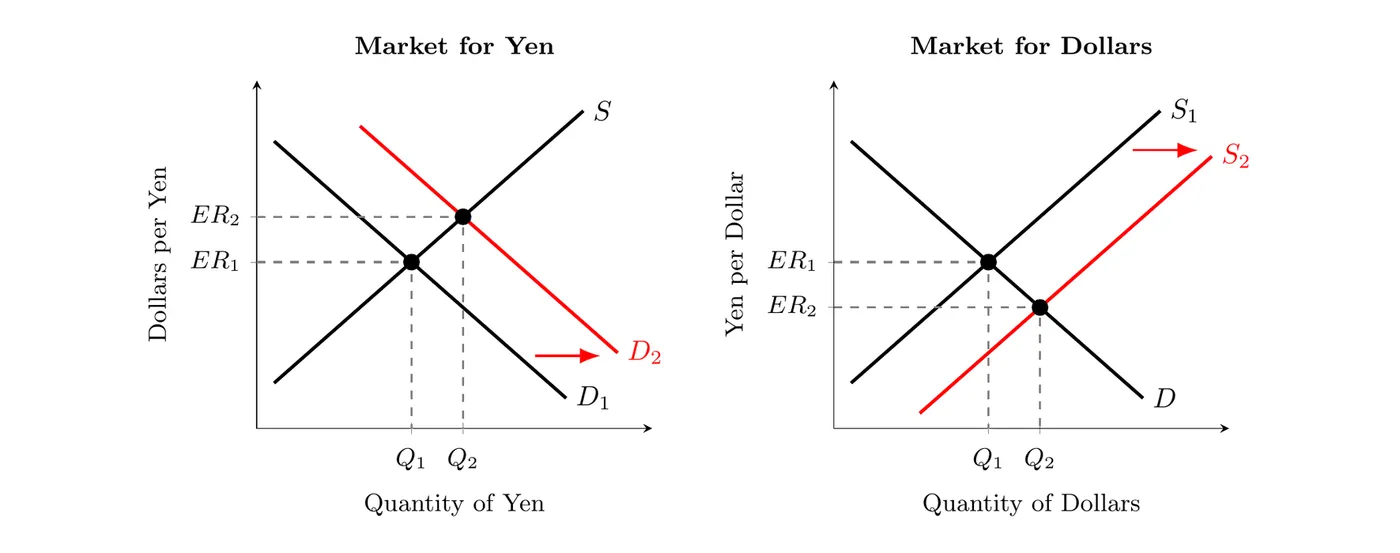
- Tastes/preferences: if Americans want more Japanese goods, demand for yen rises and supply of dollars rises too. The yen appreciates, the dollar depreciates.
- National income/real GDP: if U.S. income grows faster than Japan’s, Americans can afford more of everything, including Japanese goods. This causes the faster-growing country’s currency (the dollar) to depreciate, while the slower-growing country’s currency (the yen) appreciates.
- Relative price levels (inflation): the country with lower inflation sees its currency appreciate; higher inflation leads to depreciation. If U.S. inflation is higher, American goods get relatively pricier, demand for dollars falls, and the dollar depreciates.
- Real interest rates: savers chase the highest real return. If real rates rise in Japan, American savers want Japanese assets, raising demand for yen and supply of dollars, so the yen appreciates and the dollar depreciates.
- Trade restrictions: tariffs or quotas reduce purchases of foreign goods, lowering demand for the foreign currency and supply of the domestic currency, causing the domestic currency to appreciate.
Graphing a shift. Take shifter 1, Americans wanting more Japanese goods. To buy them, Americans trade dollars for yen. In the market for yen, demand shifts right and the exchange rate (dollars per yen) rises, so the yen appreciates. In the market for dollars, supply shifts right and the exchange rate (yen per dollar) falls, so the dollar depreciates. Quick rule for which curve moves: if the change starts with foreigners wanting a country’s goods or assets, demand for that country’s currency shifts. If it starts with that country’s own people wanting foreign goods or assets, the supply of its currency shifts.
Policy Effects
- Expansionary fiscal policy (raises AD, real GDP, and P) → currency appreciates. More spending or lower taxes means a bigger deficit, so the government borrows more and the real interest rate rises (4.7, 5.5). Foreign savers want those higher returns, so demand for the currency rises.
- The appreciation then makes exports pricier and imports cheaper, so net exports fall and cancel out part of the AD increase. Like crowding out, this makes fiscal policy a bit weaker in an open economy.
- Higher income and prices also pull in more imports, which pushes the other way. AP questions that link fiscal policy to the exchange rate go through the interest rate: bigger deficit, higher real interest rate, financial capital inflow, appreciation.
- Contractionary fiscal policy (lowers AD, real GDP, and P) → currency depreciates. A smaller deficit (or a surplus) means less government borrowing, so the real interest rate falls, financial capital flows elsewhere for better returns, and demand for the currency drops.
- Expansionary monetary policy (lowers rates) → currency depreciates (foreign savers buy fewer of that country’s assets).
- Full chain: the central bank buys bonds (or lowers its administered rates), the money supply rises, and interest rates fall. AD, real output, and the price level rise. Lower rates send financial capital abroad, so demand for the currency falls, supply rises, and it depreciates. That makes exports cheaper and imports pricier, so net exports rise and push AD even further right. In an open economy, the exchange rate makes monetary policy stronger.
- Contractionary monetary policy → currency appreciates.
- Full chain: the central bank sells bonds (or raises its administered rates), the money supply falls, and interest rates rise. AD, real output, and the price level fall. Higher rates attract foreign financial capital, so the currency appreciates, net exports fall, and AD shifts even further left.
Effects on Net Exports and AD
Action | Effect on relative prices | Effect on net exports | Effect on AD |
Currency appreciates | Foreign goods get cheaper; domestic goods get pricier abroad | Imports rise, exports fall, NX falls | AD shifts left |
Currency depreciates | Domestic goods get cheaper abroad; foreign goods get pricier | Imports fall, exports rise, NX rises | AD shifts right |
Bottom line: a currency’s value reflects how desirable it is, driven by income, inflation, and interest rates. Anything that makes a country’s goods or assets more desirable makes its currency appreciate. Appreciation makes exports pricier and imports cheaper, so net exports (and AD) fall.