

6.6 - Real Interest Rates and International Capital Flows
How Capital Flows Work
In an open economy where capital flows freely, the guiding rule is simple: money flows to whichever country offers the higher real interest rate, since that means a better return for savers.
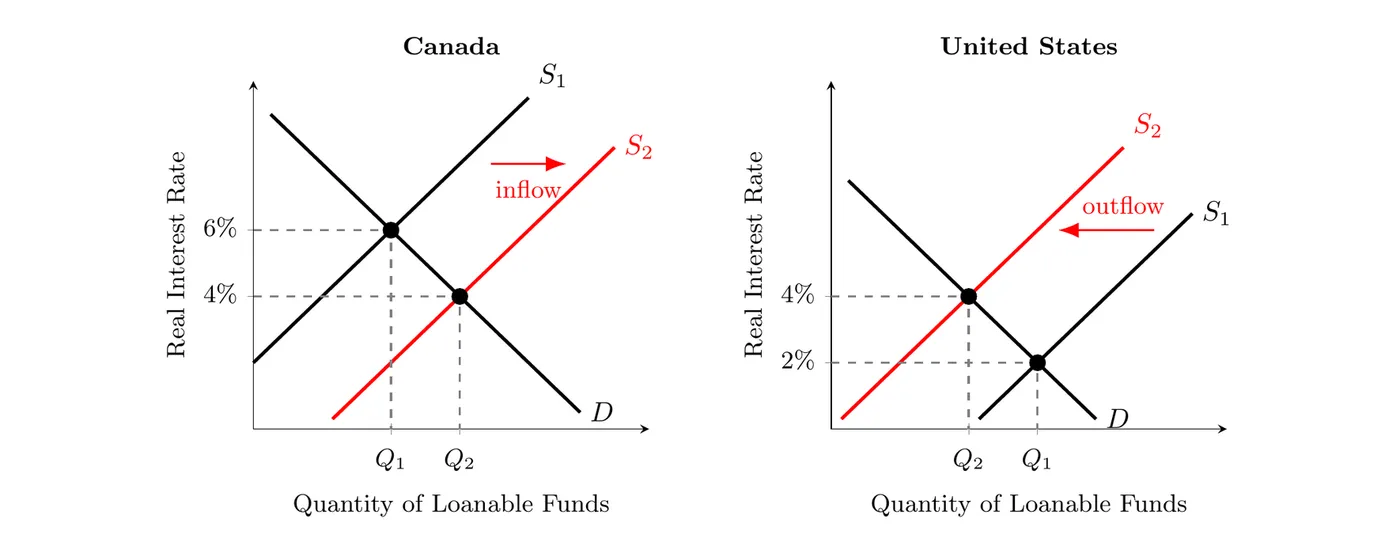
Example: if Canada’s real rate is 6% and the U.S.’s is 2%, capital flows from the U.S. to Canada, as American savers chase the better return in Canadian bonds and institutions.
Effect on loanable funds: Canada (receiving inflows) sees its supply of loanable funds shift right; the U.S. (losing outflows) sees its supply shift left.
Interest Rate Convergence
Capital keeps flowing as long as a gap in real rates exists. As money flows into Canada, its rate gets pushed down; as money flows out of the U.S., its rate gets pushed up. Eventually the two rates converge somewhere in the middle (say, 4%). If too much capital flowed and Canada’s rate dropped below the U.S. rate, the flow would simply reverse.
Generally, capital tends to flow from slower-growing economies toward faster-growing ones, since faster growth usually means higher demand for capital and thus a better return for savers.
Connection to FOREX
Changes in real interest rates also move the foreign exchange market. To buy foreign financial assets, savers first need to convert their currency. So if real rates rise in Japan, American savers wanting Japanese bonds increase demand for yen and supply of dollars.
Back to the Canada example: American savers buying Canadian bonds supply U.S. dollars and demand Canadian dollars, so the Canadian dollar appreciates and the U.S. dollar depreciates. The flows show up in the BOP too. Canada’s CFA moves toward a surplus (financial capital inflow), and since the stronger Canadian dollar cuts Canada’s net exports, its current account moves toward a deficit. The U.S. gets the opposite: a CFA deficit (outflow), a weaker dollar, and higher net exports.
One thing to watch for: capital inflows can show up in both the FOREX model and the loanable funds model, so read questions carefully to know which one’s being asked about.
Central Banks and Capital Flows
A central bank can move its country’s interest rate in the short run, and that changes capital flows:
- Contractionary monetary policy (the Fed sells bonds or raises its administered rates): U.S. interest rates rise, U.S. assets pay more, and net capital inflows rise. Demand for dollars increases and the dollar appreciates.
- Expansionary monetary policy (the Fed buys bonds or lowers its administered rates): U.S. interest rates fall, financial capital flows out to countries with better returns, and net capital inflows fall. The dollar depreciates.
This only lasts in the short run. In the long run, the price level adjusts to the new money supply and the real interest rate goes back to where the loanable funds market sets it (monetary neutrality, 5.3).
Bottom line: the core rule for international capital flow is that money chases the highest real interest rate. This flow shifts loanable funds supply in both countries until their real rates converge, linking their financial markets together.
BackNext