

5.1/5.2 - Factor Markets
What Are Factor Markets?
Factor markets are where productive resources get bought and sold. The roles flip compared to product markets: here, businesses are the buyers (demanders) and households are the sellers (suppliers).
Three main resources:
- Land → earns rent.
- Labor → earns wages (our focus here).
- Physical capital → earns interest, often financed through loans.
Factor prices work as signals, just like product prices. Factors of production respond to them: a higher wage for nurses draws more people into nursing, and higher rent for farmland pulls more land into farming. Firms respond too, using less of a factor when it gets more expensive.
A firm's decision to hire a factor comes down to three things:
- Productivity of the factor: how much extra output it adds (its marginal product).
- Price of the output: what that extra output sells for.
- Cost of the factor: the wage, rent, or interest the firm has to pay for it.
The first two together make up the factor's MRP (below), and the firm compares that to the third.
MP, MC, and the Hiring Rule
To decide how many workers to hire, a firm looks at its production function.
- Marginal Product (MP): the extra output from one more worker. MP rises at first (specialization) but eventually falls as more workers pile on, because of diminishing marginal returns.
- Marginal resource cost (MRC): the extra cost of hiring one more worker, found as the change in total labor cost divided by the change in the number of workers. When a firm can hire all the workers it wants at the market wage, MRC is just the wage. (Don't mix this up with the marginal cost of output from 3.1, , which is the cost of making one more unit of the product.)
- Marginal Revenue Product (MRP): the extra revenue from hiring one more worker.
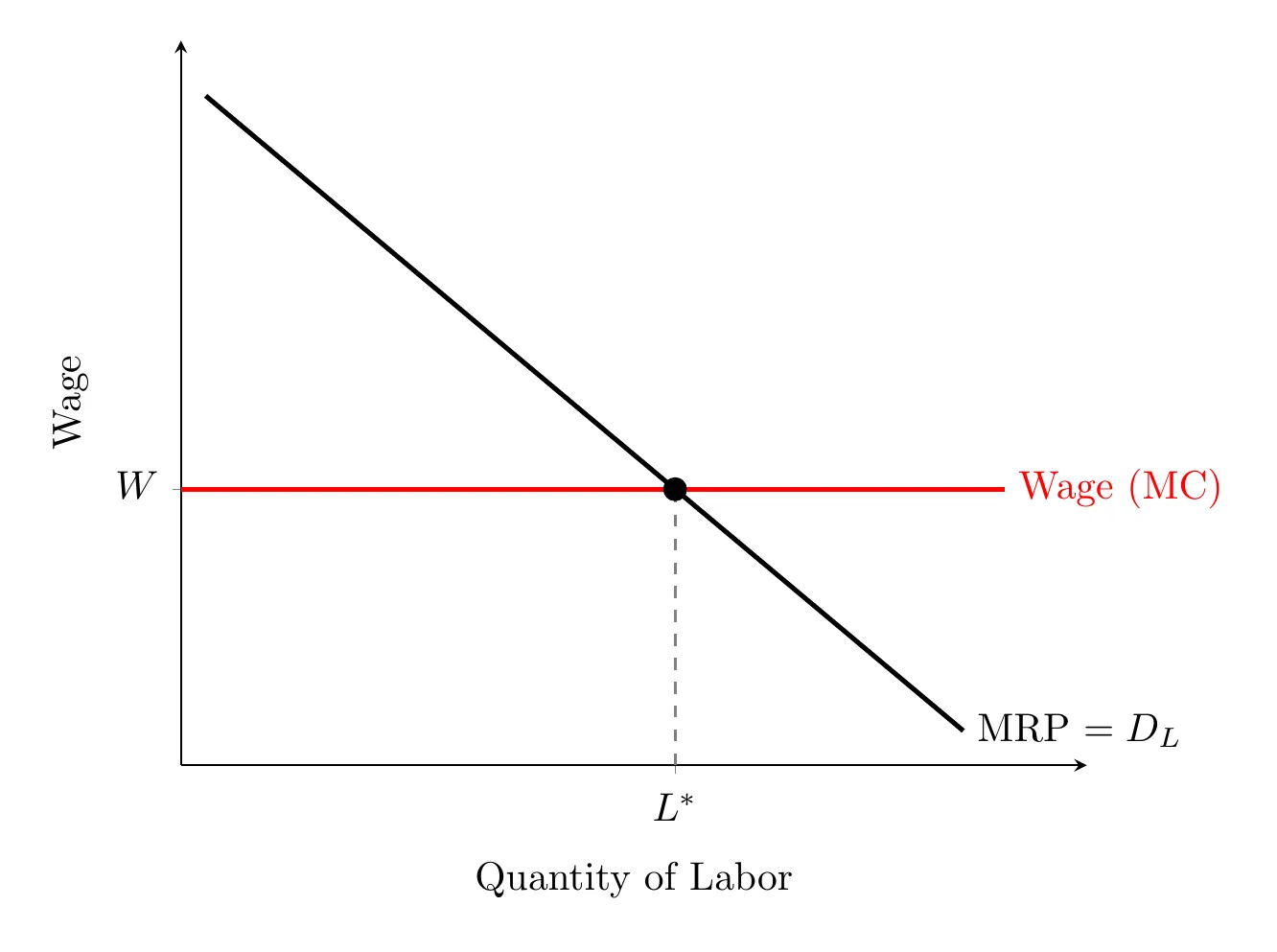
Hiring rule: keep hiring as long as MRP is greater than or equal to the marginal cost (wage).
Example: a pizza shop's next worker would add 3 pizzas an hour (MP), and pizzas sell for $10, so that worker's MRP is 3 × $10 = $30 an hour. At a wage of $18 an hour, hiring them adds $12 an hour to profit, so the shop hires. It keeps hiring until diminishing returns push MRP down to the wage.
The Demand for Labor (Derived Demand)
Labor demand is a derived demand, it comes from demand for whatever the labor produces. More demand for houses means more demand for carpenters.
Labor demand slopes downward, so the quantity of labor demanded falls as the wage rises. Because of diminishing marginal returns, each extra worker's MRP is lower than the last one's, so a firm only hires more workers if the wage drops to meet that lower MRP.
Labor demand shifts when:
- Product price/demand changes: higher product price raises MRP, shifting demand right.
- Productivity changes: more productive workers have higher MRP.
- Example: better training or better equipment raises each worker's MP, so MRP rises at every quantity of labor and labor demand shifts right.
- Substitute resource prices change: cheaper automation might reduce demand for labor.
- Complementary resource prices change: if a resource used alongside labor gets cheaper (say, delivery trucks), firms buy more of it and need more workers to use it (drivers), so labor demand shifts right.
- Number of employers changes: a new hospital opening in town shifts the demand for nurses there to the right.
A change in the wage itself doesn't shift labor demand. It's a movement along the curve (a change in the quantity of labor demanded).
Supply of Labor and Economic Rent
The labor supply curve slopes upward, higher wages attract more willing workers.
Supply shifts with things like the size of the available workforce, population age (retirement), or how much people value leisure.
- Immigration: more workers moving into a country or region shifts labor supply right. Less immigration shifts it left.
- Education and training: more people trained for a job (more nursing programs, say) shifts supply in that job right. Tougher education or licensing requirements shift it left.
- Working conditions: safer, more pleasant jobs with better benefits draw more workers (right). Dangerous or unpleasant jobs draw fewer (left).
- Age distribution: more people of working age shifts supply right. An aging population with more retirees shifts it left.
- Alternative options: if pay rises in another job these workers could do, some switch over. If warehouses raise wages, some retail workers leave, shifting the labor supply for retail left.
- Preferences for leisure: if people start valuing free time more, they offer fewer hours of work, shifting supply left.
- Cultural expectations: norms about who works matter too. As it became more common for women to work outside the home in the second half of the 1900s, labor supply in many markets shifted right.
Just like with demand, a change in the wage itself is a movement along the supply curve, not a shift.
Economic rent is any payment to a worker above the bare minimum needed to keep them in that job (wage minus opportunity cost).
Equilibrium and Minimum Wage
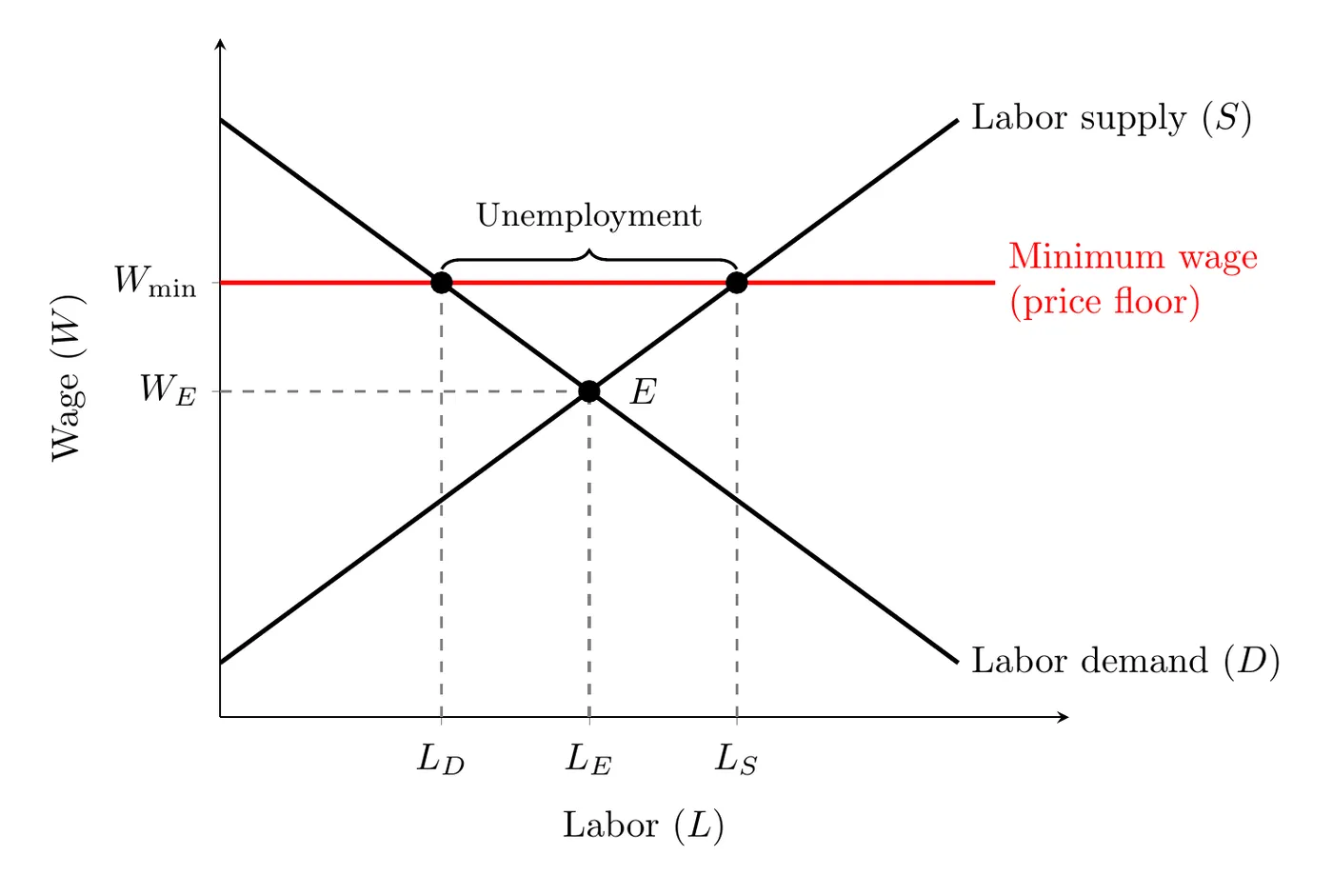
Where labor supply meets labor demand sets the equilibrium wage and quantity, with no unemployment, since the number of workers firms want exactly matches the number willing to work at that wage.
Minimum wage acts as a price floor. Set above equilibrium, it’s “binding” and creates a gap where quantity supplied exceeds quantity demanded, unemployment.
Changes in the Labor Market
When labor demand or supply shifts, the equilibrium wage and quantity of labor change the same way they do in a product market:
- Labor demand increases (higher product price, more productive workers): the wage and employment both rise.
- Labor demand decreases: the wage and employment both fall.
- Labor supply increases (more immigration, more people trained): the wage falls and employment rises.
- Labor supply decreases (more retirements, tougher licensing): the wage rises and employment falls.
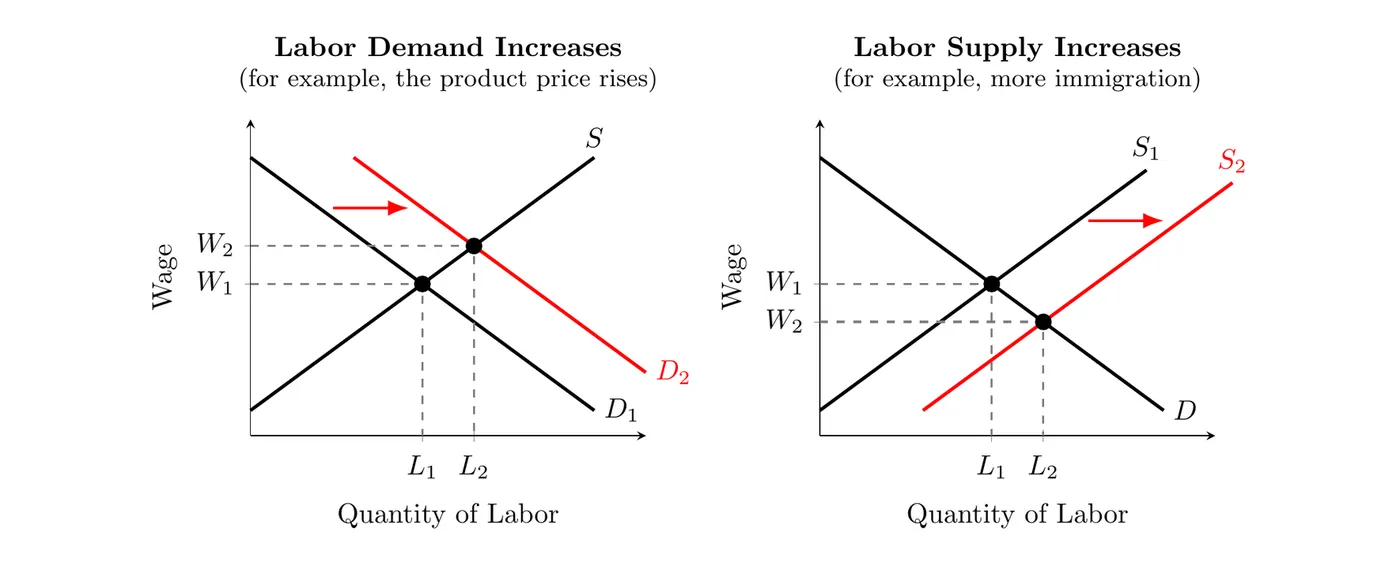
Example: a housing boom raises the price of new homes. Carpenters' MRP goes up, so the demand for carpenters shifts right, and both their wage and the number of carpenters hired rise.
Bottom line: factor markets flip the usual roles, businesses demand resources, households supply them. Firms hire up to the point where MRP equals wage. Market forces usually clear the labor market on their own, but interventions like minimum wage can create a surplus of labor, otherwise known as unemployment.