

5.3 - Profit-Maximizing Behavior in Perfectly Competitive Factor Markets
Characteristics
In a perfectly competitive factor market, no single firm can move the market wage:
- Many buyers and sellers: lots of firms competing for labor, lots of workers offering it.
- Identical skills: workers are interchangeable in skill.
- Perfect information and mobility: workers know all their options and can move freely between jobs.
- Wage takers: firms simply pay whatever wage the broader market sets.
- Output market doesn't matter here: a firm can be a wage taker in the labor market even if it's an imperfect competitor where it sells. A coffee shop has some control over its prices (monopolistic competition), but it hires baristas from the same big pool of workers as every other cafe and store in town, so it pays the going wage.
Marginal Resource Cost (MRC)
MRC (also called Marginal Factor Cost, MFC) is the extra cost of hiring one more worker.
- Perfectly elastic supply: labor supply is horizontal at the market wage for this firm.
- MRC = wage: since the firm can hire as many as it wants at that constant wage, MRC equals the wage.
Marginal Revenue Product (MRP)
MRP is the extra revenue from the output an additional worker produces.
You can also find MRP straight from total revenue, as the change in total revenue from hiring one more worker:
Which MR goes into the formula depends on the firm's output market:
- Perfectly competitive output market: MR equals the price, so . This is also called the value of the marginal product (VMP). Here MRP falls only because MP falls.
- Imperfectly competitive output market (monopoly, oligopoly, monopolistic competition): the firm has to lower its price to sell more, so MR is less than P. MRP is smaller than VMP and falls faster, because both MP and MR shrink as more workers are hired.
Since MRP represents the maximum a firm would pay for a worker, the MRP curve is the firm’s labor demand curve. It follows the shape of MP: rising at first with specialization, then falling with diminishing returns.
A firm always ends up hiring on the falling part of MRP, so labor demand is drawn sloping down: at a higher wage, fewer workers have an MRP high enough to be worth hiring.
The Hiring Rule
Hire up to the quantity where MRP = MRC. Hire a worker if MRP is greater than or equal to MRC (they add more to revenue than cost); never hire one whose MRP falls below MRC.
On a graph, the market sets the wage and each firm takes it:
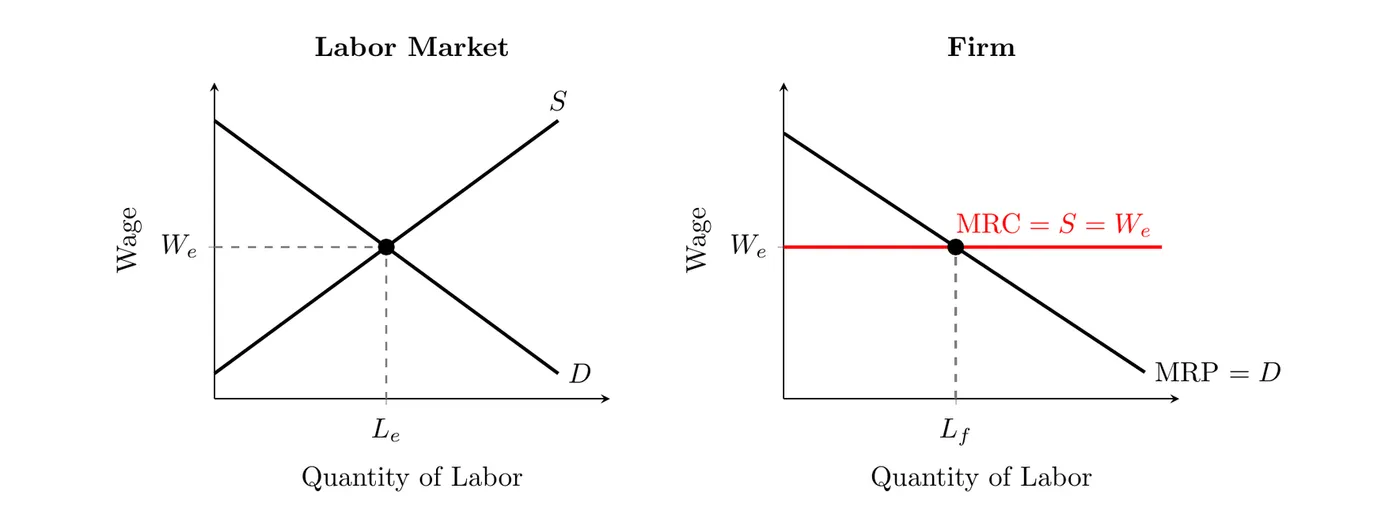
- Labor market (left): market supply and demand for labor set the wage, .
- Firm (right): the firm can hire as many workers as it wants at , so that wage line is both the firm's labor supply and its MRC (). The firm hires workers, where MRP = MRC.
- If the market wage changes: say more immigration increases market labor supply. The market wage falls, the firm's wage line shifts down, and the firm hires more workers (moving down its MRP curve). A higher market wage does the opposite.
- If MRP changes: a higher product price or more productive workers shift the firm's MRP curve right, so it hires more workers at the same wage.
Worked Example: How Many Workers to Hire
A bakery sells bread for $5 a loaf in a perfectly competitive market and hires workers in a perfectly competitive labor market at $30 an hour. Output is in loaves per hour.
Workers | Total Product | MP | Total Revenue | MRP | MRC (wage) |
0 | 0 | $0 | |||
1 | 10 | 10 | $50 | $50 | $30 |
2 | 22 | 12 | $110 | $60 | $30 |
3 | 32 | 10 | $160 | $50 | $30 |
4 | 40 | 8 | $200 | $40 | $30 |
5 | 46 | 6 | $230 | $30 | $30 |
6 | 50 | 4 | $250 | $20 | $30 |
- MP: the change in total product. The 4th worker raises output from 32 to 40 loaves, so MP = 8.
- MRP: the change in total revenue, or MP × P. For the 4th worker, $200 - $160 = $40, which matches 8 × $5.
- MRC: in a perfectly competitive labor market, every worker costs the market wage, $30.
- How many to hire: keep hiring while MRP is at least MRC. Workers 1 through 5 each add at least $30 (the 5th worker's MRP is exactly $30, where MRP = MRC). The 6th worker would add only $20 but cost $30, so the bakery hires 5 workers.
- If the wage rises: at a wage of $45, the bakery hires only 3 workers, since the 4th worker's MRP ($40) is now below the wage. A higher wage means fewer workers hired, which is the downward-sloping labor demand curve at work.
Combining Labor and Capital
To use resources efficiently, firms follow two rules:
1. Least-cost combination rule: to produce a given output as cheaply as possible, marginal product per dollar must be equal across all resources:
If one resource gives more output per dollar than the other, shift toward using more of it until the ratios equalize.
Example: labor costs $15 an hour and the last worker added 30 units, so labor gives 30 / 15 = 2 units per dollar. A machine rents for $50 an hour and the last machine added 50 units, only 1 unit per dollar. Labor is the better deal, so the firm should use more labor and less capital. As it does, labor's MP falls and capital's MP rises (diminishing returns) until the two ratios match.
This is the same idea as utility maximization in 1.6: consumers equalize marginal utility per dollar across goods, and firms equalize marginal product per dollar across inputs.
2. Profit-maximizing combination rule: to maximize total profit, MRP per dollar should equal 1 for every resource:
Why 1? A ratio of 1 means MRP equals the resource's price, which is just the hiring rule (MRP = MRC) applied to every input at once. If MRP / price is above 1 for an input, the last dollar spent on it brings back more than a dollar of revenue, so the firm should use more of it. Below 1, it should use less.
A firm at the profit-maximizing combination is automatically at the least-cost combination too, but not the other way around: a firm can make the wrong amount of output at the lowest possible cost.
Bottom line: firms in perfectly competitive factor markets are wage takers, treating the market wage as a constant MRC. By comparing that cost to each worker’s MRP, the firm finds the ideal headcount. And to get the best value from every resource, it balances marginal productivity per dollar across labor and capital alike.