

5.4 - Monopsonistic Markets
What Is a Monopsony?
Where a monopoly is a single seller, a monopsony is a single buyer, usually the only employer in a labor market.
- No alternatives: workers have nowhere else to go within that market.
- High entry barriers: keep other employers from moving in to compete for workers.
- Classic example: an old mining town, where the mining company was the only employer, and sometimes even owned the store where workers spent their wages. True monopsonies are rare today, but some regions still have one dominant employer.
The Cost of Labor: Supply vs. MRC
Since the monopsonist is the whole market, the firm’s supply curve is just the upward-sloping market supply curve.
- Wage-taker vs. wage-maker: competitive firms hire freely at the market wage, but a monopsonist has to raise wages to attract each additional worker.
- MRC exceeds wage: since raising the wage for one new hire also means paying that higher wage to everyone already on staff, the cost of that new hire (MRC) is higher than their wage alone.
- Example: paying one worker $10, but needing $11 to attract a second, total cost jumps from $10 to $22. That second worker’s MRC isn’t $11, it’s $12 ($11 for them plus $1 extra for the first worker).
- On a graph, the MRC curve sits above the supply curve.
- With a straight-line supply curve, MRC starts at the same point on the wage axis but rises twice as steeply.
Hiring and Wage-Setting
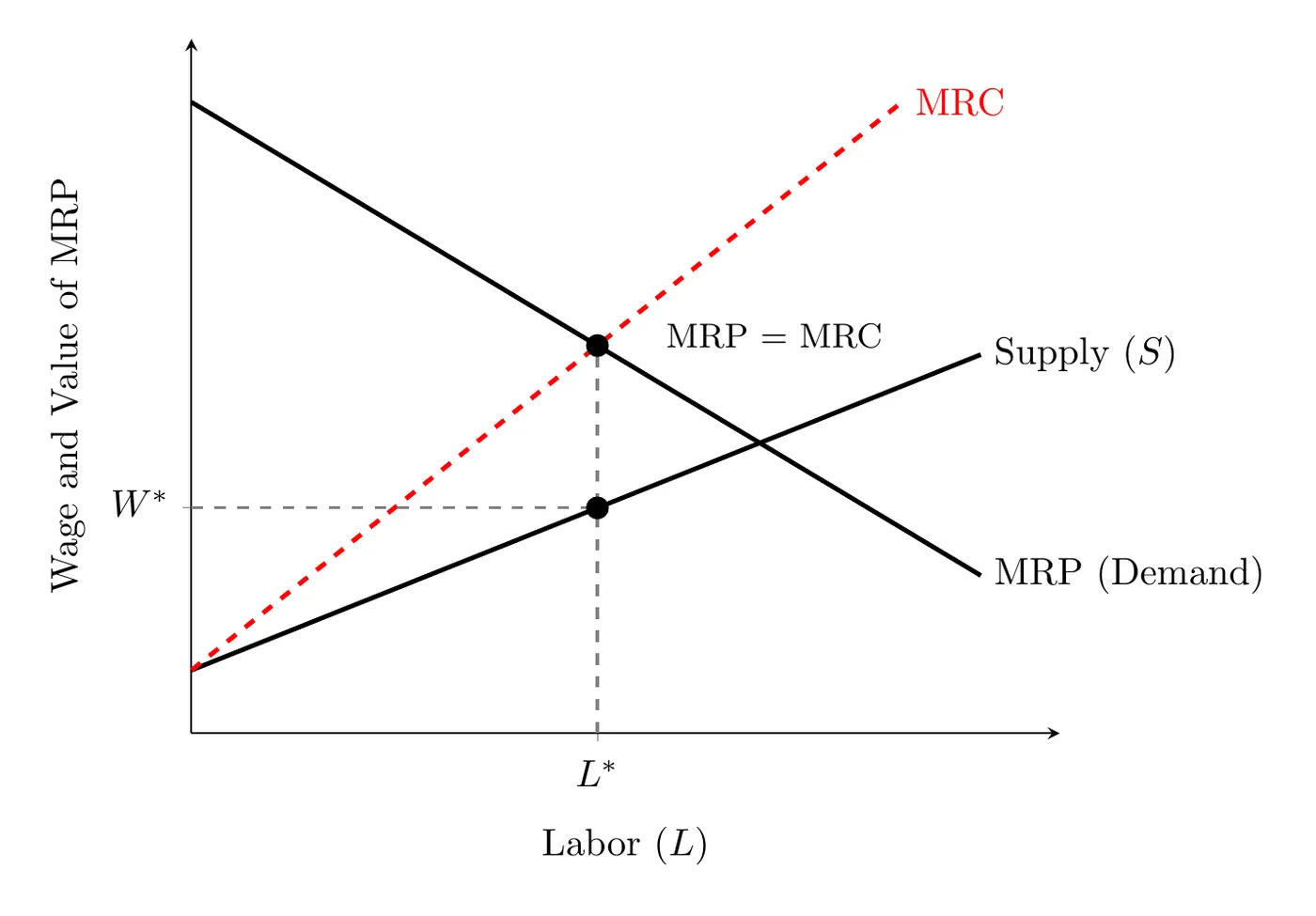
Two steps:
- Find quantity: hire where MRP = MRC.
- Find wage: don’t pay where MRP=MRC, look down at the supply curve to find the lowest wage workers will accept for that quantity.
Worked Example: Hiring in a Monopsony
A town's only employer faces the labor supply below. To attract each extra worker it has to raise the wage by $1, and it pays everyone the same wage.
Workers | Wage (supply) | Total Labor Cost | MRC | MRP |
1 | $8 | $8 | $8 | $20 |
2 | $9 | $18 | $10 | $18 |
3 | $10 | $30 | $12 | $16 |
4 | $11 | $44 | $14 | $14 |
5 | $12 | $60 | $16 | $12 |
6 | $13 | $78 | $18 | $10 |
- MRC: the change in total labor cost. Hiring the 4th worker raises total labor cost from $30 to $44, so MRC = $14, even though that worker's wage is only $11. The extra $3 is the $1 raise for the 3 workers already on staff.
- Quantity: hire while MRP is at least MRC. The 4th worker's MRP ($14) equals MRC ($14), but the 5th worker's MRP ($12) is below MRC ($16), so the firm hires 4 workers.
- Wage: read the supply column at 4 workers. The firm pays $11, not $14.
- Compared to competition: a competitive market would hire where MRP equals the supply wage, at 5 workers and $12. The monopsony hires fewer workers and pays a lower wage.
Inefficiency
Compared to a competitive market, a monopsony:
- Hires fewer workers and pays lower wages.
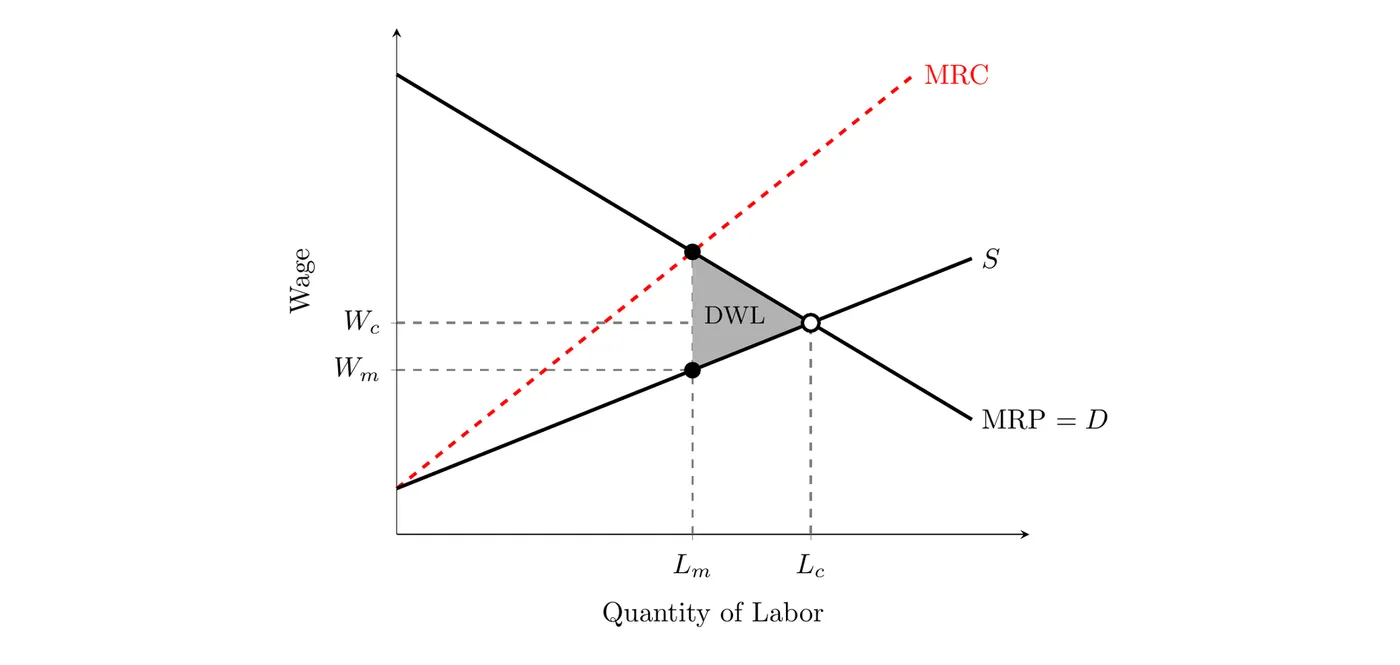
- Creates deadweight loss, since it restricts hiring to keep wages down, missing out on hires that would happen competitively.
On a graph, the competitive outcome is where MRP (labor demand) crosses supply, at and . The monopsony hires only and pays . The shaded triangle between MRP and supply, from to , is the deadweight loss: those workers have an MRP higher than the wage they'd accept, but they never get hired.
Minimum Wage in a Monopsony
Normally minimum wage causes unemployment in a competitive market, but a monopsony is the exception:
- A binding minimum wage makes MRC horizontal (perfectly elastic) at that wage level, up until it hits the supply curve.
- Since the firm no longer has to raise everyone’s pay just to hire one more person, the incentive to restrict hiring disappears.
- Result: an effective minimum wage in a monopsony can raise both wages and employment at the same time.
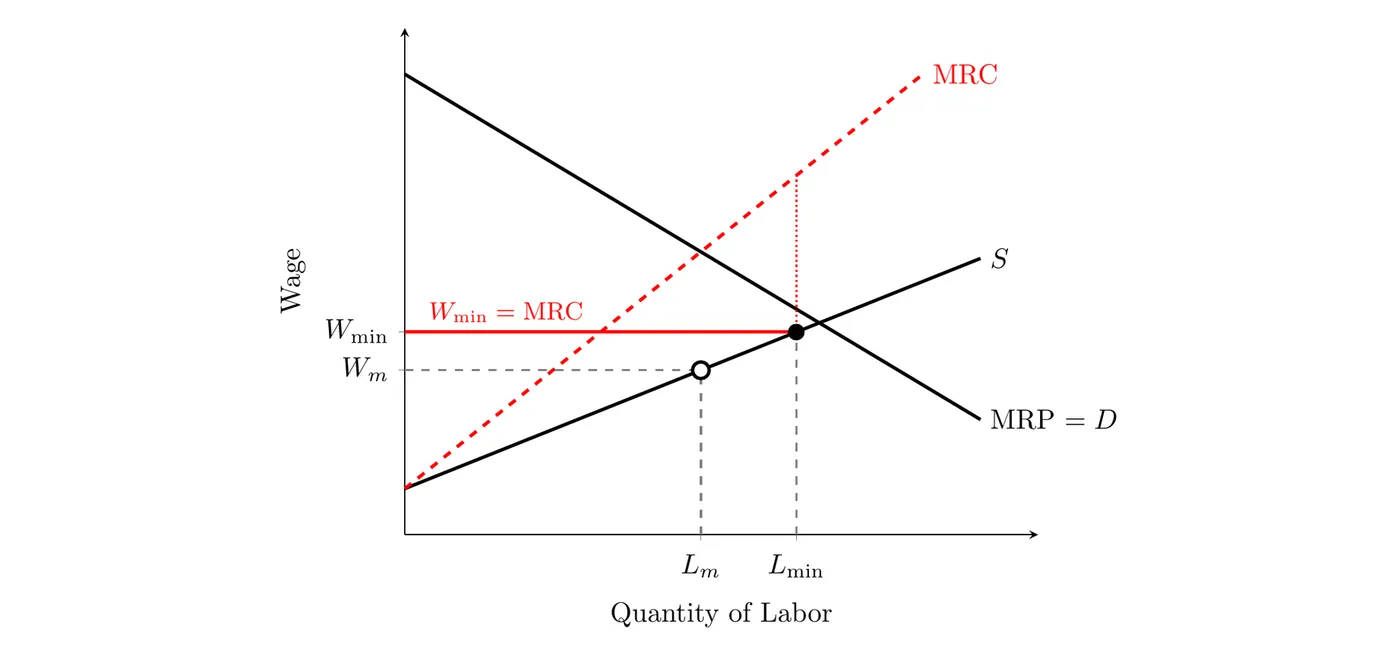
- On the graph: a minimum wage at makes MRC flat at out to , where it reaches the supply curve. Past that point the firm would have to raise wages again, so MRC jumps back up to the original MRC curve. MRP is still above at , so the firm hires workers at : more workers and a higher wage than and .
- In the table above: a $12 minimum wage makes MRC $12 for each of the first 5 workers. The 5th worker's MRP is $12, so the firm hires 5 workers at $12, up from 4 workers at $11.
- Where it stops working: the best minimum wage is the competitive wage (where MRP crosses supply). It brings employment all the way up to the competitive level and wipes out the deadweight loss. Set it any higher, and the firm only hires up to where MRP equals the minimum wage, so each further increase cuts employment, just like in a competitive market.
Bottom line: a monopsony is a buyer’s monopoly that suppresses wages and restricts hiring. Because hiring one more worker means a raise for the whole staff, MRC stays above the wage, leading the firm to hire at MRP=MRC but pay according to supply. Interestingly, this is one of the rare cases where minimum wage actually improves outcomes.