

7.4 - Reasoning Using Slope Fields
Sketching Particular Solutions from Slope Fields
A particular solution is a specific curve that passes through a given point on a slope field. Unlike the general solution, which represents all the possible curves, a particular solution corresponds to one specific value of .
Either way, a solution to a differential equation is a function. The general solution is a family of functions (one curve for each value of ), and on a slope field it shows up as a whole set of curves, each one following the hash marks. A particular solution is one function from that family.
Some solutions are just horizontal lines. If at every point on a line , then is itself a solution, called an equilibrium solution. For example, is all along , so is a solution.
Drawing Solution Curves
To sketch a particular solution through a point, follow the “current” created by the slope field hash marks. Think of dropping a leaf in a river. The hash marks show which way the water flows, and they guide the leaf along a path.
Example: Consider the slope field for
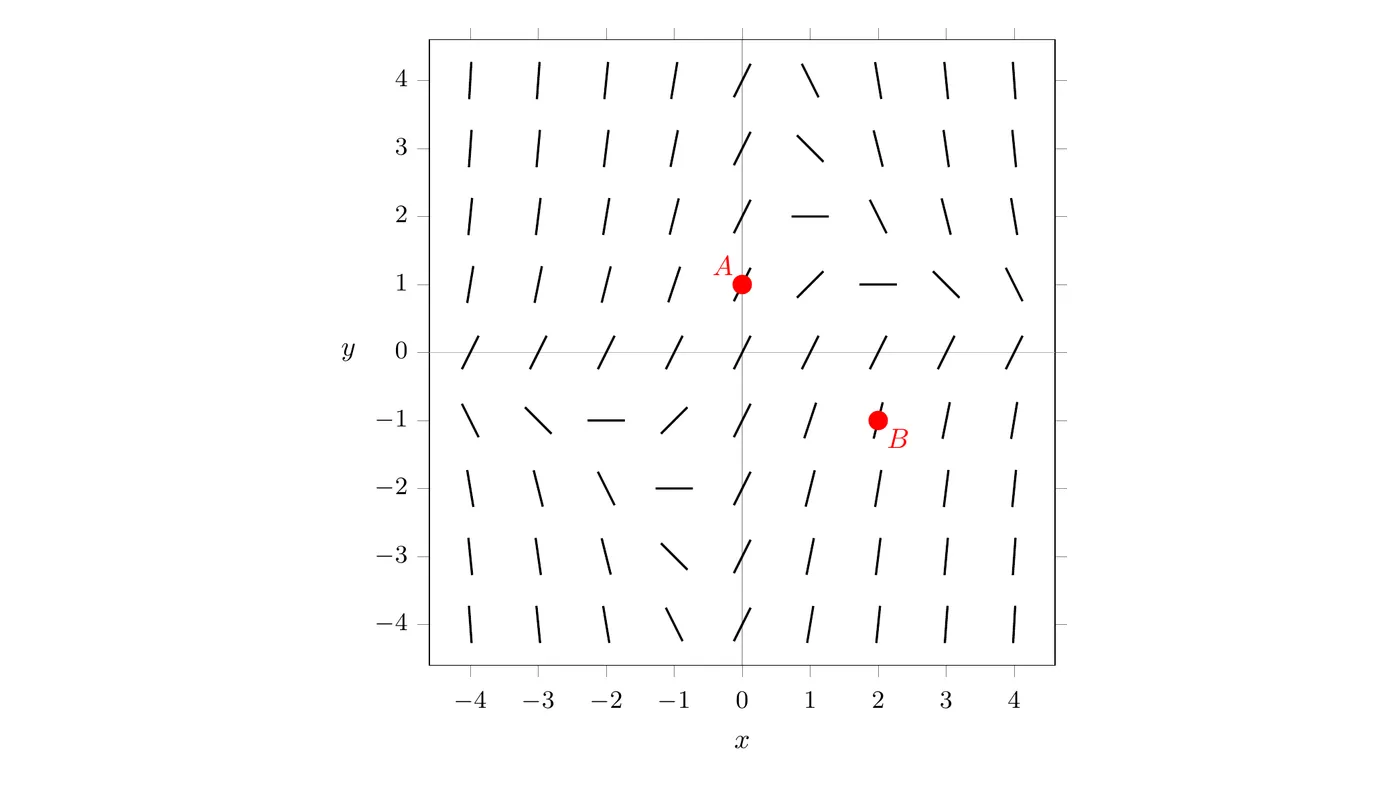
Point A: Sketch the particular solution through
Starting at and following the hash marks:
- Moving left, in the negative direction, the curve drops quickly (the slopes there are positive, so going left means going down). It bottoms out a little below , between and , where the hash marks level off, then rises slowly toward the -axis, which looks like a horizontal asymptote
- Moving right, in the positive direction, the curve rises at first, reaches a maximum where the hash marks go horizontal, then curves downward
Point B: Sketch the particular solution through
Starting at , the hash marks show:
- Moving left, the hash marks get very steep, so the curve drops fast and leaves the bottom of the window around . It can look like a vertical asymptote, but it isn’t one: the curve just keeps dropping below the window before it turns around
- Moving right, the curve rises quickly at first, but the slopes get smaller as it climbs. It crosses the -axis between and , levels off at a maximum just above the -axis (around ), then drifts slowly back down toward it
- Near , the curve comes up steeply from the bottom edge, passes through , peaks just above the -axis, and then flattens out
Matching Slope Fields to Solution Equations
Given a slope field and a specific point, you might have to identify which equation is the particular solution passing through that point.
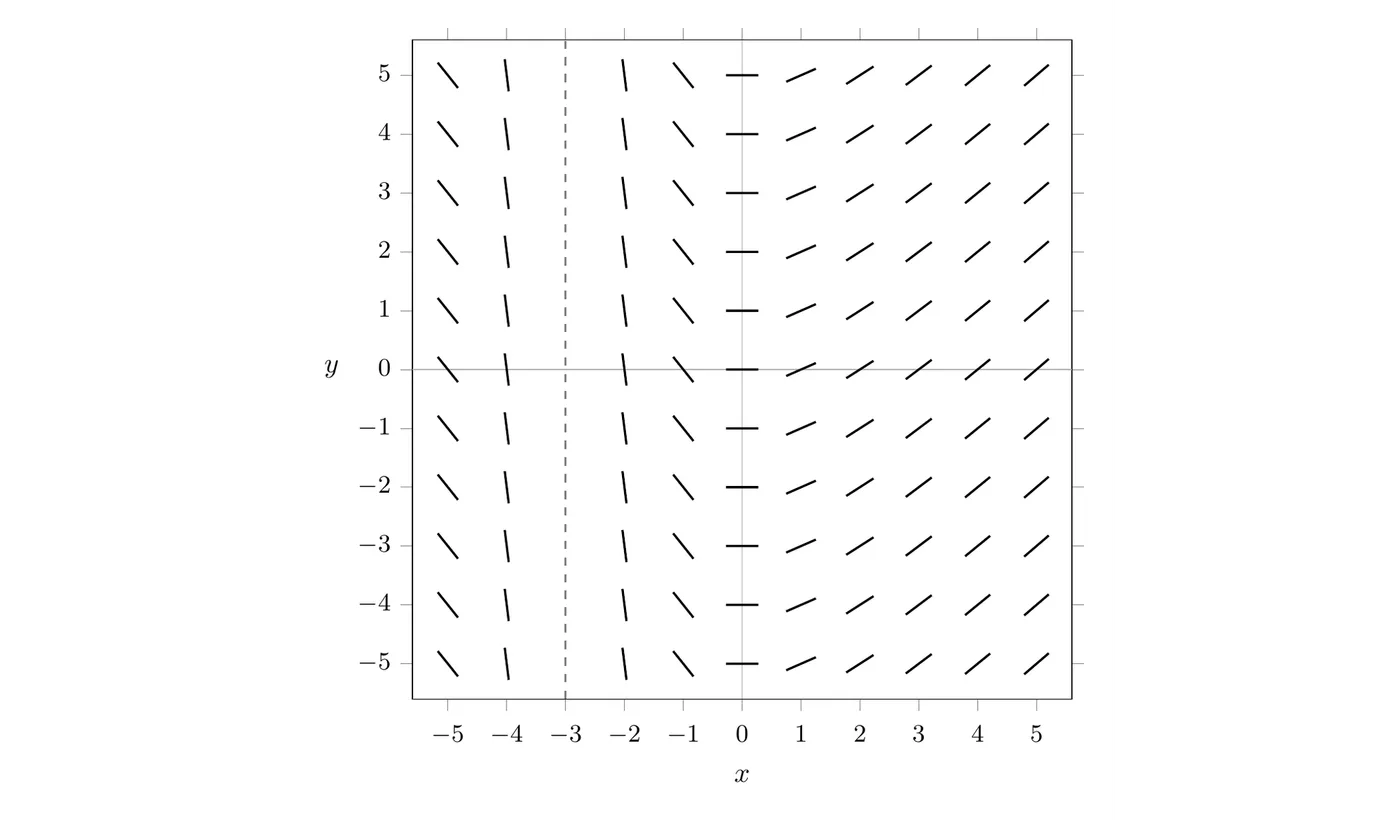
Problem: The slope field below represents a differential equation. Which function is the particular solution passing through ?
(A)
(B)
(C)
(D)
Strategy: Use Multiple Tests
Test 1: Does it pass through the given point?
Substitute :
- (A): ✓
- (B): ✓
- (C): ✗
- (D): ✗
Eliminate (C) and (D).
Test 2: Identify the vertical asymptotes
The slope field shows a vertical asymptote at , and only there.
- (A): the denominator equals zero when or , so this has vertical asymptotes at both and ✗
- (B): the denominator equals zero only when , so this has a vertical asymptote at only ✓
Test 3: Check the behavior near the asymptote
For (B), . The numerator is always positive, so the sign depends entirely on .
As , the denominator approaches , so .
As , the denominator approaches , so .
That matches the steep hash marks on both sides of in the slope field.
Answer: (B)
General Approach
- Verify the point. Substitute the coordinates into each option
- Check the asymptotes. Vertical asymptotes come from zero denominators, and horizontal asymptotes come from end behavior
- Examine special behaviors. Periodic functions like have repeating vertical asymptotes, and exponential functions have no vertical asymptotes
- Use graphing technology if you have it, to confirm
Finding Points with Specific Slope Values
A common question asks: “for which points does equal a specific value?”
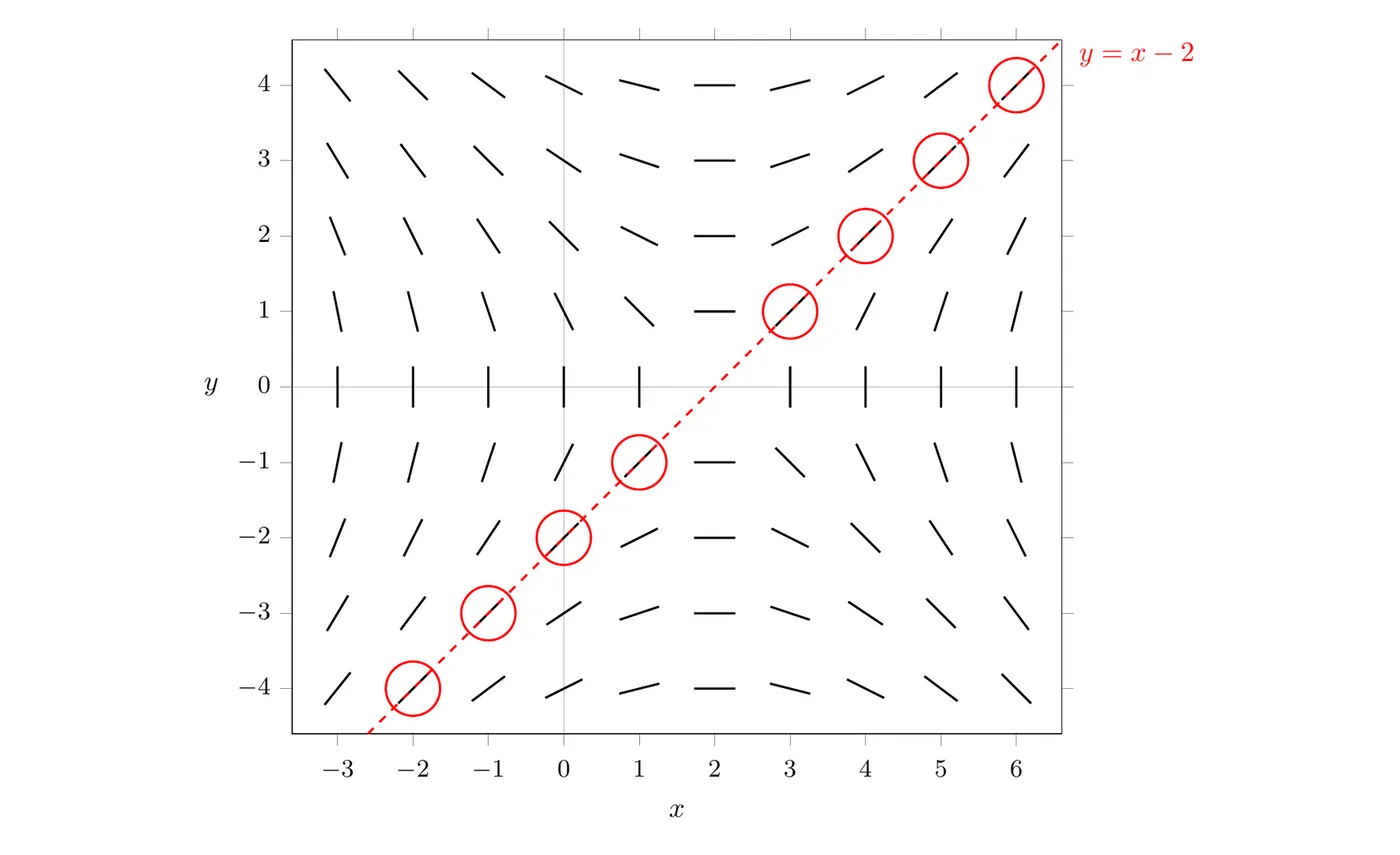
Problem: Given the slope field for , describe all the points where .
Algebraic Solution
Set the differential equation equal to the slope you want:
Solve for the relationship between and :
Answer: every point on the line has a slope of , except . There , so is undefined.
Visual Confirmation
On the slope field, find all the hash marks with slope , meaning diagonal lines going up and to the right at 45°. They form a diagonal line pattern along .
Another Example
Problem: For the differential equation , find all the points where .
Answer: every point on the line has a derivative of zero, meaning horizontal tangent lines.
Determining if a Slope Field Matches a Differential Equation
Sometimes you have to explain why a given slope field does NOT match a differential equation.
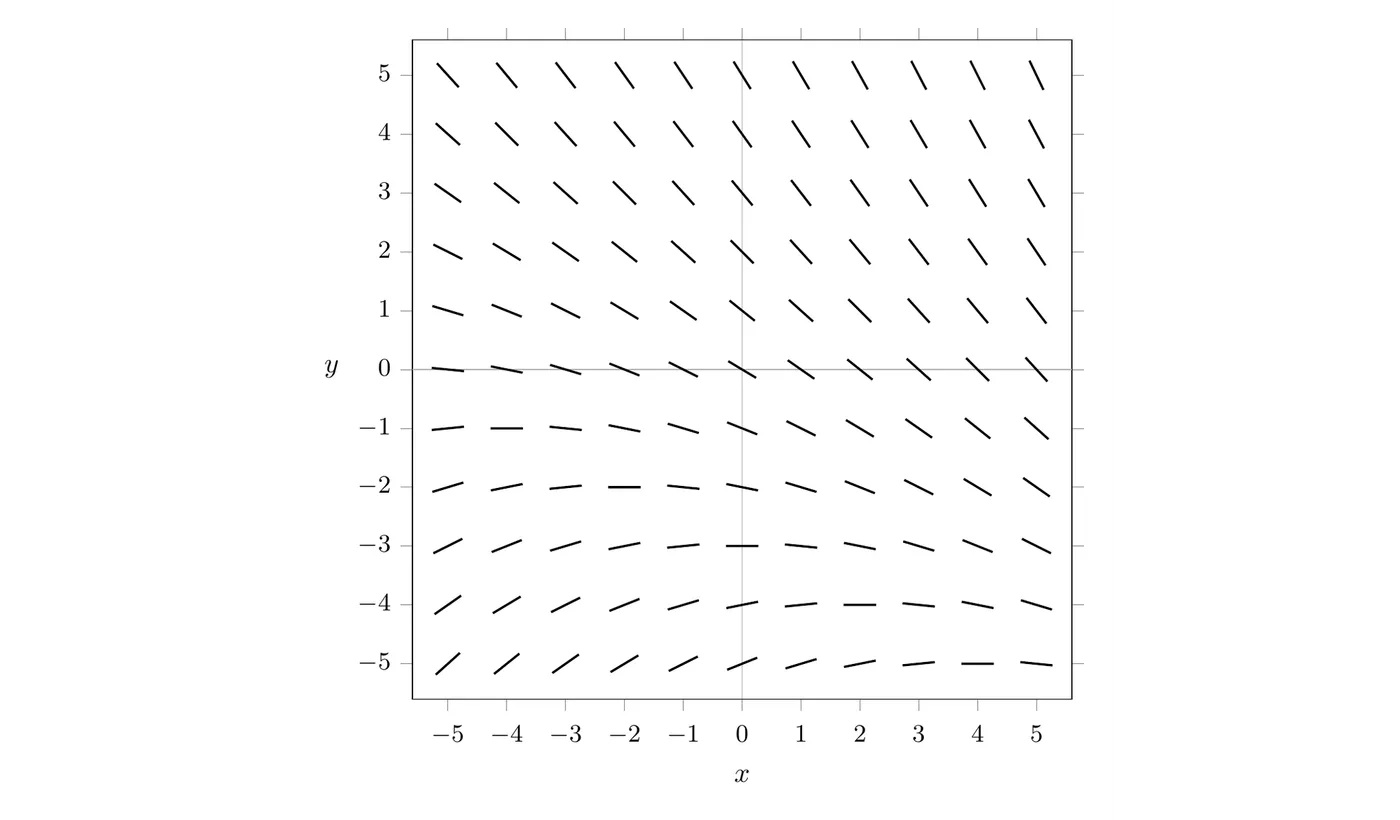
Problem: Explain why the slope field below does NOT represent .
Analysis Method
For , notice that the derivative depends only on , not on .
Key principle: when depends only on , every point with the same -coordinate has to have an identical slope.
Test this property. Along the horizontal line :
- The derivative should be everywhere
- So every hash mark at should have the same slope of
Looking at the slope field: the hash marks at have different slopes at different -values, which violates the requirement.
Alternative Explanation
Test a specific point. When , the differential equation gives:
So every point along the -axis, where , has to have slope , meaning horizontal hash marks.
Looking at the slope field: the hash marks along the -axis are not horizontal, since they have nonzero slopes.
Conclusion: the slope field doesn’t match , because the slopes vary along horizontal lines, and specifically, the slopes at are nonzero when they should be zero.
Summary of Reasoning Techniques
For Sketching Curves
- Start at the given point
- Follow the flow of the hash marks like a river current
- Look for patterns. Where do the curves flatten (horizontal marks)? Where are the asymptotes (steep or missing marks)?
For Matching Equations
- Eliminate options that don’t pass through the given point
- Identify and count the vertical asymptotes
- Check for periodic vs. non-periodic behavior
- Consider end behavior and horizontal asymptotes
For Describing Points with Specific Slopes
- Set equal to the value you want
- Solve algebraically for the relationship between and
- The result is usually a curve or a line
For Verifying Matches
- If depends only on , the slopes are constant along vertical lines
- If depends only on , the slopes are constant along horizontal lines
- Check the special cases, like where the derivative should be zero
Key Takeaways
- Particular solution: a specific curve through a given point, which you sketch by following the slope field hash marks
- Families of functions: the general solution is a family of functions (one for each ). A horizontal line where all along it is an equilibrium solution
- Matching solutions to slope fields: use point verification, asymptote identification, and behavior analysis
- Finding points with specific slopes: set equal to the value and solve algebraically
- Constant slopes along lines: if only, the slopes are identical along horizontal lines, and if only, they’re identical along vertical lines
- Asymptote detection: vertical asymptotes appear where the hash marks are extremely steep or missing, so check the denominators of the candidate functions
- Special value verification: test where (horizontal marks) or is undefined (vertical marks or no marks)
- Elimination strategy: use multiple tests to systematically knock out the wrong answer choices
- Visual plus algebraic: combine slope field observation with equation manipulation for a complete understanding