

7.9 - Logistic Models with Differential Equations (BC ONLY)
Note: this is a BC Calculus topic. It’s not on the AB exam.
Introduction
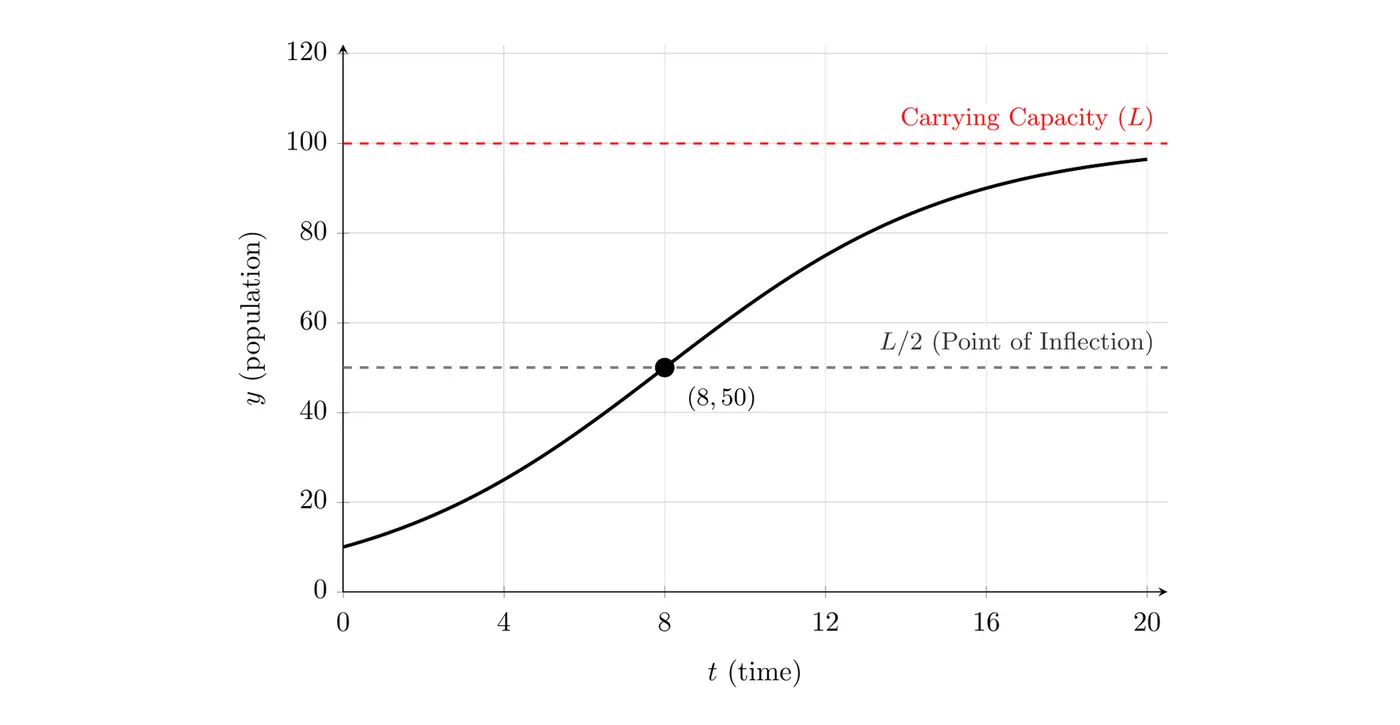
Exponential growth increases forever with no ceiling. Logistic growth has a limiting value. The quantity grows like an exponential at first (faster and faster), then slows down as it approaches a maximum sustainable level.
Key Features
Carrying capacity (): the maximum sustainable value. Also called the limiting value or ceiling.
Point of inflection: located at , exactly halfway to the carrying capacity.
- Before the inflection point: growth rate is increasing (concave up)
- After the inflection point: growth rate is decreasing (concave down)
- At the inflection point: growth rate is at its maximum
Important distinction: in the S-shaped curve above, the population keeps increasing the whole time. It’s the rate of increase that rises and then falls.
The Two Forms
A logistic differential equation can be written two equivalent ways.
Form 1:
Form 2:
Converting between them: factor out of Form 1.
Recognition Tip
The dependent variable appears twice. That’s the giveaway.
- is logistic with
- is logistic with
Finding Key Values
Example 1: Form with
Given , find the carrying capacity and the inflection point.
This is Form 1, so is the denominator under :
The inflection point is at .
Example 2: Form with
Given , find the same things.
This is Form 2, so is the number in the factor:
Maximum growth rate happens at .
Maximum Value vs. Maximum Rate
These get confused constantly.
Question | Answer | Why |
Maximum value of the function | That’s the carrying capacity, the ceiling (when the solution starts below it) | |
Maximum rate of change | That’s the inflection point |
Example 3
A population follows .
(a) Maximum population? That’s the carrying capacity: .
(b) Population where growth rate is greatest? That’s the inflection point:
Showing It with the Second Derivative
Quick way to see it: is a downward-opening parabola in , with zeros at and . A parabola’s highest point is halfway between its zeros, at .
On free response, show it with . Expand, then differentiate with respect to (remember is a function of , so each term gets a ):
For , is positive, so the sign of comes from :
- : , so is increasing (concave up)
- : , so is decreasing (concave down)
So is greatest at . In Example 3, changes sign at , and the fastest growth rate is .
Converting to Standard Form
Sometimes you have to do algebra to find .
Example 4
Find the carrying capacity for .
Step 1: Expand.
Step 2: Factor out the coefficient of to match Form 1.
(Check: , which matches.)
Step 3: Identify .
Example 5
Find the carrying capacity for .
Step 1: Expand.
Step 2: Factor out .
Step 3:
Example 6: Word Problem (State Park Visitors)
Problem: The number of people in a state park increases at a rate proportional to the product of the current number of people and the difference between the park’s capacity and the current number. Capacity is 3000. When there are 800 people, the rate of increase is 120 people per hour. Write a differential equation.
Step 1: Identify the model. “Rate proportional to the product of the current number and the difference from capacity” is a logistic model.
You’ll also see this worded as “jointly proportional to and .” Jointly proportional means proportional to the product, so it’s the same logistic model.
Step 2: Use Form 2.
Step 3: Plug in .
Step 4: Find . When , :
Step 5: Write the equation.
Or in Form 1:
Using the Initial Condition
You can describe a logistic solution without solving the differential equation. Plug the starting value into the right side to get the sign of , then compare the starting value to and .
Example 7: A lake is stocked with fish, and the number of fish follows
where is in years. The carrying capacity is , so the population grows fastest when .
- If : , so the population increases toward . It’s concave up until , where it grows fastest, then concave down.
- If : , so it also increases toward . It starts above , so it’s already past its fastest growth: concave down the whole time, with no inflection point.
- If : . The lake is overstocked, so the population decreases toward (concave up) and never gets near .
- If or : , so the population never changes. and are the equilibrium solutions.
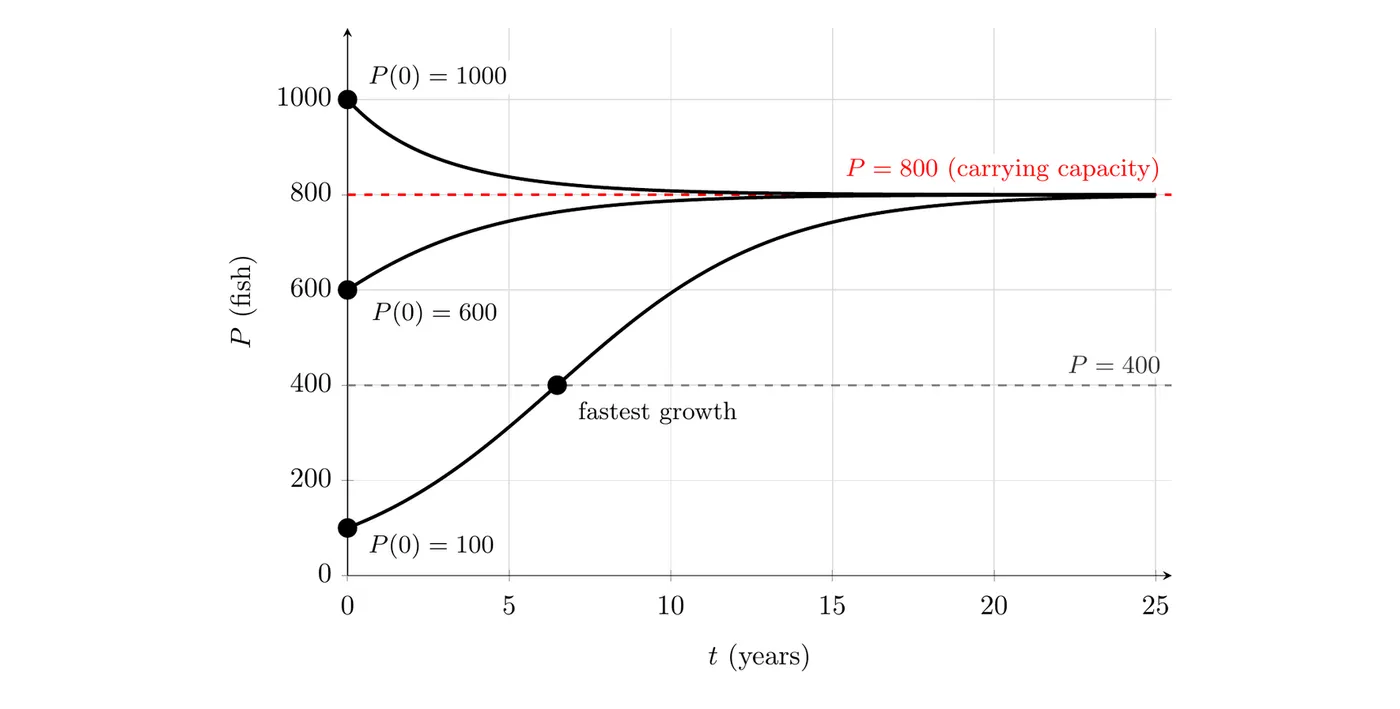
In every case that starts above , the limiting value is the carrying capacity:
So for “what happens in the long run?” questions, the answer is no matter where a positive population starts. The initial condition only decides whether it rises or falls to get there, and whether it passes the fastest-growth point on the way.
Solving the Logistic Equation (Optional)
The general solution to is
(If the equation is written as , with no in front, the exponent becomes instead.)
where is the carrying capacity, is the growth constant, comes from the initial condition, and is time.
The derivation involves separating variables, doing partial fraction decomposition on , integrating, and solving for .
For most AP problems you don’t need this. Focus on pulling and the inflection point straight out of the differential equation.
Strategy Summary
For multiple choice:
- Spot the logistic form (dependent variable appears twice)
- Find fast: in Form 1 it’s the denominator under ; in Form 2 it’s the number in
- Maximum value is (when starts below )
- Maximum rate is at
For free response:
- Show work for the inflection point: set and solve
- Verify the concavity change by checking the sign of on both sides
- State conclusions clearly
Common Question Types
- Direct identification: “What is the carrying capacity?” Read off directly.
- Inflection point: “At what population is growth fastest?” Answer .
- Setting up: “Write a differential equation for…” Use context to spot logistic, then find and .
- Manipulation required: The equation needs factoring first to get to standard form.
Key Takeaways
- Logistic growth has a carrying capacity
- Two equivalent forms: and
- Recognition: the dependent variable shows up twice
- Maximum value is (when starts below )
- Long run: for any starting value above . If it starts above , the solution decreases to
- Point of inflection is always at
- Maximum growth rate happens at the inflection point, NOT at the maximum value
- On free response, show it with , which changes sign at
- Before the inflection point: concave up, growth rate rising
- After the inflection point: concave down, growth rate falling
- BC only, not on the AB exam
- Maximum value () is not the same as maximum rate ()