

3.4 - Carrying Capacity
Learning Objectives
The essential objective is describing what carrying capacity is and explaining the impact it has on ecosystems. That requires understanding the processes of overshoot and the die-off that follows. The associated skill is data analysis, specifically explaining what the data shows about an environmental issue.
Defining Carrying Capacity (K)
Carrying capacity (K) is the maximum population size a specific ecosystem can sustainably support.
- Basis: Carrying capacity is directly based on resource availability within the ecosystem and the resource needs of the species being measured.
- Limiting factors: Resources that restrict how many individuals can survive are known as limiting factors. These are typically food, water, or space, meaning habitat, nesting sites, or hunting areas.
- Species specificity: The K value is different for every species, because each one has unique habitat and food requirements. The carrying capacity for deer in an ecosystem would be much higher than the carrying capacity for wolves.
Population Dynamics: Fluctuation and Instability
A population rarely stays at a perfect size right at its carrying capacity. Instead, populations usually fluctuate above and below that level.
Overshoot and Die-off
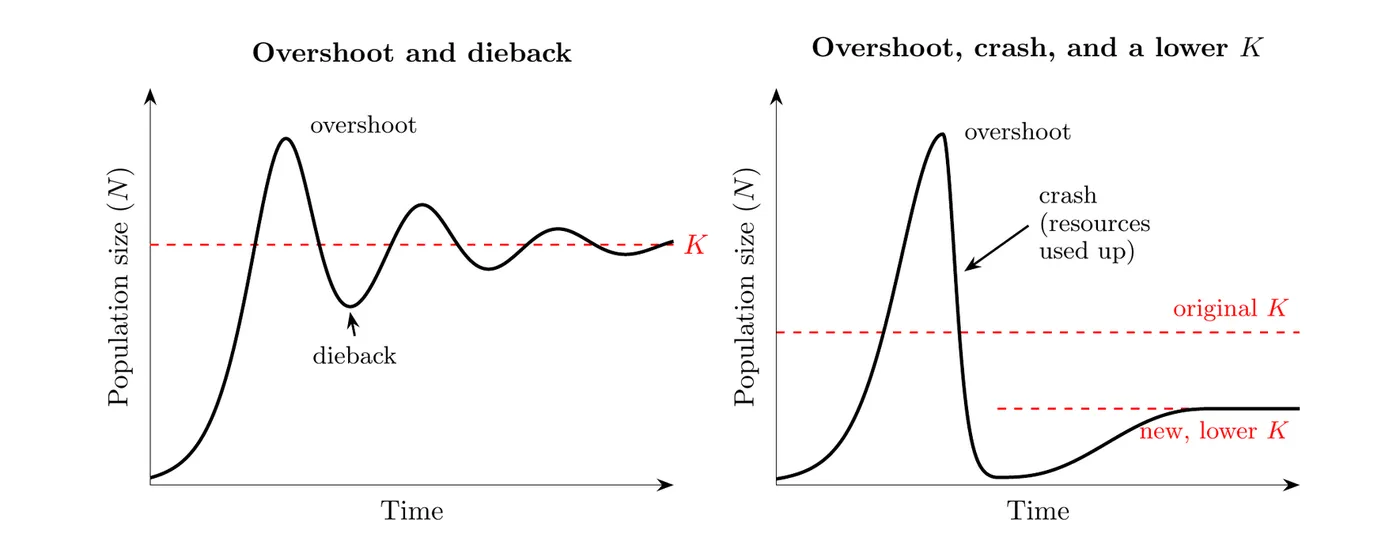
- Overshoot: This happens when a population briefly grows beyond the carrying capacity of the ecosystem.
- Die-off: Overshoot is followed by a die-off, where organisms starve, get eaten by predators, or fail to find necessary resources, which brings the population back down.
- Example (deer): Deer populations frequently overshoot their K in the spring after fawns are born, which causes a sudden, dramatic increase in numbers. Many deer then struggle to find enough vegetation and die off, returning the population to sustainable levels.
- Why they die: Once there are more individuals than the resources can support, they face famine (not enough food or water), disease (crowded, weakened animals catch and spread disease more easily), and conflict (more fighting over food, territory, and mates). This drop is also called dieback, and it’s often severe.
Catastrophic Crash
Sometimes the die-off is catastrophic, meaning it’s not just a small dip but a major decline in population size. This intense crash occurs if:
- Resources are severely depleted.
- The population becomes very dense, leading to a severe disease outbreak or famine.
Environmental Impacts of Overshoot
Overshoot also damages the environment the population depends on, and that damage can last.
- Resource depletion: While a population is above K, it uses resources faster than they can be replaced. Plants get overgrazed, prey gets overhunted, and water sources get used up or fouled with waste.
- Habitat damage: Overgrazing strips plant cover, which leads to soil erosion and lets other, often less useful, plants take over.
- Effects on other species: Other species that need the same resources lose them too. For example, too many deer eat the young trees and shrubs that many forest birds need for food and nesting.
- A lower K afterward: Because the resource base is damaged, the carrying capacity after a crash can be lower than it was before (right graph above). The population then levels off at this new, lower K until the resources recover, which can take decades for slow-growing food like lichen.
Reindeer Population Crash Example
A historical example of a crash happened after 25 reindeer were introduced to St. Paul Island, Alaska, in 1911.
- Growth and overshoot: The population grew exponentially between 1930 and 1937, seriously overshooting the island’s K. At its peak in 1938, reindeer density was estimated at three times its maximum sustainable density.
- Resource depletion: That rapid growth led to heavy overgrazing of lichen, their crucial winter food source, which takes a long time to regrow.
- Crash and recovery: The herd crashed to only eight animals by 1950. It didn’t recover on its own. In 1951, 31 reindeer were brought from Nunivak Island to restart the herd. The damage lasted: the lichen never came back, because grasses, sedges, and other flowering plants took over the overgrazed ground, so later herds have stayed far smaller than the first peak of about 2,000.
Predator-Prey Dynamics and Carrying Capacity
Carrying capacity can also be limited by factors other than food or water, like predation. The populations of predators and their main prey often follow a predictable, repetitive cycle.
Hare and lynx cycle:
- The small lynx population allows the hare population to increase dramatically.
- The abundance of hares causes the lynx population to grow rapidly.
- The large lynx population eats the hares faster than they can reproduce, which crashes the hare population.
- The drastic decline in their main food source forces the lynx population to crash as well.
Conclusion: In this example, the carrying capacity for the lynx is highly dependent on the limiting resource (the hare population), and it decreases dramatically as hares decline. The entire cycle then restarts as the hare population begins growing without its main predator around.
Big picture: Think of carrying capacity like the maximum occupancy sign posted in a restaurant (the ecosystem). The restaurant’s capacity is determined by limiting factors, like the number of available seats (space) or waiters (resources). When a population exceeds that limit (overshoot), the system fails (die-off or crash) because there aren’t enough resources to sustain everyone, and the population drops back down to a level the restaurant can actually manage.