

3.5 - Population Growth and Resource Availability
Learning Objectives
The central objective is explaining how resource availability affects population growth. This topic builds directly on carrying capacity and limiting factors.
Essential Knowledge: Resources and Carrying Capacity
- Resource limitation: Resources in an ecosystem are always limited. Those limited resources, like food and space, restrict population growth.
- Finite at every time scale: No resource is unlimited, whether you look at one season or thousands of years. Even renewable resources like grass or fish only regrow at a certain rate, and the total amount of land, water, and nutrients in an ecosystem is fixed. So no population can keep growing forever.
- Increasing carrying capacity (K): Population growth and carrying capacity can increase if the limiting resources also increase.
- Abundant resources speed up growth: When food, water, and space are plentiful, almost every individual survives and reproduces, so births far outpace deaths and growth accelerates (exponential growth, below). For example, when fertilizer runoff loads a lake with nitrogen and phosphorus, algae populations explode into an algal bloom (Topic 8.5).
- Decreasing survival: When limiting resources decrease, individuals become less able to survive and reproduce, which drops the population back down below carrying capacity.
- Unequal shares when resources shrink: When the resource base gets smaller, it isn’t split evenly. Bigger, stronger, or more dominant individuals (or those holding the best territories) still get enough, while others go without. That raises mortality (more deaths) and lowers fecundity (how many offspring individuals can produce, since underfed females breed less or not at all). Both push growth down until the population falls to, or below, carrying capacity.
- Example: During a severe drought on Daphne Major, a small Galápagos island, in 1977, plants made very few seeds. The medium ground finch population fell from about 1,200 birds to about 180 in a year. Survival wasn’t equal: birds with bigger beaks, which could crack the large, hard seeds that were left, survived better than small-beaked birds (2.6 explains how this changed the population’s average beak size).
Basic Population Characteristics
Characteristic | Definition and Significance |
Population Size (N) | The number of organisms in a population. A larger population is generally safer from decline thanks to factors like genetic diversity, which allows adaptation, and the protection offered by large herds. |
Density | The number of individuals per unit of area, like panthers per square mile. As density increases, competition for resources gets stiffer, and the likelihood of a disease outbreak increases because diseases move more easily. |
Sex Ratio | The ratio of males to females. A ratio closer to 50:50 is optimal for reproduction. Bottleneck events like natural disasters can produce skewed sex ratios, such as 75 males to 1 female, which severely limits population recovery because reproduction is limited by the number of females. |
Population Distribution Patterns
Distribution describes how organisms are spread out relative to one another in a population.
- Random distribution: Typical for plants like trees that have their seeds dispersed randomly by wind or animals.
- Uniform distribution: Typical of nesting animals, predatory animals that defend a central den area, or plants that secrete defensive chemicals into the soil to kill other plants nearby.
- Clumped distribution: Typical of animals that live in herds or groups, like meerkats.
Factors Limiting Population Growth
Limiting factors are categorized based on whether their impact is related to the density of the population.
Factor Type | Definition and Impact | Examples |
Density-Dependent | Factors that limit population growth because individuals become too densely populated. The impact on the population depends on how dense it is. | Increased competition for food, water, habitat, and nesting sites. Disease is density-dependent because it spreads more easily in dense populations. |
Density-Independent | Factors that impact population growth regardless of density. They hit populations of 50 or 5,000 members similarly. | Natural disasters such as floods, hurricanes, tornadoes, and fires. |
Modeling Population Growth
Exponential and Logistic Growth
The experiment Russian biologist Georgy Gause ran on Paramecium (single celled organisms) in the early 1930s demonstrates two key growth models.
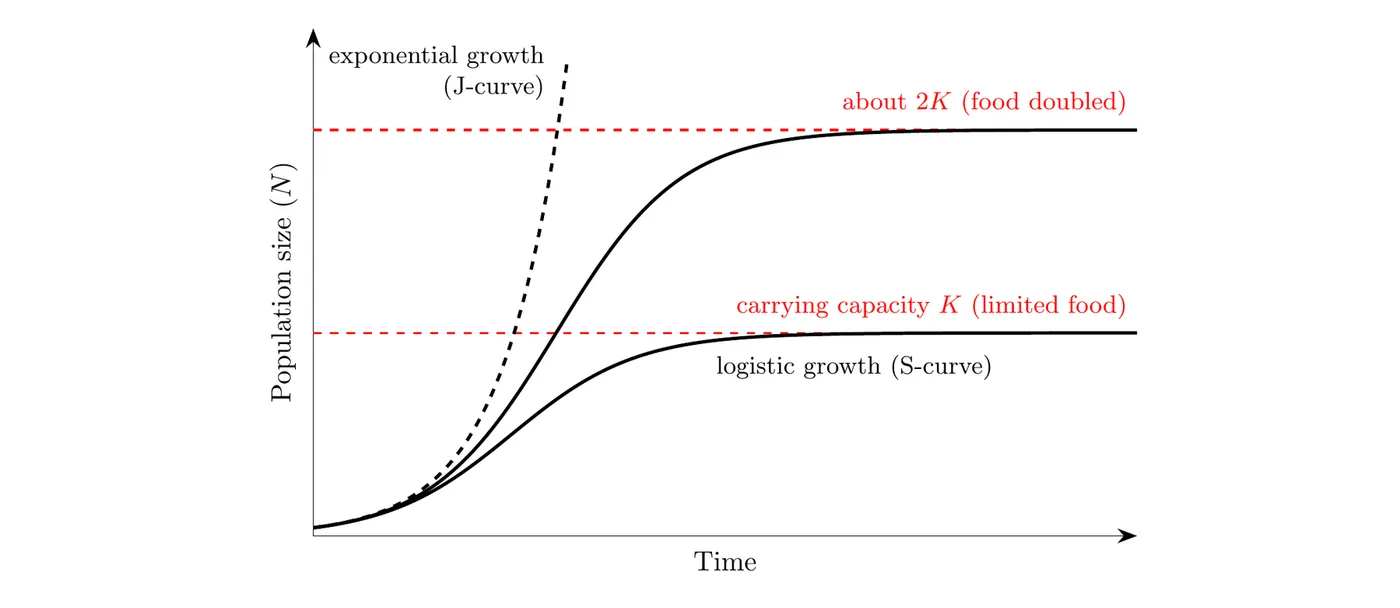
- Exponential growth: The initial stage, where growth is very rapid. The population grows at its biotic potential (maximum growth rate) because there are no limiting resources like food or space restricting the growth rate.
- Logistic growth: The more realistic model for populations in nature. Eventually, competition for limited resources (food, water, or space) slows the exponential growth dramatically until the population reaches a carrying capacity. Real populations then usually fluctuate above and below K (Topic 3.4).
Paramecium Experiment Results
- When Paramecium were grown with a limited food supply, they grew rapidly and then hit a carrying capacity.
- When Gause doubled the food supply, the Paramecium’s new carrying capacity roughly doubled too. This illustrates the key principle that increasing a limiting resource increases the carrying capacity.
Calculating Population Change
Population size changes based on four factors: inputs (births and immigration) and outputs (deaths and emigration).
The basic formula:
Example: A deer population starts the year at 2,000. During the year, 450 fawns are born, 160 deer die, 30 deer move in, and 70 move out.
To turn that into a growth rate, divide the change by the starting population size:
- The “deer” units cancel, leaving a percent per year. On the AP exam, show this setup with units, not just the final number. Topic 3.8 uses the same idea with birth and death rates per 1,000 people.