

1.1 - Scalars and Vectors in One Dimension
Scalar Quantities
Scalars are physical quantities that only have magnitude, meaning just a numerical size or amount, with no direction attached.
For example, if someone walks 45 meters, that tells you how far they went but not which way. That value could apply to movement in literally any direction.
Common scalars in kinematics: distance, speed, time
Other scalars in physics: energy, power, mass, temperature
Vector Quantities
Vectors need both magnitude and direction to fully describe them. That extra directional piece is what separates them from scalars.
For example, walking 45 meters north gives you the complete picture: how far someone went and exactly which way.
Common vectors in kinematics: position, displacement, velocity, acceleration
Other vectors in physics: force, momentum, electric field, magnetic field
Visualizing Vectors
Vectors are drawn as arrows, where:
- the length of the arrow shows the magnitude
- the direction of the arrow shows the direction
The tail is where the vector starts, and the head is the arrowhead at the end.
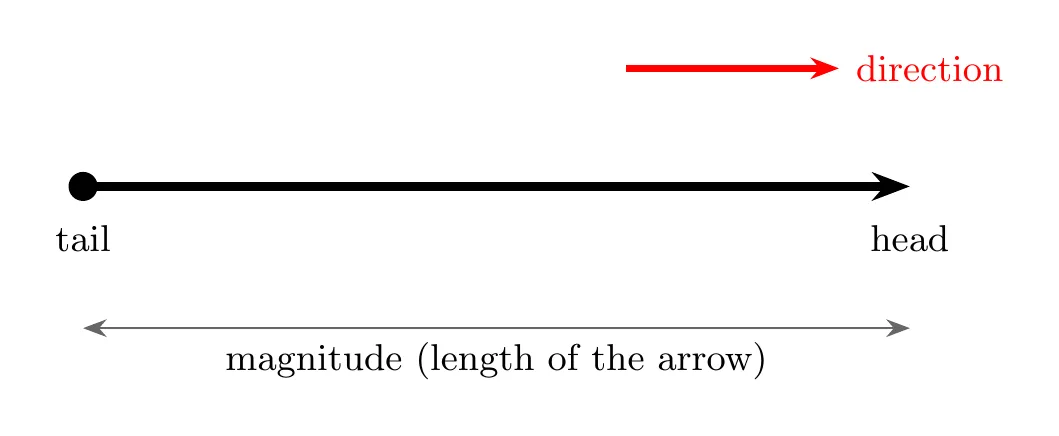
Drawing vectors to scale: pick a scale and use it for every arrow in the same diagram. If 1 cm stands for 5 m/s, a velocity of 20 m/s is drawn 4 cm long, and a velocity of 10 m/s in the opposite direction is drawn 2 cm long, pointing the other way. A vector with twice the magnitude always gets an arrow twice as long.
Vector Notation
You write a vector with a little arrow above the symbol, so means velocity as a vector.
When you’re just working in one dimension, subscripts tell you which direction you’re dealing with:
- for horizontal velocity
- for vertical velocity
- for horizontal acceleration
The subscript is basically just a reminder of which axis you’re looking at.
Vector form vs. component form: written as a full vector equation, the velocity relationship is . The AP equation sheet writes the same relationship along one axis: .
Components don’t need arrows. A component like or is just a number with a sign and a unit. In one dimension the sign already tells you the direction, so no arrow is needed.
Example: a cart rolls in the direction at and has a constant acceleration of . After 6.0 s:
The negative sign by itself tells you the cart has turned around and is now moving at 1.0 m/s in the direction.
Sign Convention in One Dimension
In one dimension, direction gets shown through positive and negative signs:
- positive usually means right or up
- negative usually means left or down
For example:
- means moving 30 m/s in the positive direction
- means moving 30 m/s in the negative direction
Adding and Subtracting Vectors
Combining vectors to get one resultant vector is called a vector sum, and this covers both addition and subtraction.
Addition:
Subtraction:
Subtracting a vector is really the same as adding its opposite:
In one dimension, signs do the work. Choose a positive direction, give every vector a or sign to match its direction, then add the signed numbers. Opposite directions always get opposite signs.
Currents in real life:
When a current flows the same way you’re moving, the velocities just add together (downstream). When the current works against you, it subtracts from your velocity (upstream).
In competitive sprinting, there’s actually a rule about this: if the wind pushing a runner along is stronger than the allowed limit (usually 2.0 m/s), the record doesn’t count because the runner got too much help from the wind. Headwinds, on the other hand, always count toward the record since they make the performance more impressive, not less.
Worked Example: Vector Sum in One Dimension
A robot vacuum moves 3.5 m east, then 6.0 m west, then 1.2 m east. Find its total displacement and the total distance it traveled.
Setup: east is positive, so the three displacements are m, m, and m.
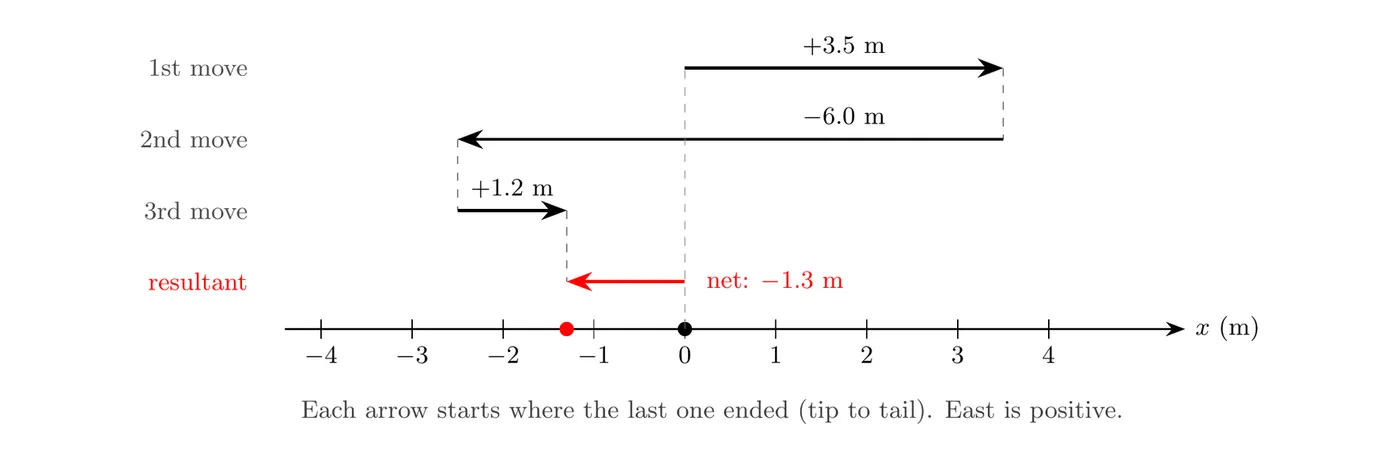
Displacement (vector sum):
The negative sign means the robot ends up 1.3 m west of where it started.
Distance (scalar sum): distance ignores direction, so just add the sizes:
Subtracting vectors works the same way. If a ball hits a wall at m/s and bounces straight back at m/s, its change in velocity is
That’s bigger than either speed, because reversing direction means the ball first loses all 8.0 m/s and then gains 6.0 m/s the other way.
Rate, Distance, and Time
The basic relationship between speed, distance, and time is:
where is rate (speed), is distance, and is time.
You can rearrange this to solve for time. Starting with , multiply both sides by to get , then divide both sides by :
That gives you time whenever you know distance and rate.
Worked Example: River Kayaking
Two kayakers start at the same time from opposite ends of a 24-mile river route. Both can paddle at 6 mph in still water. Kayaker A goes downstream (with the current), Kayaker B goes upstream (against it), and the current itself is 2 mph. How long does each one take, and how much sooner does one finish?
Using :
Kayaker A (downstream): the current helps, so their effective speed is mph.
Kayaker B (upstream): the current fights them, so their effective speed is mph.
Difference:
So Kayaker A finishes a full 3 hours (180 minutes) before Kayaker B.
Scalars vs. Vectors at a Glance
Scalar | Vector |
Magnitude only | Magnitude and direction |
Simple arithmetic | Follows vector addition rules |
Example: 15 meters, 8 seconds | Example: 15 m east, 8 m/s upward |
No directional symbol | Arrow notation or subscripts |
Key Takeaways
- Scalars have magnitude only: distance, speed, time, energy
- Vectors have magnitude and direction: displacement, velocity, acceleration, force
- Vectors are drawn as arrows, arrow length shows magnitude, arrow direction shows direction
- Vector notation uses arrows over letters () or subscripts (, )
- In one dimension, opposite directions get opposite signs
- Vector subtraction just means adding the inverse:
- Time formula:
- Helpful currents/winds add to velocity, opposing ones subtract from it