

1.4 - Reference Frames and Relative Motion
What is a Reference Frame?
A reference frame is basically the perspective you’re observing motion from, the “viewpoint” of whoever’s watching. Motion looks different depending on which frame you pick.
The key idea is that your choice of reference frame determines the direction and magnitude you measure. Two observers in two different frames can measure two completely different velocities for the exact same object.
Think of it like looking through a window frame. Everything you see is relative to that frame. If the window itself is moving, everything you see through it appears to move differently too, even though the objects out there haven’t actually changed how they’re moving.
Reference Frames in One Dimension
Stationary observer: a cyclist rides past you at 12 m/s while you stand still on the sidewalk. From your frame, the cyclist’s velocity is just 12 m/s forward.
Moving observer: now say you’re jogging at 4 m/s in the same direction as the cyclist. From your frame, the cyclist now only appears to move at 8 m/s relative to you.
Same direction:
Opposite directions:
Reference Frames in Two Dimensions
When motion happens in more than one direction at once, reference frames get more interesting, and this is where things start bridging into two-dimensional motion.
Tossing keys on a moving walkway:
If you’re standing on an airport walkway tossing your keys straight up and catching them, from your own perspective the keys go straight up and come straight back down, purely vertical motion.
But someone standing still on the ground watching you sees something different: the keys move up and forward at the same time, tracing out a parabolic arc, genuinely two-dimensional motion.
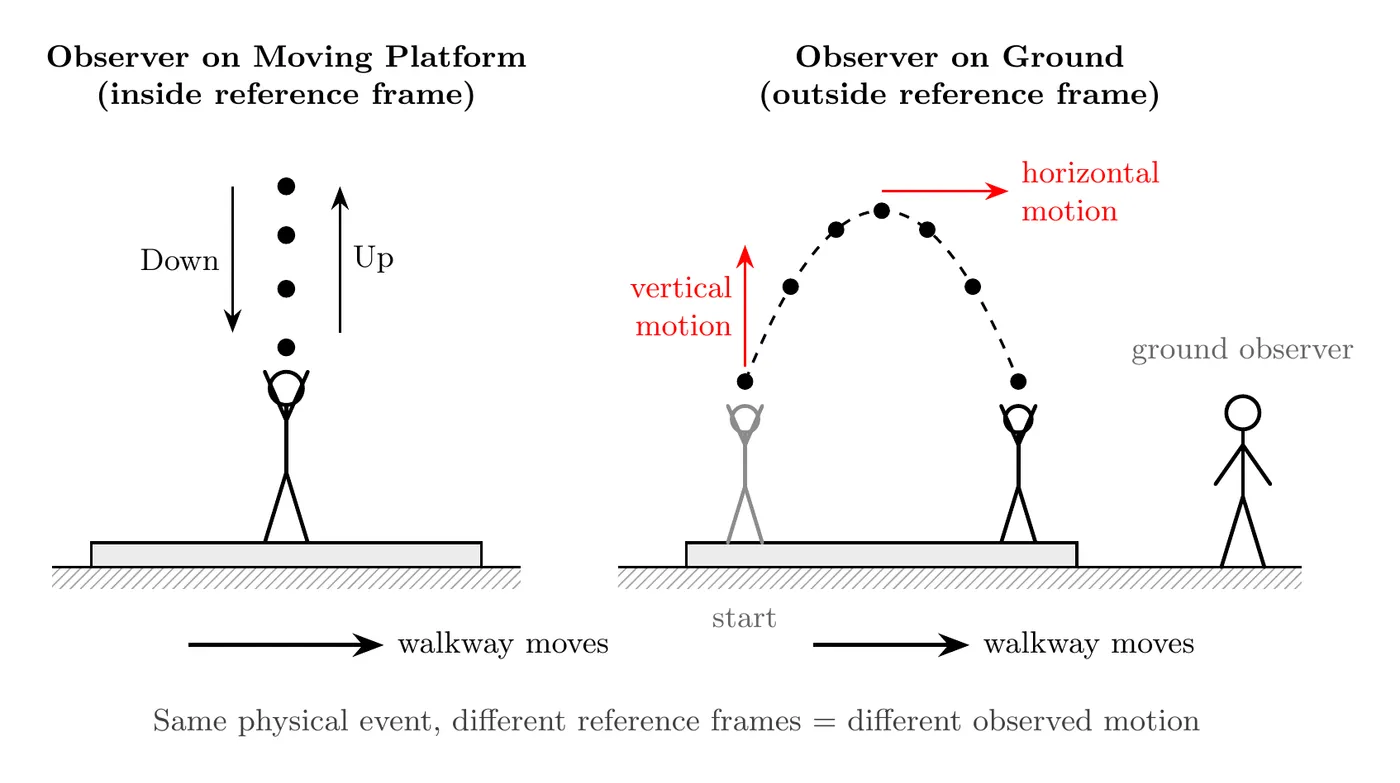
Why the difference? The keys share the horizontal velocity of the platform (and of you). Inside that frame you don’t notice this shared motion, you only feel the vertical motion you gave the keys. From outside, observers see the total motion: your vertical toss plus the platform’s horizontal movement.
Switching Between Reference Frames
You can convert a measurement from one frame to another with vector addition or subtraction.
River crossing example:
A ferry’s motor pushes it at 8 m/s in still water, but the river has a 3 m/s current flowing downstream. If the captain points the ferry straight across, where does it actually end up?
From the river’s own frame (moving with the current), the ferry crosses straight over at 8 m/s.
From the shore’s frame (which is stationary), the ferry has two velocity pieces: 8 m/s perpendicular to the shore from the motor, and 3 m/s parallel to the shore from the current. So the real path is diagonal, moving across and downstream at the same time.
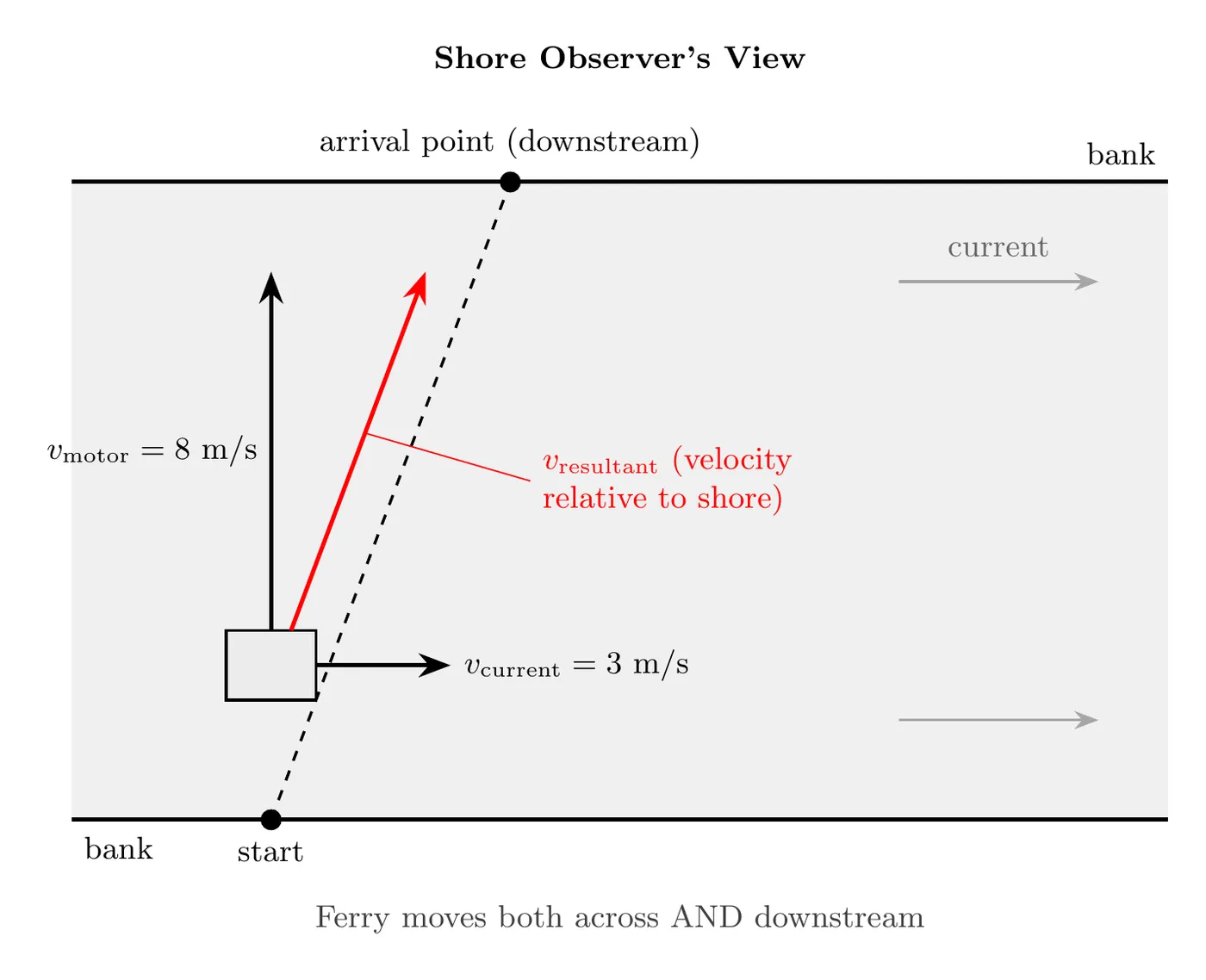
To actually travel straight across, the captain needs to aim upstream at an angle, enough that the horizontal component of the ferry’s velocity cancels out the current.
The General Rule for Combining Velocities
What you observe is the vector combination of the object’s own velocity plus the velocity of your reference frame:
In one dimension: add algebraically if they’re moving the same way, or effectively subtract if they’re opposite.
In two dimensions: use vector addition (this gets covered in more depth with projectile motion), and perpendicular components combine using the Pythagorean theorem.
Keeping track with subscripts. The two formulas on this page, and , are the same rule. They just measure the object’s velocity from different places. Writing “what” and “relative to what” in the subscripts makes it clear:
Read it as: (A relative to C) = (A relative to B) + (B relative to C). The inside letters match up like links in a chain.
- Flipping the order flips the sign: . If a train moves at m/s relative to the ground, the ground moves at m/s relative to the train.
- Ferry: (ferry rel shore) = (ferry rel water) + (water rel shore). The motor’s velocity is measured relative to the water, so the current gets added on.
- Cyclist and jogger: (cyclist rel jogger) = (cyclist rel ground) + (ground rel jogger) m/s. Adding the ground’s velocity relative to the jogger is the same as subtracting the jogger’s velocity relative to the ground.
On the AP exam: relative-velocity calculations in AP Physics 1 stay in one dimension (everything moving along the same line). The two-dimensional pictures on this page (keys, ferry, ladder) build intuition for projectile motion. Also, assume every reference frame is inertial unless a problem says otherwise.
Acceleration Stays the Same Across Frames
Here’s a useful fact: acceleration is identical in every inertial reference frame.
An inertial frame is one moving at constant velocity, meaning it’s not accelerating.
So if two observers are each moving at their own constant (but different) velocities, they’ll disagree on the object’s velocity but agree completely on its acceleration.
For example, a car accelerates from rest at 3 m/s². Someone standing still measures 3 m/s², and someone riding in another vehicle at a constant 20 m/s also measures 3 m/s². That’s because acceleration is about the change in velocity, and both observers see the exact same change, just starting from different reference points.
Check it with numbers: say the car goes from 0 to 12 m/s in 4.0 s, measured from the ground. From a truck cruising at a constant m/s, the car’s velocity goes from m/s to m/s. Both observers see the same change:
The truck’s constant velocity shifts every velocity reading by the same amount, so it cancels out of .
Worked Example: Relative Velocity
A delivery drone flies at 22 m/s relative to the ground. A bird flies the same direction at 9 m/s relative to the ground. How fast does the drone appear to move from the bird’s point of view?
So from the bird’s perspective, the drone only seems to move at 13 m/s, slower than its true ground speed, because the bird is already moving forward too.
What if the bird flew the opposite direction instead?
Now the drone looks even faster, because the two are approaching each other.
Worked Example: Walking on a Train
A train moves east at 22.0 m/s relative to the ground. A passenger walks toward the back of the train at 1.5 m/s relative to the train. A cyclist on a road next to the tracks rides east at 6.0 m/s relative to the ground. East is positive.
Passenger relative to the ground:
Walking toward the back still leaves the passenger moving east at 20.5 m/s, just a little slower than the train.
Passenger relative to the cyclist:
Cyclist as seen by the passenger: flip the sign, m/s. To the passenger, the cyclist seems to slide backward (west) at 14.5 m/s, even though the cyclist is really moving east.
Who’s Actually Moving?
This raises a deeper question. If you’re in a car passing pedestrians on the sidewalk, from your frame the pedestrians appear to move backward relative to you, but from their frame, you’re the one moving forward relative to them. Neither description is more “correct,” motion is genuinely relative. Classical mechanics has no absolute stationary reference frame.
Climbing a Ladder on a Moving Train
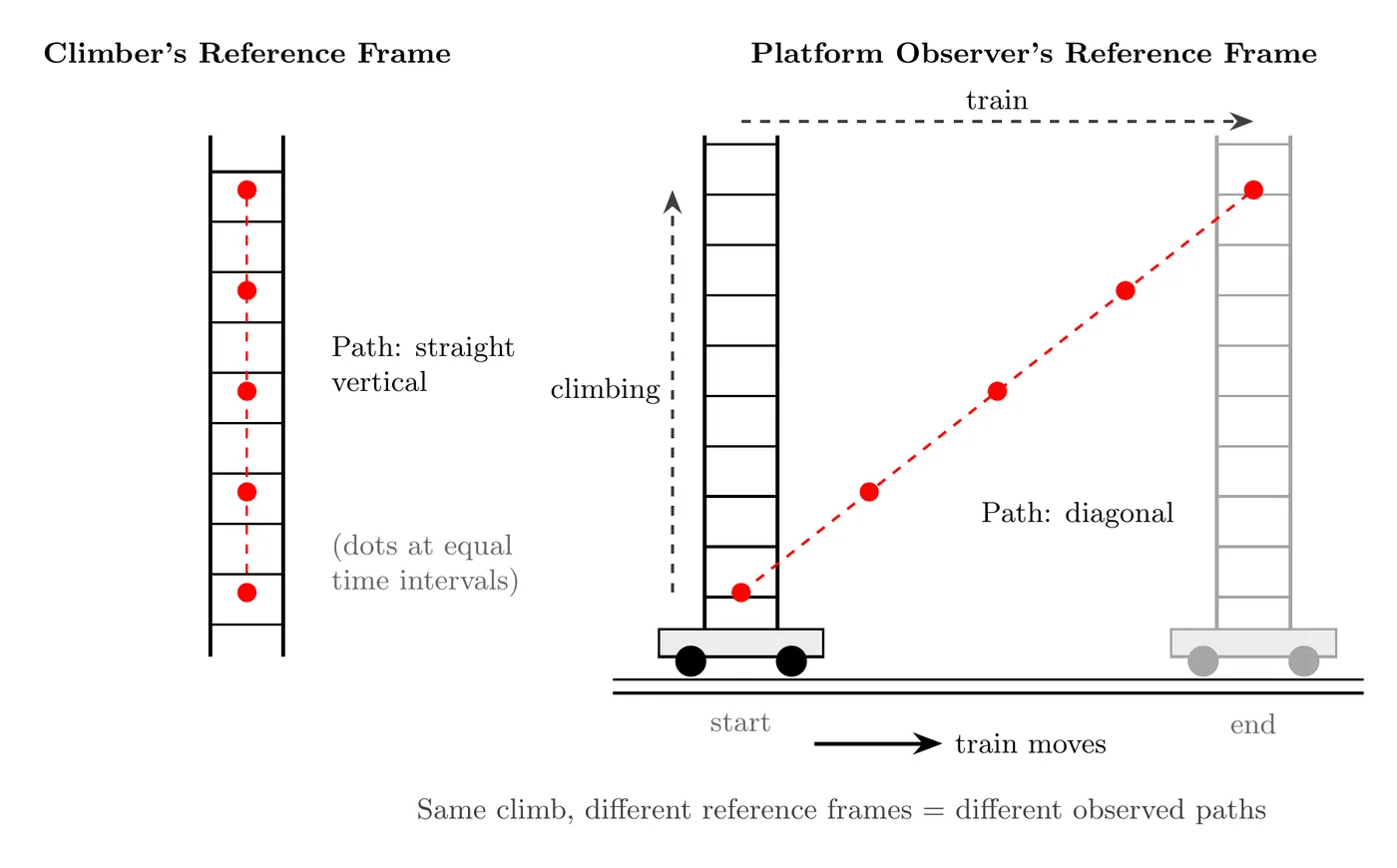
If someone climbs a ladder at constant speed on a train that’s also moving at constant velocity:
From the climber’s own frame (on the train), the motion is purely vertical, straight up the ladder.
From someone standing still on the platform, the motion has both a vertical and horizontal component, so the path looks diagonal. The vertical part is the climbing speed, the horizontal part is the train’s speed.
Bridge to Two Dimensions
Reference frames naturally lead into two-dimensional motion: a vertical component and a horizontal component combining together. This is exactly what sets up projectile motion, the next big topic.
Where This Shows Up in Real Life
Aviation: pilots have to account for wind when planning a flight path, since velocity relative to the air isn’t the same as velocity relative to the ground.
Maritime navigation: ships aim at an angle toward their destination to make up for ocean currents.
Sports: a quarterback has to account for a receiver’s velocity when throwing to a moving target.
Everyday life: walking forward inside a moving bus, your speed relative to the bus is different from your speed relative to the ground outside.
Key Takeaways
- A reference frame is the observer’s perspective, and it determines what velocity gets measured
- Different frames measure different velocities for the same object
- Velocity in one frame equals the object’s velocity plus or minus the observer’s frame velocity (vector addition)
- Subscript rule: , and swapping the letters flips the sign
- Same direction motion: (object looks slower)
- Opposite direction motion: subtracting a negative observer velocity makes the object look faster
- Inside a moving frame, shared motion is invisible, you only notice relative motion
- Outside, watching a stationary frame, you see every component of the motion
- Acceleration stays the same across all inertial (constant velocity) frames
- Motion on a moving platform looks one-dimensional from inside, two-dimensional from outside
- River and wind problems need vector addition to convert between frames
- On the AP Physics 1 exam, relative-velocity calculations stay in one dimension
- “Who’s moving?” has no absolute answer, motion is always relative to your chosen frame
- Reference frames are the conceptual bridge from 1D motion into 2D motion