

1.5 - Vectors and Motion in Two Dimensions
Vectors and Components
Any vector can be broken down into two perpendicular components. This lets you analyze complicated motion by splitting it into simpler pieces.
A resultant vector is the single vector that represents the combined effect of two perpendicular components.
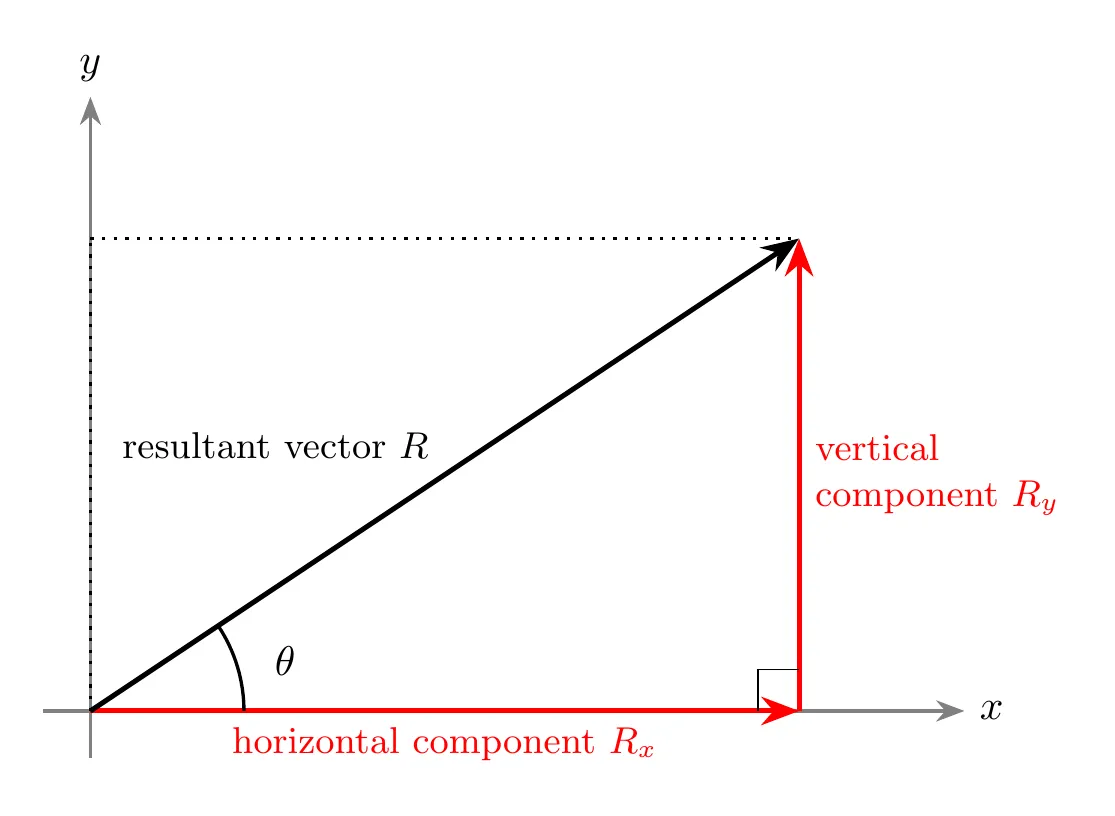
Finding magnitude: use the Pythagorean theorem.
where is the magnitude of the resultant, and , are the horizontal and vertical components.
Finding direction: the angle from horizontal is
Resolving a Vector into Components
Going the other way, breaking one vector into its perpendicular pieces, is called resolving it into components.
When the angle is measured from horizontal (the usual physics convention):
Make sure your calculator is in degree mode, not radians, for this. Physics problems usually give angles in degrees (30°, 45°, 60°, and so on). Radians come back in Unit 5, where they’re used to measure angular position and rotation. Using the wrong mode gives you completely wrong components.
If the angle is measured from vertical instead, sine and cosine swap places:
Always double check which direction the angle is being measured from.
On the AP equation sheet, the trig relationships are written for a right triangle with hypotenuse , side opposite the angle , and side next to it:
For a vector, the vector itself is the hypotenuse and its components are the two legs. The sheet also has a table of sine, cosine, and tangent for 0°, 30°, 37°, 45°, 53°, 60°, and 90°. The 37° and 53° angles come from the 3-4-5 triangle, so the table lists their sines and cosines as and .
You choose the axes. Components depend on the coordinate system you pick, but the vector itself doesn’t change. Horizontal and vertical axes are the usual choice. On a ramp, tilting the axes so runs along the ramp is often easier (you’ll do this a lot in Unit 2). Pick whatever axes make the most components zero or simple.
Worked Example: Resolving a Vector
A drone flies at 14.0 m/s, 30.0° above the horizontal. Find its horizontal and vertical velocity components.
Check: the components should rebuild the original vector.
Same vector, tilted axes: if you set up the -axis along the drone’s path instead, the components are m/s and . The vector didn’t change, only the axes did.
Two-Dimensional Motion: The Big Idea
You can analyze two-dimensional motion by splitting it into two separate, independent one-dimensional motions along perpendicular axes, usually horizontal and vertical.
Horizontal and vertical motion happen at the same time but don’t affect each other at all. You analyze them separately with the same 1D kinematic equations you already know, and time is the one thing linking both dimensions together.
Horizontal (x):
Vertical (y):
Projectile Motion
Projectile motion is a special case of 2D motion with two specific conditions:
- Zero horizontal acceleration (no horizontal forces, ignoring air resistance)
- Constant vertical acceleration (gravity pulling down)
Only gravity acts, air resistance is ignored, and the acceleration is constant, the same as free fall.
Horizontal motion (constant velocity):
Vertical motion (constant acceleration):
Using :
Using :
The negative signs mark the downward direction gravity is pulling.
The AP exam uses on both multiple choice and free response.
Solving Projectile Motion Problems
- Resolve the initial velocity into components first, always the first step: ,
- Set up your coordinate system: pick an origin (usually the launch point), decide which directions are positive, note your initial position (often , )
- Write equations for both dimensions using the components you found
- Use time as the shared link: solve for time in one dimension, then plug it into the other
- Bring in algebra tools as needed: vertex of a parabola for max height, roots of a quadratic for launch/landing times, substitution between equations
Worked Example: Projectile Launch
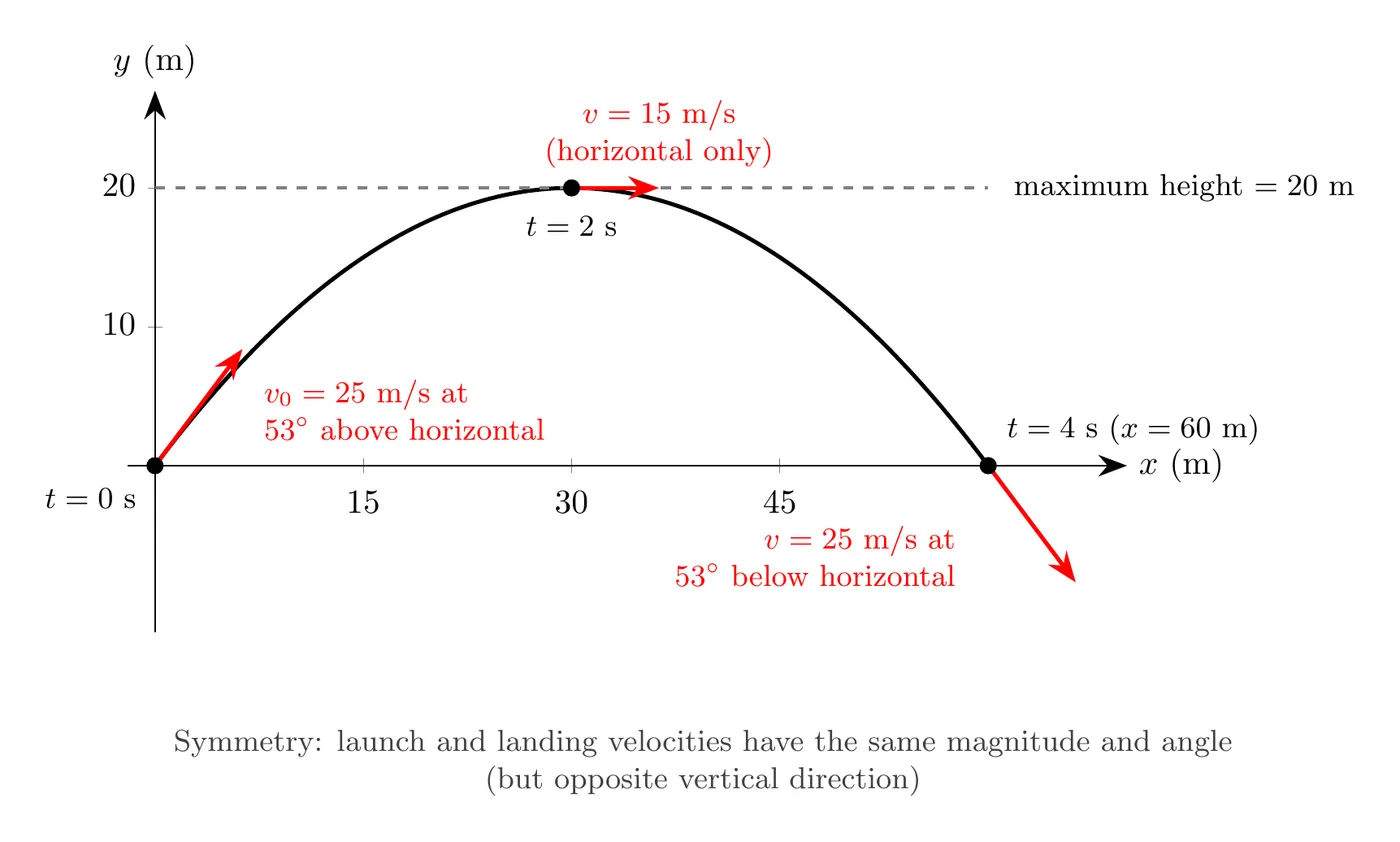
A soccer ball is kicked from ground level at 25 m/s, 53° above horizontal, with negligible air resistance. Using , find the maximum height and the landing velocity.
Resolving the initial velocity:
(53° is a special angle from the 3-4-5 triangle, where and .)
Setting up equations:
Horizontal: , and m/s (constant)
Vertical: , and
Maximum height:
At the top of the arc, . Setting gives s. Plugging into the position equation:
You can also get this from the vertex formula for a parabola, peaks at . Here , , so s, matching what we got from the physics approach, both give m.
Landing velocity:
The ball lands when : , giving (launch) or s (landing). You can also get this from symmetry, since it took 2 seconds to reach the top, it takes another 2 seconds to come back down, so s.
At landing, the horizontal component is unchanged at m/s. The vertical component is:
Interesting detail: the vertical speed is the same magnitude as at launch (20 m/s), just flipped to negative.
Magnitude of landing velocity:
Direction:
So the ball lands at 25 m/s, 53° below horizontal.
Why the symmetry? When the launch and landing heights are equal and air resistance is negligible, time going up equals time coming down, gravity accelerates the same both ways, horizontal velocity never changes, and the vertical speed at landing matches the vertical speed at launch, just reversed. That’s why the landing velocity mirrors the launch velocity exactly, same size and angle, opposite vertical direction.
Worked Example: Launched Horizontally
A ball rolls off a lab table that is 1.25 m high, moving horizontally at 2.40 m/s. Using , find how long it’s in the air, how far from the table it lands, and its velocity just before it hits the floor.
Setup: origin at the edge of the table, up is positive. Launched horizontally means m/s and . The ball lands at m.
Time in the air (vertical motion only):
Landing distance (horizontal motion only):
Velocity at impact: is still 2.40 m/s, and m/s.
Answers are rounded to two significant figures.
Key idea: the fall time depends only on the height and , not on the horizontal speed. Roll the ball off twice as fast and it lands twice as far away, in the same 0.50 s. If a second ball is dropped from the table edge at the same moment, both hit the floor together.
Where Projectile Motion Shows Up
Sports: basketball free throws (finding the best launch angle), soccer goal kicks (will it clear the crossbar), baseball outfield throws (maximizing range)
Emergency services: water trajectories from firefighting hoses, projectile based rescue equipment
Engineering: ballistics trajectory prediction, fountain design, placing objects on moving conveyor systems
Common Questions
Does horizontal motion affect vertical motion? No, they’re completely independent. A ball dropped straight down falls at the same rate as one launched horizontally, both only feel gravity vertically.
Why is horizontal velocity constant? With no air resistance, there’s no horizontal force acting on the projectile after launch, so by Newton’s First Law it just keeps its velocity.
What determines range? Initial speed (more speed, farther it goes), launch angle (45° gives maximum range on level ground), and the height of launch relative to landing.
When is maximum height reached? Exactly when vertical velocity hits zero, which for a symmetric trajectory is exactly halfway through the total flight time.
A Couple of Extra Insights
45° is special: on level ground, launching at 45° gives the maximum horizontal range, since it perfectly balances how fast you cover ground against how long you stay in the air.
Time of flight formula for a symmetric trajectory:
Range formula for launching from and landing on level ground at any angle :
This is also why complementary angles, like 30° and 60°, give you the exact same range.
Key Takeaways
- Vectors decompose into perpendicular components: , (angle from horizontal)
- Your calculator needs to be in degree mode for physics angle calculations
- Two-dimensional motion is really two independent one-dimensional motions analyzed separately
- Projectile motion has zero horizontal acceleration and constant downward vertical acceleration ()
- Always resolve the initial velocity into components first: ,
- Horizontal motion: , and stays constant
- Vertical motion: , and
- The exam uses on multiple choice and free response.
- Time links both dimensions, solve for it in one and use it in the other
- Maximum height occurs when , halfway through the flight (when launch and landing heights are equal)
- Launched horizontally: , and the fall time depends only on the height, not the horizontal speed
- For level-ground launches, landing speed equals launch speed, just flipped vertically
- Vertex formulas, quadratic roots, and substitution are all useful algebra tools here
- Horizontal and vertical motion are fully independent of each other