

1.2 - Displacement, Velocity, and Acceleration
Objects in Physics
When we study motion, we usually treat an object as a single point and ignore its size, shape, or internal structure. This is called treating it as a point particle.
For example, when you’re studying a train moving at 80 mph, you don’t worry about the individual cars, wheels, or passengers. You just treat the whole train as one object with one position and one velocity.
Even as a single point, the object keeps its mass (and its electric charge, if it has one). Only its size, shape, and internal structure are ignored.
When the point model works: a 1,500 kg car driving 3.0 km across town can be treated as one point with a mass of 1,500 kg. When it doesn’t: if the question is about the wheels spinning or the car tipping over, size and shape matter, so you need the system and rotation models from later units.
Position
Position is where an object is relative to some reference point you’ve chosen, called the origin. Think of it as a coordinate on a number line.
For example, if the origin is a stoplight and a bicycle is 150 meters down the road, its position is .
Displacement
Displacement is the change in an object’s position, meaning how far and in what direction it moved from where it started.
Here is displacement (a vector), is the final position, and is the initial position. Variables without a subscript are final values, and subscripts like “0” or “i” mark initial values.
Since displacement is a vector, it’s really , with direction shown through its sign.
Displacement vs. distance:
Displacement | Distance |
Vector | Scalar |
Cares about direction | Ignores direction |
Can be positive, negative, or zero | Always positive or zero |
Shortest path from start to finish | Total path length traveled |
Velocity
Average velocity is displacement divided by the time it took:
It’s a vector, and it only cares about your starting and ending points, not the path you took to get there.
Average speed is total distance divided by time:
Average speed is a scalar, and it’s always at least as big as the magnitude of average velocity.
A good real-world example is a navigation app: it calculates the total distance of your route and gives you an estimated average speed based on that and your travel time. But your actual displacement (start to destination, straight line) is usually shorter than the distance you drove because of all the turns.
Instantaneous velocity is your velocity at one specific moment, which mathematically happens as the time interval shrinks toward zero:
That’s the calculus definition, the derivative of position with respect to time.
A car’s speedometer shows instantaneous speed, the speed at that exact instant. If it also showed direction, it would be showing instantaneous velocity.
Acceleration
Acceleration is how fast velocity is changing.
Average acceleration:
Just like average velocity, average acceleration only uses the velocities at the start and end of the interval. Whatever the velocity did in between doesn’t change the answer.
Units: . A constant acceleration of means the velocity goes up by 3 m/s every second.
An object accelerates whenever the magnitude or direction of its velocity changes (or both):
- Magnitude changes, direction stays the same: a car speeding up or slowing down on a straight road
- Direction changes, magnitude stays the same: a car turning a corner at constant speed
- Both change: a car speeding up while turning
“Quick” vs. “fast”:
When a manufacturer says a car goes 0 to 60 mph in 3.5 seconds, that’s describing acceleration, how quickly speed changes, not top speed. A sedan might take 8 seconds to hit 60 mph while a sports car takes 3 seconds, but they could both eventually cruise at the same 60 mph. The sports car just has greater acceleration getting there.
How vehicles accelerate:
- Gas pedal: speeds you up (acceleration in the direction of motion)
- Brake pedal: slows you down (acceleration against the direction of motion)
- Steering wheel: changes direction (acceleration sideways to motion)
Instantaneous acceleration is acceleration at a specific moment:
This is the derivative of velocity with respect to time.
Definition Equations vs. Derived Equations
The equations above are definition equations, meaning they define the quantities themselves:
- defines displacement
- defines average velocity
- defines average acceleration
Derived equations come later, built by manipulating these definitions or working from graphs.
Worked Example: Jogger’s Motion
A jogger runs 4 km north from home, then turns around and runs 3 km south. The whole trip takes 35 minutes. Find the displacement, distance, average speed, and average velocity.
Setup: north is positive, south is negative, and home is the origin.
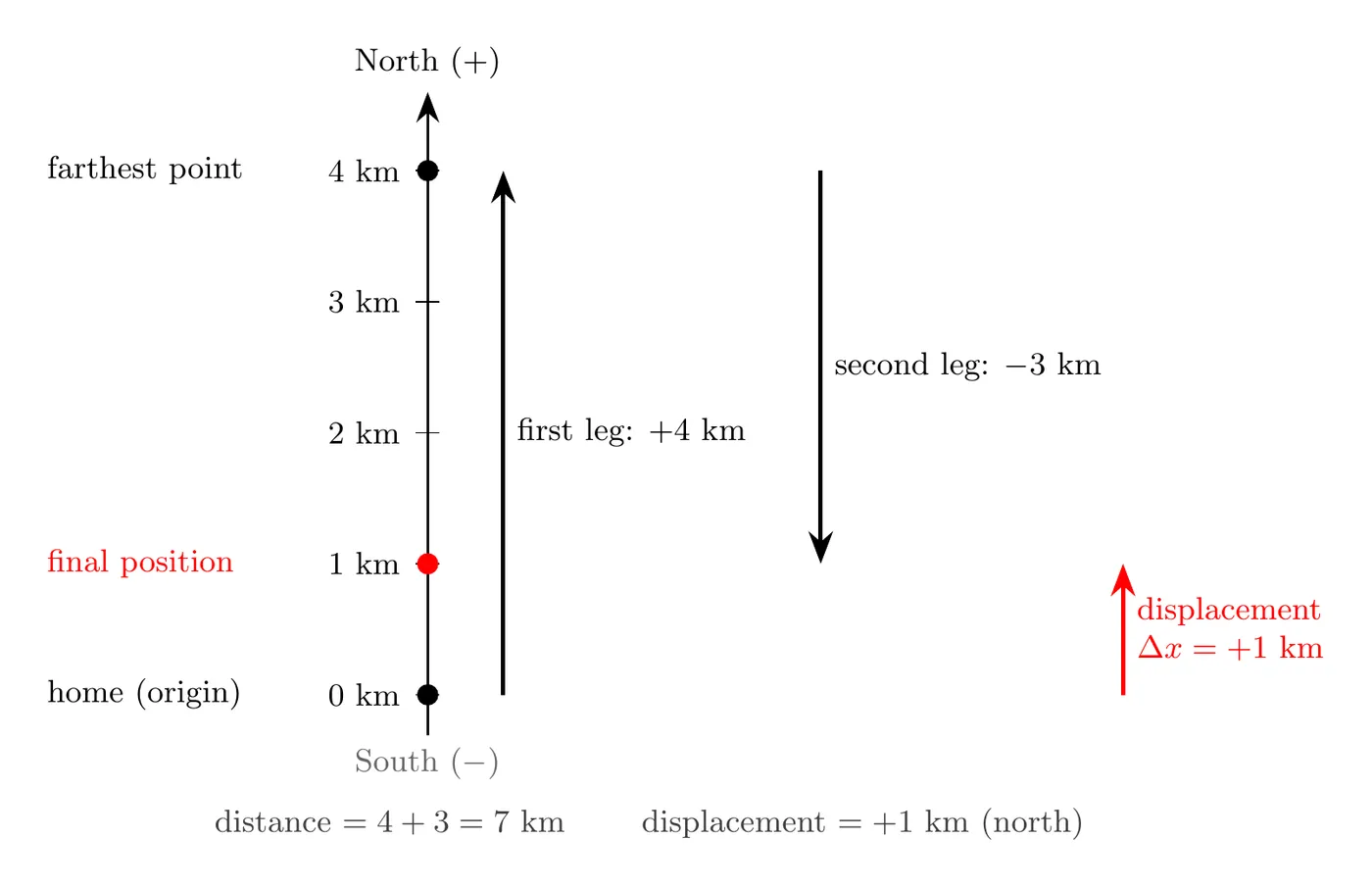
Displacement:
Starting position km. After going north, position is km. After coming back 3 km south, final position is km.
Distance: this ignores direction and just adds up both legs.
Average speed:
Average velocity:
Notice how much bigger the average speed (12 km/h) is compared to the average velocity’s magnitude (1.7 km/h). That’s because the jogger backtracked, covering a lot of ground but ending up close to where they started.
Speed vs. Velocity in Straight-Line Motion
If motion is in a single direction with no reversal, average speed and the magnitude of average velocity are equal. Think of a 100-meter sprint: displacement is 100 m forward, distance is 100 m, so both numbers match.
They only differ when direction changes, the path isn’t straight, or there’s backtracking involved.
Worked Example: Average Acceleration
Part 1: a cyclist speeds up from 3.0 m/s to 9.0 m/s in a straight line in 4.0 s. Find the average acceleration.
Part 2: a rubber ball moving at 18 m/s hits a wall and bounces straight back at 12 m/s. It touches the wall for 0.020 s. Find the average acceleration during the bounce.
Setup: toward the wall is positive, so m/s and m/s.
The acceleration points away from the wall. A common mistake is subtracting the speeds ( m/s), which ignores the change in direction and gives an answer 5 times too small.
Part 3 (only the endpoints count): a car moving at m/s brakes for a yellow light, then speeds back up to m/s. The whole thing takes 30 s. Its average acceleration over those 30 s is , even though it was accelerating almost the whole time.
Worked Example: Average Velocity Over Shrinking Time Intervals
A cart starts from rest and speeds up steadily. Its position is (with in meters and in seconds). Find the average velocity over shorter and shorter intervals that all start at s.
At s the cart is at m. For each interval, :
Interval | |||
2.0 s to 3.0 s | 1.0 s | 7.5 m | 7.5 m/s |
2.0 s to 2.1 s | 0.10 s | 0.615 m | 6.15 m/s |
2.0 s to 2.01 s | 0.010 s | 0.06015 m | 6.015 m/s |
As shrinks, the average velocity closes in on 6.0 m/s, the instantaneous velocity at s. You can check it another way: this cart has a constant acceleration of and started from rest, so m/s.
On a position vs. time graph, this is a secant line turning into a tangent line as its two points slide together (see 1.3).
Key Takeaways
- Objects are treated as point particles, ignoring size and internal structure
- Position is location relative to an origin:
- Displacement is the change in position: (a vector)
- Distance is total path length traveled (a scalar)
- Average velocity is displacement over time: (a vector)
- Average speed is distance over time: (a scalar)
- Instantaneous velocity is velocity at one moment (what a speedometer shows, plus direction)
- Acceleration is change in velocity over time: (a vector)
- Acceleration happens when the magnitude and/or direction of velocity changes
- When velocity reverses direction, find with signed velocities, not by subtracting speeds
- “Quick” means large acceleration, “fast” means large speed
- Definition equations establish the basic quantities and may not be on your formula sheet
- Average speed is always greater than or equal to the magnitude of average velocity, and they’re equal only for straight-line motion with no reversal (instantaneous speed always equals the magnitude of instantaneous velocity)