

3.2 - Work
Work: Physics vs. Everyday Definition
The physics definition of “work” is quite different from everyday usage. Everyday, “work” can mean any effort or activity, studying, thinking, even just standing still holding something. In physics, work specifically means energy transferred into or out of a system by a force acting over a distance. That means you can exert a force without doing any work at all, a counterintuitive fact worth keeping in mind.
Definition of Work
Work is the amount of energy transferred into or out of a system by a force acting on it as it moves through some distance. For work to happen, a force must be applied, the object must actually move (displacement occurs), and the force and displacement must share some parallel component. Miss any of those and no work is done.
where is work in Joules, is the magnitude of the applied force in Newtons, is displacement in meters, and is the angle between the force and displacement vectors. The cosine term makes sure only the parallel component of force actually contributes to the work.
On the AP equation sheet, the same equation is written as:
where is the component of the force parallel to the displacement and is how far the point where the force is applied moves (for a box or block, that’s the same as above). So the work done by a constant force depends on just two things: the force component along the motion, and how far the force’s point of application moves.
Conservative vs. Non-Conservative Forces
Forces are classified based on whether the work they do depends on the path taken.
Conservative forces are path-independent, meaning work only depends on the starting and ending configurations, not the route in between. They keep energy conserved and can be linked to a potential energy. Examples include gravity, spring force, and electrostatic force. If you move something in a closed loop against a conservative force, the net work is zero, whatever energy you put in going one way, you get back coming the other way.
Non-conservative forces are path-dependent, meaning the work really does depend on the specific route taken. They dissipate mechanical energy rather than conserving it, typically as heat, and that energy can’t be fully recovered as useful work. Examples include friction and air resistance.
Path independence, with numbers: a 2.0 kg box ends up 2.5 m lower than where it started. If it’s lowered straight down, gravity does J. If it slides down a 5.0 m ramp tilted 30° above the horizontal instead, gravity makes a 60° angle with the box’s displacement along the ramp, so J. Same start, same finish, same work, even though the second path is twice as long.
Returning to the start: toss a 0.40 kg ball straight up so it rises 2.5 m, then catch it at the height you let it go. On the way up, gravity points opposite the motion and does J. On the way down, gravity points along the motion and does J. The total work done by gravity is zero, and the change in the ball-Earth system’s gravitational potential energy is zero too, because the system ended in the same configuration it started in.
Only conservative forces get a potential energy. Potential energy is energy stored in a system’s configuration, so each configuration needs one value of it. That only works if the force’s work depends on nothing but the start and end positions. Friction fails that test: the work it does depends on how far something slides, not just where it ends up, so there’s no such thing as “friction potential energy.” The energy friction takes away turns into thermal energy instead.
Work as a Scalar Quantity
Like energy, work is a scalar, not a vector. But it can still be positive, negative, or zero, showing the direction energy is flowing.
Sign | Meaning | Energy Flow |
Positive work () | Force aids motion | Energy added to system |
Negative work () | Force opposes motion | Energy removed from system |
Zero work () | Force perpendicular to motion, or no motion at all | No energy transfer |
Positive work happens when you push a box forward as it slides forward, when gravity pulls a falling object down, or when an engine accelerates a car. Negative work happens when friction opposes a sliding box, when air resistance acts on a moving car, or when you catch a baseball (your hands push opposite to the ball’s motion). Zero work happens when you carry a backpack horizontally (force up, displacement horizontal), from normal force on a sliding object (perpendicular to motion), or pushing on a wall that doesn’t move.
The Parallel Component Requirement
Only the force component parallel to displacement does any work, which is exactly why cosine shows up in the formula.
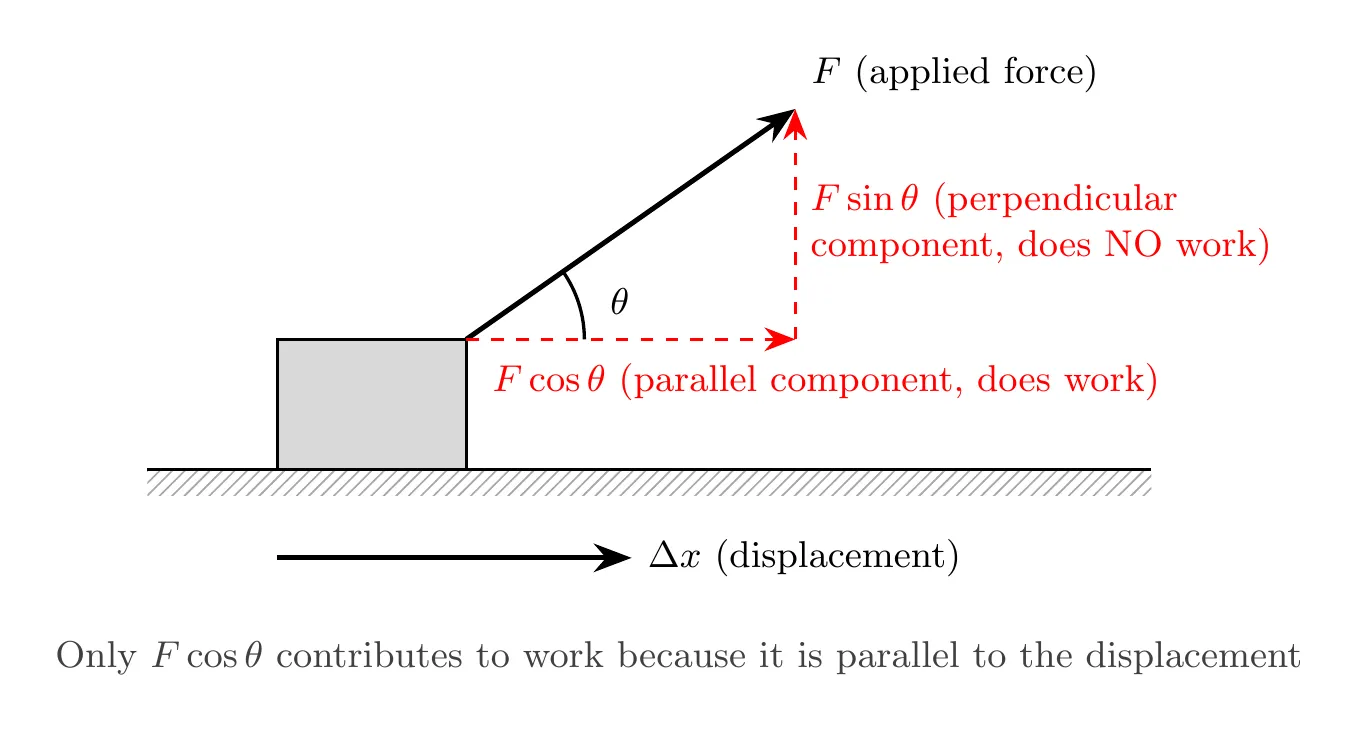
Angle | Work Done | |
0° (same direction) | 1 | (maximum positive) |
90° (perpendicular) | 0 | (no work) |
180° (opposite direction) | -1 | (maximum negative) |
Carrying objects horizontally: a student carries a 5 kg backpack, walking 20 meters horizontally on level floor. The force involved is upward (supporting the backpack’s weight), while the displacement is horizontal, giving and , so the work done by the student on the backpack is . This might feel counterintuitive since you get tired carrying it, but in physics terms, you’re not transferring energy into the backpack’s motion. Your muscles are doing internal work to maintain tension, but that’s not mechanical work on the backpack itself.
Centripetal force in circular motion: an object moving in a circle at constant speed has centripetal force pointing toward the center, while displacement is tangent to the circle, always perpendicular (). So work is zero at every instant, and total work over any arc, or a full circle, is also zero. Physically, this force changes direction without changing speed, so it doesn’t change kinetic energy.
Normal force on a horizontal surface: a box slides across a horizontal floor, normal force points up while displacement is horizontal, giving and zero work from the normal force.
Friction and Negative Work
Friction always does negative work on a moving object, because it always opposes motion, meaning .
Example: a 10 kg box slides 5 meters across a floor with . Friction force is N, so the work by friction is J. Friction removes 150 J of kinetic energy from the box, converting it to heat, and the box slows down.
Friction depends on the path length, not the displacement. Friction points opposite the motion at every moment, so it takes energy out the whole time something slides. The mechanical energy friction removes (turning it into thermal energy) is the friction force times the length of the path, :
Example, different paths between the same points: a 5.0 kg box is pushed across a floor with from point A to point B, 4.0 m away. Friction is N. Pushed straight from A to B (path length 4.0 m), friction removes J. Pushed around an obstacle on a 10.0 m path to B, friction removes J. Pushed from A to B and back to A (path length 8.0 m, displacement zero), friction still removes J.
Same endpoints, different work: that’s what path-dependent means. The round trip shows it best, since the displacement is zero but friction still took 80 J out of the box’s mechanical energy.
The Work-Energy Theorem
Work-Energy Theorem: the net work done on an object equals the change in its kinetic energy.
Net work is the sum of work done by every force acting on the object:
For example, a box sliding with an applied force and friction on a level surface has . Since motion is horizontal on a level surface, both and are zero (perpendicular to motion), leaving .
This theorem is a powerful tool connecting forces (which do work) to motion (kinetic energy). Use it when you know initial and final speeds and need to find forces or distances, when you know forces and distances and need speed changes, or when several forces act at once and you just want the net effect. It also has real advantages over Newton’s Second Law directly: you don’t need to know acceleration, you don’t need to know time, and working with scalars (energy, work) is often simpler than working with vectors (forces, accelerations).
Worked Example: Pulling a Sled at an Angle
A child pulls a 15 kg sled from rest across level snow with a rope at 37° above the horizontal. The tension in the rope is 60 N, the coefficient of kinetic friction is 0.15, and the sled moves 8.0 m. Find the net work done on the sled and its final speed. Use m/s², , and (the values in the equation sheet’s trig table).
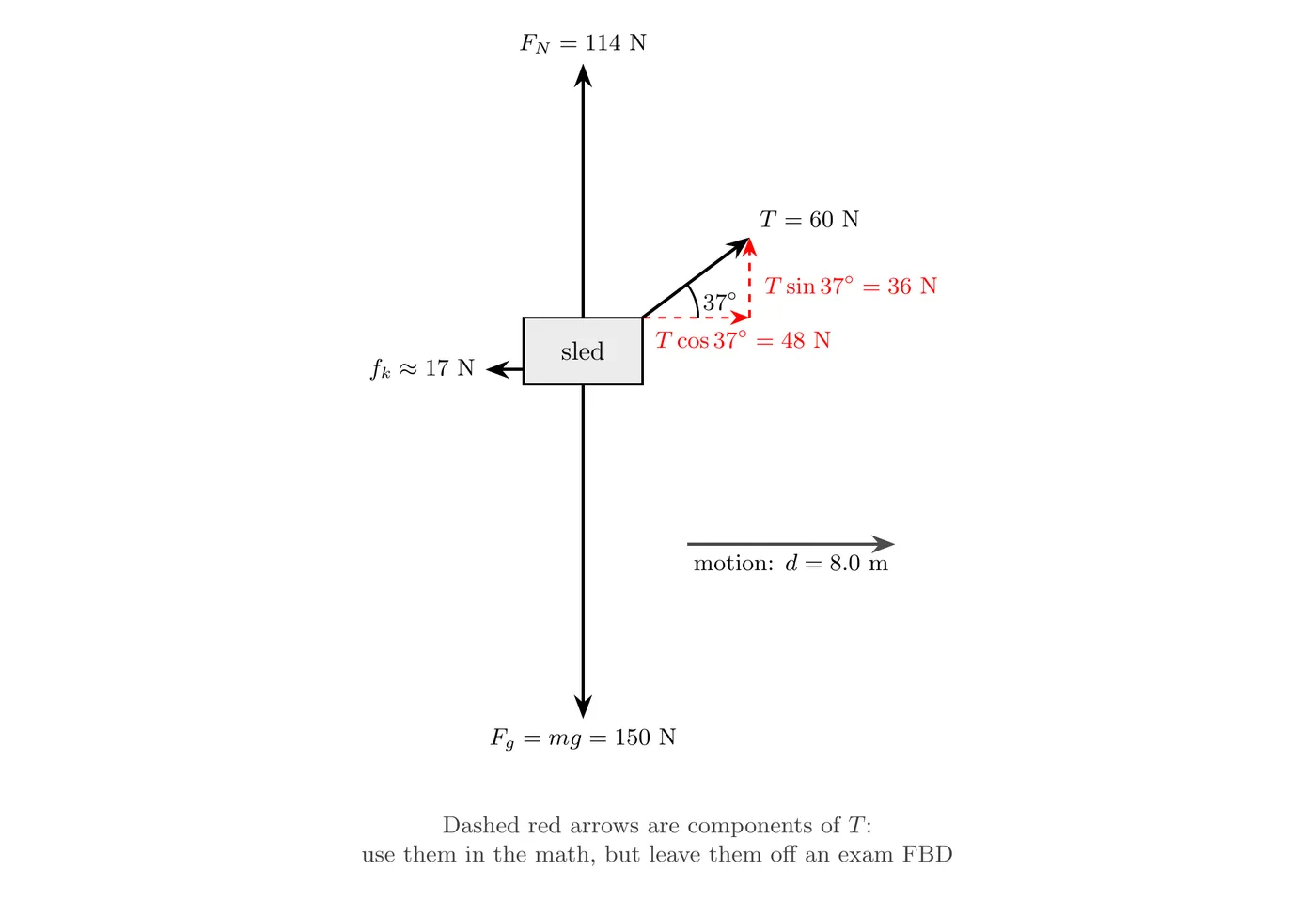
Draw the forces: tension along the rope, the normal force up, weight N down, and kinetic friction backward.
Find the normal force: the sled doesn’t move vertically, so the vertical forces balance. The rope’s vertical component, N, helps hold the sled up, so the snow pushes up less: N. That makes friction N (about 17 N).
Work done by each force ():
The normal force and gravity are perpendicular to the motion, so . The vertical part of the tension, , does no work either, but it still matters: it lowers the normal force, which lowers friction.
Apply the work-energy theorem:
The given values have two significant figures, so the answers are about J of net work and a final speed of 5.7 m/s.
Objects vs. Systems: Where the Work Goes
The equation sheet writes the work-energy theorem as : add up the work from every force, each one using the distance its own point of application moves. That version is built for an object, something with no internal structure that can only speed up or slow down.
When a system can be treated as an object: if the system’s center of mass moves the same distance as the point where the force is applied, the system can be modeled as an object, and the only energy the work can change is kinetic energy. For example, push a 2.0 kg box from rest with a constant 12 N horizontal force for 3.0 m across frictionless ice. Your hands and the box’s center of mass both move 3.0 m, so J and m/s.
When the force changes the system’s shape instead: an external force can also change a system’s configuration. Slowly push the free end of a horizontal spring ( N/m) that’s attached to a wall, compressing it 0.10 m. The end you push moves 0.10 m, but the spring’s center of mass only moves about half that (one end is stuck to the wall), and the spring never picks up speed. Your force grows steadily from 0 to N, so the average force is 10 N and you do J of work. None of it becomes kinetic energy. All of it is stored as elastic potential energy: J.
A force whose point of application doesn’t move does no work. When a skater pushes off a wall, the wall pushes on the skater’s hands, but the hands don’t move while they’re touching the wall. The point of application has zero displacement, so the wall does zero work on the skater. A 50 kg skater who leaves at 2.0 m/s gains J, and that energy comes from inside the skater (chemical energy in the muscles), not from the wall. The skater’s shape changes as the arms extend, so the skater can’t be modeled as an object here. Jumping works the same way: the floor pushes you up, but it does no work on you.
Work as Area Under a Force vs. Displacement Graph
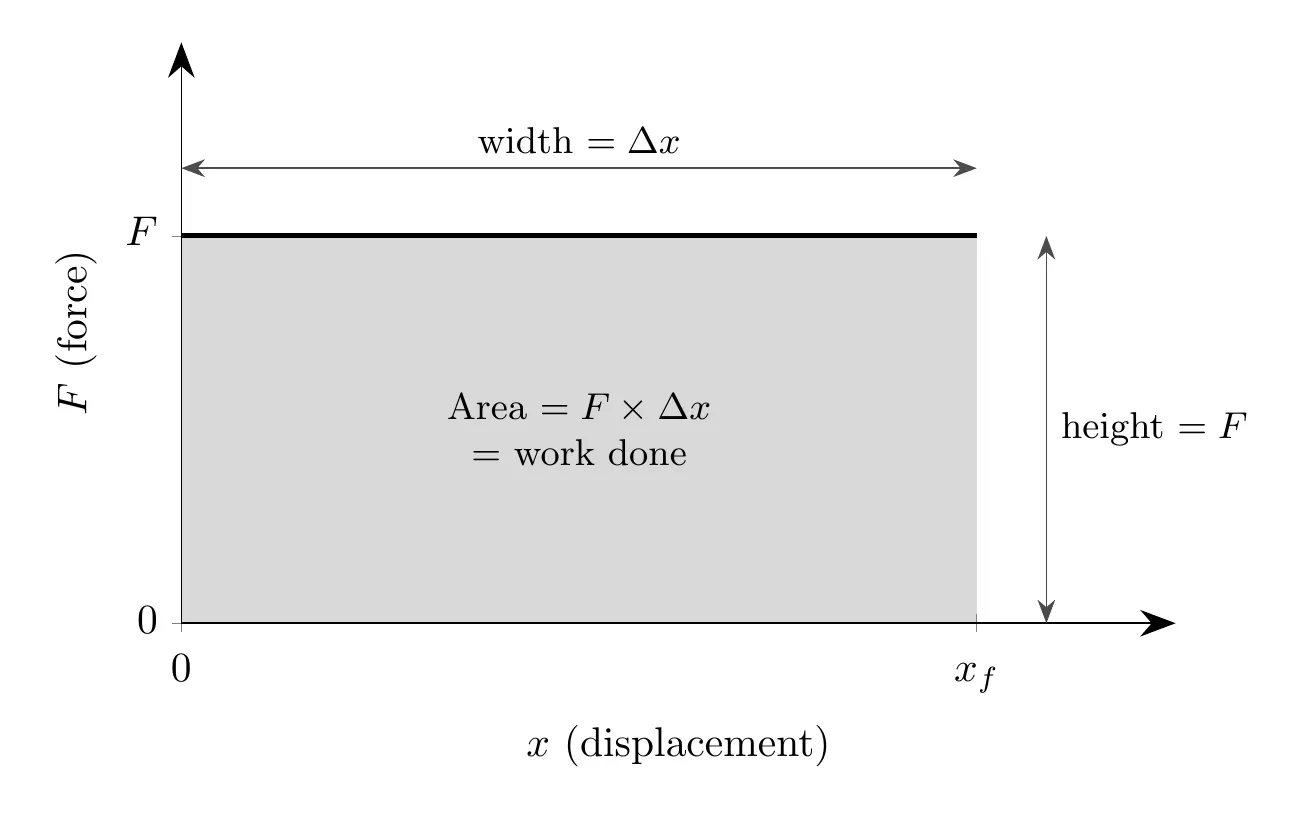
Graphically, work equals the area under a Force vs. Displacement curve.
For a constant force, this area is a rectangle:
For a varying force, like one that increases linearly, the shape is a triangle:
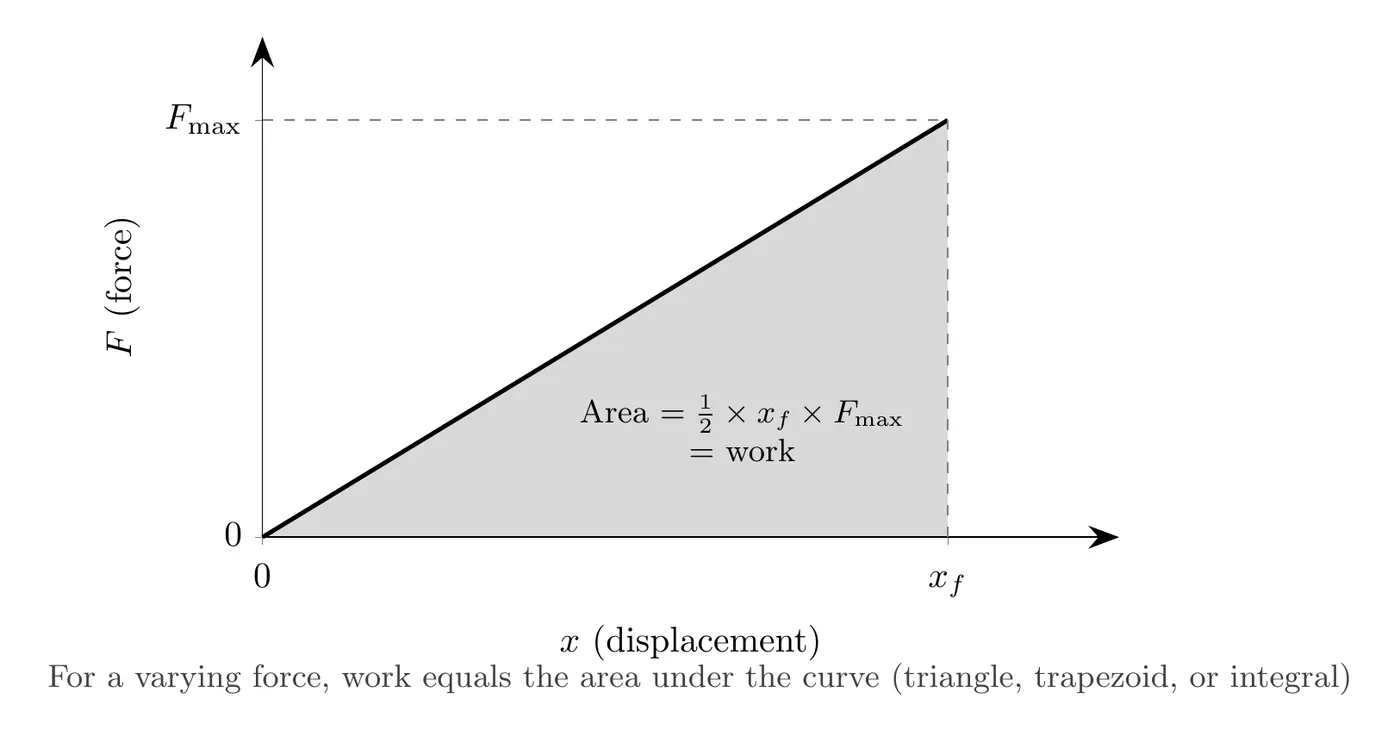
For a trapezoid or more complex shapes, break them into simpler pieces (rectangles plus triangles), or use integration directly.
Spring force example: a spring’s force varies linearly with displacement, , giving a straight line graph from the origin. The work to stretch it from to is:
This connects directly to spring potential energy, coming up next.
Area below the axis counts as negative work. If the force points opposite the displacement, the graph dips below the -axis, and that area subtracts. Add up all the areas with their signs to get the net work.
Worked Example: Reading a Force vs. Position Graph
A 4.0 kg cart starts from rest at on a frictionless track. The graph shows the net force on the cart as a function of its position. Find the net work done from to m, the cart’s speed at m, and where the cart is moving fastest.
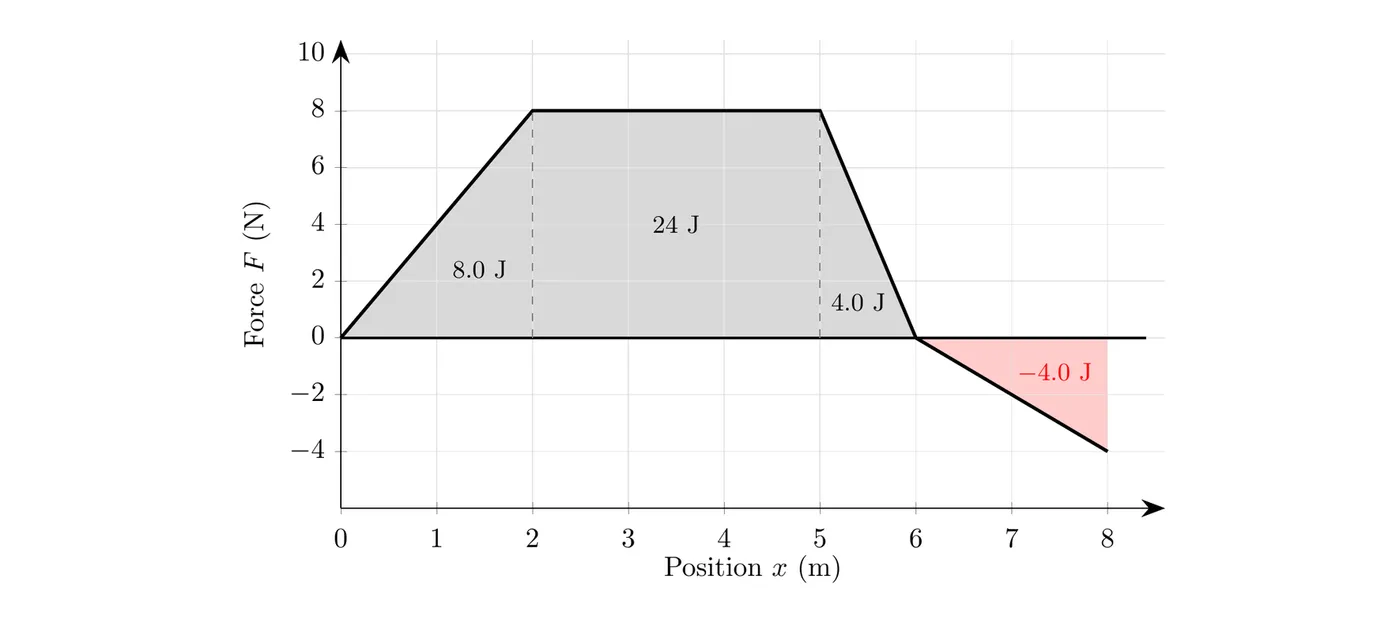
Split the area into simple shapes: a triangle from 0 to 2.0 m, J; a rectangle from 2.0 to 5.0 m, J; a triangle from 5.0 to 6.0 m, J; and a triangle below the axis from 6.0 to 8.0 m, J.
Speed at 8.0 m: by the work-energy theorem, J, so m/s.
Fastest point: the cart speeds up as long as the force is positive and slows down once it turns negative, so it’s fastest at m. There, J and m/s.
Worked Example: Bullet Penetrating Wood
A 2.60 gram bullet travels at 335 m/s and penetrates eight 1-inch pine boards, each 0.75 inches thick, stopping after passing through all of them. Find the average stopping force from the wood.
Total thickness: inches, which converts to m.
Finding the change in kinetic energy: initial mass kg, initial speed m/s, final speed (the bullet stops).
The bullet loses 146 J of kinetic energy, the negative sign showing energy is being removed.
Applying the work-energy theorem: the only force doing work here is the wood’s stopping force, which opposes the bullet’s motion (negative work). Writing that work as , where is the magnitude of the stopping force:
Calculating the force:
The wood exerts an average force of roughly 960 Newtons against the bullet’s motion. Acting over 0.15 meters, this force removes all 146 J of kinetic energy, bringing the bullet to a stop.
This is an average force because the actual force varies as the bullet penetrates, likely higher initially when the bullet carries the most energy, and lower as it slows down. The 146 J doesn’t just disappear, it mostly converts into thermal energy (heat in the wood and bullet), sound energy (the bang), and deformation energy (splintering wood, a deforming bullet).
Problem-Solving Strategy
For work calculations: identify every force acting on the object, then for each one determine its magnitude, its angle relative to displacement, and whether it does positive, negative, or zero work. Calculate each individual work with , then sum them to get net work.
For work-energy problems: find the change in kinetic energy, , apply the work-energy theorem, , relate that work to the actual forces and distances involved, and solve for whatever’s unknown.
Key Takeaways
- Work is energy transferred by a force acting over a distance:
- Units are Joules (J), the same as energy
- Work is a scalar, but it can be positive, negative, or zero
- Positive work means the force aids motion, adding energy
- Negative work means the force opposes motion, removing energy
- Zero work happens when force is perpendicular to displacement, or there’s no displacement at all
- Conservative forces (gravity, springs, electrostatic) do path-independent work
- Non-conservative forces (friction, air resistance) do path-dependent work
- Only the parallel component of force does work, hence the cosine
- Perpendicular forces never do any work
- Carrying objects horizontally does no work on them, since the force is perpendicular to the motion
- Friction always does negative work on a moving object
- Work-Energy Theorem:
- Net work is the sum of the work done by every individual force
- Graphically, work equals the area under a Force vs. Displacement curve
- The work-energy theorem is useful whenever relating forces and distances to speed changes
- Energy dissipated by non-conservative forces like friction usually ends up as heat
- On the equation sheet: and
- Only conservative forces have a potential energy, and their work around a closed path is zero
- Friction’s work uses the length of the path, so a round trip still removes mechanical energy
- A force whose point of application doesn’t move (a wall you push off, the floor when you jump) does no work
- If a force changes a system’s shape, its work can go into potential energy instead of kinetic energy