

3.4 - Conservation of Energy
Mechanical Energy
Before getting into conservation itself, let’s nail down mechanical energy.
A system made of only one object can only have kinetic energy. For example, a hockey puck sliding across frictionless ice has kinetic energy , but no potential energy, since there’s no force storing energy based on position.
A system with multiple objects interacting through conservative forces can have both kinetic and potential energy. Conservative forces allow reversible changes: compress a spring and release it, and it returns to its original state; lift something and lower it back down, and it returns to its original height. Energy converts between forms without any loss.
Shape changes count too: a system that can change shape and then spring back, like a spring, a bungee cord, or a trampoline, stores elastic potential energy while it’s deformed. A shape change that doesn’t spring back (a car crumpling, a lump of clay flattening) doesn’t store energy that way; the mechanical energy mostly turns into thermal energy and sound.
Mechanical energy is the sum of kinetic and potential energy in a system.
where is the mechanical (total) energy, is kinetic energy, and is potential energy in all its forms, gravitational, elastic, and so on. Sometimes it’s written to distinguish it from other energy types like thermal or chemical. At any point along an object’s path:
Mechanical energy represents the total capacity to do work within the mechanical system.
The Law of Conservation of Energy
The simplified version, taught in earlier grades, says energy cannot be created or destroyed, only transferred or transformed. That’s conceptually correct but not precise enough for problem solving.
The more precise physics version says: if the work done on a system is zero and there are no non-conservative interactions within the system, the total mechanical energy stays constant.
Mathematically, this means:
The Most Important Equation to Write Down
On free-response questions involving conservation of energy, always write this first:
Or equivalently:
Writing this shows you understand the fundamental principle, it’s usually worth points even if later algebra goes wrong, and it sets up the right framework for the rest of the problem. Also acceptable expanded forms include , , and .
When Conservation of Energy Applies
Ideal conditions (a conservative system): conservation of mechanical energy applies when there’s no external work (), no non-conservative forces like friction or air resistance, and the system is closed, with no energy entering or leaving. Examples include an object in free fall (ignoring air resistance), a frictionless roller coaster, an ideal pendulum with no friction at the pivot, and a mass on a frictionless spring.
Non-ideal conditions (non-conservative forces present): when friction or air resistance acts, mechanical energy is not conserved. The modified equation becomes:
Friction does negative work, so mechanical energy decreases, but that energy isn’t destroyed, it converts to thermal energy (heat), and you have to account for that dissipated energy. For a block sliding with friction:
Since friction does negative work:
The mechanical energy lost equals the thermal energy friction generates.
Choosing the System
Energy is conserved in every interaction. It’s never created or destroyed. What changes from problem to problem is whether energy stays inside the system you picked or crosses its boundary, and that depends on which objects you include.
A system with constant total energy: you can always choose a system big enough that its total energy stays constant, by including every object that interacts and keeping any thermal energy inside. For a dropped ball, the ball-Earth system works. If there’s friction, include the surfaces that rub, so the thermal energy stays in the system too.
A system whose energy changes: if a force from outside the system does work on it, energy crosses the boundary, and the system’s total energy changes by exactly that amount:
Positive external work means energy flows into the system; negative work means energy flows out. Here counts every kind of energy in the system, thermal energy included. That’s different from the form above, which only tracks mechanical energy.
Worked example, one event, two systems: a 0.50 kg ball is dropped from rest 2.0 m above the ground (ignore air resistance). How much kinetic energy does it have just before it lands?
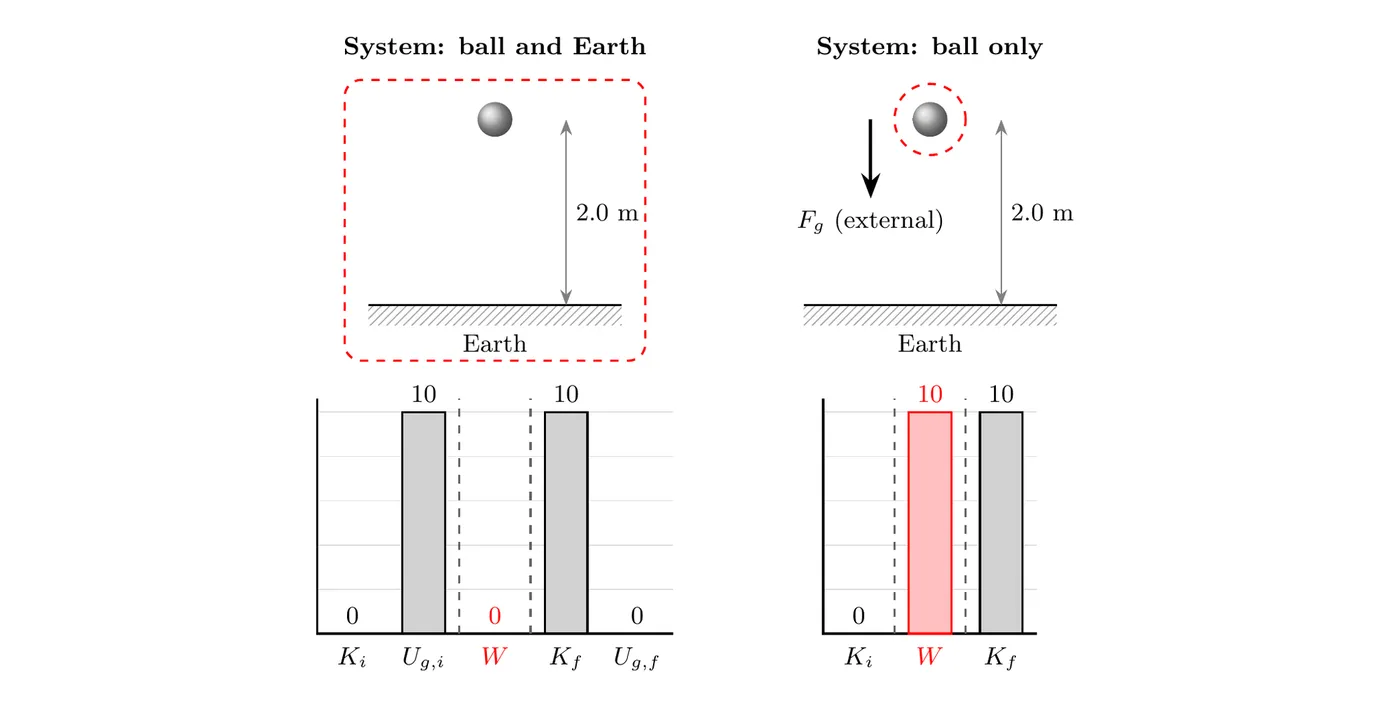
System: ball and Earth. Gravity acts between two objects inside the system, so it’s an internal conservative force, and nothing outside does work: . The system’s gravitational potential energy turns into kinetic energy: J, so J, and the total mechanical energy stays constant.
System: ball only. Earth is outside the system, so there’s no potential energy to talk about (one object alone can only have kinetic energy). Gravity is now an external force that does work on the ball: J. That energy crosses into the system, so J.
Both choices give J and a landing speed of m/s. The physics is the same, only the bookkeeping changes. What you can’t do is count gravity twice: if you include , don’t also add the work done by gravity.
Friction works the same way. Take a block sliding to a stop on a rough floor. If the system is the block and the floor, friction is internal: the mechanical energy drops, but it shows up as thermal energy in the block and floor, so the total stays constant. If the system is just the block, friction from the floor is an external force that does negative work, so energy leaves the system.
Problem-Solving Strategy
- Identify initial and final states: pick two key moments, typically the starting position for the initial state and wherever you want to find something for the final state.
- Write the conservation statement: (or if friction is present), and .
- Write energy expressions for each state: initial kinetic energy (zero if starting from rest), initial potential energy or ; final kinetic energy (zero if ending at rest), final potential energy or .
- Substitute and solve: , then solve algebraically for the unknown.
- Simplify: watch for terms that equal zero, like starting from rest () or a reference point (). These simplifications make the algebra much easier.
Real-World Applications
Roller coasters are designed around conservation of energy. Gravity/drop coasters, the traditional kind, start with large potential energy at the top of a tall lift hill, convert it into kinetic energy on the first drop, and every subsequent hill has to be shorter than the first, since no more energy gets added along the way. Launch coasters, the modern kind, use a powerful launch (magnetic linear motors on many rides, hydraulic systems on others) to add initial kinetic energy, which means they can have tall hills anywhere in the layout. For example, Kingda Ka in New Jersey (open from 2005 to 2024) used a hydraulic launch to send riders over a 456 ft tall hill.
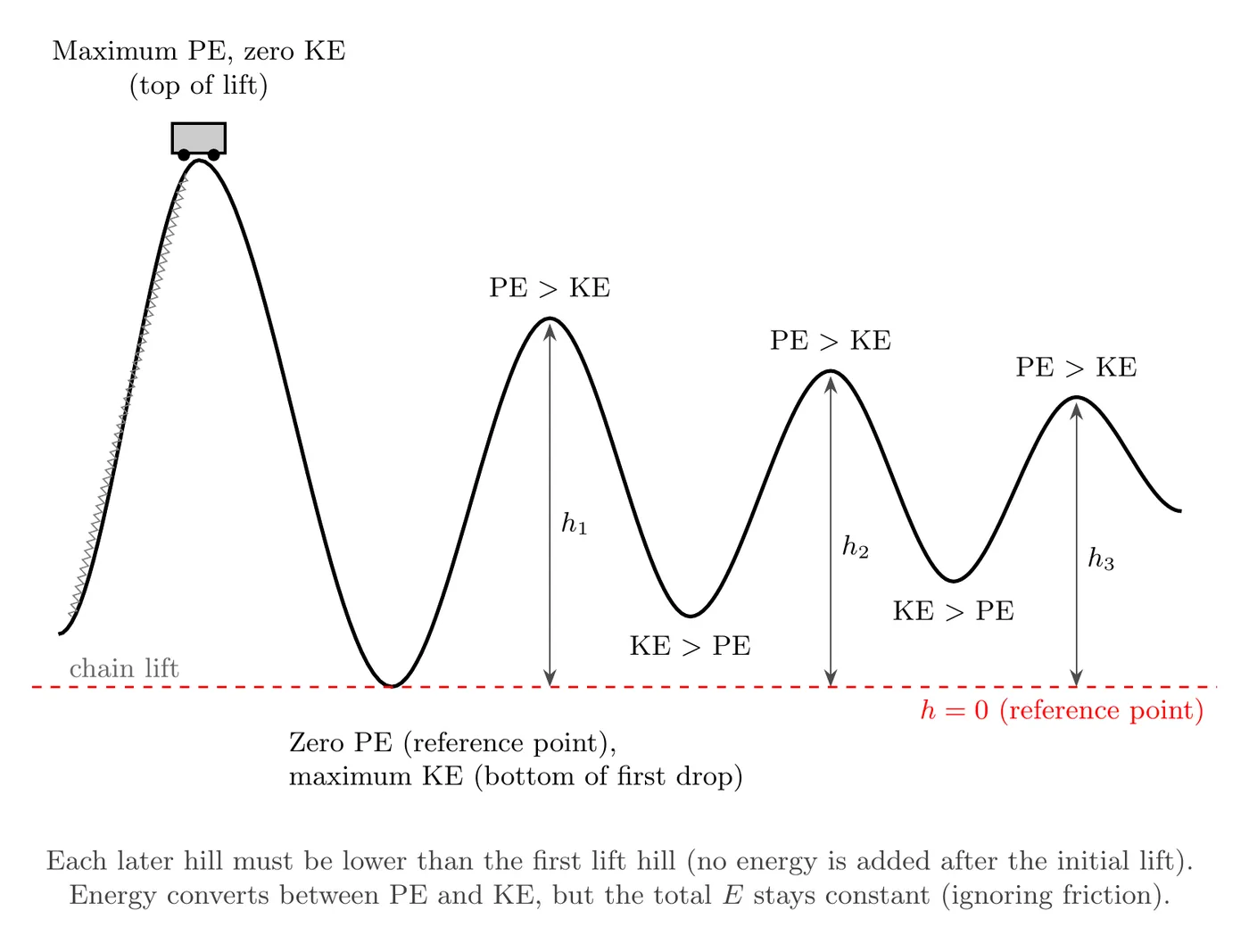
The design principle: the first hill has to be the tallest (or the ride needs enough launch speed to compensate), since no more energy gets added afterward, and every following hill can only be at most as tall as the current potential energy allows.
Pendulum rides like pirate ship attractions at amusement parks are giant pendulums: at the highest points, potential energy is maximum and kinetic energy is momentarily zero, at the lowest point, potential energy is zero (reference) and kinetic energy is maximum, and energy keeps converting back and forth between the two.
Diving: an Olympic diver converts gravitational potential energy into kinetic energy on the way down. At the platform, potential energy is high and kinetic energy is zero. At the water surface, potential energy is zero (reference) and kinetic energy is high. The final speed depends only on height, not on the diver’s mass.
Worked Example: Diver from Platform
A 60 kg diver stands on a 10 meter platform, steps off, and falls into the pool below. Use m/s². Find her speed at the water, then determine whether a 75 kg diver would have a different speed.
Setup: initial height m, initial speed (starting from rest). Final height m (set as the reference point), final speed is what we want. Reference point is the water surface.
Writing conservation of energy: , so . Initial kinetic energy (not moving yet), initial potential energy . Final kinetic energy , final potential energy (at the reference point).
Substituting:
Dividing both sides by (notice it cancels completely):
Plugging in numbers:
The diver reaches the water moving at 14 m/s, about 32 mph.
Would a 75 kg diver be different? No, speed here is independent of mass. In the derivation, appeared on both sides and canceled out completely, leaving with no mass term at all. Even though the 75 kg diver has more gravitational potential energy (, larger ) and more kinetic energy at the bottom (, larger ), the ratio stays the same since both scale with mass proportionally. Speed depends only on height and gravitational field strength, not mass. This is basically Galileo’s principle in action, ignoring air resistance, everything falls at the same rate regardless of mass, and conservation of energy provides the mathematical proof of it.
Some things stay the same between the two divers: final speed (14 m/s), time to reach the water ( s), and acceleration during the fall ( m/s²). But other things differ:
Quantity | 60 kg Diver | 75 kg Diver |
Initial PE | J | J |
Final KE | J | J |
Momentum at impact | kg·m/s | kg·m/s |
So while both divers hit the water at the same speed, the heavier one has more momentum and kinetic energy, meaning the water has to do more work to stop them, a greater impact force and deeper penetration into the water.
Energy Transformations: Gain vs. Loss
Writing can be rearranged as , or : whenever kinetic energy increases, potential energy decreases by the same amount, and whenever potential energy increases, kinetic energy decreases by the same amount.
For a falling object going down: potential energy decreases (getting lower, ), kinetic energy increases (speeding up, ), and shows the gain in kinetic energy equals the loss in potential energy. Going up, it’s the reverse: potential energy increases (), kinetic energy decreases (), and the losses in kinetic energy equal the gains in potential energy.
An alternative way to write this is , rearranged as , or in words: gain in kinetic energy equals loss in potential energy.
Energy Bar Charts
An energy bar chart shows how much of each type of energy a system has at one moment. Each column is one energy type (, , ), and the height of the bar is the amount. Draw one chart for each moment you care about. If no energy crosses the system boundary, the bars add up to the same total in every chart: energy just moves from one column to another.
Worked example: a 0.50 kg block is pushed against a spring ( N/m), compressing it 0.30 m, and released from rest at A. It slides along a frictionless track and up a frictionless ramp. The system is the block, the spring, and Earth, with on the level track.
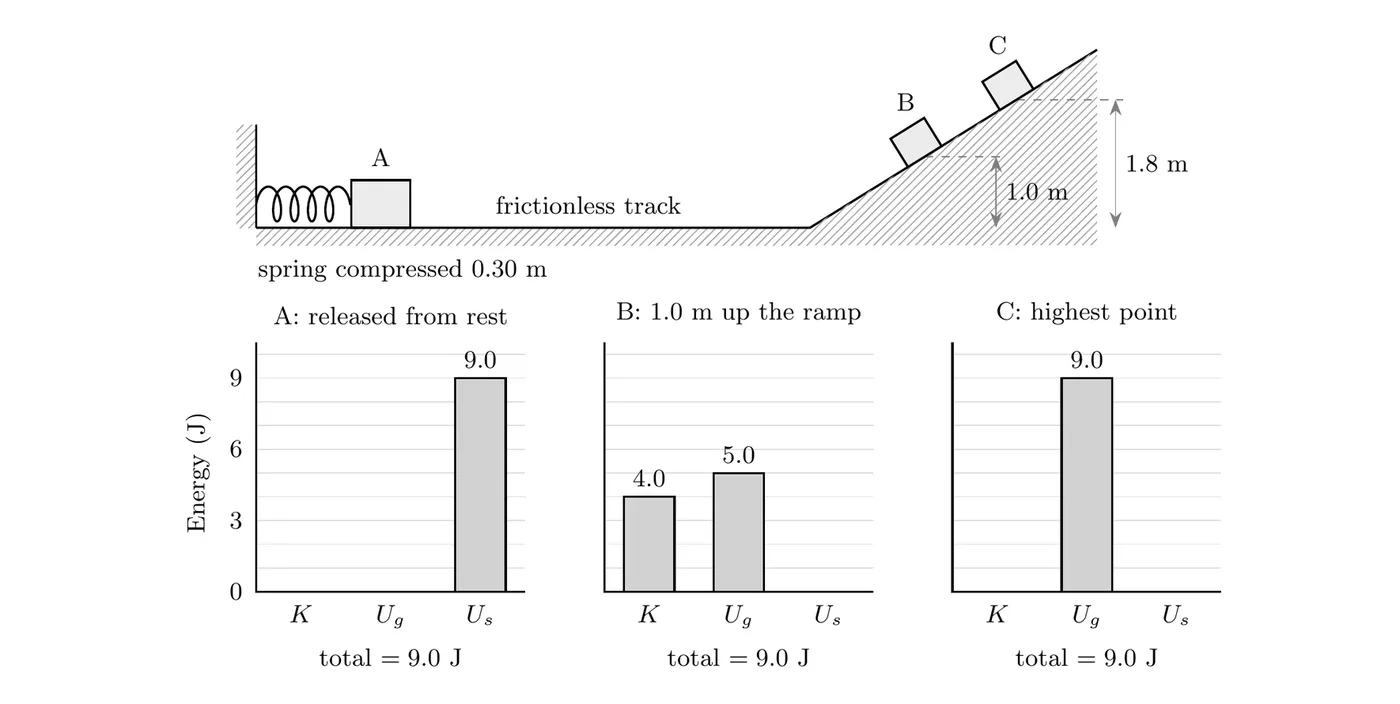
At A: all the energy is elastic, J, and . That 9.0 J is the total for every chart.
At B (1.0 m up the ramp): the block has left the spring, so . J, and the rest is kinetic: J, so m/s.
At C (highest point): the block stops for an instant, so and all 9.0 J is gravitational: m.
With friction: if the ramp had friction and the block only made it to 1.6 m, its gravitational potential energy at the top would be J. The missing 1.0 J didn’t vanish. It became thermal energy in the block and ramp, so a complete bar chart for that case needs a thermal energy column (or, if the ramp is outside the system, a bar for the negative work friction did).
Common Problem Types
Object released from height: given height (and sometimes mass), find the speed at the bottom. At the top, it’s all potential, zero kinetic; at the bottom, it’s all kinetic, zero potential: .
Object launched upward: given initial speed (and sometimes mass), find the maximum height. At the bottom, it’s all kinetic, zero potential; at the top, it’s all potential, zero kinetic: .
Roller coaster problems: given height at multiple points and speed at one, find speed at another. Compare two states with different mixtures of kinetic and potential energy: .
Spring-mass systems: given spring constant, compression or stretch, and mass, find speed passing through equilibrium. When compressed, it’s all elastic potential, zero kinetic; at equilibrium, it’s all kinetic, zero elastic potential: .
Common Mistakes
Forgetting to write : don’t jump straight into equations without stating the principle first, always start with or .
Inconsistent reference points: don’t use different reference points for the initial and final states, pick one and stick with it throughout.
Including energy that shouldn’t exist: don’t write potential energy at a point where you’ve set , at the reference point, .
Sign errors with : don’t write but then swap in instead of . Always remember , final minus initial.
Key Takeaways
- Mechanical energy: , the sum of kinetic and potential energy
- Single-object systems only have kinetic energy, multi-object systems with conservative forces have both
- Conservation of energy: with no external work and no non-conservative forces,
- Always write first: or on free-response questions
- Equivalent forms: or
- With non-conservative forces: , energy dissipated by friction
- Roller coasters need their first hill to be the tallest (if gravity-powered), unless energy is added by a launch
- In free fall problems, final speed doesn’t depend on mass, since mass cancels
- Different masses have different energies but the same speeds, falling from the same height
- Problem-solving flow: identify initial/final states, write , write energies, substitute, solve
- Common simplifications: (starting from rest) or (at the reference point)
- Energy converts between kinetic and potential, but total stays constant in a conservative system
- : a gain in one always equals a loss in the other
- Choose your reference point at the lowest position to avoid negative heights
- Conservation of energy is a powerful alternative to Newton’s Laws, working with scalars instead of vectors, no acceleration needed
- Energy is conserved in every interaction; whether a system’s energy changes depends on what you include in the system
- If an outside force does work on a system,
- Don’t count gravity twice: use (Earth in the system) or the work done by gravity (Earth outside), never both
- Energy bar charts show each type of energy at one moment; with no energy crossing the boundary, every chart has the same total