

3.1 - Translational Kinetic Energy
Introduction to Energy
Unit 3 covers Work, Energy, and Power, a different lens for analyzing motion compared to Newton’s Laws. Where forces describe why objects move, energy describes what objects can do because they’re moving or positioned somewhere.
This section covers translational kinetic energy, which is distinct from rotational kinetic energy (covered later on).
What is Kinetic Energy?
The word “kinetic” comes from the Greek kinesis, meaning motion. Kinetic energy is the energy an object has because it’s moving. This is intuitive: a rolling ball, a flying arrow, a speeding car, they all have kinetic energy just from moving.
where is kinetic energy in Joules, is mass in kg, and is speed in m/s. Note that it’s speed (the magnitude of velocity) that matters here, not velocity itself, direction plays no role in kinetic energy.
This equation is on the AP Physics 1 equation sheet, written exactly this way: .
Units: The Joule
Every form of energy, not just kinetic, is measured in Joules (J).
The unit is named after James Prescott Joule (1818 to 1889), an English physicist whose experiments connected mechanical work to thermal energy.
Joule showed that mechanical energy could be converted into heat through friction.
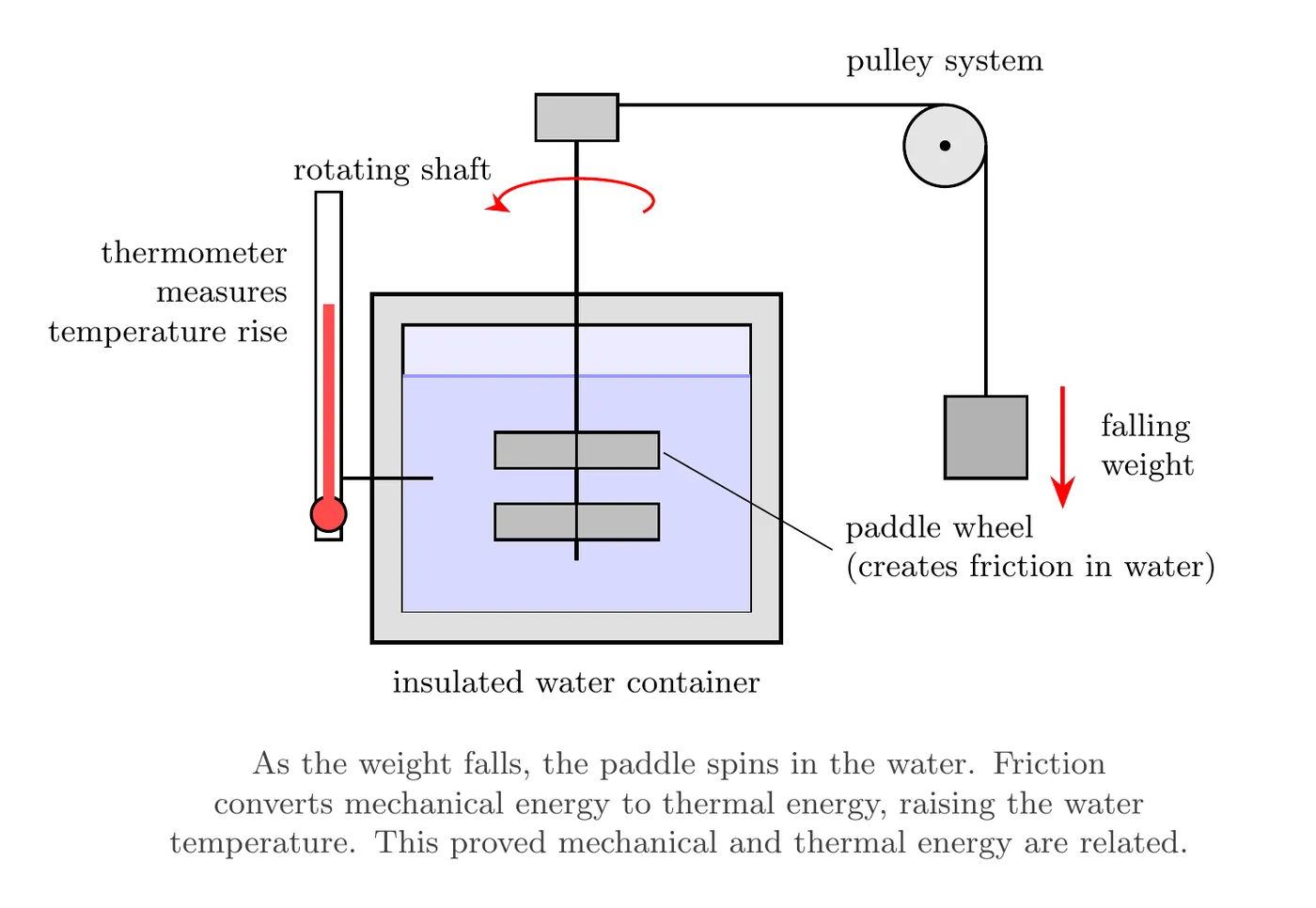
Before Joule’s work, many scientists thought heat was a fluid called “caloric.” Joule measured how much heat a given amount of mechanical work produces (the mechanical equivalent of heat), which showed that heat is a form of energy and helped establish the First Law of Thermodynamics.
Energy as a Scalar Quantity
Unlike forces and velocities, energy is a scalar, not a vector. That means energy has magnitude only, no direction, and energies simply add up arithmetically, no need to resolve vector components. Total energy is just
Example: two objects with kinetic energies of 50 J and 30 J have a total kinetic energy of J, no directions to worry about.
Example, opposite directions: two 2.0 kg carts roll toward each other, one moving right at 3.0 m/s and the other moving left at 3.0 m/s. Their velocities point opposite ways, but kinetic energy doesn’t care about direction. Each cart has J, so the total is J, not zero. (Momentum, a vector covered in Unit 4, would cancel here. Kinetic energies never cancel, they only add.)
Kinetic Energy is Always Positive
Kinetic energy can never be negative. There are two reasons for this: velocity gets squared, so is always positive no matter which direction the object moves, moving right at +5 m/s or left at -5 m/s both give . And mass is always positive, as far as we know, nothing has negative mass. So positive mass times positive always gives a positive kinetic energy.
Physically, energy represents a capacity to do work or cause change. A stationary object has zero kinetic energy, the minimum possible, and motion only ever raises it above zero, there’s no “less than zero” for this kind of energy.
Frame of Reference and Kinetic Energy
Different observers measure different kinetic energies for the same object, depending on their frame of reference, since kinetic energy depends on speed, and speed itself is relative to whoever’s watching.
Train example: a passenger walks forward at 2 m/s inside a train moving at 30 m/s. An observer on the train measures the passenger’s speed as m/s, giving J. An observer on the ground measures the passenger’s speed as m/s, giving J. Both are correct, kinetic energy really is frame-dependent.
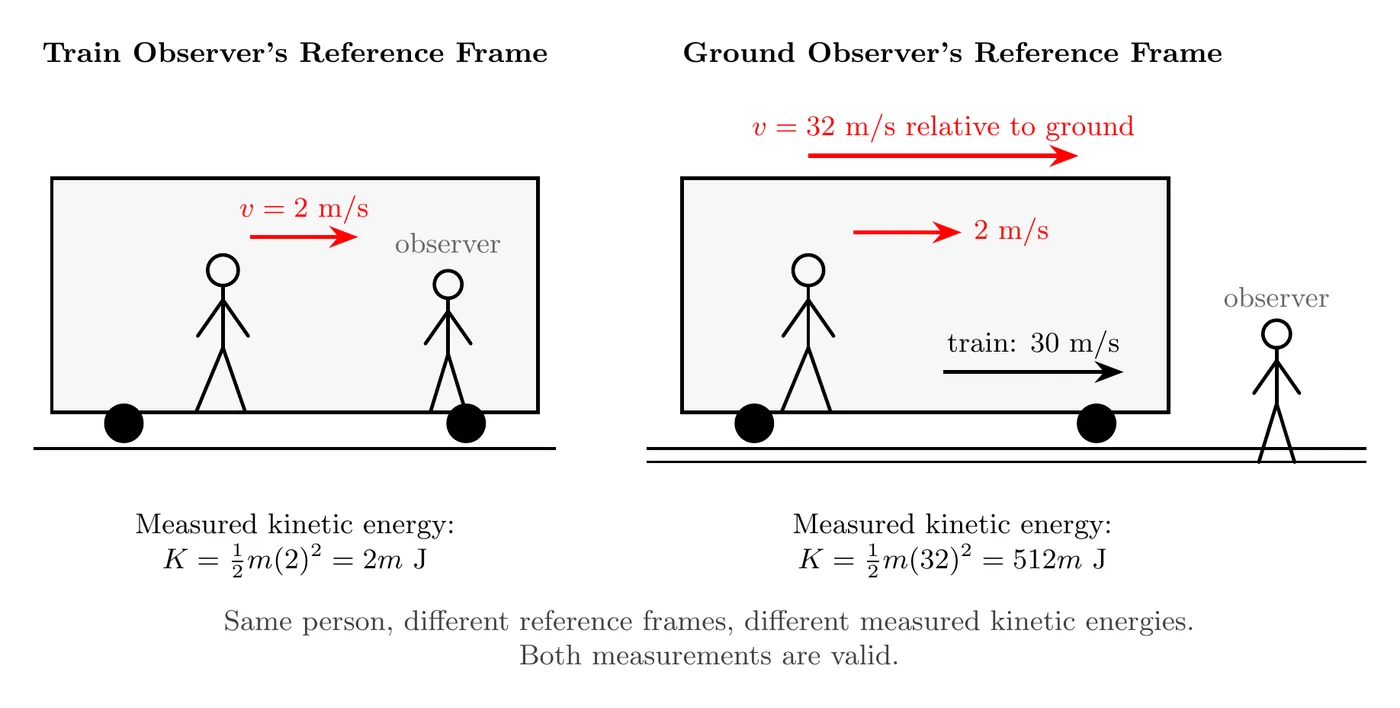
With numbers: if the passenger’s mass is 60 kg, the observer on the train measures J, and the observer on the ground measures J, about J. Same passenger, same moment, two different (and both correct) kinetic energies.
The practical takeaway: stay consistent with your reference frame when solving problems. The ground or Earth is the usual default unless a problem tells you otherwise.
Proportionality Relationships
Relationship to mass: at constant velocity, , kinetic energy is directly proportional to mass. Double the mass and you double the kinetic energy, triple it and you triple the energy, halve it and you halve the energy.
Example: a 1000 kg car at 20 m/s has J, and a 2000 kg car at the same 20 m/s has J, exactly twice as much, since it has twice the mass at the same speed.
Relationship to velocity: at constant mass, , kinetic energy is proportional to the square of velocity. Double the speed and you quadruple the kinetic energy, triple the speed and you get nine times the energy, halve the speed and you get a quarter of the energy.
Example: an object at 10 m/s has J, and the same object at 20 m/s has J. Doubling the speed gives times the energy.
That quadratic relationship matters a lot: small increases in speed produce large increases in energy, which is exactly why highway collisions are so much more dangerous than parking lot collisions.
Change | Mass Effect | Velocity Effect |
Double | ||
Triple | ||
Halve |
So changes in velocity have a much bigger effect on kinetic energy than changes in mass do.
Worked Example 1: Cyclist’s Kinetic Energy
A cyclist with mass 75 kg rides at a constant 8.0 m/s on flat ground. Find the kinetic energy.
The cyclist has 2400 Joules of kinetic energy from their motion, energy that could be transferred elsewhere, like heat from braking or potential energy riding uphill.
Worked Example 2: Finding Mass from Kinetic Energy
A meteor enters Earth’s atmosphere with kinetic energy J, traveling at m/s. Find its mass.
Rearranging for mass:
That’s roughly 1.1 trillion kilograms, an enormous meteor, roughly a sphere of rock about 1 km across. An impact like that would cause catastrophic global effects.
Worked Example 3: Subatomic Particle Kinetic Energy
An electron in a particle accelerator travels at m/s, with mass kg (the problem gives this value, since particle masses aren’t on the AP Physics 1 equation sheet). Find its kinetic energy.
First, , so:
Even at a tremendous speed (18 million m/s, about 6% the speed of light), the electron’s kinetic energy is tiny in everyday units, since its mass is so incredibly small. That’s exactly why physicists at this scale usually use electron-volts (eV) instead of Joules.
Notes on Problem Solving
Unit consistency: always work in SI units, mass in kilograms, speed in meters per second, giving energy in Joules. Common conversions needed include km/s to m/s (multiply by 1000), g to kg (divide by 1000), and km/h to m/s (multiply by 1000, then divide by 3600).
Constants on the equation sheet: the AP Physics 1 equation sheet only lists three constants: N·m²/kg², m/s² (also written as 9.8 N/kg), and 1 atm Pa. Particle masses aren’t on it, so if a problem involves an electron ( kg) or a proton or neutron (about kg), the problem will give you the mass.
Rearranging the equation: solve for kinetic energy with , solve for mass with , or solve for speed with (and don’t forget the square root at the end).
Real-World Applications
Vehicle safety: kinetic energy is why high-speed crashes are so dangerous. A car at highway speed has far more kinetic energy than at city speed, thanks to the relationship, and all that energy has to be dissipated somehow during a collision, through crumpling metal, airbags, and so on. Comparing a car at 25 mph () to the same car at 50 mph (), doubling the speed gives 4 times the energy and 4 times the destructive potential.
Sports: pitchers maximize ball speed to increase the kinetic energy delivered to the plate, bowlers use heavy balls at moderate speed for high kinetic energy to knock down pins, and racers try to minimize vehicle mass to reach higher speeds for a given amount of energy input.
Projectiles and impacts: bullets have small mass but very high velocity, giving substantial kinetic energy. Pile drivers use a large mass dropped from height, converting potential energy into kinetic energy to drive foundation piles. Meteorite impacts are devastating even for small rocks because of their astronomical speeds.
Key Takeaways
- Translational kinetic energy: , the energy of motion
- Units are Joules (J), where
- Named after James Prescott Joule, who proved mechanical and thermal energy are connected
- Energy is a scalar quantity, no direction, only magnitude
- Kinetic energy is always positive or zero, never negative, since velocity is squared and mass is always positive
- Frame of reference matters, different observers measure different kinetic energies for the same object
- Proportional to mass: , double the mass doubles the energy
- Proportional to the square of velocity: , double the speed quadruples the energy
- Velocity’s quadratic relationship makes it the dominant factor in kinetic energy
- Always use SI units, kg for mass, m/s for speed
- The formula rearranges to solve for , , or depending on what’s unknown
- Subatomic particle masses aren’t on the AP Physics 1 equation sheet, so problems that need them give them to you
- Kinetic energy explains the danger of high-speed collisions, since energy scales with speed squared
- At rest, J, the minimum possible kinetic energy