

3.3 - Potential Energy
Introduction to Potential Energy
We’re moving from the work-energy theorem toward conservation of energy. The work-energy theorem focused on kinetic energy changes, but conservation of energy also needs an understanding of potential energy, which gets combined with kinetic energy in the next topic to analyze complete mechanical systems.
When Does Potential Energy Exist?
A system made of two or more objects has potential energy when those objects interact only through conservative forces. For AP Physics 1, we mostly focus on two conservative forces, gravitational force (near Earth’s surface) and elastic/spring force, and later, the gravitational field force from universal gravitation.
Potential energy belongs to the system, not one object. It comes from the interaction between objects, so a single object on its own can’t have any. When people say “the book’s potential energy,” they really mean the potential energy of the book-Earth system. If you pick a system that leaves Earth out (just the book), there’s no gravitational potential energy at all; gravity is then an outside force that does work on the book (more on choosing systems in 3.4).
Properties of Potential Energy
Like all forms of energy, potential energy is a scalar, no direction, only magnitude. It’s tied to the position or configuration of objects within a system, essentially stored energy based on where things are, energy that could be converted into kinetic energy.
A book on a shelf has high gravitational potential energy, since it could fall. A compressed spring has high elastic potential energy, since it could push something. A stretched rubber band has high elastic potential energy, since it could snap back.
Reference Point: Zero Potential Energy
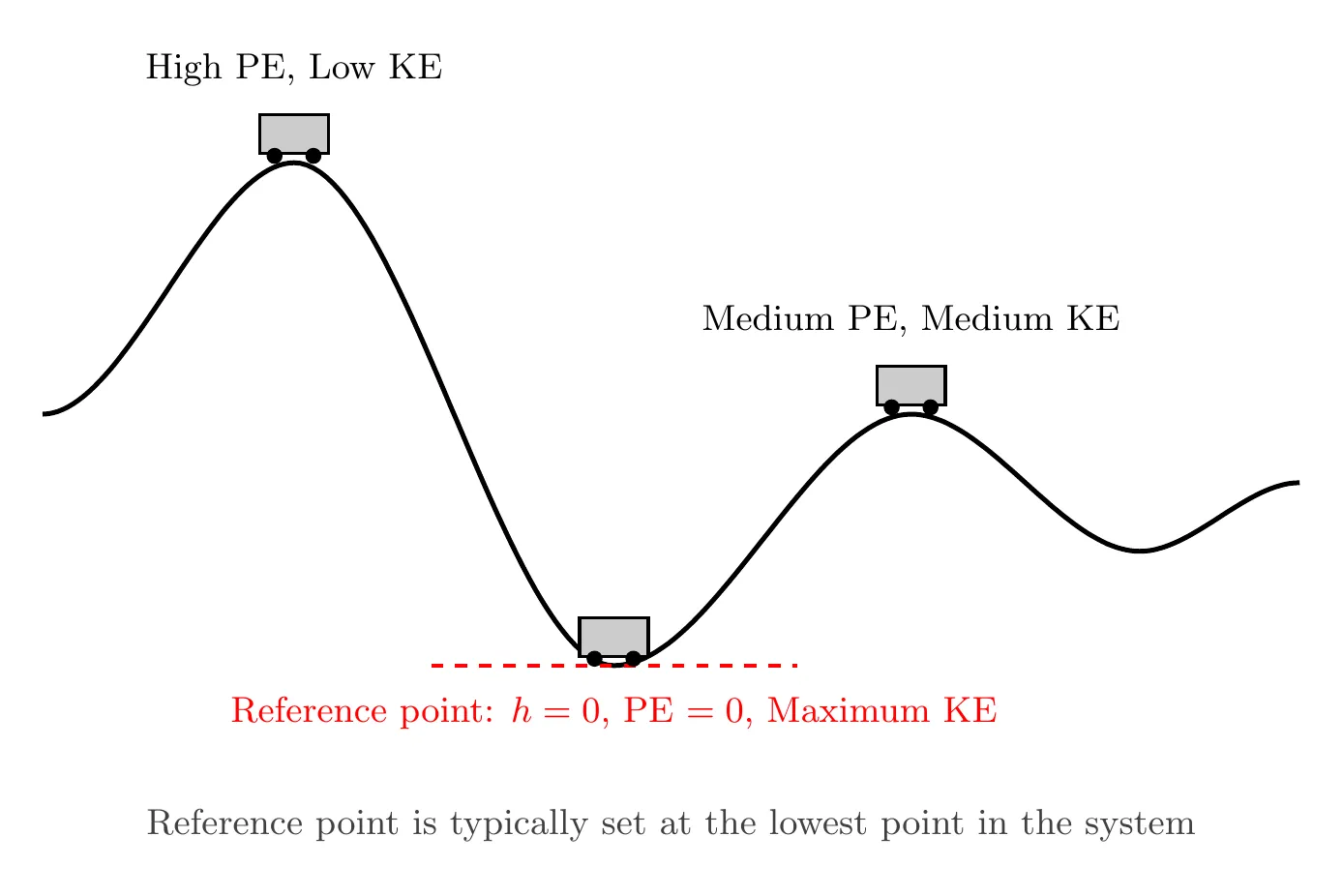
Potential energy is relative, it depends on where you define the zero point. That location is called the reference point, and at that point, .
You get to choose the reference point (unless a problem states one explicitly). Different reference points give different potential energy values, but the changes in potential energy stay the same regardless.
The best practice is to set the reference point at the lowest point in the problem, whether that’s or . This helps because at the lowest point you usually have maximum kinetic energy and zero potential energy, which makes calculations cleaner and avoids negative potential energy values (even though those are mathematically valid).
Scenario | Good Reference Point |
Ball dropped from building | Ground level () |
Roller coaster | Lowest point of track |
Spring oscillation | Equilibrium position (relaxed length) |
Pendulum | Lowest point of swing |
Types of Potential Energy
Elastic potential energy is stored in springs, rubber bands, or other elastic materials when stretched or compressed.
where is elastic potential energy in Joules, is the spring constant in N/m, and is the displacement from equilibrium in meters. The associated conservative force is Hooke’s Law, .
It’s always positive or zero, since can never be negative. It follows a quadratic relationship, doubling the displacement quadruples the potential energy. And it’s symmetric, compressing or stretching by the same amount stores the same energy either way.
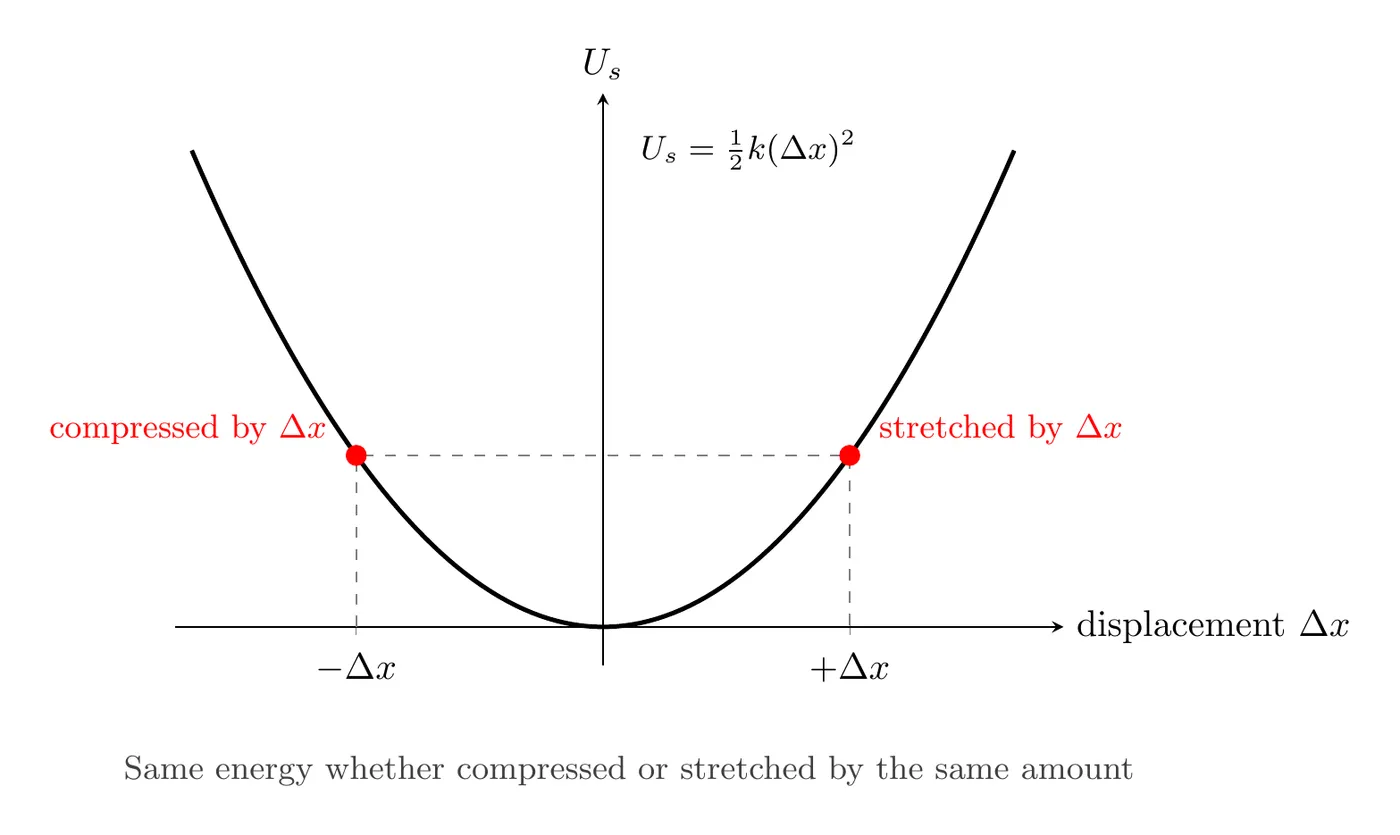
When you compress or stretch a spring, you’re doing work against the spring force, and that work gets stored as elastic potential energy. Release it, and that stored energy converts into kinetic energy.
Gravitational potential energy (near Earth’s surface) is energy stored because of an object’s position within Earth’s gravitational field.
where is gravitational potential energy in Joules, is mass in kg, is the gravitational field strength (9.8 m/s² near Earth’s surface; the AP exam uses 10 m/s² for numbers, see 1.3), and is height above the reference point in meters. The associated conservative force is weight, .
It grows linearly with height, and it’s mass-dependent, heavier objects have more gravitational potential energy at the same height. Its value also depends on where you’ve set .
On the AP equation sheet, this one is written as a change:
where is the change in vertical position. It’s an approximation: it treats as the same at every height, which is very close to true near a planet’s surface (climbing 1 km above Earth’s surface only lowers by about 0.03%). For big distances, like a satellite’s orbit, changes a lot, and you need the general equation below.
For roller coasters, the top of the first hill has maximum gravitational potential energy, the bottom of a valley usually has minimum (often zero if that’s the reference), and energy keeps converting between and throughout the ride. For hydroelectric dams, water at high elevation has high , and as it falls, that converts into kinetic energy, which drives the turbines.
Gravitational field potential energy applies when objects are far from Earth’s surface, or when we’re considering interactions between large masses like planets, stars, and satellites.
where is gravitational field potential energy in Joules, N·m²/kg² is the universal gravitational constant, and are the two masses in kg, and is the distance between their centers of mass in meters. The associated conservative force is Newton’s Law of Universal Gravitation, .
Unlike the other potential energies, this one is negative (or zero at infinite separation). That negative sign has a physical meaning: zero potential energy is defined at infinite separation, and bringing masses together actually releases energy since they attract each other, meaning all bound states end up with negative potential energy. Potential energy increases, becomes less negative, as distance increases.
Use this formula for satellite orbits, interplanetary missions, objects far from Earth where isn’t roughly constant, or any problem involving two astronomical bodies. Use instead for objects near Earth’s surface, small heights compared to Earth’s radius, or whenever m/s² is a good approximation.
Example, when the near-surface shortcut fails: a 500 kg satellite moves from an orbit of radius m to one of radius m (both measured from Earth’s center). Earth’s mass is kg (a problem would give you this, it’s not on the equation sheet). Find the change in the satellite-Earth system’s potential energy.
So J: the potential energy goes up (gets less negative) as the satellite moves away. Using J instead would more than double the answer, because is much weaker that far out than at the surface.
Relationship Between Force and Potential Energy
Potential Energy | Associated Force |
Systems With More Than Two Objects
Potential energy comes from pairs of interacting objects. When a system has more than two objects, its total potential energy is the sum of the potential energy of every pair. Count each pair once: three objects make 3 pairs, and four objects make 6 pairs.
Example, three spheres: three 4.0 kg spheres sit at the corners of an equilateral triangle with 0.50 m sides. Each pair has J, and there are 3 pairs:
Example, block, spring, and Earth: a 0.50 kg block bounces on a vertical spring ( N/m). At one moment the spring is stretched 0.10 m and the block is 0.30 m above the floor (the reference level). The block-Earth pair has gravitational potential energy and the block-spring pair has elastic potential energy (an ideal spring has no mass, so the spring-Earth pair adds nothing). The system’s total is J.
Worked Example: Spring Potential Energy
A perfectly elastic spring has an unstretched length of 20 cm and a spring constant of 400 N/m. Find the elastic potential energy when the spring’s length is 23 cm, and the additional potential energy stored when it’s stretched further to 26 cm.
At 23 cm: displacement from equilibrium is m (always measure from the equilibrium, or relaxed, length, not from an origin or some other point).
Stretched 3 cm beyond its natural length, the spring stores 0.18 Joules, energy that could be released to accelerate an attached mass.
At 26 cm: the new displacement is m (a common mistake is to use m instead, but always measure from equilibrium, not from the previous position).
Additional energy: the question asks how much more energy is stored compared to the 23 cm position.
Stretching from 23 cm to 26 cm (another 3 cm) stores 0.54 J more, considerably more than the first 3 cm of stretch (0.18 J), because potential energy grows with the square of displacement, meaning the spring gets progressively harder to stretch the farther you go.
To see why more concretely: stretching from 0 to 3 cm stores , and stretching from 0 to 6 cm stores . The additional energy for that second 3 cm segment is , three times as much as the first segment. Each additional bit of stretch takes more work than the last, since the spring force itself grows linearly with displacement.
Unit Conversions for Springs
Watch out for inconsistent units between the spring constant and displacement. The standard SI unit for spring constant is N/m, but sometimes it’s given in N/cm, which needs converting. For example, if N/cm:
Make sure your units match: if is in N/m, use in meters (converting everything to SI is generally the safest practice).
Setting Up Reference Points in Practice
For spring systems, the reference point is the equilibrium (relaxed) position, where . There, elastic potential energy is zero and the spring force is zero.
For gravitational systems, the reference point is typically the lowest point in the problem. There, gravitational potential energy is zero, though the object can still have kinetic energy, often its maximum, at that point.
Pendulum example:
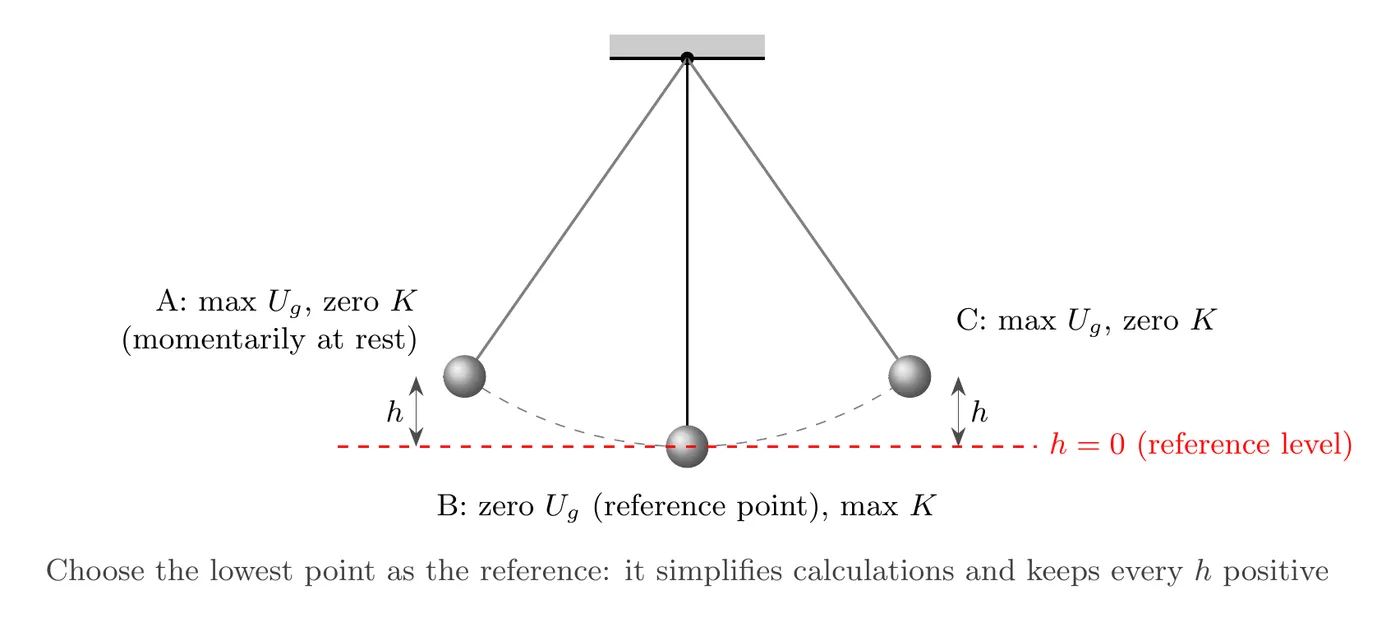
Worked example, same change from any reference point: a 0.50 kg book falls from a shelf 2.0 m above the floor onto a desk 1.0 m above the floor. Find the change in the book-Earth system’s gravitational potential energy using three different zero points.
Reference () | on the shelf | on the desk | |
Floor | J | J | J |
Desk | J | J | J |
Shelf | J | J | J |
The values of depend on the reference point, but the change, J, comes out the same every time. Only changes in potential energy affect what actually happens, so you’re free to put the zero wherever it makes the math easiest.
Key Takeaways
- Potential energy is energy stored due to position or configuration in a conservative force field
- Energy is a scalar, with no direction
- Potential energy is relative to a chosen reference point, where
- Best practice: set the reference point at the lowest position in the problem
- Elastic potential energy: (springs, rubber bands), tied to Hooke’s Law , always positive or zero, quadratic with displacement
- Gravitational potential energy (near the surface): (objects near Earth), tied to weight , linear with height, used when height changes are small compared to Earth’s radius
- Gravitational field potential energy: (satellites, orbits), tied to universal gravitation , negative or zero at infinity, used for large distances or astronomical problems
- Each potential energy has an associated conservative force
- Always measure spring displacement from the equilibrium position, not from a previous position
- Potential energy values depend on your choice of reference, but changes in potential energy don’t
- Potential energy belongs to a system of interacting objects, never to one object alone
- With more than two objects, total potential energy is the sum over every pair
- On the equation sheet: , , and (near a surface, where is nearly constant)
- Coming up next: combining potential and kinetic energy in conservation of energy