

3.5 - Power
Definition of Power
Power is the rate at which energy is transferred or converted with respect to time.
Power tells you how quickly work is done or energy is converted, not just the total amount. Consider two workers: Worker A lifts 100 bricks to a roof in 1 hour, Worker B lifts the same 100 bricks to the same roof in 30 minutes. Both do the same total work, but Worker B has twice the power, since the same task got done in half the time.
Transfer or conversion: power can describe energy crossing a system’s boundary, like a motor doing work to lift a block, or energy changing form inside a system. For example, when a 0.20 kg ball is falling at 5.0 m/s, the ball-Earth system’s gravitational potential energy turns into kinetic energy at a rate of W, which is 10 J every second at that moment.
Average vs. Instantaneous Power
Average power is total energy transferred divided by the total time interval:
Both forms are on the AP Physics 1 equation sheet, written . AP Physics 1 also uses instantaneous power, covered next.
Instantaneous power is power at one specific moment, defined with calculus:
If force or velocity changes over time, instantaneous power varies too. Average and instantaneous power are only equal when the power holds steady, like a force pushing something at constant velocity. A constant force on an object that’s speeding up delivers more and more power as the object gets faster (see the worked example below).
Deriving the Power-Force-Velocity Relationship
Starting from , and substituting the work formula :
Rearranging:
Since is exactly velocity:
where is power in Watts, is the magnitude of the force in Newtons, is speed in m/s, and is the angle between force and velocity. This form is especially handy when force and velocity are known, since it skips having to calculate work and time separately.
Special case, force parallel to velocity: the most common scenario, where and , simplifying to:
This is the form used most often. Just make sure is the force whose power you’re finding, pointing along the motion (one specific force like a motor’s pull, or the net force for the net power), not just any force.
On the AP equation sheet this is written as:
where is the component of the force parallel to the velocity. Because is the speed at one instant, this gives the instantaneous power, and it can change from moment to moment even when the force is constant.
Units of Power
The SI unit is the Watt (W):
Named after James Watt (1736 to 1819), the Scottish inventor who improved the steam engine. For scale: an incandescent light bulb is about 60 W, an LED bulb producing the same brightness is only 7 to 10 W, a microwave oven runs about 1000 W, and a hair dryer runs about 1500 W.
Since a Watt is a small unit for many applications, we often use the kilowatt (kW), equal to 1000 W, common for electric power consumption (your bill measures kilowatt-hours, kWh), vehicle engines especially in electric vehicles, and industrial machinery. A kilowatt-hour (kWh) is a unit of energy, not power, the energy used when 1 kW runs for 1 hour: .
Horsepower (HP) is a non-SI unit common in the US for rating engines and motors:
James Watt originally needed a way to compare his steam engines to the horses they’d be replacing, so he measured how much work a horse could do over time and defined that as one horsepower.
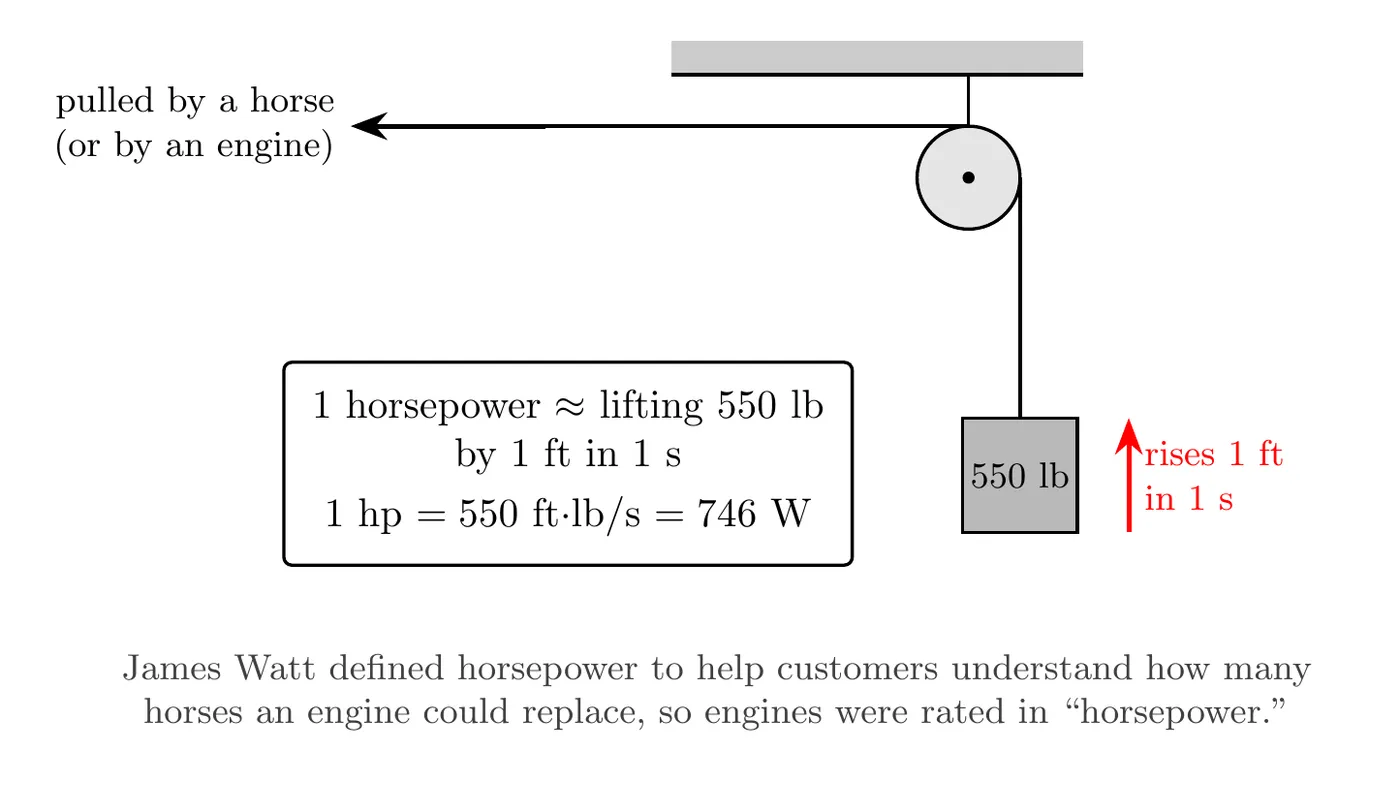
For scale, car engines run 150 to 400 HP for typical passenger vehicles, lawn mowers run 5 to 25 HP, pool pumps run 0.5 to 2 HP, and industrial motors can run into the thousands of HP.
Horsepower | Watts | Kilowatts |
0.5 HP | 373 W | 0.373 kW |
1 HP | 746 W | 0.746 kW |
100 HP | 74,600 W | 74.6 kW |
500 HP | 373,000 W | 373 kW |
Problem-Solving Strategy
If force and velocity are known and parallel, use . If they’re at an angle, use . If total work and time are known, use . If any form of energy changes over time, use , and for a common case, gravitational potential energy change, that’s .
Worked Example: Electric Motor Lifting a Block
A 10 kg block is attached to a light cord wrapped around a pulley, driven by an electric motor. The motor lifts the block at an instantaneous speed of 3 m/s with an upward acceleration of 2 m/s². Use m/s². Find the power the motor delivers.
Draw: the forces on the block are tension (, upward from the cord) and weight (, downward).
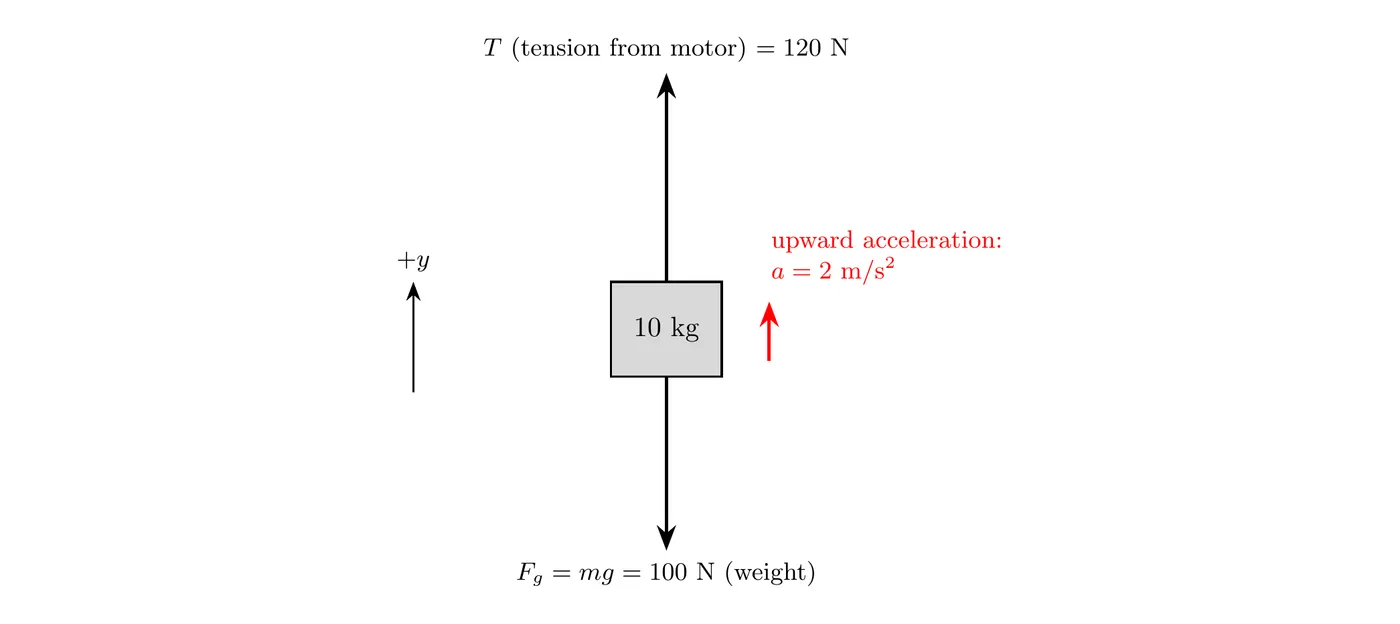
Sum: the block accelerates upward, so with up as positive:
The tension has to support the weight () and provide the extra force to accelerate upward (), giving a total of .
Solve for tension:
The motor pulls with 120 N to lift the block at this acceleration, more than the block’s weight (100 N), since it also has to accelerate the block upward.
Solve for power: with force and velocity in the same (upward) direction, and , so :
The motor delivers 360 Watts to lift the block at 3 m/s while accelerating it at 2 m/s², the rate at which it’s converting electrical energy into mechanical work.
Converting to horsepower (optional):
That’s roughly half a horsepower, comparable to a small pool pump (0.5 to 1 HP), a garage door opener (0.5 HP), or a typical household vacuum (1 to 2 HP).
A quick comparison: if the block instead moved at constant velocity (), tension would just be N, and power would be W. Less power is needed to maintain constant velocity than to accelerate.
Worked Example: Instantaneous vs. Average Power
A 1200 kg car starts from rest. A constant net forward force of 3000 N acts on it (ignore drag) until it reaches 20 m/s. Find the instantaneous power at 20 m/s and the average power over the whole run.
Instantaneous power at 20 m/s: the force and velocity point the same way, so
Average power: the net work equals the change in kinetic energy, and the time comes from kinematics, with m/s²:
The average is only half the final instantaneous power. With a constant force, grows steadily as the car speeds up, from 0 at the start to 60 kW at the end, so it averages out to 30 kW (the power at the average speed of 10 m/s). The given values have two significant figures, so the answers are 60 kW and 30 kW.
Real-World Applications
Elevators work essentially like the worked example, a motor lifting a mass vertically. Power requirements depend on the weight of the elevator plus passengers, the speed (faster elevators need more power), and the acceleration (smooth starts and stops require carefully controlling power delivery). Express elevators in skyscrapers travel at high speeds (10+ m/s), require very powerful motors (hundreds of HP), and need to deliver that power smoothly for passenger comfort.
Automobiles: an advertised horsepower rating shows the maximum power output. For example, a 300 HP engine at maximum power is putting out , which accelerates the car and overcomes air resistance and friction. Since , or , more power at a given speed means more force available for acceleration. Cruising on the highway needs much less power, just enough to overcome drag and friction, typically 20 to 40 HP for a car at 65 mph, with the extra power reserved for acceleration, hill climbing, or higher speeds.
Renewable energy: solar panels are rated by power output in Watts, a “300 W solar panel” produces 300 Watts under ideal sunlight. Wind turbines are rated in megawatts (MW, one million Watts), and a 2 MW turbine can power roughly 500 homes.
Common Question Types
Given force and velocity: find power with .
Given work and time: find power with . For example, lifting 500 kg to a 20 m height in 10 seconds: J, so W kW.
Given energy change and time: find power with . For example, a battery storing 50,000 J in 25 seconds: W kW.
Comparing power of different processes: same work over different times means different power. If two cranes lift identical loads to the same height, one taking 30 seconds and the other 20 seconds, the faster crane delivers more power (same work, less time).
Common Mistakes
Confusing energy and power: saying “the motor has 500 Watts of energy” is wrong, it’s “the motor delivers 500 Watts of power,” energy per time, not energy itself. Power is like a flow rate (gallons per minute), energy is like total volume (gallons).
Using the wrong force: when calculating power for something accelerating upward, don’t just use weight, use tension (or the net force plus weight), , not just .
Forgetting : don’t use if force and velocity aren’t actually parallel, use with the appropriate angle. A common case is pulling a sled at an angle, where only the horizontal component of the force contributes to power in the direction of motion.
Unit confusion: don’t mix Watts, horsepower, and kilowatts without converting first, always match units before comparing or adding.
Key Takeaways
- Power is the rate of energy transfer or work done:
- Power tells you how fast work is done, not how much total work
- Derivation chain:
- Most useful form: , when force and velocity are known
- Simplified form: when force and velocity are parallel ()
- SI unit: the Watt (W), where
- Other units: kilowatt (kW) = 1000 W, horsepower (HP) = 746 W
- AP Physics 1 uses both average power, , and instantaneous power,
- Use the force whose power you’re finding in power calculations (one specific force for its power, or the net force for the net power)
- For lifting with acceleration: , not just
- The same work in less time means more power
- Power ratings show up everywhere: engines (HP), light bulbs (W), solar panels (W), motors (HP or kW)
- Historical context: James Watt defined horsepower to compare engines to horses
- Electric power uses the same Watt unit as mechanical power
- The power equals force times velocity relationship is key for moving-object problems
- Always check units, convert HP to W or kW to W before calculating
- With a constant force on an object that’s speeding up, instantaneous power grows with speed, so it ends up bigger than the average
- Power can describe energy entering or leaving a system, or energy changing form inside it