

5.1 - Rotational Kinematics
Introduction to Rotation
We’re shifting from linear kinematics (motion along a line) to rotational kinematics (motion around an axis). Many of the concepts directly mirror what we covered in Unit 1, just with new variables and a new perspective. Instead of asking “how far?” we now ask “how much did it rotate?” Instead of “how fast is it moving?” we ask “how fast is it spinning?”
Rigid Systems vs. Objects
So far we’ve modeled almost everything as an object: a single point with mass and no size, so every part of it moves the same way. That can’t describe spinning. As a wheel turns, the top moves one way, the bottom moves the opposite way, and points near the axle barely move at all.
For rotation we use a rigid system instead: a system that holds its shape (it doesn’t stretch, bend, or squish), but whose points move in different directions, and at different speeds, as it rotates. A spinning wheel, a swinging door, and a seesaw are all rigid systems. A rigid system can’t be modeled as an object, because an object has no size, so the model can’t tell the top of the wheel from the bottom or say where a force is applied. For a rigid system, where a force acts matters, which is the idea behind torque (5.3).
When you can ignore the spin: if the motion you care about is well described by the motion of the system’s center of mass, you can still treat the system as a single object. For example, Earth spins on its axis once a day, but when you study Earth’s yearly revolution around the center of mass of the Earth-Sun system, the spin doesn’t matter, so Earth is treated as an object. The same thing can be an object in one problem and a rigid system in another: a car is an object when you find its stopping distance, but each wheel is a rigid system when you ask how fast it spins.
Angular Displacement
Angular displacement () measures the angle through which a point or rigid system rotates about a specified axis.
where is angular displacement, is the final angular position, and is the initial angular position.
Angular measurements in physics use radians, not degrees.
Radians create a natural connection between angular and linear quantities (coming up next), and they simplify equations for calculus-based physics. One important note for calculators: treat radians as a unit, like meters, when doing these calculations. You don’t need to switch your calculator to radian mode for this, we’re using radians as a measurement unit here, not for trig functions.
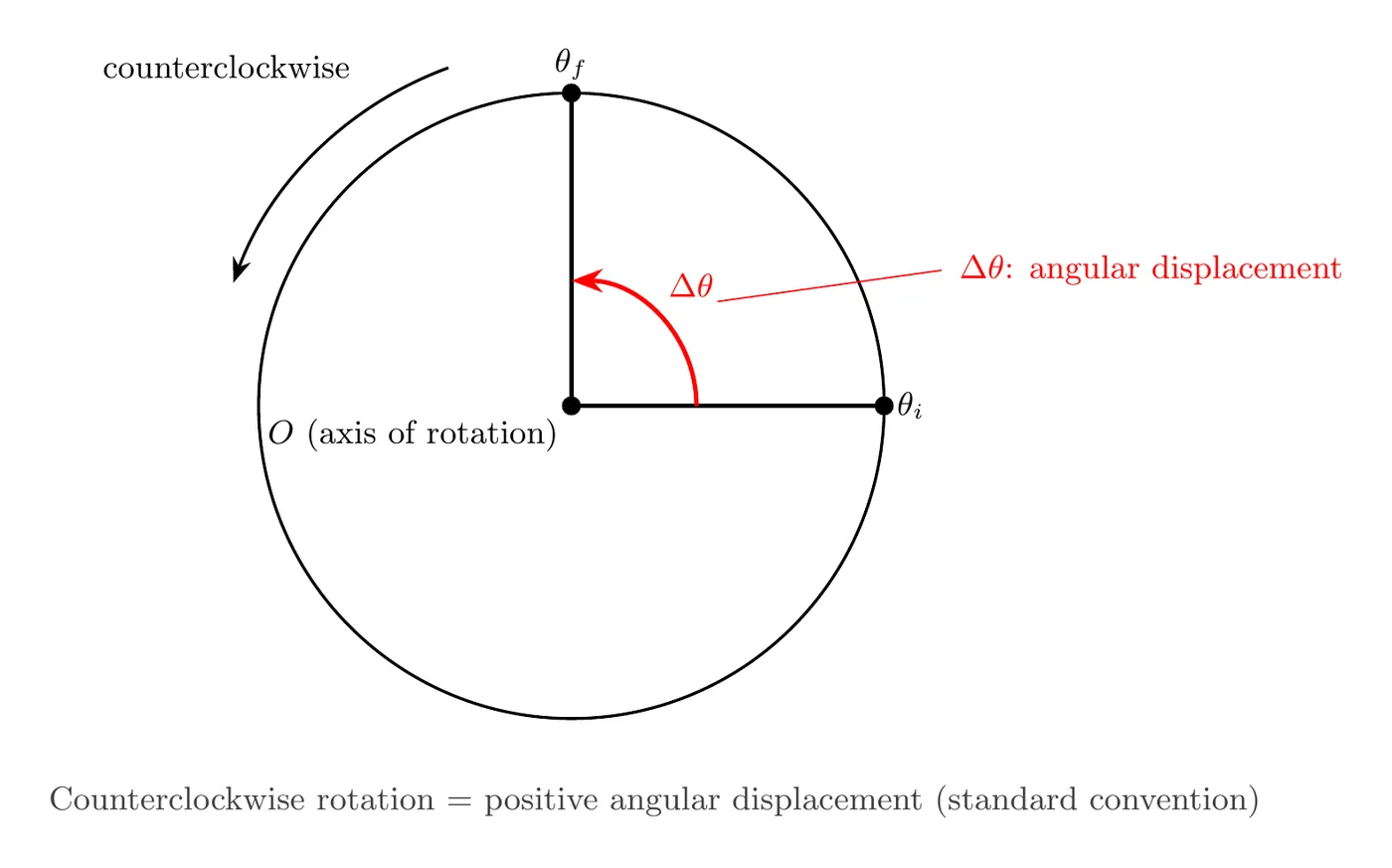
For example, a half rotation is rad, a quarter rotation (90°) is rad, and three complete rotations is rad.
Angular Velocity
Angular velocity () is the rate at which angular position changes over time.
with units of radians per second (rad/s). The lowercase Greek letter omega represents angular velocity, just as represents linear velocity.
Angular velocity tells you how fast something’s spinning. A car wheel might have rad/s (spinning rapidly), a clock’s second hand has rad/s (one revolution per minute), and Earth’s rotation is rad/s (one revolution per day).
For calculus-based physics, instantaneous angular velocity at a specific moment is , but AP Physics 1 mainly works with average angular velocity.
Angular Acceleration
Angular acceleration () is the rate at which angular velocity changes over time.
with units of radians per second squared (rad/s²). It tells you how quickly the spin speeds up or slows down. A ceiling fan starting up has positive angular acceleration (speeding up), a braking bicycle wheel has negative angular acceleration (slowing down), and a constant-speed turntable has zero angular acceleration (steady rotation).
By convention, positive means increasing angular velocity in the positive direction, and negative means decreasing angular velocity.
Linear and Rotational Quantities Side by Side
Rotational kinematics directly parallels linear kinematics, every linear quantity has a rotational counterpart.
Linear Quantity | Symbol | Rotational Analog | Symbol |
Position | Angular position | ||
Displacement | Angular displacement | ||
Velocity | Angular velocity | ||
Acceleration | Angular acceleration | ||
Time | Time |
If you understand linear motion, you already understand rotational motion, just by substitution.
Rotational Kinematic Equations (Constant Angular Acceleration)
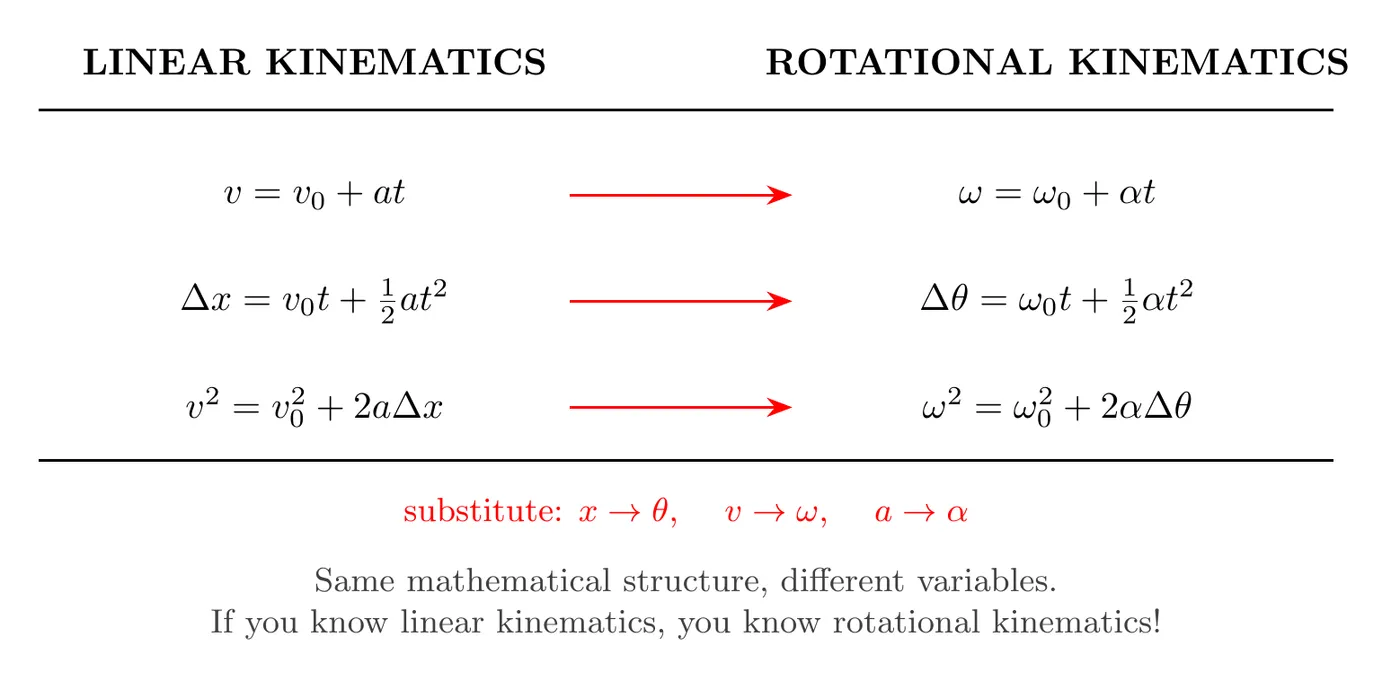
For constant angular acceleration, we have equations directly analogous to the linear CAKE equations. Recall the linear versions:
Substituting angular quantities gives the rotational versions:
Final angular velocity (missing ):
Angular displacement (missing , quadratic in time):
The “timeless” equation (missing ):
Problem-Solving Strategy
The approach is identical to linear kinematics: list known values with their symbols (initial angular velocity , final angular velocity , angular acceleration , time , angular displacement ), identify the unknown, choose the equation that contains your unknown and three knowns, solve algebraically, then check units (rad/s, rad/s²) and whether the answer makes physical sense.
Worked Example: Ceiling Fan Starting Up
A ceiling fan starts from rest and accelerates uniformly at 3.5 rad/s² for 4.0 seconds. Find the final angular velocity, and the number of revolutions it completes.
Final angular velocity: given , rad/s², s. Since is missing, use :
After 4 seconds, the fan spins at 14 radians per second.
Number of revolutions: using , and since :
Converting to revolutions using radians:
The fan completes about 4.5 rotations during the 4-second startup, and it’s important to report the numerical value (4.46), not leave the answer in terms of .
Unit Conversions for Angular Measurements
Radians to revolutions: . Revolutions to radians: .
Degrees to radians (if needed): . For example, 90° = rad.
RPM to rad/s: RPM (revolutions per minute) is common in the real world but needs converting for physics calculations.
For example, an engine at 3000 RPM: rad/s.
Special Case: Starting from Rest
Many problems have , which simplifies the equations to , , and , cutting down on algebra.
Sign Convention
Rotation directions are described as clockwise or counterclockwise about a given axis, as seen from one viewpoint. One direction is chosen as mathematically positive and the other becomes negative. The standard choice is counterclockwise positive and clockwise negative. If nearly everything in a problem turns clockwise, you can call clockwise positive instead, as long as every angular quantity in that problem uses the same choice.
A positive angular velocity means spinning counterclockwise viewed from above, and negative means clockwise. Positive angular acceleration means speeding up counterclockwise, or slowing down clockwise, while negative angular acceleration means slowing down counterclockwise, or speeding up clockwise.
Graphs of Rotational Motion
Graphs of angular position, angular velocity, and angular acceleration versus time follow the same rules as the , , and graphs from Unit 1, with the angular variables swapped in.
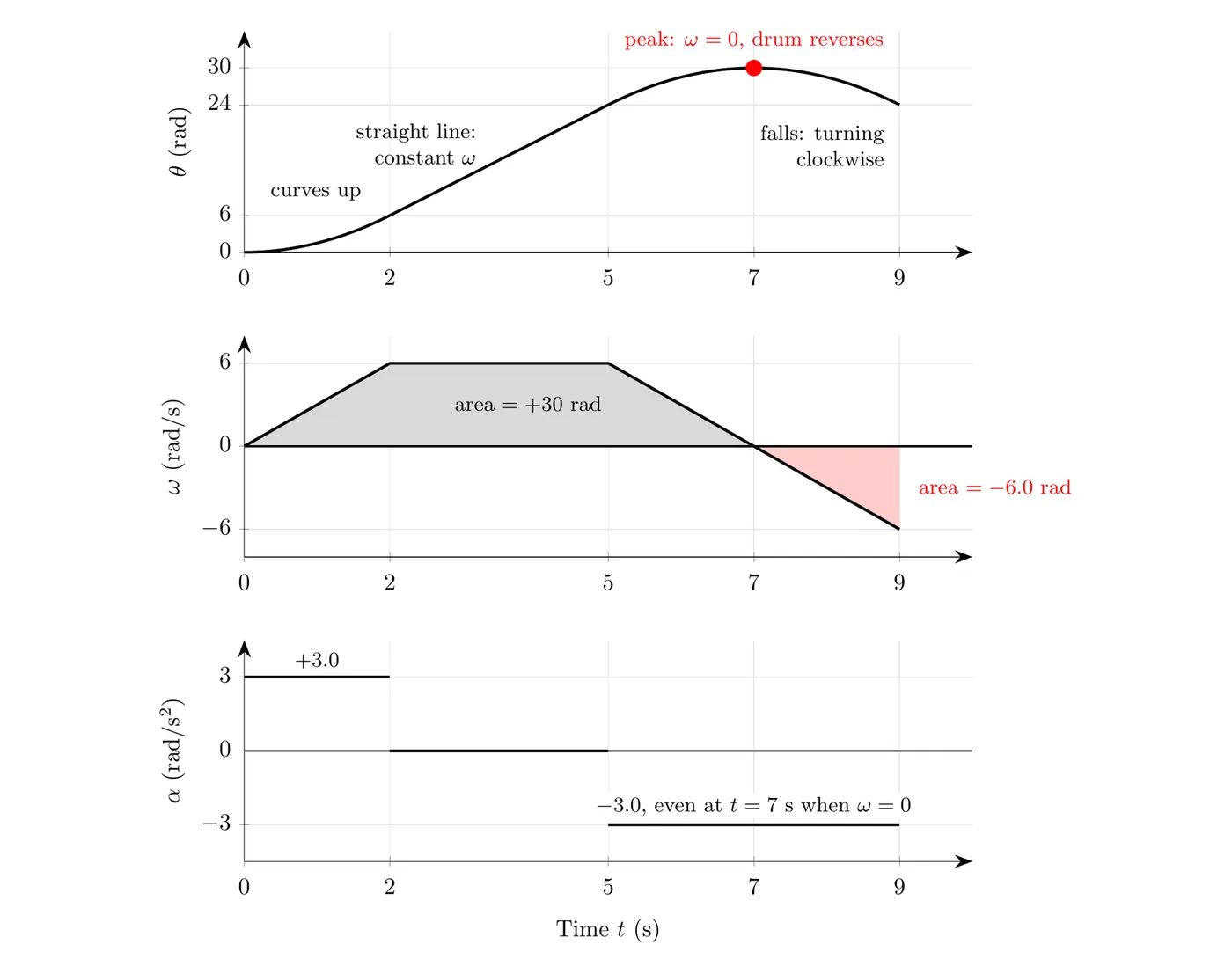
Angular position vs. time ( vs. ): the slope at any moment is the angular velocity . A straight line means constant , a curve that gets steeper means the spin is speeding up, a flat section means the system isn’t turning, and a downward slope means it’s turning in the negative (clockwise) direction.
Angular velocity vs. time ( vs. ): the slope is the angular acceleration , and the area between the graph and the time axis is the angular displacement . Area above the axis counts as positive (counterclockwise) and area below counts as negative (clockwise).
Angular acceleration vs. time ( vs. ): the area between the graph and the time axis is the change in angular velocity .
Worked Example: Washing Machine Drum
A washing machine drum turns one way and then the other to tumble the clothes. Its angular velocity for the first 9.0 s is graphed below, with counterclockwise as positive. Find (a) the angular acceleration in each stage, (b) when the drum reverses direction and its angular acceleration at that moment, (c) its angular displacement from 0 to 9.0 s, and (d) the total angle it turns through, in revolutions.
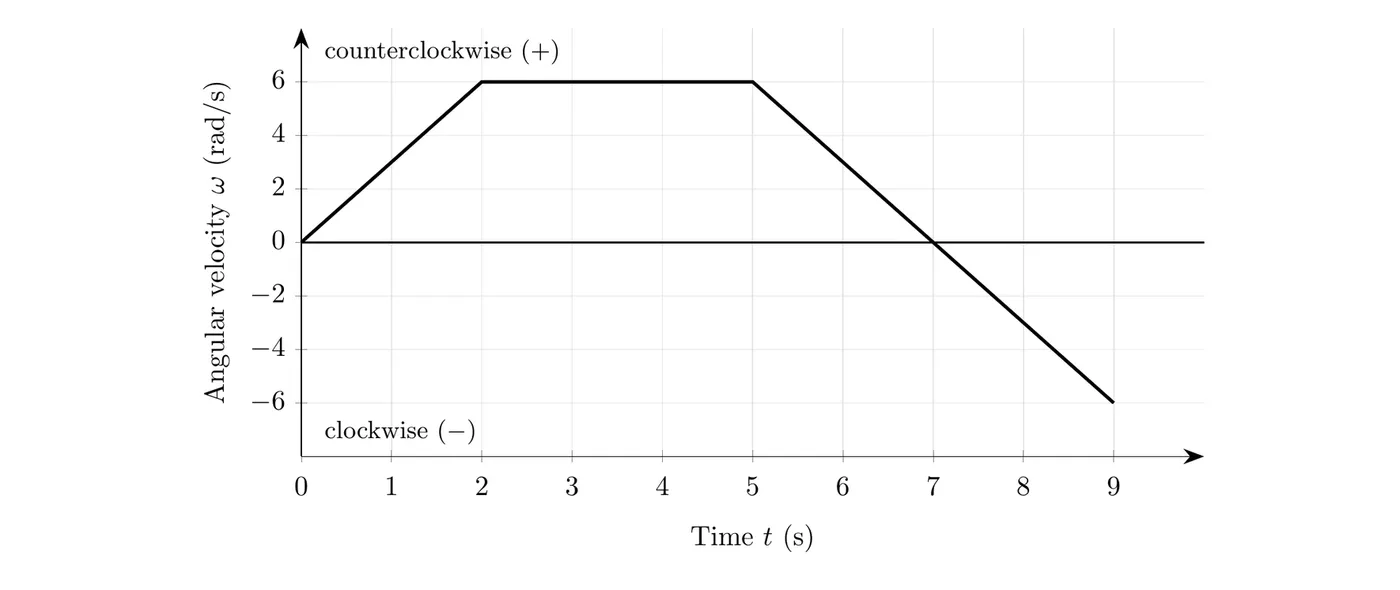
(a) Angular acceleration: is the slope of each straight segment.
From 2.0 s to 5.0 s the graph is flat, so and the drum spins at a steady 6.0 rad/s.
(b) Reversing: the drum reverses when changes sign, where the graph crosses the time axis at s. At that instant , but is still rad/s², not zero, because the slope of the line hasn’t changed. From 5.0 s to 7.0 s, is positive and is negative (opposite signs), so the drum slows down while turning counterclockwise. From 7.0 s to 9.0 s, both are negative (same signs), so it speeds up turning clockwise.
(c) Angular displacement: add the signed areas. The area above the axis (a triangle, a rectangle, and a triangle) is positive, and the triangle below the axis is negative:
The drum ends up 24 rad (about 3.8 revolutions) counterclockwise from where it started. Its average angular velocity over the 9.0 s is rad/s.
(d) Total angle turned: count every area as positive, the way distance works in Unit 1:
Check with a kinematic equation: from 5.0 s to 9.0 s the angular acceleration is constant, so , which matches the rad and rad triangles canceling.
Here is the same motion on all three graphs. The vs. graph curves upward while the drum speeds up, is a straight line while is constant, peaks at s where , and then falls as the drum turns clockwise. The vs. graph is a set of flat steps, and its areas ( rad/s from 0 to 2.0 s and rad/s from 5.0 to 9.0 s) add up to rad/s, the drum’s total change in angular velocity (from 0 to rad/s). Spread over 9.0 s, that’s an average angular acceleration of rad/s², even though was never actually rad/s² at any instant.
Real-World Applications
Automotive: wheels have positive angular acceleration while a car speeds up, spin at roughly 90 rad/s at highway speed (about 30 m/s on a tire of radius 0.33 m, using from 5.2), and anti-lock braking systems produce rapid angular deceleration with pulsing.
Machinery: motors and engines are rated in RPM, startup involves angular acceleration, and governors regulate angular velocity.
Sports: figure skating spins speed up when arms are pulled in (conservation of angular momentum, covered later), with a typical spin running 3 to 6 revolutions per second, or about 19 to 38 rad/s.
Astronomy: Earth’s rotation is rad/s, essentially constant, with no meaningful angular acceleration.
Common Mistakes
Using degrees instead of radians: don’t plug directly into the rotational kinematic equations, convert to radians first, rad.
Wrong calculator mode: don’t switch your calculator to radian mode for these problems, keep it in whatever you normally use, radians here are a unit, not a trig function setting.
Forgetting to convert revolutions: don’t leave your answer in radians if the problem asks for revolutions, divide by to convert.
Confusing linear and angular equations: don’t use for rotational motion, use the angular version, .