

6.2 - Torque and Work
Work in Rotational Systems
In linear motion, work transfers energy through , force applied over a displacement. Rotational systems follow the same principle.
where is work in Joules, is torque in N·m, and is angular displacement in radians. This holds because torque is the rotational equivalent of force, and angular displacement is the rotational equivalent of linear displacement. The work done by a torque depends on both its magnitude and how far the object rotates.
Positive and negative work: a torque can transfer energy into a system or out of it. Use the same sign convention as Unit 5 (counterclockwise is positive). If the torque points the same way the object turns, and have the same sign, is positive, and the torque adds energy (a motor spinning up a fan). If the torque opposes the rotation (a brake pad, or friction in an axle), and have opposite signs, is negative, and the torque takes energy out. A torque on something that doesn’t rotate () does no work at all, no matter how large it is.
Constant vs. changing torque: (on the formula sheet) works when the torque stays constant during the rotation. If the torque changes as the object turns, use the area under a torque vs. angular position graph instead.
Graphical Analysis: Torque vs. Angular Position
The work done on a rigid system by a torque can be found from the area under a torque versus angular position graph.
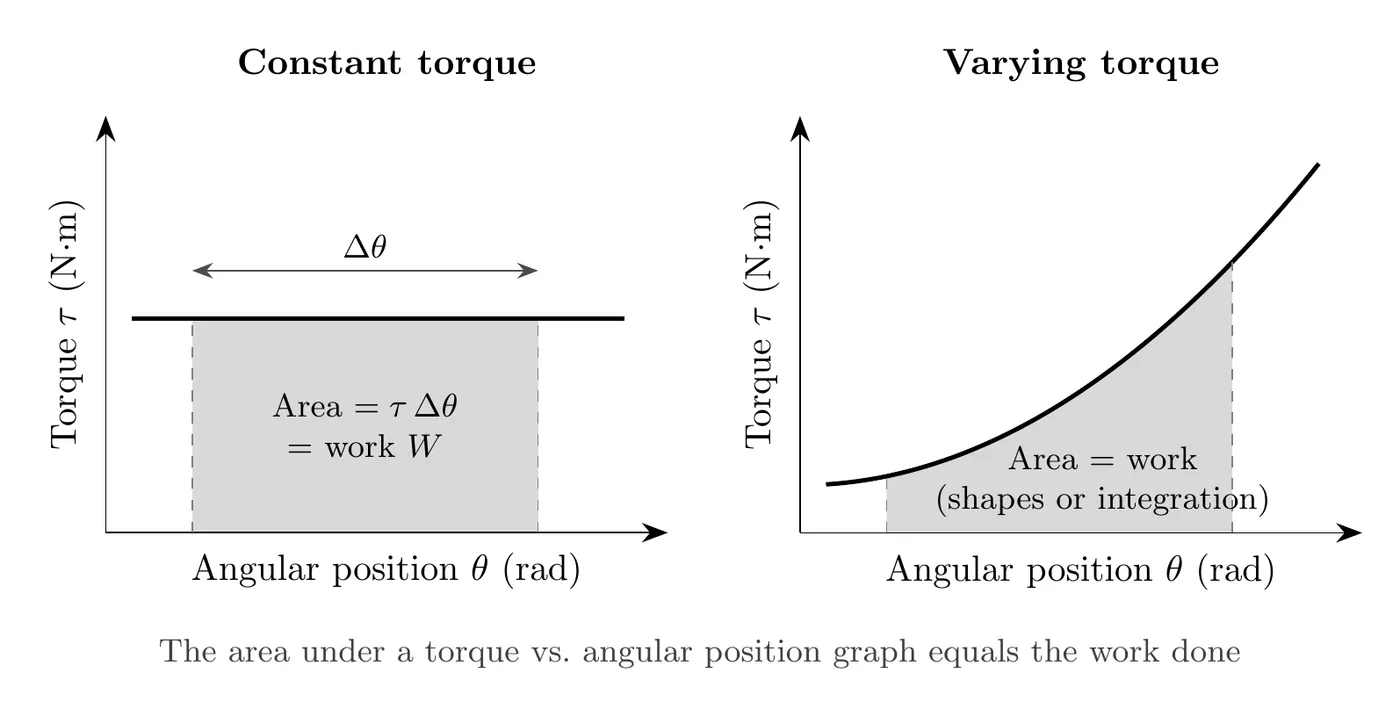
This is exactly analogous to finding work from the area under a force-displacement graph in linear motion.
Area above the axis (positive torque) is positive work, energy added. Area below the axis (negative torque) is negative work, energy removed. Add the areas with their signs to get the net work.
Worked Example: Reading Work from a Torque Graph
A flywheel with rotational inertia kg·m² starts from rest. The graph shows the net torque on it as a function of its angular position. Find (a) the net work done from to 6.0 rad, (b) the flywheel’s angular speed at 6.0 rad, and (c) its angular speed at 8.0 rad.
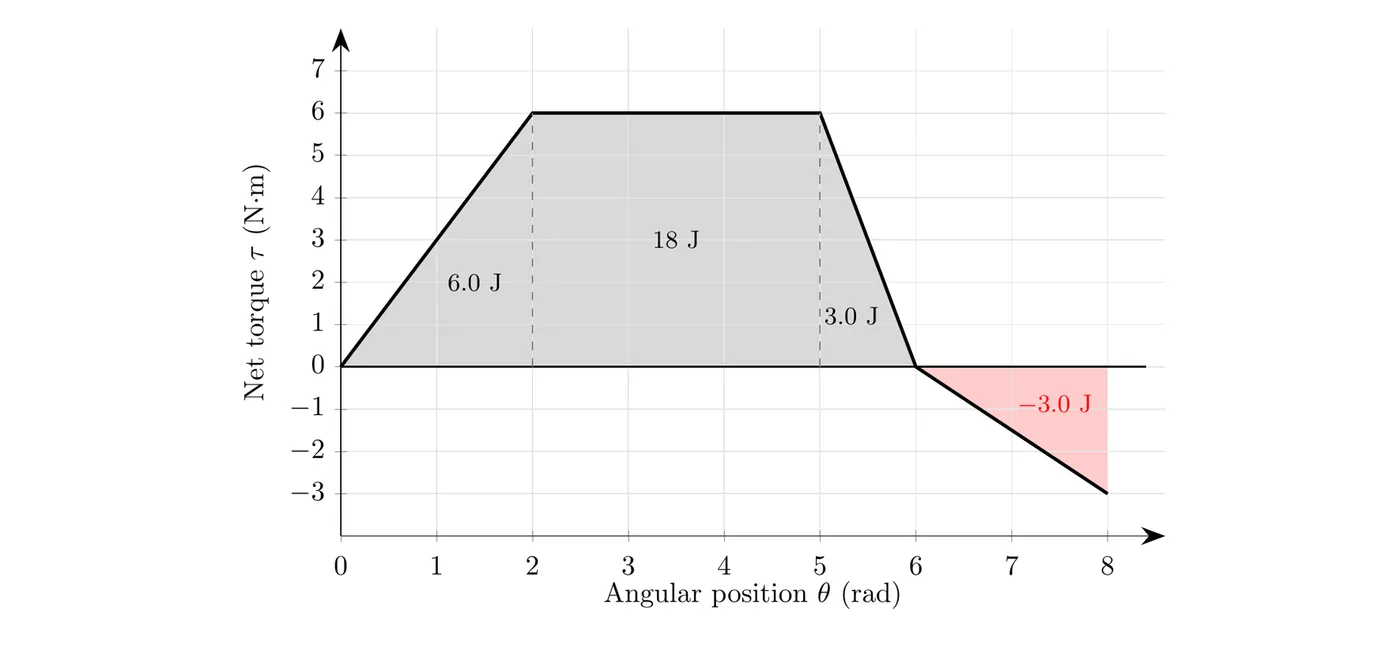
(a) Splitting the area into shapes: a triangle from 0 to 2.0 rad, a rectangle from 2.0 to 5.0 rad, and a triangle from 5.0 to 6.0 rad.
(b) Using the work-energy theorem: the flywheel starts from rest, so all 27 J becomes rotational kinetic energy.
(c) The negative region: from 6.0 to 8.0 rad the torque is negative, so it does negative work, J. The net work from 0 to 8.0 rad is J.
The torque took 3.0 J back out, so the flywheel slowed from 6.0 rad/s to about 5.7 rad/s. It’s still spinning the same direction: a negative torque only means the torque opposes the rotation.
Work-Energy Theorem for Rotation
Just as work equals the change in translational kinetic energy in linear systems, , work also equals the change in rotational kinetic energy:
Since both expressions equal work, we can combine them:
This is especially useful when you’re given torque and angular displacement and need angular velocity, or the reverse.
Worked Example: Rotating Disk with Applied Torque
A torque of N·m acts on a disk with moment of inertia kg·m², starting from rest (), and the disk rotates through 10 revolutions. Find the final angular velocity.
Converting revolutions to radians:
Applying the work-energy relationship: since :
Solving for final angular velocity:
After 10 revolutions under this torque, the disk rotates at 8.68 rad/s.
Important Reminders
Always convert angular measurements to radians before calculating: 1 revolution equals radians, and 1 degree equals radians. If given a torque vs. angular position graph and asked for the change in kinetic energy, find the area under the curve, since the work done by torque directly equals the change in rotational kinetic energy.
Problem-solving strategy: identify the given quantities and what you’re solving for, convert all angles to radians, choose the right equation (either a direct work calculation or the work-energy theorem), and check whether the initial or final conditions simplify things (like starting from rest).