

6.3 - Angular Momentum and Angular Impulse
Angular Momentum of Rotating Systems
Angular momentum is the rotational equivalent of linear momentum. Just as linear momentum is , angular momentum for a rotating system is:
where is angular momentum in kg·m²/s, is moment of inertia in kg·m², and is angular velocity in rad/s.
Linear | Rotational |
Example: a 2.0 kg solid disk of radius 0.30 m spins at 12 rad/s. Its rotational inertia is kg·m², so its angular momentum is kg·m²/s.
Angular Momentum of a Single Object
For a single object (not a rigid rotating system) moving about some reference point, angular momentum can be calculated as:
where is the object’s mass in kg, is its linear velocity in m/s, is the distance from the reference point to the object in meters, and is the angle between the velocity vector and the position vector.
Example: a planet orbiting a star with mass kg, orbital velocity m/s, and orbital radius m, moving perpendicular to the radius ():
This formula is especially useful for analyzing linear motion that creates rotational effects, like someone running tangentially and pushing a merry-go-round.
Angular Momentum of an Object Moving in a Straight Line
An object doesn’t have to spin, or even curve, to have angular momentum. A puck sliding in a straight line has angular momentum about any point that isn’t on its line of motion. The formula sheet writes the equation as , the same thing as above.
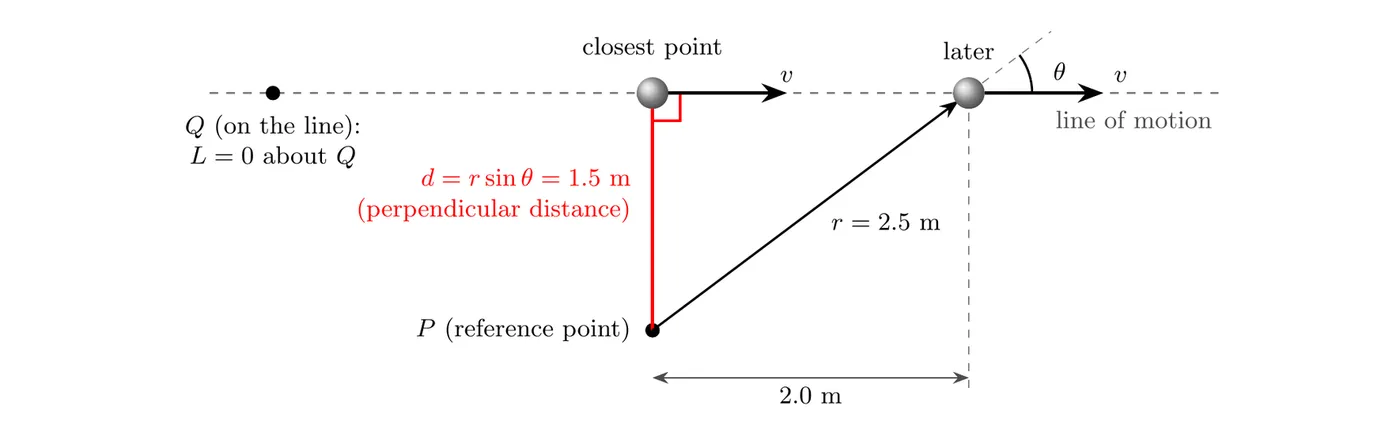
Look at the part. In the right triangle in the figure, is the side opposite , which is the perpendicular distance from the reference point to the line of motion (the same lever-arm idea as in torque). So the angular momentum depends on four things:
- Mass : twice the mass, twice the angular momentum.
- Speed : twice the speed, twice the angular momentum.
- Distance from the reference point to the object.
- Angle between and the velocity. Together, and set the perpendicular distance .
As the puck slides past, and both change, but doesn’t, because the line of motion stays the same distance from . So an object moving in a straight line at constant speed has constant angular momentum about any fixed point.
The reference point matters: the value of depends on which point or axis you measure it about. About , a point on the puck’s line of motion, and . About a point farther from the line, is larger. The same goes for rigid objects: a rod has a different about its center than about its end, so its is different too. Always state the axis, and use the same axis for every part of a problem.
Worked Example: Angular Momentum of a Sliding Puck
A 0.16 kg hockey puck slides in a straight line at a constant 12 m/s. At its closest approach it passes 1.5 m from point . Find its angular momentum about (a) at the closest point and (b) later, when it’s 2.5 m from . (c) What is its angular momentum about point on its path?
(a) At the closest point, the velocity is perpendicular to , so :
(b) Now m, and from the triangle, (so ):
Same as (a). No net force acts on the puck, so there’s no torque about , and its angular momentum about can’t change.
(c) is on the line of motion, so (or ) and about . Same puck, same motion, different answer, because the reference point changed.
Angular Impulse-Momentum Theorem
Just as linear impulse changes linear momentum, angular impulse changes angular momentum.
Angular impulse is the torque exerted on an object multiplied by the time interval the torque acts. Its units are N·m·s, which is the same as kg·m²/s, the unit of angular momentum.
Direction (sign): angular impulse has the same direction as the torque that delivers it. With counterclockwise as positive, a counterclockwise torque gives a positive angular impulse and a clockwise torque gives a negative one. A torque in the same direction as the rotation speeds the object up, and a torque against the rotation slows it down.
Linear: . Angular:
where is net torque in N·m, is the time interval in seconds, and is the change in angular momentum in kg·m²/s. Expanded:
This is an extension of Newton’s Second Law for rotation, .
Where it comes from: start with Newton’s second law in rotational form, , and write the angular acceleration as . If the rotational inertia stays constant:
Multiply both sides by and you get , written on the formula sheet. It’s the rotational version of from Unit 4.
Graphical Analysis: Angular Momentum vs. Time
Finding torque from an L vs. t graph: the net torque equals the slope of an angular momentum vs. time graph:
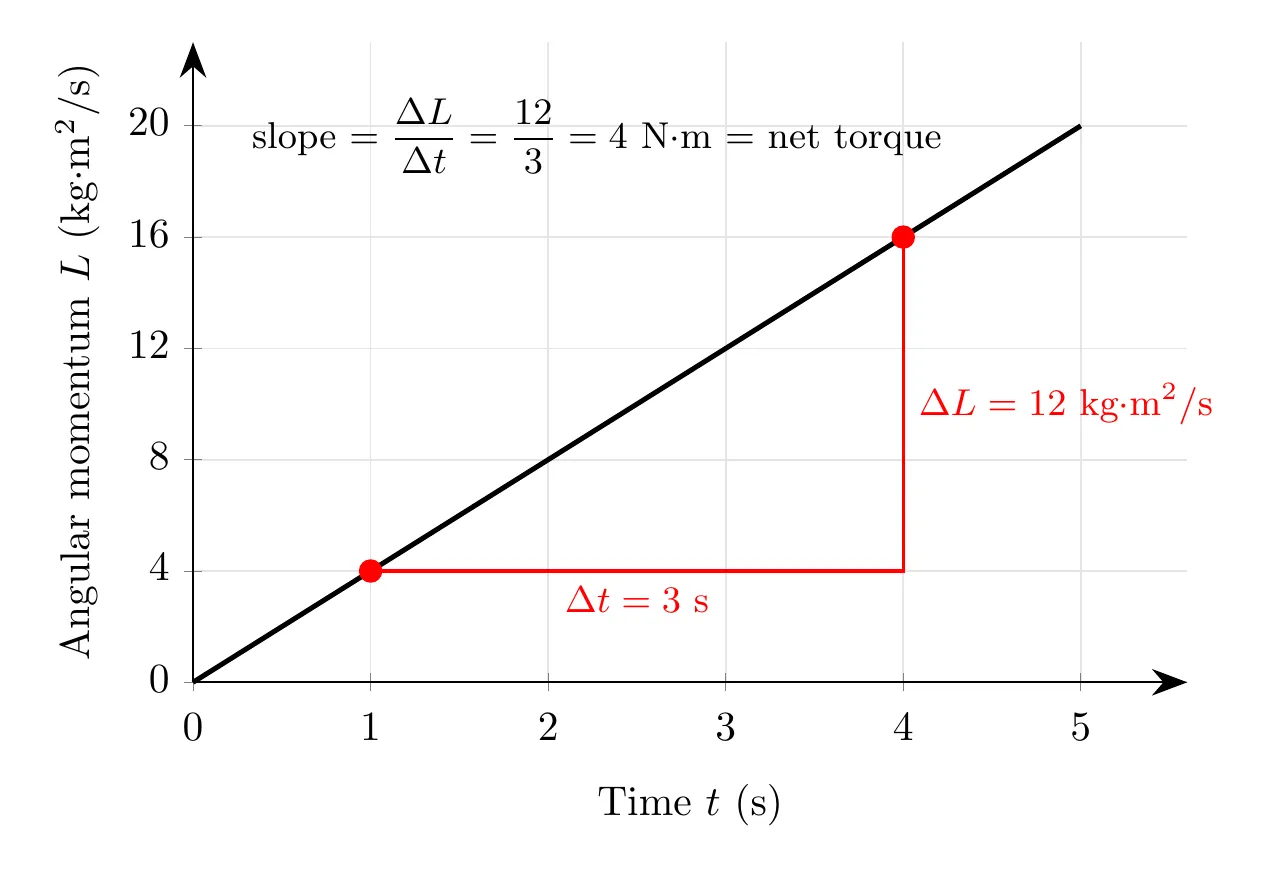
For a curved graph, the instantaneous torque at any point is the slope of the tangent line there.
Finding angular impulse from a τ vs. t graph: the area under a torque vs. time graph equals the angular impulse, or change in angular momentum:
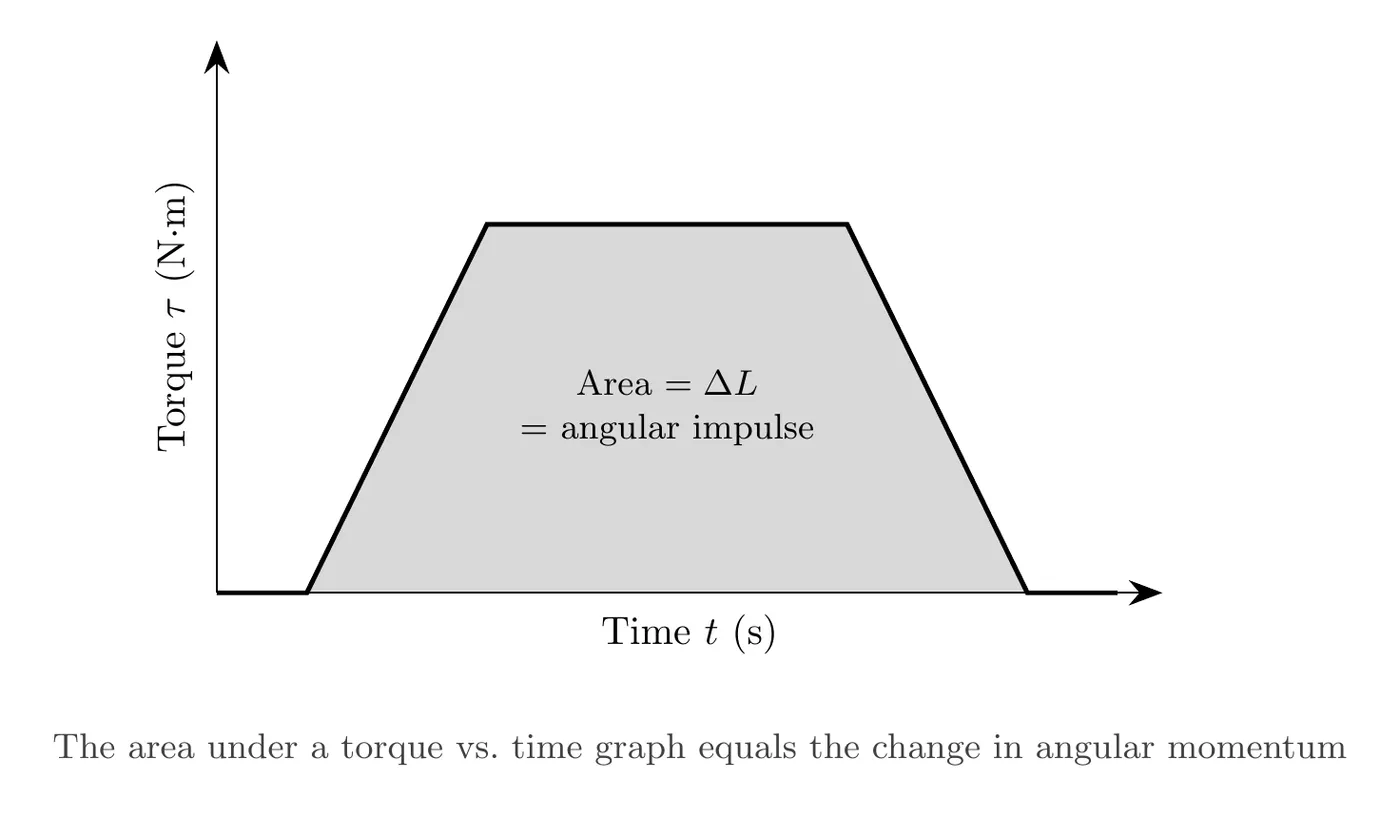
Example with the graph above: suppose the torque rises from 0 at s to 4.0 N·m at s, holds at 4.0 N·m until 7.0 s, then falls back to 0 at 9.0 s (the shape shown). The area is two triangles and a rectangle: N·m·s. So the angular impulse is 24 N·m·s, and the object’s angular momentum goes up by 24 kg·m²/s. If it started at rest with kg·m², it ends at rad/s.
Worked Example: Braking a Bicycle Wheel
A bicycle wheel with kg·m² spins counterclockwise at 8.0 rad/s. A brake pad exerts a constant friction torque of 0.30 N·m, clockwise, for 2.0 s. Find the angular impulse and the wheel’s final angular velocity.
Signs first: counterclockwise is positive, so rad/s and N·m.
Angular impulse: N·m·s. It’s negative, the same direction as the clockwise torque.
Initial angular momentum: kg·m²/s.
Final angular momentum and angular velocity:
The wheel is still turning counterclockwise, just slower. To stop it completely, the brake would need an angular impulse of N·m·s, which takes s.
Worked Example: Comparing Torques from L vs. t Graphs
Two objects, A and B, each have straight-line angular momentum vs. time graphs. Object A’s line goes from (0,0) to (5, 20), and Object B’s line goes from (0,0) to (5, 10), half the slope. Additionally, . Find how the average torques on the two objects compare.
Finding average torques: the average torque equals the slope of each L vs. t graph.
Taking the ratio: , so , or equivalently .
Notice the rotational inertias never entered the torque calculation: net torque is the slope of the vs. graph, whatever is. The inertias only matter for the angular accelerations, : and , so A’s angular velocity grows 4 times as fast as B’s.
Common Mistakes
Confusing which formula to use: use for rigid rotating systems (disks, wheels, rotating rods), and for single objects moving about a point (particles, satellites, orbiting objects).
Forgetting the angle in : always identify the angle between velocity and position vectors. When velocity is perpendicular to the radius, (the most common case); when velocity is parallel to the radius, , giving .
Incorrectly finding slope from graphs: don’t read just one point, you need two to find slope, .
Mixing up slope and area: the slope of an L vs. t graph gives torque, while the area under a vs. t graph gives the change in angular momentum, don’t swap these.
Ignoring moment of inertia differences: two objects can share the same angular momentum but have different angular velocities if their moments of inertia differ, since means a larger requires a smaller for the same .