

6.6 - Motion of Orbiting Satellites
Satellite Systems and Central Objects
When analyzing satellite systems, we focus on a massive central object (a star or planet) with an orbiting satellite whose mass is negligible by comparison, and we assume the central object’s own motion is negligible. For example, planetary masses in our solar system are so tiny compared to the Sun’s that we can ignore any wobble the Sun experiences from the planets, and just consider the planets revolving around it.
A satellite’s motion is constrained by conservation laws, and which quantities stay constant depends on the type of orbit.
Circular Orbits
In a circular orbit, several things stay constant: total mechanical energy (), gravitational potential energy (), angular momentum (), and kinetic energy (KE). Since the orbit is circular, the satellite stays at a constant distance from the central object, so gravitational potential energy never changes. Its speed also stays constant, so kinetic energy stays constant too. Angular momentum is conserved simply because there’s no external torque acting.
The numbers for a circular orbit: gravity supplies the centripetal force, which gives (from Topic 2.9). Then , exactly half the size of . So the total energy is
Example: a 1000 kg satellite in a circular orbit 400 km above Earth’s surface ( m, kg) moves at m/s. Its kinetic energy is J, the potential energy is J, and the total is J. All three stay constant for the whole orbit, because and never change.
Elliptical Orbits
In an elliptical orbit, only some quantities stay constant. Total mechanical energy () and angular momentum () are conserved, but gravitational potential energy () and kinetic energy (KE) both vary.
As the satellite moves closer to the central object, gravitational potential energy becomes more negative (decreasing) while kinetic energy increases. As it moves farther away, potential energy becomes less negative (increasing) while kinetic energy decreases. The sum, total mechanical energy, stays exactly the same throughout.
Why the satellite speeds up near the central object: gravity always pulls the satellite straight toward the center of the central object. About that center, gravity’s line of action passes right through the axis, so its lever arm is zero and it exerts no torque. With no torque, the satellite’s angular momentum about the center stays constant. At the closest and farthest points, the velocity is perpendicular to (), so gives:
Half the distance means twice the speed. This is Kepler’s second law (a planet sweeps out equal areas in equal times) written as conservation of angular momentum.
Worked Example: Speed and Energy in an Elliptical Orbit
A 1000 kg satellite orbits Earth ( kg) in an elliptical orbit. At its closest point it’s m from Earth’s center, moving at m/s. Its farthest point is m from Earth’s center. Find its speed at the farthest point, then check that the total mechanical energy is the same at both points.
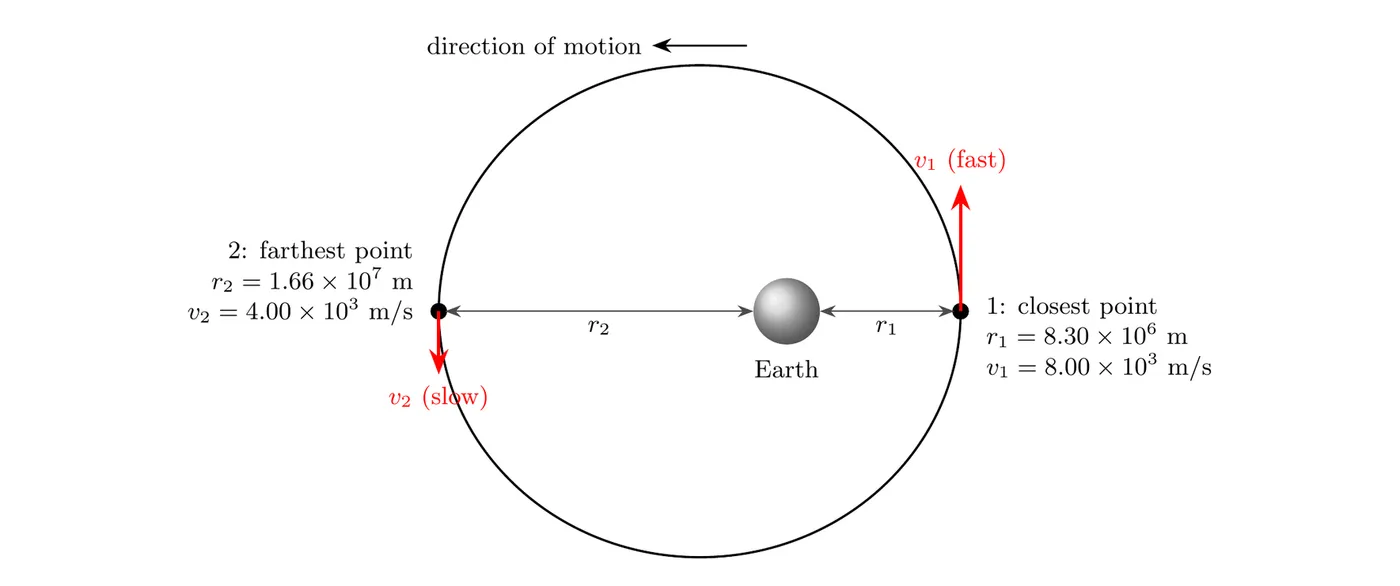
Speed from angular momentum:
Energy at the closest point:
So J.
Energy at the farthest point: J and J (twice as far, so half as negative), so J.
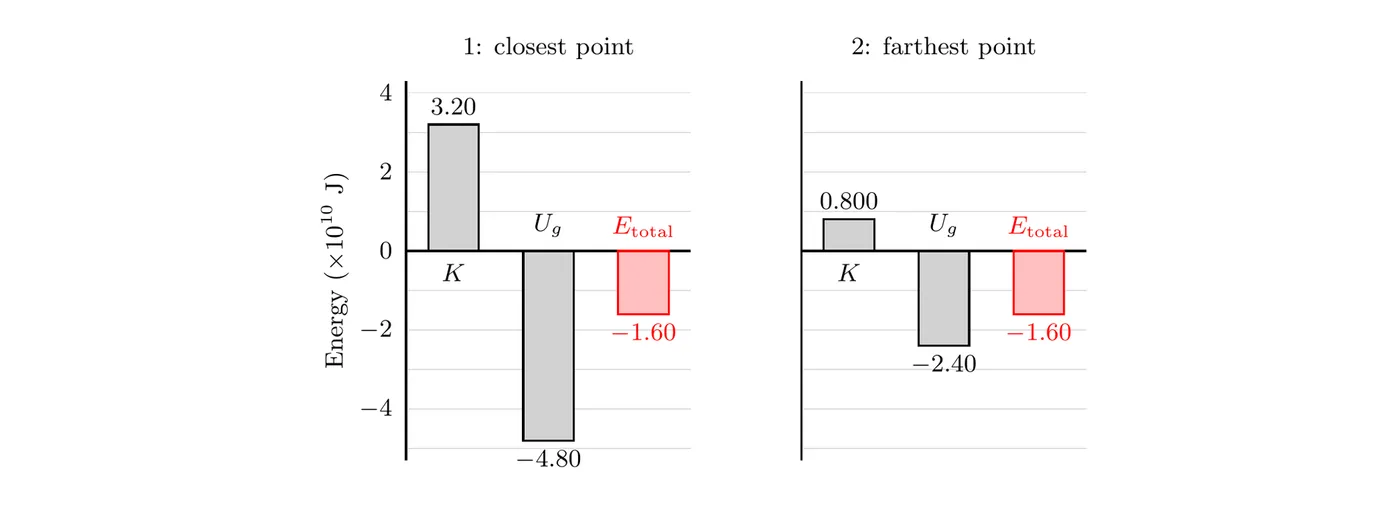
The total stays at J while energy shifts between kinetic and potential: going out, the satellite slows down and rises (gets less negative); coming back in, it speeds up again. The total is negative because the satellite is bound to Earth.
Gravitational Potential Energy, Revisited
For satellite systems, we use the more general form:
where is gravitational potential energy in Joules, N·m²/kg² is the universal gravitational constant, and are the two masses in kg, and is the distance between their centers in meters.
Why the negative sign? It comes from our choice of reference point: gravitational potential energy is defined to be zero when the satellite is infinitely far from the central object. As , , but at any finite distance, is negative. The closer the objects get, the more negative the potential energy becomes, which makes physical sense, since you’d have to add energy to the system to pull the objects apart back to infinity.
The change in gravitational potential energy is:
If starting from infinity ():
Escape Velocity
Escape velocity is the minimum speed an object needs to escape a celestial body’s gravitational pull and reach an infinite distance away, where gravitational potential energy is zero.
where is the mass of the planet or central object in kg, and is its radius in meters.
Deriving it from energy conservation: for an object to just barely escape, at the surface, , and at infinity, . Setting :
Notice that escape velocity is independent of the escaping object’s own mass.
Escape velocity in energy terms: a satellite is moving at escape velocity when the total mechanical energy of the satellite and central object system is exactly zero, . That’s what the derivation above sets up. If gravity from the central object is the only force, the sign of the total energy tells you what happens:
- (slower than escape velocity): the satellite is bound. Launched straight up, it slows down, stops at some maximum distance, and falls back; moving sideways fast enough, it stays in orbit.
- (exactly escape velocity): the satellite moves away forever, slowing down the whole way. Its speed approaches zero as its distance approaches infinity.
- (faster than escape velocity): the satellite escapes and still has some speed left over even infinitely far away.
Derived, not given: isn’t on the formula sheet, so expect to derive it from and , which are. Compared with the circular orbit speed at the same distance, , escape velocity is times larger. For the satellite 400 km up, m/s.
Worked Example: Comparing Escape Velocities of Two Planets
Planet A has mass kg and radius m. Planet B (like Earth) has mass kg and radius m. Find the ratio of their escape velocities.
Setting up the ratio directly:
Substituting values:
Planet A’s escape velocity is about 92.7% of Planet B’s.
Double checking by computing both escape velocities directly: for Planet A:
For Planet B:
Taking the ratio: , matching the earlier result.
Worked Example: Minimum Launch Speed from a Planet’s Surface
A planet has mass kg and radius m. Find the minimum launch speed for an object to escape the planet’s gravity.
Common Mistakes
Forgetting the negative sign in gravitational potential energy: the formula is , not positive. That negative sign is essential, it reflects that energy has to be added to separate the objects, and objects bound in orbit have negative total mechanical energy.
Using the wrong mass in escape velocity: in is the planet’s mass, not the escaping object’s, and escape velocity doesn’t depend on the escaping object’s mass at all.
Using the wrong radius: should be the planet’s radius, the distance from its center to its surface. If launching from above the surface, use the distance from the planet’s center to the actual launch point, and don’t confuse radius with diameter.
Assuming everything is conserved in elliptical orbits: in an elliptical orbit, both KE and change, only total mechanical energy and angular momentum stay constant. Closer to the central body, decreases (more negative) and KE increases; farther away, increases (less negative) and KE decreases.
Confusing circular and elliptical orbit properties: in a circular orbit, distance stays constant, so every form of energy stays constant. In an elliptical orbit, distance varies, so KE and vary, but total energy stays constant.
Sign errors in energy conservation problems: remember is negative at any finite separation, and exactly zero at infinity. Total mechanical energy for a bound system is negative, and escaping requires total energy to be at least zero.
Calculator errors with large exponents: be careful entering scientific notation, and keep track of positive versus negative exponents, remembering that dividing exponents subtracts them, like .
Not simplifying ratios first: when comparing escape velocities, simplify algebraically before plugging in numbers, constants like cancel out in ratios, reducing both errors and effort.
Thinking escape velocity depends on direction: it doesn’t, escape velocity is a speed, not a velocity, and the same magnitude works in any direction, what matters is the kinetic energy provided.