

6.5 - Rolling
Kinetic Energy of Rolling Objects
When an object both rotates and moves linearly, like a wheel rolling down a road, it carries two kinds of kinetic energy at once: translational kinetic energy from the linear motion of its center of mass, and rotational kinetic energy from spinning about that center of mass.
where is mass in kg, is the center of mass velocity in m/s, is the moment of inertia about the center of mass in kg·m², and is angular velocity in rad/s. This can also be rewritten purely in linear or purely in rotational terms using the relationships between them.
Rolling Without Slipping: Velocity Distribution
When an object rolls without slipping, different points on it move at different speeds relative to the ground.
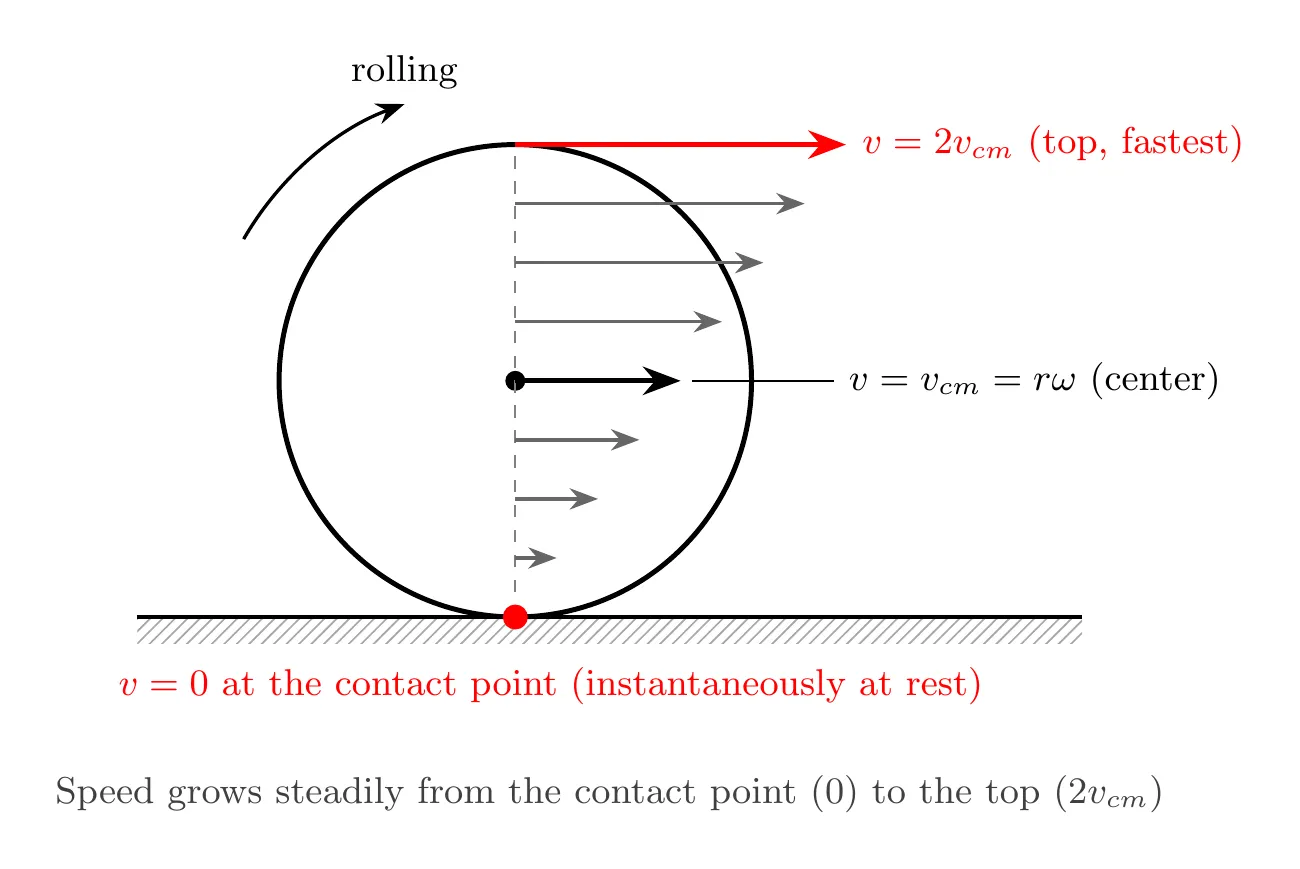
The top of the wheel moves at (the fastest point), the center of mass moves at (the reference velocity), and the bottom of the wheel moves at (instantaneously at rest). That bottom point being momentarily still is crucial, it’s exactly where static friction acts between the object and the surface. The point touching the ground is stationary for just an instant, then continues rotating as the wheel advances.
Rolling Without Slipping: The Special Condition
Rolling without slipping happens when rotational and translational motion are perfectly synchronized, and the usual linear-rotational relationships hold true:
Position: , where is the distance the center of mass travels.
Velocity: , the single most important equation for these problems.
Acceleration:
where is the radius of the rolling object, is angular displacement in radians, is angular velocity in rad/s, and is angular acceleration in rad/s². These relationships only hold when there’s no slipping.
Why these hold: an object rolling without slipping lays its rim down on the ground like tape coming off a roll. In one full turn ( rad), every point on the rim touches the ground once, so the center moves forward exactly one circumference, . That’s (on the formula sheet). Divide both sides by the time to get , and do the same with the changes in and to get .
Example: a bike wheel of radius 0.35 m turns 10.0 times while rolling without slipping. It rolls m.
When Slipping Occurs
When a rotating system is slipping relative to a surface, the center of mass motion and the rotational motion can’t be directly related, the relationship breaks down, since the point of contact is now actually moving relative to the surface.
Energy dissipation during slipping: the point where kinetic friction acts moves relative to the surface, kinetic friction does negative work on the system, energy dissipates (usually as heat), and mechanical energy isn’t conserved.
The role of friction in rolling: friction is what makes an object start rolling or change how fast it spins. At the bottom contact point, the object momentarily has zero velocity, and static friction is what prevents slipping there. On a ramp, static friction at the contact point exerts the torque about the center that spins the object up as it speeds up. Without friction (think of a ball on ice), a ball released on a ramp would slide down without spinning. But on level ground at constant speed, an ideal rolling object needs no friction at all: nothing has to change its or , so it keeps rolling on its own.
For rolling without slipping, static friction does no work, because its point of application never actually moves. But once slipping starts, kinetic friction takes over and dissipates energy.
Rolling While Slipping: What Changes
When , the contact point slides along the surface, so kinetic friction acts, pointing opposite to the way the contact point slides. That one friction force does two jobs at once: as a force, it changes ; as a torque about the center, it changes . It keeps acting until , and from then on the object rolls without slipping. (AP Physics 1 asks you to explain these changes, not calculate them.)
- Skidding (): a bowling ball released sliding down the lane with little spin. The bottom of the ball slides forward, so kinetic friction points backward. It slows the center of mass ( decreases) and its torque spins the ball up ( increases) until .
- Spinning too fast (): a ball dropped straight down while spinning forward. The bottom of the ball slides backward along the floor, so kinetic friction points forward. It speeds the center of mass up from zero and slows the spin until , and the ball rolls away.
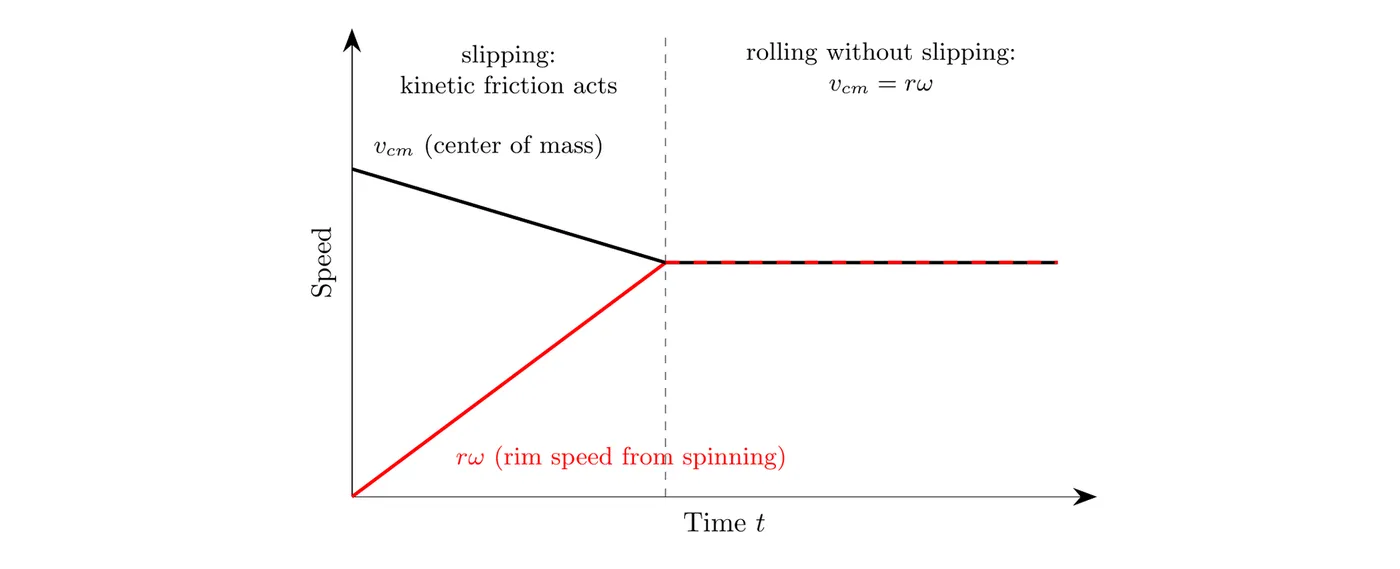
The graph shows the bowling ball. While it slips, kinetic friction dissipates mechanical energy as thermal energy, since its point of application moves along the lane. Once the ball rolls without slipping, the contact point is at rest, the kinetic friction stops, and (ideally) the ball rolls on at constant speed with no more energy lost.
Worked Example: Finding Angular Velocity from Linear Velocity
A solid cylinder with radius m rolls without slipping at a constant m/s. Find its angular velocity.
Since it rolls without slipping, rad/s.
The phrase “rolls without slipping” is the key piece of information here, it’s what lets us use at all. Without that condition, we couldn’t directly relate the linear and angular velocities.
Worked Example: Total Kinetic Energy of a Rolling Object
A solid sphere ( kg, m) rolls without slipping at m/s, with . Find its total kinetic energy.
Finding angular velocity: rad/s.
Translational kinetic energy: J.
Moment of inertia: kg·m².
Rotational kinetic energy: J.
Total kinetic energy: J.
An alternative, more compact method: using , and for a solid sphere where :
Same answer either way.
Worked Example: Rolling Down a Ramp (Energy Bar Charts)
A solid cylinder ( kg, radius 5.00 cm, ) is released from rest and rolls without slipping down a ramp. Its center drops a height of 1.00 m. Find its speed and angular speed at the bottom, and draw energy bar charts for the system of the cylinder and Earth.
Is mechanical energy conserved? Yes. The friction here is static: it acts at the contact point, which is momentarily at rest, so it does no work and dissipates no energy. Gravity is inside the system (as ), and the normal force does no work since it’s perpendicular to the motion.
Energy conservation, with at the bottom and :
The energies: at the top, J. At the bottom, J and J. For a solid cylinder, two thirds of the energy goes into moving the center of mass and one third into spinning, whatever the mass, radius, or height.
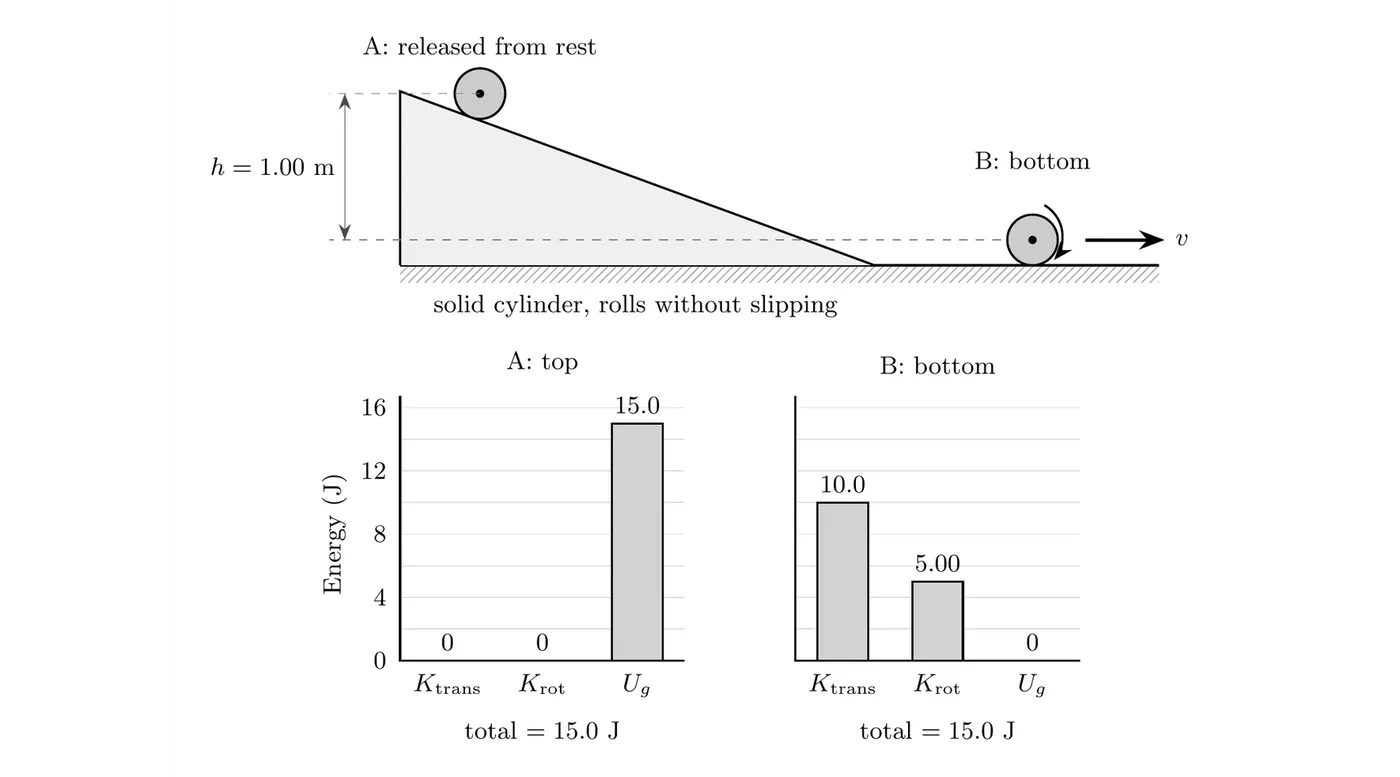
Compare with sliding: a block sliding down a frictionless ramp of the same height would reach m/s, faster, because all 15.0 J goes into translational kinetic energy. The rolling cylinder has the same total energy at the bottom but holds a third of it as spin.
Common Mistakes
Using when slipping occurs: this only works for rolling without slipping, so always check whether the problem states that condition, or whether friction is enough to prevent slipping. If it’s actually slipping, .
Forgetting rotational kinetic energy: it’s common to calculate only and forget the object is also spinning. A rolling object always has both translational and rotational KE, use .
Using the wrong moment of inertia: different shapes have different formulas, solid sphere is , solid cylinder or disk is , hollow sphere is , and hoop or hollow cylinder is . Always double check which shape you’re dealing with.
Confusing static and kinetic friction: rolling without slipping involves static friction, which dissipates no energy, while slipping involves kinetic friction, which does dissipate energy. Static friction can provide torque without doing any work, since its contact point doesn’t move.
Thinking the bottom of the wheel is moving: for rolling without slipping, the contact point has instantaneously. It feels counterintuitive, but it’s essential, and it’s exactly why static friction (not kinetic) acts at that point.
Sign errors with direction: when using , make sure and are in consistent directions, if the wheel rolls right, it rotates in a specific sense (clockwise or counterclockwise depending on your viewpoint), and you should track positive and negative directions carefully throughout.
Mixing up radius and diameter: these relationships all use radius , not diameter. If you’re given a diameter, divide by 2 first, and always double check your units, meters, centimeters, or otherwise.