

6.4 - Conservation of Angular Momentum
Total Angular Momentum of a System
The total angular momentum of a system about an axis is just the sum of the angular momenta of all its parts about that axis:
Any change in a system’s angular momentum has to come from an interaction between the system and its surroundings. With no external torques, angular momentum stays constant.
Conservation of Angular Momentum
Just like a system’s linear momentum stays constant without external forces, its angular momentum stays constant without external torques.
For rotating systems: , or more compactly, . Equivalently, . The total angular momentum of the system stays constant, even though individual parts within it might change.
The Inverse Relationship Between I and ω
When angular momentum stays constant and the moment of inertia changes, angular velocity has to change inversely: . Large pairs with small (spread-out mass rotates slowly), and small pairs with large (concentrated mass rotates quickly).
Figure skater example: with arms extended, is large and is small, the skater spins slowly. With arms pulled in, is small and is large, the skater spins rapidly. Even as both and change, their product stays constant, , which is exactly how skaters control their spin rate through body position.
Linear-to-Rotational Collisions
When something with linear momentum interacts with a rotating system, angular momentum is still conserved, just converted using .
Example, a clay ball landing on a rotating turntable’s edge: before the collision, . After the collision, , where (treating it as a point mass at distance ). Conservation gives:
The final moment of inertia includes both the disk and the now-attached ball.
External Torque and Angular Momentum
If the net external torque on a system is zero, the system’s total angular momentum stays constant: . But individual angular momenta within the system can still change, as long as the total stays fixed: angular momentum can transfer between parts while the sum of all angular momenta remains the same.
Why the parts’ changes cancel (Newton’s third law): when two parts of a system interact, each exerts a force on the other. The forces are equal and opposite and act along the same line, so about any axis they exert equal and opposite torques, for exactly the same time. The angular impulses are therefore equal and opposite too: whatever angular momentum one part gains, the other part loses.
Choosing the System
Angular momentum is conserved in every interaction: it never appears or disappears, it only moves from one object to another. Whether a system’s angular momentum stays constant depends on where you draw the system boundary:
- Net external torque is zero: the torques between parts are internal and cancel in pairs, so the system’s total angular momentum is constant. Choose the system to include every object that exerts a torque during the interaction (the clay and the turntable, or the skater’s arms and body).
- Net external torque is not zero: angular momentum is transferred between the system and its surroundings. The change in the system’s angular momentum equals the angular impulse from outside, .
Example: a lump of clay lands on a spinning turntable. If the system is the turntable alone, the clay is outside the system and exerts a torque on it, so the turntable’s angular momentum changes. If the system is the turntable plus the clay, that torque is internal, and the total stays constant (as long as the axle is frictionless).
A system that can change shape (a skater pulling in their arms, a student moving weights toward their chest) is a nonrigid system. Moving mass closer to the axis lowers , so goes up while stays the same, with no outside torque needed.
Worked Example: Clay Lands on a Turntable
A turntable is a uniform 2.0 kg disk of radius 0.20 m, spinning counterclockwise at 3.0 rad/s on a frictionless axle. A 0.25 kg lump of clay moving at 1.2 m/s, tangent to the rim and in the same direction the rim moves, hits the rim and sticks. Find the final angular velocity, and how much angular momentum moves from the clay to the turntable.
Before: the turntable has kg·m², so kg·m²/s. The clay has kg·m²/s. Total: kg·m²/s.
After: the clay is a point mass at the rim, kg·m², so the system’s rotational inertia is kg·m². No external torque acts on the clay plus turntable system, so:
The transfer: afterward the turntable has kg·m²/s (up by 0.024) and the clay has kg·m²/s (down by 0.024). The turntable gained exactly the angular momentum the clay lost, and the total never changed:
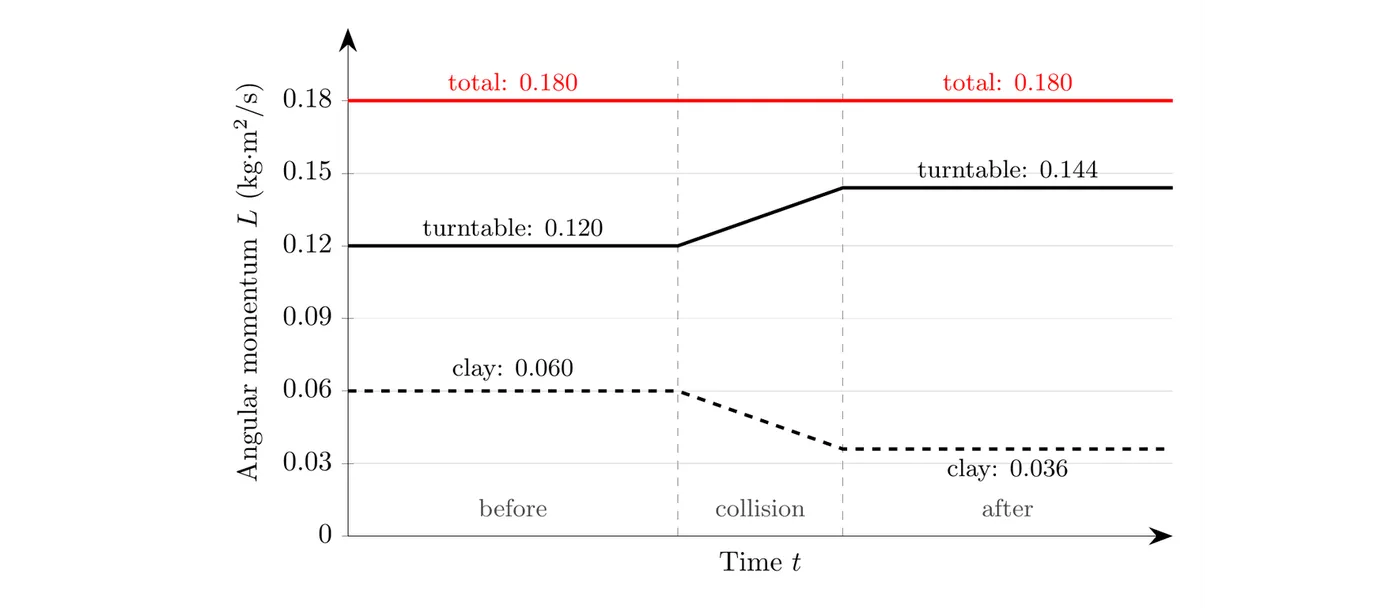
Energy check: kinetic energy is not conserved. Before: J. After: J. About 0.036 J (10%) became thermal energy as the clay squished, just like the kinetic energy lost in a perfectly inelastic collision.
Worked Example: Rotating Platform with Adjustable Mass Distribution
A student on a rotating platform holds weights in each hand. With arms extended, kg·m² and rad/s. With arms pulled in, kg·m². Find .
Applying conservation:
Checking the ratio: , so . Reducing the moment of inertia to about 31% of its original value increases the angular velocity to 320% of its original value, keeping the product constant.
Energy check: the student’s rotational kinetic energy goes up, even though angular momentum stays the same. Before: J. After: J, 3.2 times as much. The extra energy comes from the student’s muscles, which do work pulling the weights inward. Since is constant, , so cutting by a factor of 3.2 raises by the same factor.
Conceptual Problem: Comparing Before and After
A person on a rotating stool has . How does compare to ?
Dividing both sides by :
The final angular velocity is three times the initial one. Remember the inverse relationship: if decreases by some factor, increases by that same factor.
Common Mistakes
Using the wrong moment of inertia: always keep straight which state you’re in, pairs with , and pairs with . Don’t mix them up as , that’s incorrect.
Forgetting to include all parts of the system: when objects combine (stick together), the final moment of inertia has to include all of them, for example, disk plus landing object gives .
Not recognizing the inverse relationship: it’s easy to think larger means larger , but it’s actually the opposite, large means small , and small means large .
Assuming kinetic energy stays constant: with no external torque, the system’s angular momentum stays constant, but its rotational kinetic energy usually doesn’t. It goes down when objects stick together (the clay on the turntable lost about 10% as thermal energy) and goes up when someone pulls mass inward (the student’s kinetic energy rose by a factor of 3.2). Only assume , not necessarily .
Sign errors in collisions: when combining linear and rotational motion, track direction carefully. Angular momentum from linear motion, , is positive if it causes counterclockwise rotation and negative for clockwise, keep sign conventions consistent throughout.
Forgetting the point mass moment of inertia: when a mass lands on a rotating platform, its own moment of inertia is (assuming it lands at distance from the axis), and this needs to be added to the platform’s moment of inertia.