

3.3 - Resistance, Resistivity, and Ohm’s Law
Resistance
Resistance measures how strongly an object opposes the movement of electric charge.
The unit is the ohm (Ω), where 1 Ω = 1 V/A.
Resistance and Physical Properties
For a resistor with uniform geometry, the resistance depends on three things:
where:
- = resistance (Ω)
- = resistivity of the material (Ω·m)
- = length of the resistor (m)
- = cross-sectional area (m²)
On the AP equation sheet this is written , with for length. It’s the same equation.
The relationships are:
- Resistance is proportional to length. Longer resistors have more resistance, since there’s more material for the charges to travel through.
- Resistance is proportional to 1/area. Thicker resistors have less resistance, since there’s more room for the charges to flow.
- Resistance is proportional to resistivity. Materials with higher resistivity fight the current more.
Example: wire A has a resistance of 8.0 Ω. Wire B is made of the same metal, but it’s twice as long and has twice the diameter. What is the resistance of wire B?
Doubling the diameter doubles the radius, and the area of a circle goes as , so wire B’s area is times bigger:
Answer: 4.0 Ω. The usual trap is treating twice the diameter as twice the area.
Resistivity
Resistivity () is a fundamental property of a material that captures how strongly it opposes the motion of charge.
It depends on the atomic and molecular structure of the material, so it’s an intrinsic property that doesn’t care about the object’s shape or size.
Resistivity values cover a huge range, and that range is what separates conductors from insulators:
- Copper: about Ω·m. Very low, which is why wires are made of it.
- Nichrome (a nickel and chromium alloy): about Ω·m, roughly 65 times copper’s. It’s used for the glowing coils in toasters and space heaters.
- Glass: more than Ω·m, over times copper’s. That’s an insulator.
Temperature Dependence
For a conductor, resistivity usually increases with temperature. As things heat up, the atoms vibrate more, which causes more collisions with the moving charge carriers and drives the resistance up.
Ohm’s Law
Ohm’s law connects current, resistance, and the potential difference across a conductive element:
or, equivalently:
where:
- = potential difference (voltage) across the element (V)
- = current through the element (A)
- = resistance of the element (Ω)
The equation sheet writes Ohm’s law as , with for the potential difference across the element. It’s the same relationship. For a fixed resistance, the current is directly proportional to the potential difference, so doubling doubles .
Ohmic vs. Non-Ohmic Materials
Ohmic materials obey Ohm’s law, so they have constant resistance no matter the current. Ideally, the resistivity of an ohmic material stays constant regardless of temperature. Their characteristics:
- A linear relationship between voltage and current.
- Constant resistance.
- A graph of vs. that’s a straight line through the origin.
Non-ohmic materials have resistance that changes with current or voltage, like diodes, lightbulbs, and thermistors.
On the AP exam: the equation sheet says resistors and lightbulbs are ohmic unless a problem says otherwise. A real bulb filament isn’t ohmic (its resistance rises a lot as it heats up), but in AP problems you keep a bulb’s resistance constant unless you’re told it changes or you’re shown a curved vs. graph.
Energy Conversion
Resistors turn electrical energy into thermal energy through a process called Joule heating. This can raise the temperature of both the resistor and its surroundings.
That heating is why wires get hot when they carry current, and why resistors show up in devices like toasters and heaters.
Example: the resistor in practice problem 2 below (12 V across it, 0.40 A through it) turns electrical energy into thermal energy at W. Every second, 4.8 J goes into warming the resistor and the air around it (power is covered in 3.4).
Finding Resistance from a Graph
For an ohmic element, you can get the resistance from a graph of current vs. potential difference:
Alternatively, if you plot vs. :
For an ohmic material, this graph is a straight line, and the slope (or its inverse) gives the constant resistance.
Example (lab): to find the resistance of an unknown resistor, connect it to an adjustable power supply with an ammeter in series with it and a voltmeter in parallel across it. Set several different potential differences, record the current each time, and graph vs. :
(V) | (mA) |
1.0 | 41 |
2.0 | 78 |
3.0 | 122 |
4.0 | 158 |
5.0 | 201 |
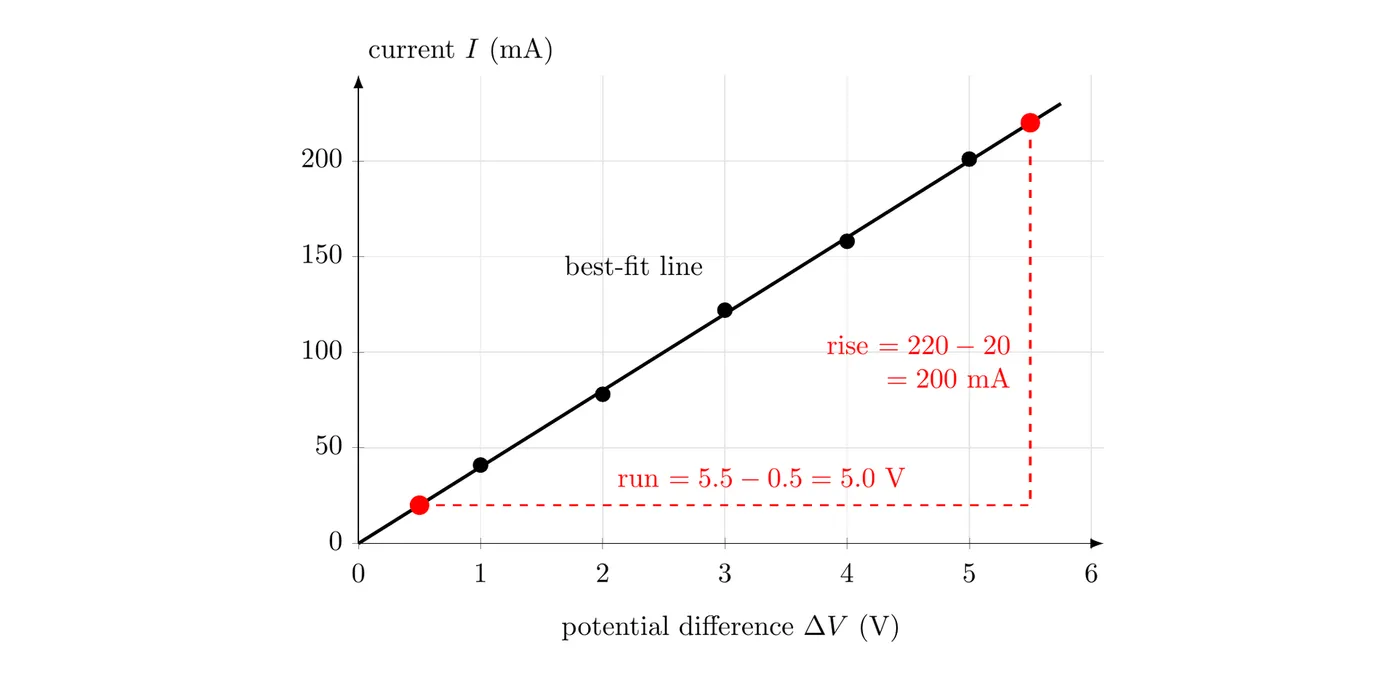
Draw one best-fit line through the data (don’t connect the dots, and don’t use a single data point). Then take the slope from two points on the line that are far apart, here (0.5 V, 20 mA) and (5.5 V, 220 mA):
Answer: about 25 Ω. The points fall close to a straight line through the origin, so the resistor is ohmic.
Practice Problems
1. A copper wire has a resistance of 0.50 Ω. If it’s stretched to twice its original length, and the volume stays constant, what’s its new resistance?
2. A resistor carries 0.40 A when 12 V is applied across it. What is its resistance?
3. A cylindrical resistor has length m, cross-sectional area m², and resistivity Ω·m. Find its resistance.
4. An experiment measures the current through a resistor at different applied voltages, and the data points fall on a straight line through the origin. When V, A.
- (a) Is this an ohmic material? Explain.
- (b) What is the resistance?
- (c) What current would flow if V?
5. Explain why a metal wire’s resistance goes up when its temperature goes up.
Solutions
1.
When the wire stretches to twice its length, its volume stays constant:
Since :
The new resistance is:
Answer: the new resistance is 2.0 Ω, four times the original.
2.
Apply Ohm’s law directly:
Answer: the resistance is 30 Ω.
3.
Use the resistance formula:
Answer: the resistance is about 0.37 Ω.
4.
- Yes, it’s ohmic. The data forms a straight line through the origin, which means voltage and current have a linear relationship. That tells you the resistance stays constant across all values of current and voltage, which is exactly what ohmic behavior means.
- Find the resistance from the given data point:
Answer: the resistance is 3.0 Ω.
- Since it’s ohmic, the resistance holds constant:
Answer: the current would be 3.0 A.
5. As the temperature rises, the atoms in the metal vibrate more vigorously and with bigger amplitude. The moving electrons (the charge carriers) collide with those vibrating atoms more often, so they scatter more and lose more energy for every bit of distance they travel.
This higher collision rate effectively raises the material’s resistivity, which raises the wire’s resistance through . More collisions mean more opposition to the flow of charge.
Common Mistakes
- Confusing resistance and resistivity. Resistance () depends on both geometry and material, while resistivity () is only a material property, independent of shape and size.
- Using the wrong area in . Use the cross-sectional area perpendicular to the current flow, not the surface area.
- Assuming everything is ohmic. Plenty of real materials, like diodes, lightbulbs heating up, and thermistors, don’t obey Ohm’s law. Their resistance can change with current or temperature.
- Forgetting volume conservation. When a wire is stretched at constant volume, both the length and the area change. Doubling the length halves the area, which gives a factor of 4 increase in resistance.
- Mixing up slope and resistance on graphs. On an vs. graph, resistance is the inverse of the slope (). On a vs. graph, resistance is the slope.
- Ignoring units. Resistivity is in Ω·m, not Ω. Check your unit consistency, especially when finding resistance from geometry.
- Mixing up real wires with the ohmic model. Real metals do get more resistive as they heat up. The ohmic model ignores that: in AP Physics 2, an ohmic element has the same resistance at every current and temperature, and resistors and lightbulbs count as ohmic unless a problem says otherwise. If you’re told the resistance changes, or you’re shown a curved vs. graph, the element is non-ohmic.