

3.6 - Kirchhoff’s Loop Rule
Energy Changes in Circuits
You can describe energy changes in a circuit in terms of charges moving through potential differences within the circuit elements.
The change in electric potential energy for a charge moving through a potential difference is:
where:
- = change in electric potential energy (J)
- = charge (C)
- = potential difference (V)
is on the equation sheet. The loop rule below () is not, so know it by heart.
Example: a 12 V battery drives a current of 0.50 A through a resistor for 60 s. How much energy does the charge pick up in the battery, and where does it go?
Answer: going through the battery from − to +, the charge gains 360 J of electric potential energy. Going through the resistor it drops 12 V, so J: the resistor turns those 360 J into thermal energy. The net change around the loop is zero. (Check with power: J.)
Kirchhoff’s Loop Rule
Kirchhoff’s loop rule comes straight out of the conservation of energy.
Statement
If you add up the potential differences across every element in a single closed loop, they have to total zero:
or, written out:
What It Means
When a charge goes all the way around a loop and lands back where it started, the net change in electric potential is zero. Any energy it picks up from sources like batteries has to match the energy it loses in resistors and everything else.
Think of it like hiking. If you start and finish at the same elevation, your total elevation change is zero no matter what route you took.
Applying the Loop Rule
Sign Conventions
As you walk around the loop:
Across a battery (emf source):
- Going from the negative (−) to the positive (+) terminal: (you gain potential).
- Going from the positive (+) to the negative (−) terminal: (you drop potential).
Across a resistor:
- Moving in the same direction as the current: (a drop).
- Moving against the current: (a gain).
Key point: pick a direction to travel the loop (clockwise or counterclockwise) and stay consistent with your signs the whole way around.
Circuits with More Than One Loop
The loop rule works for every closed loop in a circuit, and one element can be in several loops. Take the circuit from the step-by-step example in 3.5, where the currents came out to A, A, and A:
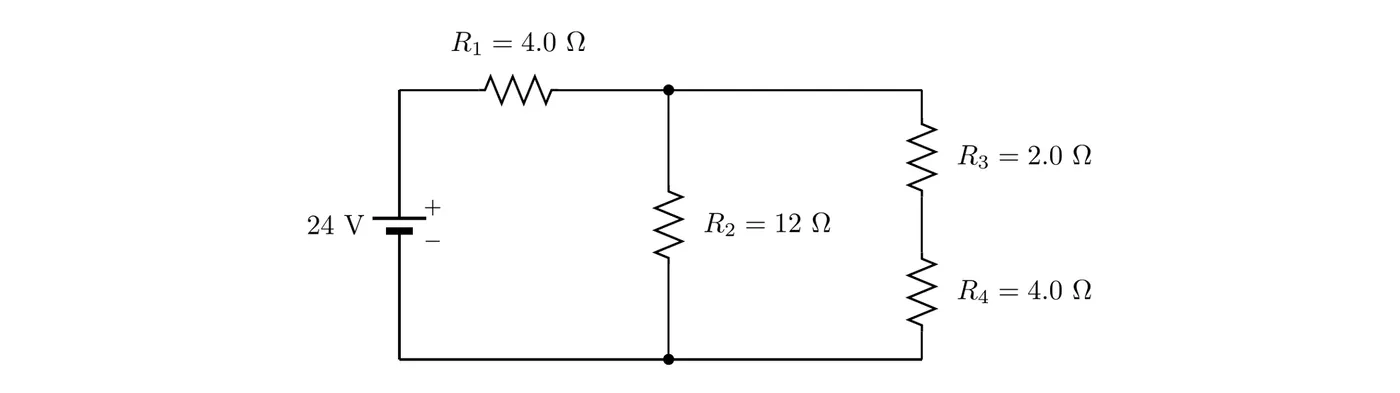
- Loop 1 (battery, , ):
- Loop 2 (battery, , , ):
- Loop 3 (only the two branches: down through and with the current, then back up through against its current):
The battery and are in both Loop 1 and Loop 2. Loop 3 doesn’t contain the battery at all, and it still adds up to zero. It also shows why parallel branches always have the same potential difference: going down one branch and back up the other has to bring you back to the potential you started at.
Potential vs. Position Graphs
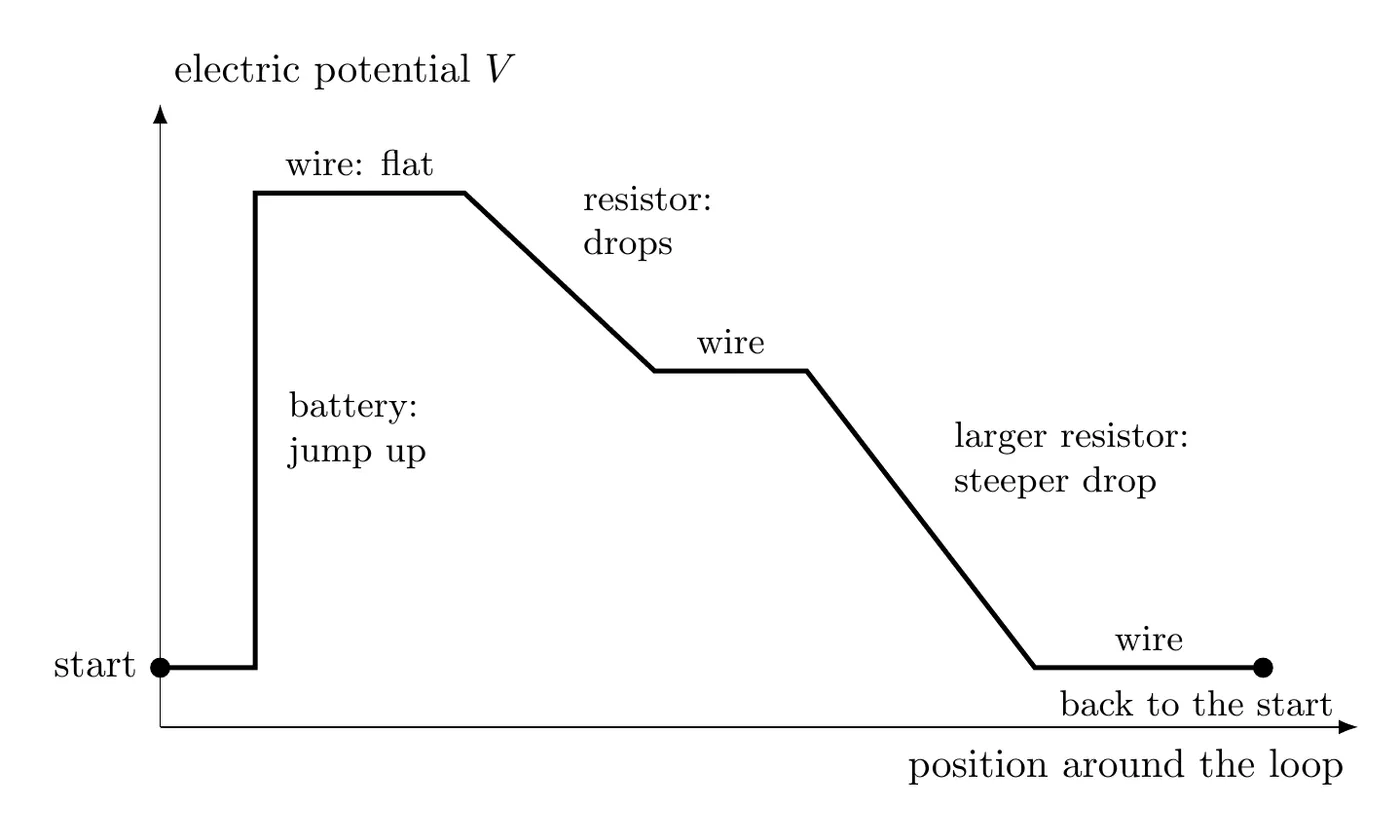
You can show the electric potential at different points in a circuit with a graph of electric potential versus position around the loop.
Example (battery with internal resistance): a battery with V and internal resistance Ω is connected to a 2.0 Ω resistor. The current is A. Start at the battery’s − terminal (call it 0 V) and walk around in the direction of the current:
- Through the ideal part of the battery: up by V.
- Through the internal resistance: down by V, so the + terminal is at 6.0 V. That’s the terminal voltage.
- Along the wire: no change.
- Through the 2.0 Ω resistor: down by V, back to 0 V.
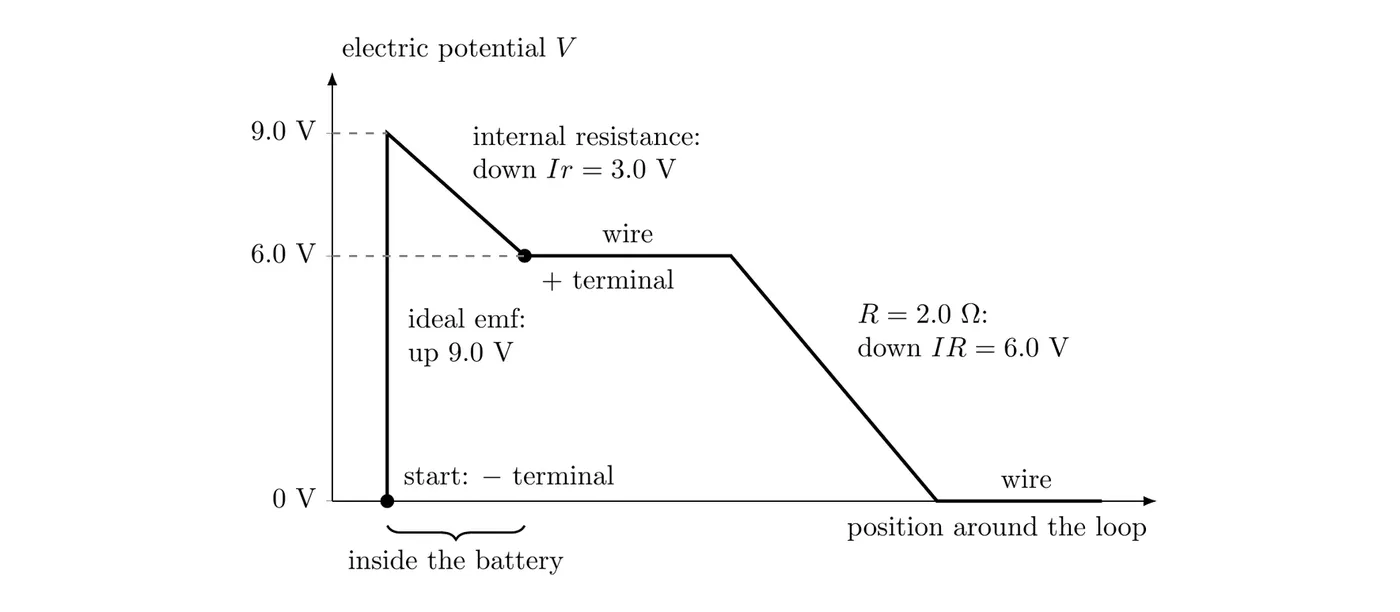
The changes add up to , just as the loop rule says.
Practice Problems
1. A simple circuit has a 12 V battery and two resistors in series: Ω and Ω. Use the loop rule to find the current.
2. In a single-loop circuit, a charge goes through a 9.0 V battery (from − to +), then through a resistor with a 4.0 V drop, then through another resistor with an unknown drop. What’s the voltage drop across the second resistor?
3. A circuit has a 15 V battery with internal resistance Ω and an external resistor Ω. Use the loop rule to find:
- (a) The current in the circuit.
- (b) The terminal voltage of the battery.
4. Picture a loop with two batteries and one resistor. Battery 1 has emf V (set up to drive current clockwise), battery 2 has emf V (also driving current clockwise), and the resistor is Ω. Find the current in the loop.
5. Sketch a rough graph of potential versus position for a loop with a 10 V battery and two resistors ( Ω and Ω) in series. Assume current is flowing.
6. A charge of C travels all the way around a circuit loop. How much net work do the electric forces do on it? Explain with energy conservation.
Solutions
1. Pick a direction (say clockwise, starting at the battery) and apply the loop rule:
Going around:
- Through the battery (− to +): V
- Through (with the current):
- Through (with the current):
Answer: the current is 1.5 A.
2. Apply the loop rule around the circuit:
Answer: the second resistor drops 5.0 V. It has to work out this way for energy conservation, since all the potential the battery hands out has to get used up in the resistors.
3.
- Apply the loop rule going around the circuit:
- Through the battery: V
- Through the internal resistance (with the current):
- Through the external resistor (with the current):
Answer: the current is 3.0 A.
- The terminal voltage is the voltage across the external resistor:
Or you can get it from V.
Answer: the terminal voltage is 12 V.
4. Both batteries push current the same way (clockwise), so they add together. Apply the loop rule going clockwise:
Answer: the current is 2.3 A. The batteries team up for a combined emf of 18 V.
5. Start at the negative terminal of the battery (call this position 0 and potential 0 V):
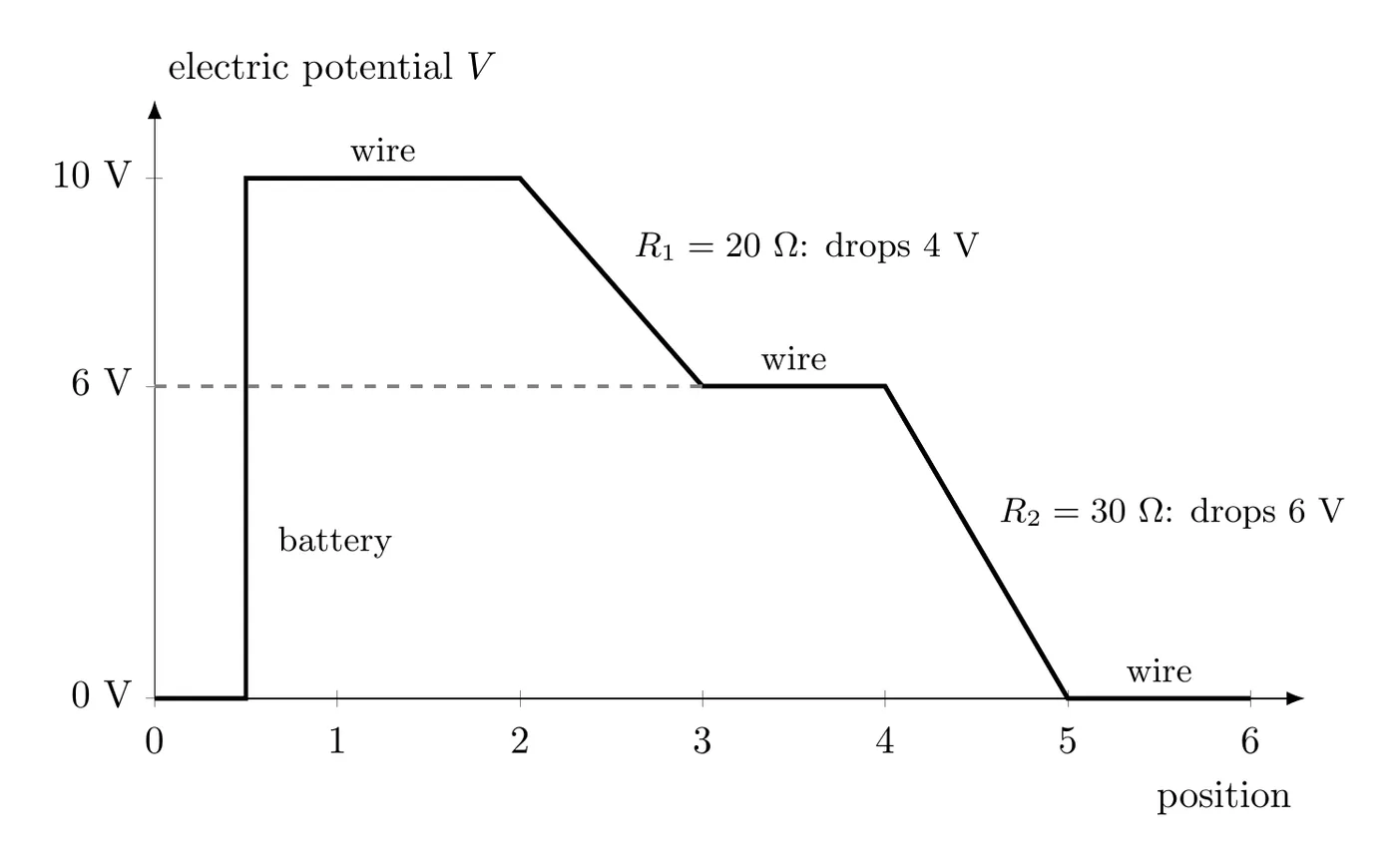
The slope through R₂ is steeper than through R₁ because R₂ is larger, so with the same current through both, it has the bigger voltage drop.
6. By the loop rule and energy conservation, the net change in electric potential around a complete loop is zero:
So the net work done on the charge is:
Answer: zero net work.
Why: the charge gains energy from batteries and loses the same amount in resistors. By the time it gets back to its starting point, it has the same potential energy it started with. Energy is conserved, so the potential energy it picks up from sources equals the energy dumped as heat in the resistors.
Common Mistakes
- Getting the signs wrong. Stay consistent with your chosen direction around the loop. Through a battery from − to + is a gain (+). Through a resistor in the direction of the current is a drop (−).
- Skipping an element. Include every single element in the loop when you set up . That means batteries, resistors, and internal resistances.
- Confusing potential difference with potential. Potential difference is the change in potential between two points. The loop rule says the sum of all those changes is zero.
- Not closing the loop. Make sure your path actually returns to where it started. You need a complete closed loop for the rule to work.
- Getting the current direction wrong through a resistor. The potential drops (goes more negative) when you move through a resistor in the direction of the current. If you’re not sure which way the current goes, just assume a direction and solve. A negative current answer means your guess was backwards.
- Adding potentials instead of potential differences. The loop rule sums the changes in potential (), not the absolute potential at each point.
- Ignoring internal resistance. When it’s there, internal resistance has to go into the loop equation as an extra potential drop.
- Misreading potential graphs. On a V vs. position graph, upward jumps mean batteries (or moving against the current through a resistor), while downward slopes mean resistors (or moving with the current).
- Using it on open circuits. The loop rule only works for closed loops where current can actually flow. It doesn’t apply to open circuits.
- Units. Keep voltages in volts, currents in amperes, and resistances in ohms so everything stays consistent.