

1.2 - Conservation of Electric Charge and the Process of Charging
The Law of Conservation of Charge
Electric charge is conserved in every process. The total charge going into a system equals the total charge you can pull back out, no matter how it gets distributed among the objects inside.
The fundamental principle: the net charge of an isolated system stays constant. Charge can’t be created or destroyed, only moved from one object to another.
Charging by Friction (Contact)
When two objects rub together, electrons can transfer from one material to the other through friction.
The process:
- Physical contact strips electrons off one surface and moves them to the other.
- The object that loses electrons becomes positively charged (a deficit of electrons).
- The object that gains electrons becomes negatively charged (an excess of electrons).
For example, rubbing a glass rod with silk moves electrons from the glass to the silk, leaving the glass positive and the silk negative.
Important: only electrons transfer between objects, never protons. Protons are locked in atomic nuclei and don’t move during ordinary charging.
Induced Charge Separation (Charging by Induction)
A system’s charge distribution can shift in response to a nearby charged object, even without any direct contact. This is called induction or polarization.
How Induction Works
When you bring a charged object near a neutral conductor:
1. The electrostatic force pushes the charges inside the neutral object around.
2. The opposite charges get pulled toward the charged object.
3. The like charges get pushed to the far side.
4. The neutral object becomes polarized, meaning the charge separates but the net charge is still zero.
Making the Charge Permanent
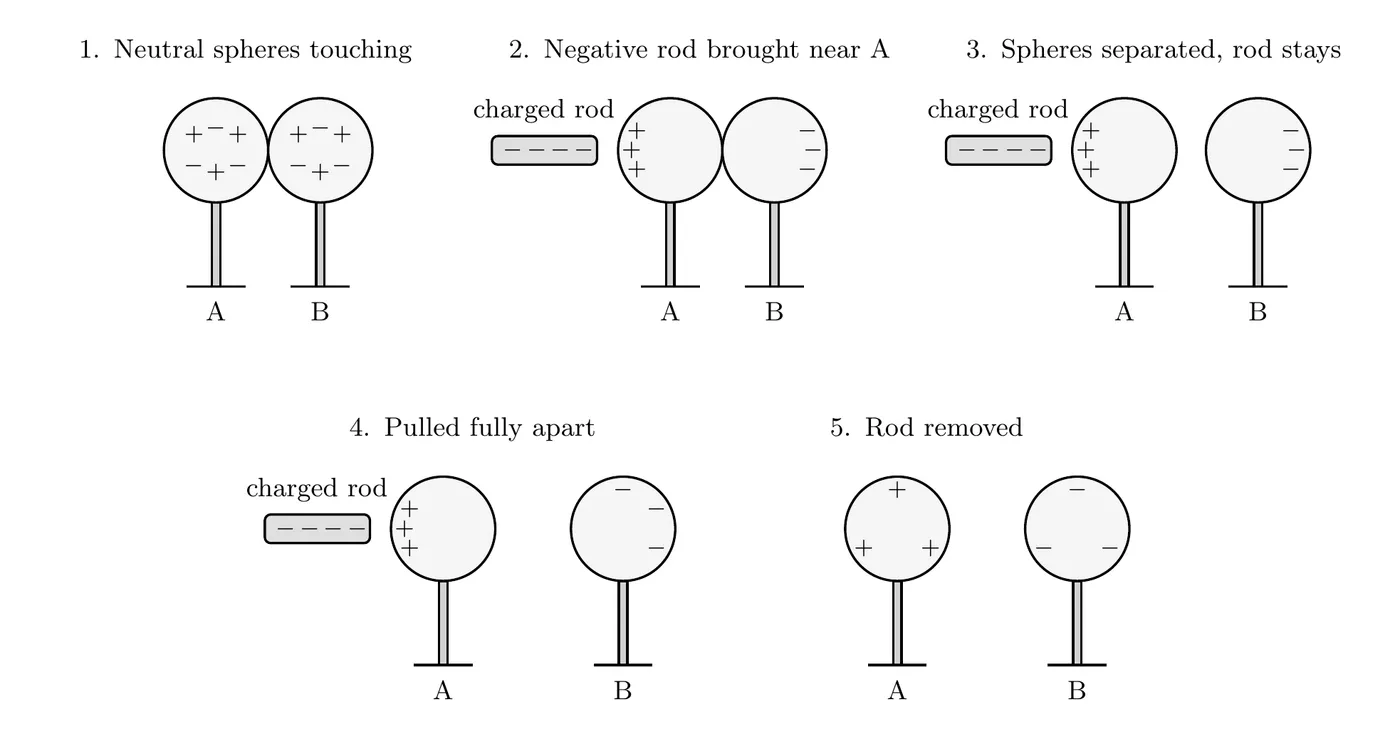
The step-by-step process:
- Initial state: two conducting spheres (A and B) are touching, and both are electrically neutral.
- Bring a charged object near: a negatively charged rod approaches sphere A.
- The positive charges in sphere A get pulled toward the rod.
- The negative charges in sphere A get pushed away from the rod.
- Negative charge piles up on sphere B.
- Separate the spheres while the rod is still there: physically pull A and B apart while the charged rod stays put.
- Sphere A keeps its excess positive charge.
- Sphere B keeps its excess negative charge.
- Remove the charged object: take the rod away.
- Sphere A stays positively charged.
- Sphere B stays negatively charged.
- Both spheres are now permanently charged, and neither ever touched the rod.
Key point: making the charge permanent this way takes conductors, because electrons have to flow from one sphere to the other. Induced charge separation itself happens in insulators too, just inside each atom or molecule instead of across the whole object (see below).
Polarization in Insulators
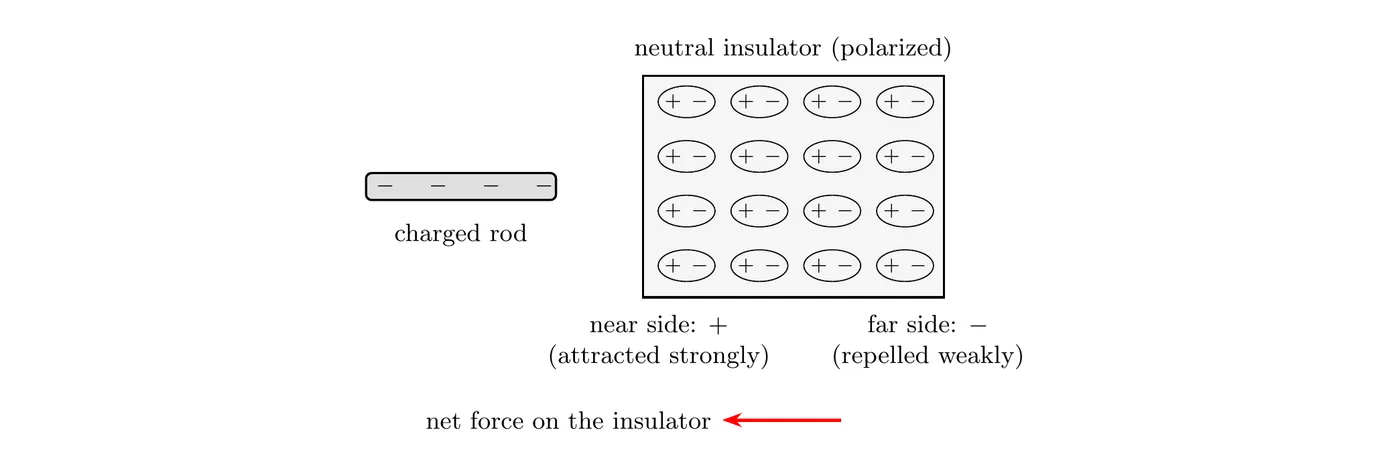
In an insulator, electrons can’t travel across the object, but each atom or molecule can still be stretched out of shape. Bring a negative rod close, and it pushes the electrons in every nearby atom slightly away, leaving the near side of each atom slightly positive. The whole object becomes polarized: the surface facing the rod is a little positive and the opposite surface is a little negative. No charge enters or leaves, so the net charge stays zero. This is induced charge separation in a neutral object.
Why a Charged Object Attracts a Neutral One
After polarization, the side of the neutral object closest to the rod carries charge opposite to the rod’s, and the far side carries charge with the same sign. The near side is attracted and the far side is repelled. Coulomb’s Law depends on , so the closer charges feel the bigger force, and the attraction wins.
Example: a rod with charge nC (treat it as a point charge) polarizes a small neutral object so that nC sits 4.0 cm from the rod and nC sits 5.0 cm from it.
Net force: N toward the rod, even though the object is neutral.
This explains some everyday effects:
- A balloon rubbed on your hair sticks to a neutral wall.
- A charged comb picks up small bits of paper.
- A charged rod bends a thin stream of water toward it.
- It works with either sign: a positive rod attracts a neutral object too, because the charges just separate the other way around.
Net Charge and Charge Distribution
The net charge is the algebraic sum of all the positive and negative charges in a system:
- An excess of electrons gives a net negative charge.
- A deficit of electrons gives a net positive charge.
When charged objects touch, the charge redistributes between them until they reach equilibrium.
Charging by conduction (contact). When a charged conductor touches a neutral one, some of the excess charge flows onto the neutral object, and both end up with the same sign of charge. For example, touch a metal sphere carrying nC to an identical neutral sphere. The excess electrons spread out over both, leaving nC on each. The number of electrons that moved onto the second sphere:
The total is still nC, so charge is conserved.
The three ways to charge an object:
Method | Contact? | What happens | Final charge |
Friction | Yes (rubbing) | Electrons move from one material to the other | The two objects get opposite signs |
Conduction | Yes (touching) | Electrons flow between the objects until the excess charge is shared | Same sign as the charged object |
Induction | No | Charges shift inside the object, then a ground or a second object carries some away | The object nearest the charged one gets the opposite sign |
Grounding
Grounding means electrically connecting a charged object to the Earth (or some other very large neutral reservoir) to neutralize its excess charge.
Why Grounding Works
The Earth acts as an infinite reservoir of charge:
- It can absorb excess electrons from a negatively charged object.
- It can supply electrons to a positively charged object.
- It’s so large that adding or removing charge has a negligible effect on its overall neutrality.
Practical Application
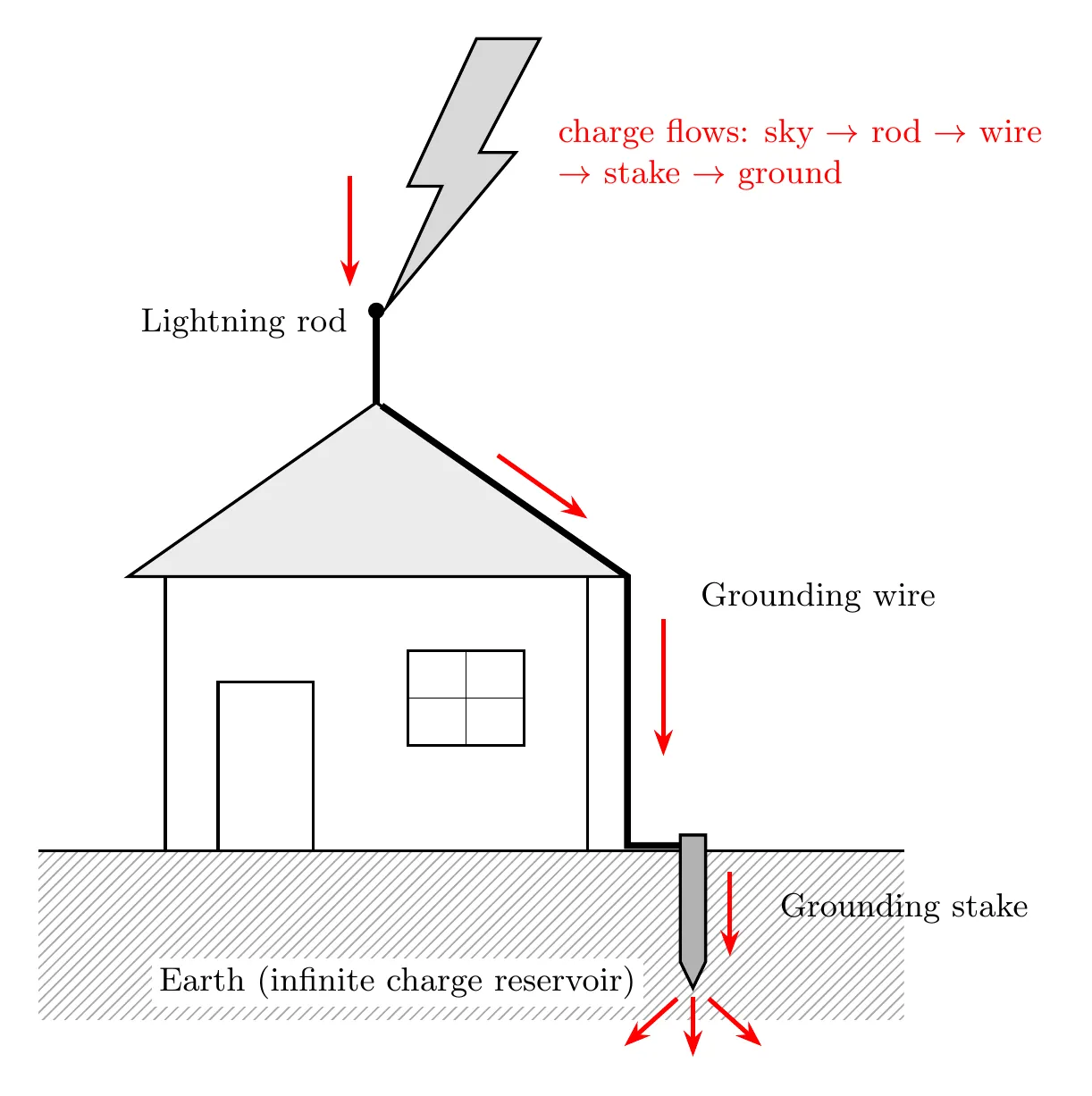
Grounding is essential in electrical systems to keep dangerous charge from building up:
- Metal stakes driven into the ground connect to a building’s electrical system.
- Any excess charge, whether from a lightning strike, static buildup, or an electrical fault, flows through the grounding wires into the Earth.
- That protects people and equipment from shock or damage.
Grounding and Conservation of Charge
Example: a metal sphere with nC is connected to ground. Earth is so large that it can supply electrons without its own charge changing noticeably, so electrons flow onto the sphere until it’s neutral:
The sphere ends with zero net charge, and Earth’s charge changes by nC, which is nothing compared with the size of Earth. Total charge is conserved.
Grounding can also give a neutral conductor a charge: ground it while a charged rod is nearby, then break the connection before taking the rod away. Topic 3.2 walks through that sequence step by step.
Example Problem: Charge Conservation with Touching Spheres
Given: two identical metal spheres on insulating stands.
- Sphere A has an excess of electrons.
- Sphere B has a deficit of 1,250 electrons.
The spheres are brought into contact, then separated.
Find:
(a) What is the final charge on each sphere?
(b) Does sphere A have an excess or a deficit of electrons afterward?
(c) How many electrons is that?
Solution
Step 1: Find the initial charge on each sphere
For sphere A (excess electrons, so negative):
For sphere B (deficit of electrons, so positive):
Step 2: Find the total charge in the system
Step 3: The charge splits equally on identical spheres
When they touch, the charge redistributes evenly:
(a) Answer: each sphere carries C.
Step 4: Excess or deficit?
The negative sign means an excess of electrons.
(b) Answer: sphere A has an excess of electrons.
Step 5: Count the electrons
Since electrons have to come in whole numbers:
(c) Answer: electrons, or about 2,620,000.
Common Mistakes
- Forgetting that only electrons move. Students sometimes think protons can transfer during charging. They can’t. Protons are locked in the nucleus and stay put in ordinary charging.
- Getting the sign wrong when converting a deficit to a charge. A deficit of electrons means a positive charge. Don’t accidentally make it negative.
- Not conserving the total charge. When objects touch and separate, the sum of the final charges has to equal the sum of the initial charges.
- Rounding the electron count badly. Charge is quantized, so you can’t have a fraction of an electron. Round to whole numbers.
- Confusing induction with conduction. In charging by induction, the charging object never touches the object being charged. In charging by friction or conduction, direct contact is required.