

1.5 - Electric Flux
The Concept of Flux
Flux describes how much of a quantity passes through a given area. Picture water flowing through a pipe: the amount of water passing through the pipe’s cross-section per unit time is the flux of water.
For electric fields, we’re asking how much of the field “flows through” or penetrates a surface.
The Mathematical Definition
For a uniform electric field passing through a flat surface, the electric flux is:
That’s a dot product (a scalar product) between two vectors, which gives a scalar result.
The Expanded Form
where:
- = electric flux (N·m²/C)
- = magnitude of the electric field (N/C)
- = area of the surface (m²)
- = angle between and , the area vector
Important: the area vector is perpendicular to the surface, pointing outward from a closed surface. Think of it as the “window” the field passes through.
For an open surface (like a flat loop or a sheet of paper), there are two directions perpendicular to it, and you choose one. The sign of the flux depends on that choice. For a closed surface (like a sphere or a box) there’s no choice: the area vector always points outward.
Three Key Orientations
How much flux you get depends heavily on how the surface is oriented relative to the field.
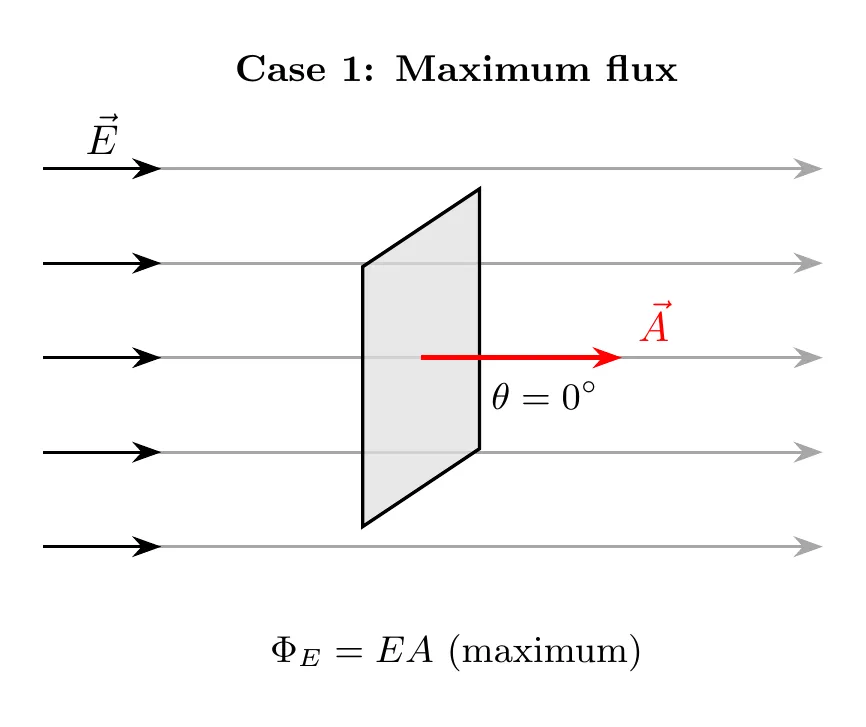
Case 1: Maximum Flux (θ = 0°)
When the field is perpendicular to the surface (and therefore parallel to the area vector):
You get maximum flux, because the field lines go straight through the surface.
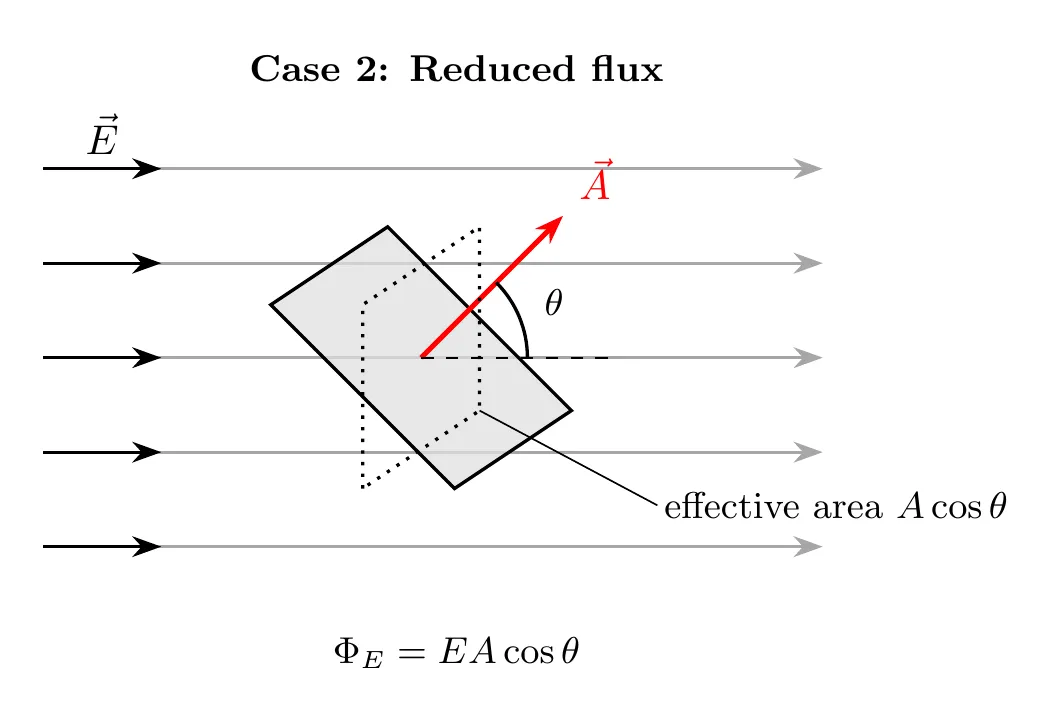
Case 2: Reduced Flux (0° < θ < 90°)
When the surface is tilted at an angle to the field:
The flux drops, because the effective area facing the field is smaller.
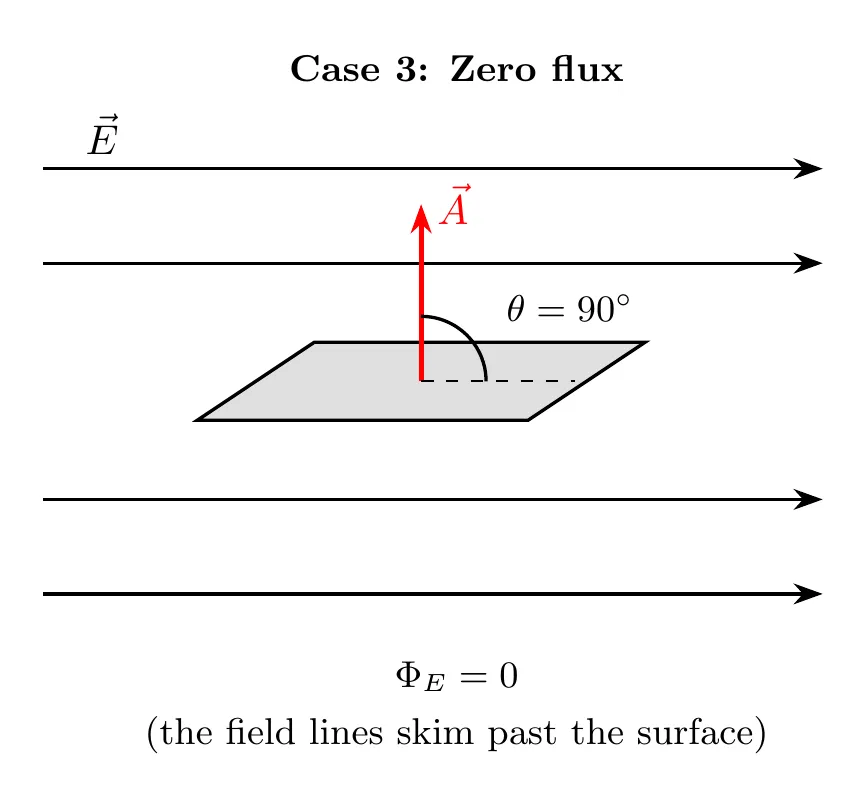
Case 3: Zero Flux (θ = 90°)
When the surface is parallel to the field (so the area vector is perpendicular to it):
No flux gets through, because the field lines run along the surface instead of through it.
The Sign of Electric Flux
The dot product hands you the sign automatically:
- Positive flux (): the field emerges outward through the surface, so the field and area vector point in roughly the same direction ().
- Negative flux (): the field enters inward through the surface, so the field and area vector point in roughly opposite directions ().
- Zero flux (): the field is tangent to the surface ().
Worked Example: A Tilted Loop
A uniform electric field of 450 N/C points straight up. A flat circular loop of radius 0.15 m is tilted so its area vector makes a angle with the field. Find the flux through the loop.
If you had picked the area vector pointing the other way (), you’d get N·m²/C. Same loop, same field: only the sign changes, because the loop is an open surface. If the loop were turned so the field skims along its face (), the flux would be zero.
The General Definition: A Surface Integral
For non-uniform fields or curved surfaces, electric flux needs a surface integral:
This adds up the flux contributions through infinitesimal area elements across the whole surface.
Simplifying for AP Physics C
When the field has the same strength everywhere on a surface and crosses it straight on everywhere (), every contributes , and the integral collapses to:
where is that constant field magnitude and is the area of the surface. Many AP problems are built this way on purpose (for example, a sphere centered on a point charge). When changes from place to place on the surface, you have to actually do the integral, as in the next example.
Common surfaces:
- Rectangle:
- Square:
- Circle:
- Sphere surface:
- Cylinder (curved surface):
Worked Example: A Field That Changes Across the Surface
A square with 0.20 m sides lies flat in the xy-plane, from to m. The electric field points straight up () through the square, but its strength grows with : , with N/(C·m). Find the flux through the square, with the area vector pointing up.

Step 1: Slice the square into strips where E is constant
depends only on , so cut the square into thin strips running parallel to the y-axis. A strip at position has width , length 0.20 m, and area . The field is the same everywhere on one strip and perpendicular to it:
Step 2: Add up all the strips
Check: because grows linearly, its average over the square is its value in the middle, N/C, and N·m²/C. Using the field at either edge instead would give 0 or 24 N·m²/C, both wrong.
Example Problem: Flux Through a Spherical Surface
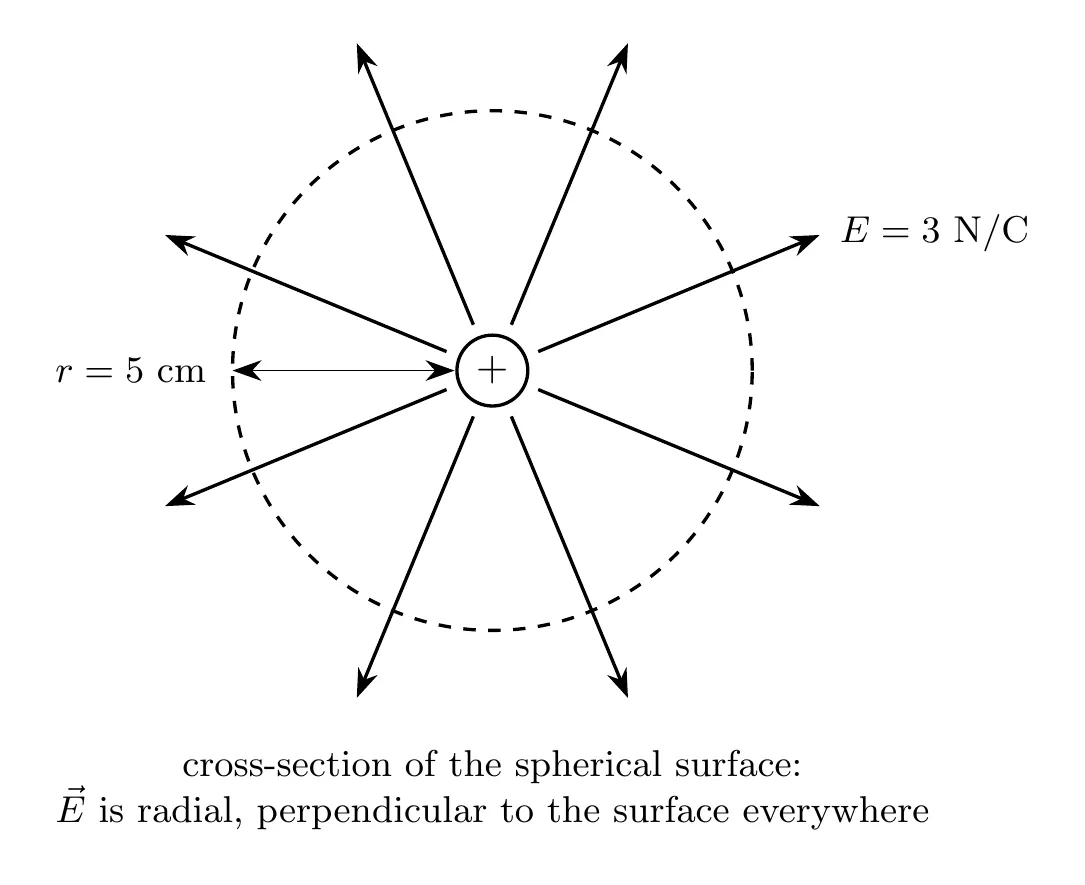
Problem: A point charge at the center of a sphere of radius 2 cm creates an electric field of 3 N/C at a distance of 5 cm from the center. What is the electric flux through a spherical surface drawn at 5 cm from the center?
Solution
Step 1: Recognize the geometry
For a spherical surface centered on a point charge:
- The field is radial, so it’s perpendicular to the surface everywhere.
- The area vector is also radial, perpendicular to the surface and pointing outward.
- So and are parallel, giving .
Step 2: Set up the flux equation
Since the field is perpendicular to the surface everywhere and has constant magnitude at radius :
Step 3: Find the surface area
For a sphere of radius cm m:
Step 4: Calculate the flux
Answer: N·m²/C.
Note: the radius of the sphere the charge sits in (2 cm) never enters the calculation. The flux is measured through the surface at 5 cm.
Alternative Example: Flux Through a Cube Face
Problem: A uniform electric field of 500 N/C points in the positive x-direction. A cube with side length 0.10 m is positioned so one face is perpendicular to the field. What is the flux through:
(a) the face perpendicular to the field?
(b) a face parallel to the field?
(c) the entire closed cube?
Solution
(a) The perpendicular face
The area vector points the same way as the field ():
(b) The parallel face
The area vector is perpendicular to the field ():
(c) The entire cube
For any closed surface with no charge inside:
- The flux entering one side equals the flux exiting the opposite side.
- So the net flux through the closed surface is zero.
The field enters through one face (−5.0 N·m²/C) and exits through the opposite face (+5.0 N·m²/C):
Units of Electric Flux
Electric flux has units of:
You can also write this as V·m (volt-meters), using the relationship between electric field and potential.
Always use the subscript to distinguish electric flux from magnetic flux , which shows up later.
Common Mistakes
- Using the wrong area. Make sure you use the right surface area formula. For a sphere it’s (surface area), not (volume). For cylinders, keep the curved surface area separate from the end caps.
- Defining the angle wrong. The angle is between the field vector and the area vector (which is perpendicular to the surface), not between the field and the surface itself.
- Forgetting unit conversions. Convert centimeters to meters before you calculate. Mixing units (cm for the radius, N/C for the field) gives you a wrong answer.
- Getting the flux sign wrong. When the field enters a closed surface (pointing inward), the flux is negative. When it exits (pointing outward), the flux is positive. The area vector is what settles this.
- Ignoring the dot product nature. Electric flux is a scalar, not a vector, because it comes from a dot product. Don’t try to give flux a direction.