

1.1 - Scalars and Vectors
Definitions
Scalars have magnitude only, so just a size.
Vectors have both magnitude and direction.
Examples: distance and speed are scalars. Position, displacement, velocity, and acceleration are vectors.
Here’s why the difference matters. If you walk 3 m east and then 3 m west, you’ve covered a distance of 6 m, but your displacement is zero, because you ended up where you started. A speedometer reading of 25 m/s is a speed. Add a direction (25 m/s north) and it becomes a velocity.
In one dimension, the sign is the direction. Pick which way is positive, and anything pointing the other way gets a negative sign. If east is , then means 4.0 m/s to the west. A negative velocity doesn’t mean “slow.” It only tells you the direction.
Drawing Vectors
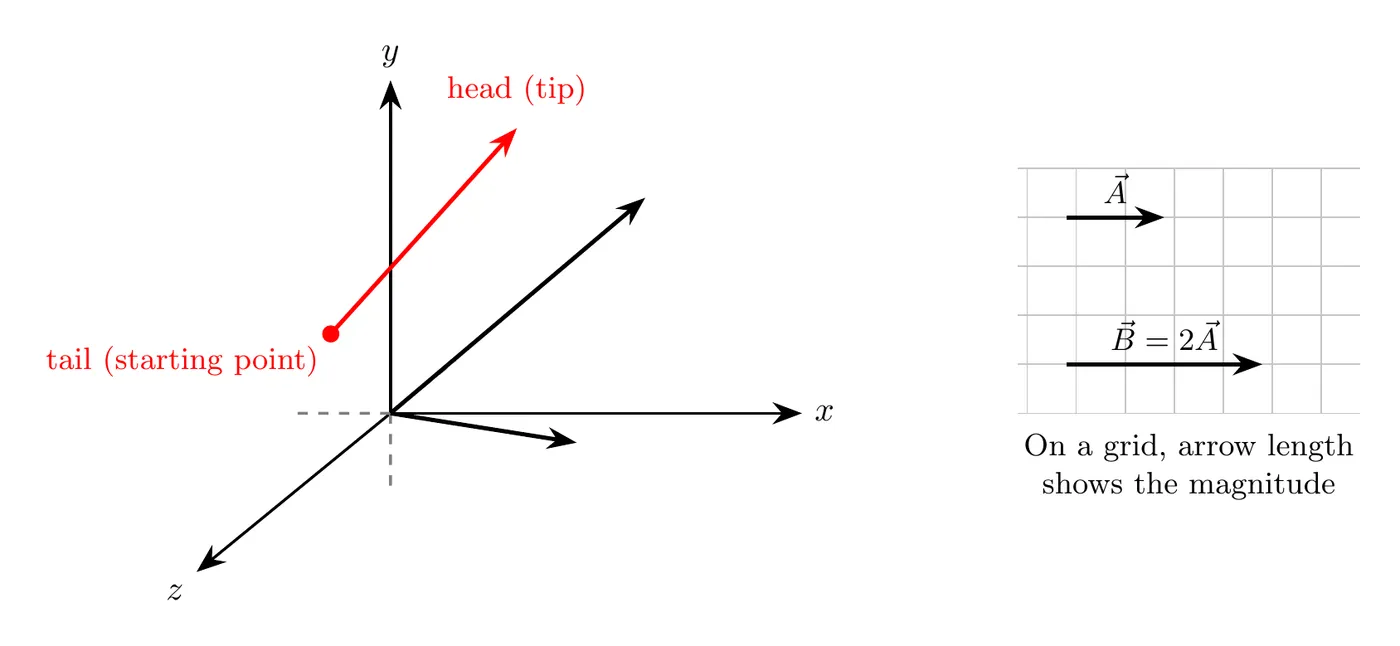
Vectors are drawn as arrows, where:
- The head is the tip of the arrow.
- The tail is the starting point.
When you draw vectors, keep their relative sizes accurate. If you’re working on a grid, use the grid spacing to hold the right proportions. This matters a lot for force vectors, where the relative sizes have to be correct.
All of these vector ideas carry over into three dimensions: , , and .
Unit Vector Notation
Vectors can be written using unit vector notation. A unit vector has a length of 1, and the number in front of it scales the vector to the magnitude you want.
The unit vectors are:
- for the x-direction
- for the y-direction
- for the z-direction
Example of Vector Notation
If , that means:
- x-component: 5
- y-component: 6
- z-component: -2
Alternative Notation
As a shorthand, you can also list a vector’s components inside angle brackets:
That said, the , , notation is the standard for AP Physics C.
Magnitude and Direction
Unit vector notation isn’t the only way to describe a vector. You can also give its magnitude (its length, which is never negative) and its direction (usually an angle measured counterclockwise from the axis). You need to be able to switch between the two forms.
Components to Magnitude and Direction
The components and are the legs of a right triangle, and the vector is the hypotenuse. Using the right-triangle relationships on the equation sheet ( and ):
In three dimensions, the magnitude just picks up one more term: .
Watch the quadrant. Your calculator’s only gives angles between and , so it can’t tell up-and-left from down-and-right. Always sketch the vector first. For m:
The calculator gives , but points up and to the left (the second quadrant). Add : the real direction is from the axis.
Magnitude and Direction to Components
If a vector has magnitude and makes an angle with the axis, its components are:
Example: a ball leaves a launcher at 12.0 m/s, above the axis.
So m/s. Check: m/s.
Position Vectors
A position vector starts at a point and points in a specific direction. We write it as .
More precisely, the position vector always starts at the origin and ends at the object’s location. That’s why its components are just the object’s coordinates: an object at m has m.
The unit vector (read “r-hat”) points in the same direction as but has a length of exactly 1 and no units. You get it by dividing the vector by its own magnitude:
For the object above, m, so
Check: . You’ll see again in force laws that point along the line between two objects, like gravity (Topic 2.6).
Vector Addition
To add vectors, add their matching components:
Graphically, adding vectors means placing them tip to tail: draw , start at the tip of , and the resultant runs from the tail of to the tip of . Adding components does the same thing with numbers.
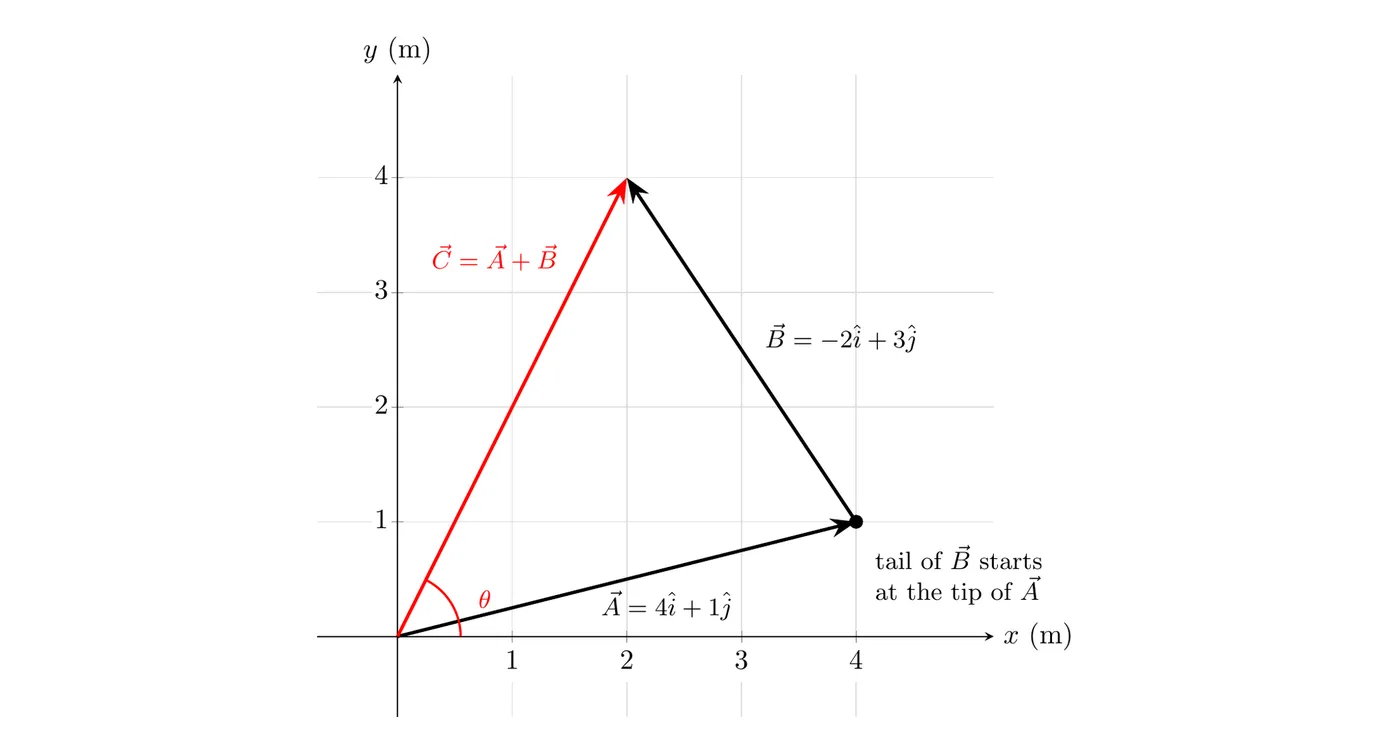
Example: a robot moves m, then m. Find its total displacement in unit vector notation and as a magnitude and direction.
The robot ends up 4.5 m from where it started, above the axis. That’s less than (about 7.7 m), because the two moves partly cancel in the direction.
Vector Subtraction
Subtracting is the same as adding the inverse. To subtract a vector, flip the signs of all its components:
If a component is positive, it becomes negative, and if it’s negative, it becomes positive.
Example Problems
Given Vectors
Part A: Find
Separate by components:
Or just: (when the coefficient is 1, people often leave it off).
Part B: Find
This is the same as , so flip all the signs of :
Or:
Part C: Find
This is the same as , so flip all the signs of :
Or:
Important Notes
Addition is commutative: .
Subtraction is not commutative: .
In fact, .
Common Mistakes
- Forgetting to flip signs during subtraction. means you negate all the components of , even the ones that are already negative.
- Assuming subtraction is commutative. The order matters. gives the opposite of .
- Mixing up unit vector notation. Always use , , (with hats), not , , .
- Not keeping relative vector sizes in diagrams. When you draw vectors, especially force vectors, their lengths have to be proportional to their magnitudes.
- Trusting the calculator’s angle. can’t tell which quadrant a vector is in. Sketch the vector, and add when it points to the left (negative component).