

1.5 - Motion in Two or Three Dimensions
Key Principle: Component Analysis
You can analyze motion in two or three dimensions using one-dimensional kinematic relationships, as long as you break the motion into components. This is the core approach for any multi-dimensional motion problem.
Important Properties of Multi-Dimensional Motion
1. Each Dimension Is Independent
Velocity and acceleration can differ in each dimension, and they can be non-uniform.
Motion in one dimension doesn’t affect motion in a perpendicular dimension. The motions are independent:
- Horizontal (x) motion doesn’t affect vertical (y) motion.
- Vertical (y) motion doesn’t affect depth (z) motion.
- Horizontal (x) motion doesn’t affect depth (z) motion.
2. Non-Constant Acceleration
When something like air resistance is present, the acceleration may not be constant, which makes the velocity non-uniform. In those cases, you need calculus.
Projectile Motion: A Special Case
Projectile motion is a specific kind of two-dimensional motion:
In one dimension (horizontal):
- Acceleration is zero ().
- Velocity is constant.
In the perpendicular dimension (vertical):
- Acceleration is constant and non-zero (, with m/s² on the AP exam).
- Velocity changes uniformly.
Note: we usually work in x and y, but depending on the coordinate system, a problem might involve x and z or y and z.
Exam scope: AP Physics C: Mechanics only asks you to calculate motion in two dimensions. Describing motion in three dimensions comes up in AP Physics C: Electricity and Magnetism.
Projectile Equations
Launch an object at speed and angle above the horizontal. Split the launch velocity into components, then use the kinematic equations separately in each direction (up is positive):
Key facts:
- Time links the two directions. The horizontal and vertical motions share the same clock, so find from one direction and use it in the other.
- At the top of the path, but is not zero. The object is still moving sideways, so its speed at the top is .
- The acceleration is downward the whole time, including at the top.
- Horizontal motion doesn’t change the fall. A ball dropped from a table and a ball rolled off the same table at the same moment hit the floor together, because both start with and have the same .
Example Problem: Projectile Launched from a Cliff
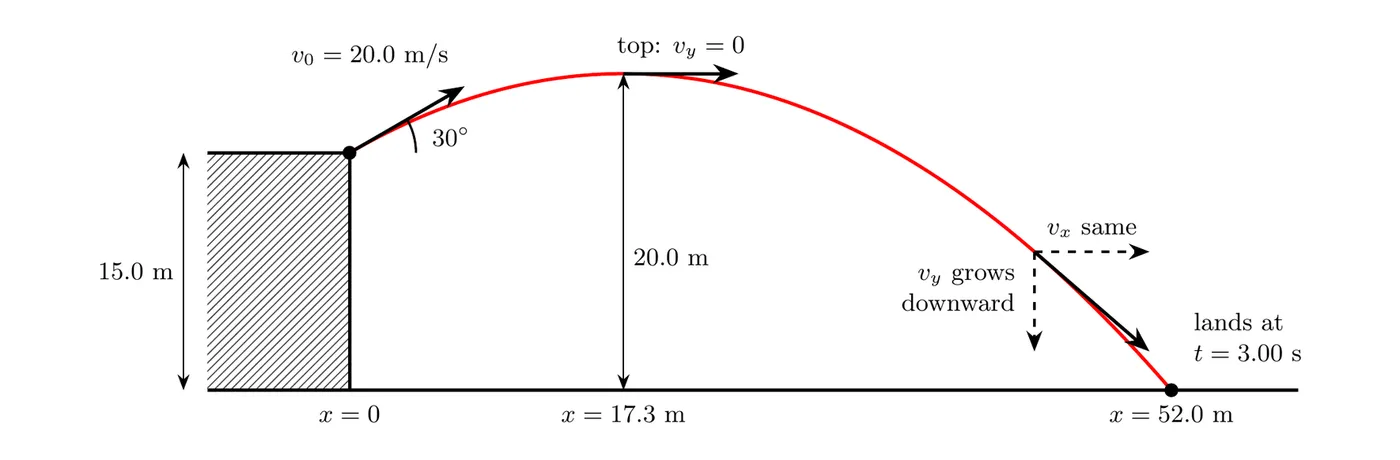
Problem: a ball is launched at 20.0 m/s, above the horizontal, from the edge of a cliff 15.0 m high. Use m/s² and put the origin at the base of the cliff.
- How high above the ground does the ball get?
- When and where does it land?
- What is its velocity just before it lands?
Step 1: Components of the Launch Velocity
Keep an extra digit in until the end, and round the final answers.
Part (a): Maximum Height
At the top, :
Answer: 20.0 m above the ground (5.00 m above the cliff), at m.
Part (b): Landing Time and Position
The ball lands when :
Only the positive root makes sense, so s. Then:
Part (c): Velocity Just Before Landing
Answer: m/s, or 26.5 m/s at below the horizontal.
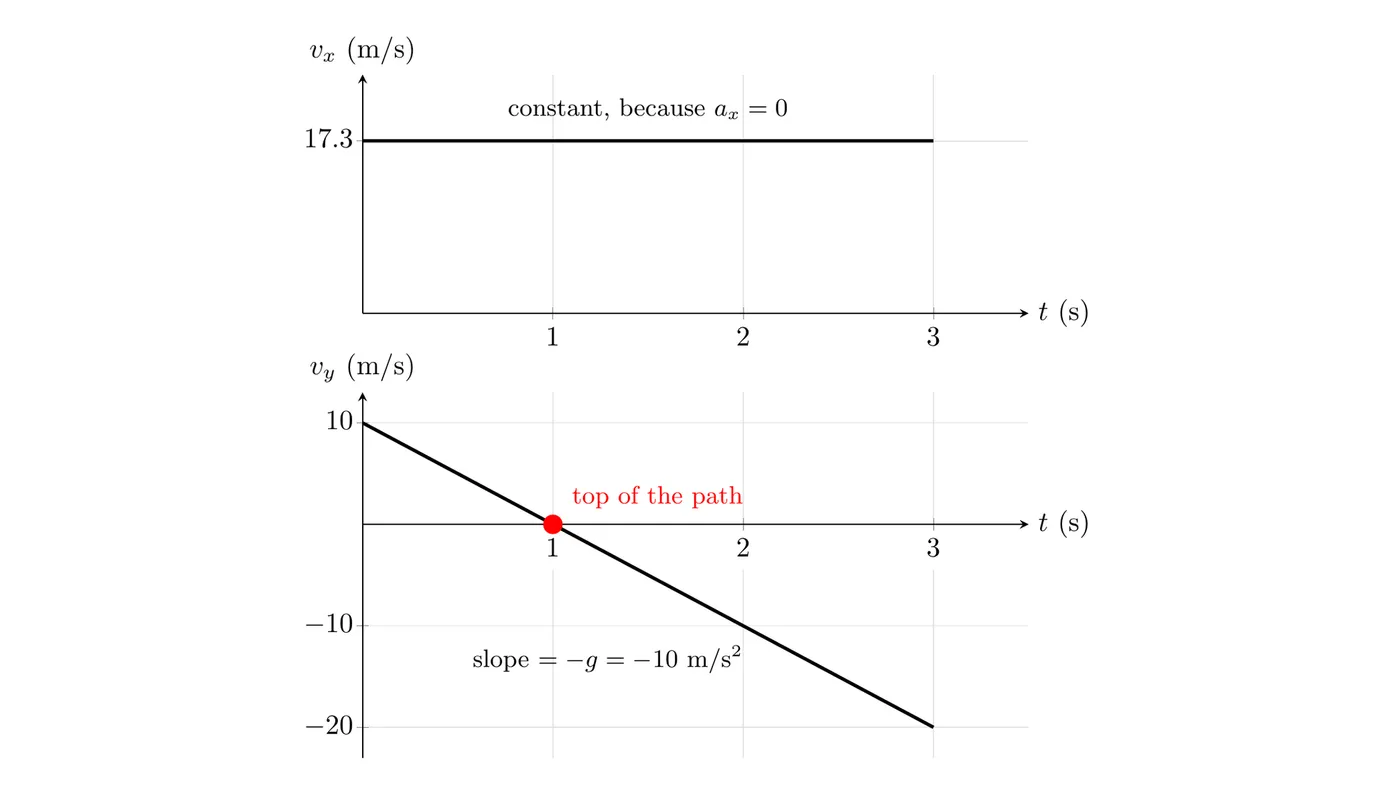
The velocity graphs show the same motion: stays flat the whole time, while is a straight line with slope that crosses zero at the top of the path.
The Range Formula (Level Ground Only)
If the projectile lands at the same height it started from, the flight time is , and the range is
using the identity from the equation sheet. The range is largest at . This formula isn’t on the equation sheet, and it’s wrong whenever the launch and landing heights differ, like the cliff above. When in doubt, go back to the component equations.
Position, Velocity, and Acceleration as Functions of Time
When position is given as a function of time, use derivatives to find velocity and acceleration:
Each component is treated on its own and differentiated separately.
Example Problem: Non-Uniform 2D Motion
Problem:
A particle’s motion is described by these position equations:
where position is in meters and time is in seconds.
- Find the displacement vector at seconds.
- Find the two equations that describe the particle’s velocity in the x and y directions.
- Find the velocity vector at seconds.
- Find the acceleration vector at seconds.
Part (a): Finding Displacement at t = 3 seconds
Displacement here is the position vector, so evaluate both position functions at seconds.
For the x-component:
For the y-component:
Displacement vector:
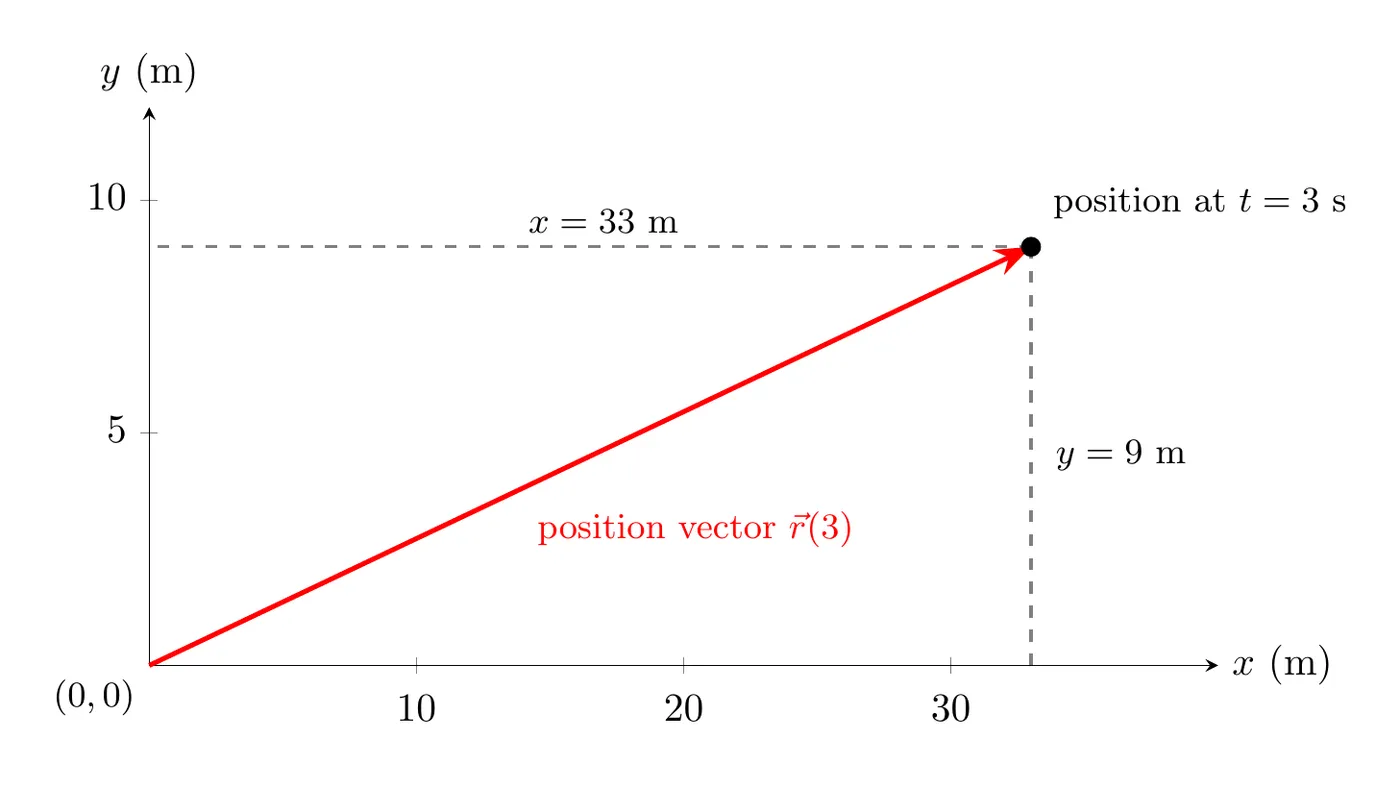
The read: at seconds, the particle has moved 33 m in the positive x-direction and 9 m in the positive y-direction from the origin.
Part (b): Finding the Velocity Equations
Velocity is the derivative of position with respect to time, so differentiate each component separately.
For the x-direction:
Using the power rule, :
For the y-direction:
Answer:
These give the velocity components at any time .
Part (c): Finding the Velocity Vector at t = 3 seconds
Evaluate the velocity equations at seconds.
For the x-component:
For the y-component:
Velocity vector:
The read: at seconds, the particle is moving at 26 m/s in the x-direction and 30 m/s in the y-direction.
Part (d): Finding the Acceleration Vector at t = 3 seconds
Differentiate each velocity component:
The read: the x-acceleration is constant, but the y-acceleration changes with time. Velocity and acceleration can be different in each direction, and they don’t have to be uniform.
Optional: Finding Magnitude and Direction
If you’re asked for the magnitude of displacement or velocity:
For our displacement:
For our velocity:
If you’re asked for the direction
(the angle from the positive x-axis):
For velocity:
Derivative Rules Reference
Power rule:
Constant multiple rule:
Sum/difference rule:
Constant rule:
Common Mistakes
- Not treating components independently. Each dimension (x, y, z) has to be analyzed on its own. Don’t mix components when taking derivatives or applying kinematic equations.
- Forgetting the unit vectors. In vector answers, always include the , , and notation to show direction. Writing “33, 9 m” isn’t the same as “ m.”
- Applying the power rule wrong. Bring the exponent down and subtract 1 from it. For , the derivative is , not or .
- Handling constant terms wrong. Differentiating a linear term like gives , not 0. The derivative of a constant (like ) is 0, but is not a constant.
- Assuming projectile motion rules always apply. Standard projectile motion assumes zero horizontal acceleration and constant vertical acceleration. If the problem gives you position as a function of time, use calculus instead.
- Confusing position with displacement. If an object starts at the origin, then position equals displacement. If it starts somewhere else, displacement is the change in position: .
- Calculating magnitude when it’s not requested. Unless you’re asked for the magnitude or speed, give vector answers in component form.
- Forgetting units. Position is in meters (m), velocity is in m/s, and acceleration is in m/s². Always include the right units in your final answer.
- Thinking motion in one dimension affects another. Horizontal motion does not affect vertical motion and vice versa. They’re independent and can be analyzed separately.